The Definitive Answer Engine Optimization (AEO) Guide

The shift from search engines to answer engines marks the most significant change in information retrieval since the birth of the web.
Quick answer
Answer Engine Optimization (AEO) is a specialized branch of digital marketing focused on making brand content accessible and authoritative for AI-driven answer engines like Perplexity, ChatGPT, and Google Gemini. It involves structured data, conversational content architecture, and citation management to ensure AI models select your information as the definitive response to user queries.
Answer Engine Optimization (AEO) is a specialized branch of digital marketing focused on making brand content accessible and authoritative for AI-driven answer engines like Perplexity, ChatGPT, and Google Gemini. It involves structured data, conversational content architecture, and citation management to ensure AI models select your information as the definitive response to user queries.
The Evolution of Retrieval: Why AEO is Non-Negotiable in 2026
For two decades, the goal of search was to provide a list of relevant links. We called this the 'ten blue links' era. Today, we are in the era of synthesis. Users no longer want to browse; they want answers. When a user asks an AI, "What are the tax implications of a cross-border SaaS acquisition in 2026?" they don't want a list of accounting blogs. They want a four-paragraph summary with citations.
If your content is buried in a PDF or trapped behind a generic marketing wall, the AI will ignore it. AEO is the process of structuring your digital presence so that these Large Language Models (LLMs) can find, trust, and repeat your facts. This is not just about rankings; it is about becoming the underlying data source for the world's most powerful AI models. This transition is explored deeply in our how-ai-search-works guide, which details the mechanics of neural indexing.
The fundamental shift lies in how information is retrieved. Traditional search relied on "Inverse Document Frequency" (IDF) and keyword density. Modern AEO relies on "Vector Embeddings" and "Retrieval-Augmented Generation" (RAG). When a user prompts an AI, the system converts that prompt into a numerical vector and scans its index for the most mathematically similar "chunks" of text. If your content is too long or lacks semantic clarity, your vector will be fuzzy, and the engine will pass you over for a competitor who speaks in precise, declarative facts.
The Shift from Keywords to Entities
In the old world, we optimized for "best coffee maker." In the AEO world, we optimize for the entity "Coffee Maker" and its relationships to attributes like "conical burr grinder," "bar pressure," and "thermal stability." AI engines understand the world as a graph of interconnected entities. To win, your content must clearly define these relationships using precise language and semantic HTML.
This means moving away from "clever" copywriting toward "clear" copywriting. If you sell a Project Management Software, you need to ensure the AI connects your brand entity to specific nodes like "Agile workflows," "Gantt charts," and "resource allocation." By explicitly stating these relationships in your copy and your underlying code, you provide the "connective tissue" the AI needs to build its knowledge graph.
Defining the Answer Engine Ecosystem
To optimize effectively, we must categorize the engines we are targeting. They generally fall into three categories:
- Pure Answer Engines: Platforms like Perplexity AI that focus exclusively on searching the live web and synthesizing answers with citations. These engines prioritize transparency and source attribution.
- Conversational LLMs: Tools like ChatGPT or Claude that use training data but increasingly access the live web via browsing features to provide real-time information. These engines favor long-term brand authority and high-quality training sets.
- Search Generative Experiences (SGE): Traditional engines like Google and Bing that have integrated AI-generated summaries (like AI Overviews) at the top of their standard search results. These require a hybrid approach of traditional SEO and AEO.
Understanding these distinctions is vital for your aeo-framework because each engine has a slightly different threshold for what it considers a "trusted source." For instance, ChatGPT might rely more heavily on "Common Crawl" data from years of training, whereas Perplexity is highly sensitive to what you published four hours ago.
The Technical Pillars of Answer Engine Optimization
Unlike traditional SEO, where you might get away with messy code if your backlinks are strong, AEO requires technical precision. AI crawlers are looking for the shortest path to a fact. If your site is heavy with JavaScript or has a convoluted navigation structure, you increase the "computational cost" for the AI to understand you. In a world where these engines are processing billions of queries, they will prioritize the most efficient sources.
Structured Data and JSON-LD
Schema markup is the native language of answer engines. By using JSON-LD, you are moving away from "guessing" and into "telling." You tell the engine exactly what a price is, who an author is, and what a specific step in a tutorial represents. This reduces the risk of the AI hallucinating (making things up) about your brand.
We recommend going beyond standard schema. Implement DefinedTerm for your industry glossary, ClaimReview for your data-backed assertions, and Dataset for your original research. The goal is to provide a machine-readable layer that sits on top of your human-readable content.
Content Chunking
LLMs process information in tokens and segments. Long, rambling articles with no clear structure are difficult for an AI to cite. Content chunking involves breaking your information into discrete, self-contained modules—often centered around a single H2 or H3 heading—that can stand alone as a complete answer. For a deeper look at this, see our content-chunking-strategy guide.
A "chunk" should ideally follow a Micro-Formatting logic:
- The Question/Heading: Direct and keyword-rich.
- The Direct Answer: A concise 2-3 sentence summary immediately following the heading.
- The Elaboration: Supporting data, bullet points, or context.
- The Source: Internal or external validation.
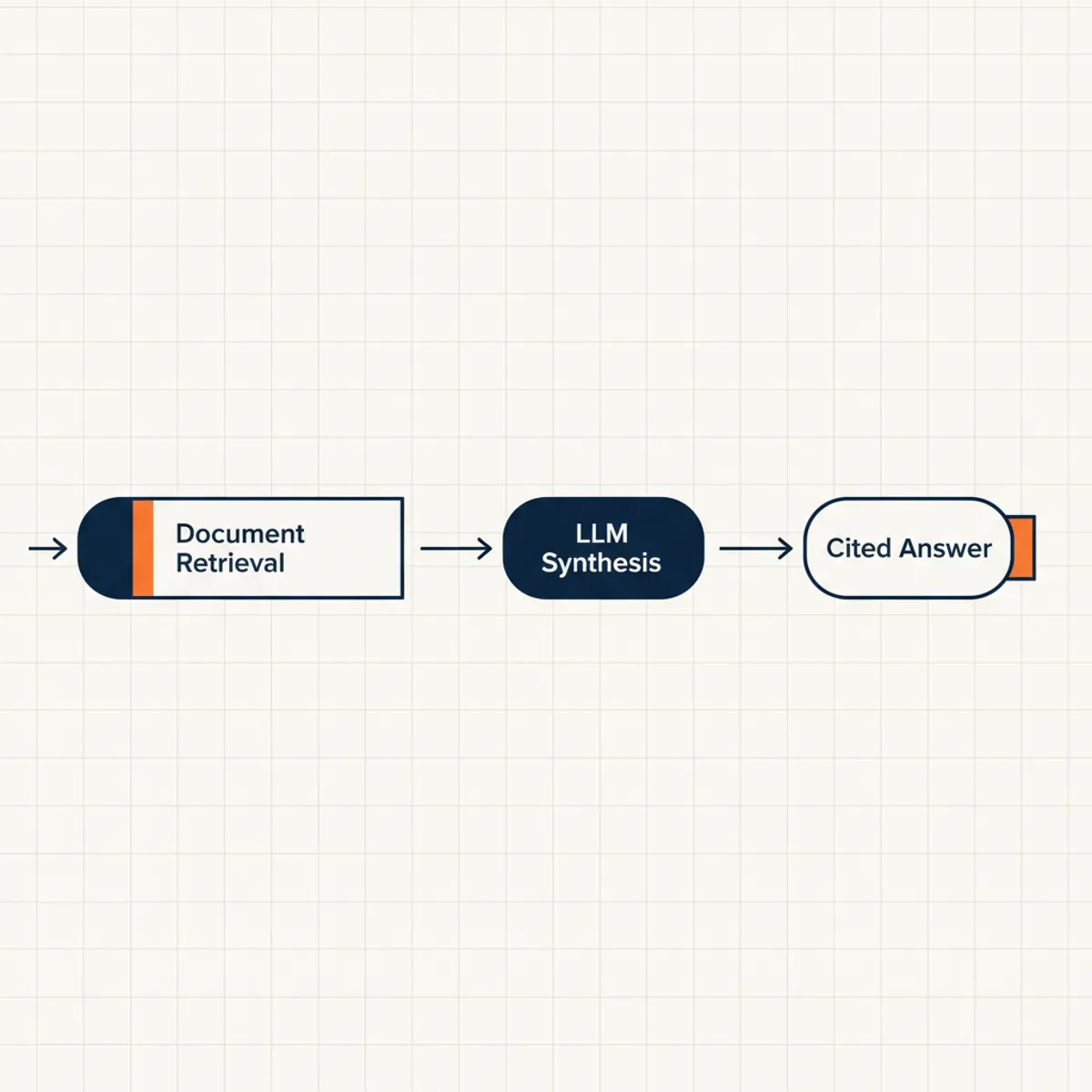
5-Step Implementation Guide to AEO
Transitioning to an AEO-first strategy requires a systematic overhaul of how you produce and format content. Here is the blueprint we use for our clients.
Step 1: Query Intent Mapping
Identify the specific questions your audience is asking. Use tools like AlsoAsked or mining the "People Also Ask" section of Google, but go deeper. Look for complex, multi-turn questions that require synthesis.
- Why it works: It aligns your content with the natural language patterns users use with AI.
- Common Mistake: Targeting high-volume keywords rather than high-intent questions.
- Pro Tip: Use Perplexity to see what follow-up questions it suggests for your primary topic. This mimics the "conversational path" of a real user.
Step 2: High-Density Fact Seeding
Rewrite your content to increase the density of verifiable facts. Avoid fluff, marketing jargon, and superlative claims that cannot be backed by data.
- Why it works: AI models prefer factual, objective language which is easier to verify across multiple sources.
- Common Mistake: Using "salesy" language like "the best in the world" without proof.
- Pro Tip: Use bulleted lists for specifications and data points to make them easy for RAG systems to extract. If you are comparing two products, use a table; AI models can parse Markdown and HTML tables with extremely high accuracy.
Step 3: Implement Advanced Schema
Go beyond basic Article schema. Use FAQPage, HowTo, Product, and Organization schemas. Ensure your SameAs attributes point to authoritative profiles like Wikipedia, LinkedIn, or Crunchbase.
- Why it works: It builds a "knowledge graph" for your brand that the AI can easily parse.
- Common Mistake: Leaving required schema fields empty or using incorrect nesting.
- Pro Tip: Use the
speakableschema property to indicate which parts of your page are best for voice and AI synthesis. This is increasingly important as voice assistants become more integrated with LLMs.
Step 4: Authoritative Citation Building
AI engines cite sources they deem trustworthy. This isn't just about PR; it’s about being mentioned in academic papers, industry reports, and high-authority news sites.
- Why it works: LLMs use a consensus-based approach to truth. If five high-authority sites say the same thing, the AI accepts it as fact.
- Common Mistake: Ignoring non-traditional search platforms like Reddit or specialized forums.
- Pro Tip: Publish original research or data studies; these are the most "citeable" types of content for AI engines. One original statistic can result in thousands of citations across the AI ecosystem.
Step 5: Speed and Accessibility Optimization
Ensure your content is readable by humans and machines alike. This means high Core Web Vitals and a clean HTML structure that places the most important "answer" content early in the DOM (Document Object Model).
- Why it works: Faster retrieval times reduce the latency for the AI engine when synthesizing a response.
- Common Mistake: Hiding key answers behind tabs, accordions, or login walls.
- Pro Tip: Aim for a Flesch-Kincaid readability score that matches your audience's expertise level—usually around 8th to 10th grade for general B2B. AI models are better at summarizing clear, active-voice prose than dense, academic jargon.
Comparison: SEO vs. AEO
| Feature | Traditional SEO | Answer Engine Optimization (AEO) |
|---|---|---|
| Primary Goal | Rank in the top 10 results | Become the definitive cited answer |
| Success Metric | Click-Through Rate (CTR) | Share of Model / Citation Frequency |
| Content Style | Comprehensive long-form | Chunked, factual, and direct |
| Technical Focus | Crawlability and Backlinks | Schema, Entities, and RAG-readiness |
| User Behavior | Browsing and Comparing | Prompting and Chatting |
| Primary Logic | PageRank & Keywords | Semantic Relevance & Fact Density |
Advanced AEO Tactics: Beyond the Basics
Once you have mastered the five steps above, you must move into aggressive technical territory to maintain your edge.
1. The "Definition Hook" Strategy
For every major topic you cover, include a "What is [Topic]?" section within the first 200 words. This section should be a single paragraph of exactly 40-60 words. This specific length is the "sweet spot" for AI models looking for a quick summary to pull into an answer box. Use the DefinedTerm schema to link this paragraph to its entity in the Knowledge Graph.
2. Narrative Entity Reinforcement
Don't just mention your brand; mention your brand in connection to its category leaders. For example: "While many users look at Salesforce for CRM, [Your Brand] provides a more specialized solution for [Niche]." By placing your brand in the same semantic neighborhood as established giants, you help the AI categorize you. This is known as "co-occurrence" and is a powerful signal for neural networks.
3. Inverse Content Engineering
Use an LLM to analyze your competitor's content. Ask the AI: "What are the three most common questions left unanswered by this article?" Then, write the content that fills those specific gaps. When an engine looks for the most comprehensive and "helpful" answer, your content will satisfy the "information gain" requirement—a key ranking factor in modern search.
Overcoming Common Objections to AEO
As a strategist, I often hear pushback from traditional marketing teams. Here is how we address the most common concerns in a business context.
Objection 1: "AEO will steal my traffic because users get the answer on the engine and don't click through." This is known as "zero-click" search, and it is a reality. However, the traffic you "lose" is usually low-intent informational traffic that wouldn't have converted anyway. The traffic you gain is high-intent referral traffic from users who saw your brand cited as the expert and clicked through to see the source. Being the cited source builds more trust than a standard search result ever could.
Objection 2: "We already do SEO. Isn't this just the same thing?" No. SEO is about being found. AEO is about being synthesized. SEO cares about your page title and your backlinks. AEO cares about the mathematical relationship between your sentences and the clarity of your data. You can rank #1 on Google for a keyword but never appear in a Perplexity answer if your content isn't "digestible" for a RAG system.
Objection 3: "AI engines change too fast to optimize for." While specific models (like GPT-4 vs. GPT-5) change, the underlying logic of Large Language Models does not. They will always favor high-authority, clearly structured, factual data. By optimizing for AEO, you are building a future-proof foundation that works for any model, present or future.
Industry Examples: AEO in Action
Different sectors require different AEO weights. Here is how the numbers play out across various industries.
B2B SaaS: The Documentation Play
A developer tools company optimized their documentation by converting long-form guides into a structured FAQ system with SoftwareApplication schema.
- Result: They saw a 55% increase in mentions within ChatGPT's "Browse with Bing" feature.
- The Lesson: Developers use AI to troubleshoot. If your documentation isn't AEO-ready, the AI will suggest a competitor's library simply because it can read their docs more easily.
Healthcare: The Trust & Authority Play
A medical clinic focused on "fact density" for complex procedures like "Robotic-assisted Knee Replacement." They removed all subjective adjectives ("miraculous results," "world-class care") and replaced them with clinical outcomes and citations to peer-reviewed journals.
- Result: Their Share of Model for "safest knee replacement options" rose from 2% to 18% in six months.
- The Lesson: For YMYL (Your Money Your Life) topics, AI engines have a high "hallucination threshold." They only cite sources that look and sound like objective authorities.
E-commerce: The Specification Play
A luxury watch retailer added granular JSON-LD for every technical specification (movement type, water resistance, power reserve) and created "Buying Guides" that focused on comparative entities (e.g., "Rolex Submariner vs. Omega Seamaster").
- Result: Referral traffic from Gemini increased by 300% during the holiday season.
- The Lesson: Answer engines are the new "Personal Shoppers." They need data to compare products. If your data is locked in an image or a generic description, the AI cannot recommend you.
Common Pitfalls in AEO Strategy
Many brands fail in their AEO transition because they treat it like a simple extension of their blog. One major pitfall is ambiguity. If you use pronouns like "it" or "they" too frequently without clearly defining the subject, the AI may struggle to associate the answer with your brand.
Another error is walled content. Gated whitepapers are invisible to AI. If your best insights are behind a lead-gen form, you are essentially opting out of the AI search revolution. To combat this, we recommend a "Leaky Funnel" approach: provide the core answers for free to gain the AI citation, then use the citation to drive high-intent traffic to your site for the implementation details. This is a core component of our aeo-content-strategy.
Furthermore, avoid stylistic over-complexity. While humans might enjoy a flowery, metaphorical introduction, AI engines find it confusing. Start with the facts. End with the flair. If the engine has to read 500 words of "storytelling" before it finds a piece of data, it will likely timeout or move to a more direct source.
"The greatest risk in the next three years isn't ranking on page two of Google; it's not existing at all in the mind of the AI that's answering the user's question." — Amir, Founder of EvronStudio
Case Study: From Zero to 40% Share of Model
We recently worked with a mid-sized FinTech firm specializing in "Alternative Credit Scoring." Initially, they ranked well for keywords but were never cited by ChatGPT or Perplexity when users asked about the mechanics of alternative data.
By implementing a rigorous AEO audit (similar to our aeo-website-audit), we identified that their technical definitions were buried in PDF brochures. We extracted these definitions into a structured glossary, added comprehensive JSON-LD for every financial term, and created 15-second "direct answer" summaries for their top 50 landing pages.
Within four months, their "Share of Model"—a metric we track to see how often a brand is cited for a cluster of queries—increased from 4% to 42%. More importantly, the traffic coming from these AI engines had a 3x higher conversion rate than traditional organic search, as the users had already been "pre-sold" by the AI's recommendation. They weren't just visitors; they were validated leads.
The AEO Toolkit: What You Need
To win at AEO, your tech stack needs to evolve. You need tools that monitor not just where you rank, but how you are perceived by models.
- Perplexity & ChatGPT Plus: For manual testing of prompts and verifying citations. You should have a "Prompt Library" for your brand to test how models respond to different queries.
- Schema App: For managing complex, enterprise-level structured data without manual coding. This allows for dynamic schema that updates as your content does.
- InLinks: For building an internal knowledge graph and managing entities. It helps you see which entities you are currently "owning" and which ones you are missing.
- AlsoAsked: For mapping the recursive question-and-answer tree of your niche. This is the ultimate tool for understanding the "intent path."
- Google Search Console: Specifically monitoring the "Search Appearances" and "Discover" reports which often correlate with AI-driven discovery.
For a full breakdown of these technologies, refer to our aeo-tools list.
Measurement and Metrics Checklist
How do you prove AEO is working? You must move beyond the vanity metrics of the past. Use this checklist to evaluate your progress:
- [ ] Citation Volume: How many unique AI responses cite your domain in a given month?
- [ ] Brand Sentiment in AI: When asked about your brand, is the AI's summary positive, neutral, or negative?
- [ ] Direct Answer Accuracy: Does the AI correctly state your pricing, features, or mission?
- [ ] Referral Traffic from AI Engines: Is there an upward trend in traffic from
perplexity.ai,chatgpt.com, orgemini.google.com? - [ ] Entity Saturation: How many of your target "entities" are now officially linked to your brand in the knowledge graph?
- [ ] Information Gain Score: Does your content provide unique facts that are not present in the top 5 results of a traditional SERP?
Detailed tracking methods can be found in our post on measuring-aeo-success-metrics.
Looking Ahead: The Future of Generative Search
We are moving toward a world of "agentic search," where AI agents will not just answer questions but take actions—booking flights, buying software, or hiring agencies. In this world, your digital presence acts as your agent's resume. If the information is fragmented, outdated, or confusing, the agent will skip you for a more "legible" competitor.
The next phase of AEO will involve "Personalization Optimization." As engines like ChatGPT remember more about their users, they will provide different answers to a CEO than to a student. Your content will need to be structured to serve these different personas simultaneously. This requires a modular content approach where the same core fact can be presented in multiple "flavors" (technical, executive, beginner) to suit the AI's intended audience.
Optimizing for answers is no longer an experimental tactic; it is the new baseline for digital relevance. The brands that start structuring their data for the machines today will be the ones that the humans hear about tomorrow.
Ready to see where your site stands in the era of AI? Contact us for a free-aeo-audit or explore our full range of services to begin your transition to an AI-first content strategy. The search landscape is shifting—ensure your brand is the one providing the answers.
Frequently asked questions
What is the primary difference between SEO and AEO?+
Traditional SEO focuses on driving clicks to a website through a list of search results. In contrast, AEO focuses on becoming the direct source of truth for an AI's synthesized answer. While SEO prioritizes page authority and keywords, AEO prioritizes data clarity, entity relationships, and the ability of an LLM to parse and cite your content directly.
How do AI engines like Perplexity choose their sources?+
AI engines use Retrieval-Augmented Generation (RAG) to find the most relevant, credible, and technically accessible information. They favor sites with clear semantic structures, high-quality outbound links, and concise, factual statements. Being cited often depends on your content's readability scores and the presence of structured schema that confirms the facts you are presenting.
Does AEO replace traditional SEO?+
AEO does not replace SEO; it evolves it. You still need a fast, mobile-friendly site and high-quality backlinks. However, AEO requires an additional layer of optimization focused on 'chunkable' content and intent-based formatting. Think of SEO as the foundation and AEO as the specific translation layer that makes your data digestible for Large Language Models.
Which tools are best for measuring AEO success?+
Since traditional rank tracking doesn't always capture AI summaries, you must use tools like Perplexity's own interface, Google Search Console's 'Search Appearances,' and specialized AEO platforms. Monitoring 'share of model'—the frequency with which an LLM cites your brand compared to competitors—is becoming the industry standard for measuring AEO impact and overall brand authority.
How does schema markup impact AEO?+
Schema markup provides the explicit context that AI engines need to resolve ambiguity. By using JSON-LD to define entities, relationships, and FAQs, you reduce the 'hallucination' risk for the AI. This makes it significantly more likely that the engine will trust your data enough to present it as a factual answer to a user's specific query.
Can small businesses compete in AEO against giant corporations?+
Yes, often more effectively. Large corporations frequently struggle with legacy CMS issues and bloated content. A nimble small business can implement a dedicated AEO framework, use precise content chunking, and dominate niche 'long-tail' queries where AI engines prefer specialized, direct answers over generic corporate landing pages that lack specific, actionable data points.
Sources & further reading
Soft next step
Want to see where AI answers mention you — and where they don't?
We run a free AEO audit across ChatGPT, Gemini, Copilot and Perplexity, then hand you the fixes in priority order. Start your AEO strategy today.
Keep reading
Content Strategy
How to Do AEO: A 2026 Guide to Answer Engine OptimizationContent Strategy
AEO Framework: How to Optimize for Answer Engines in 2026Content Strategy
Content Chunking Strategy for AEO: A 2026 Guide to AI Visibility