How AI Search Works: The 2026 Guide to Dominating Answer Engines
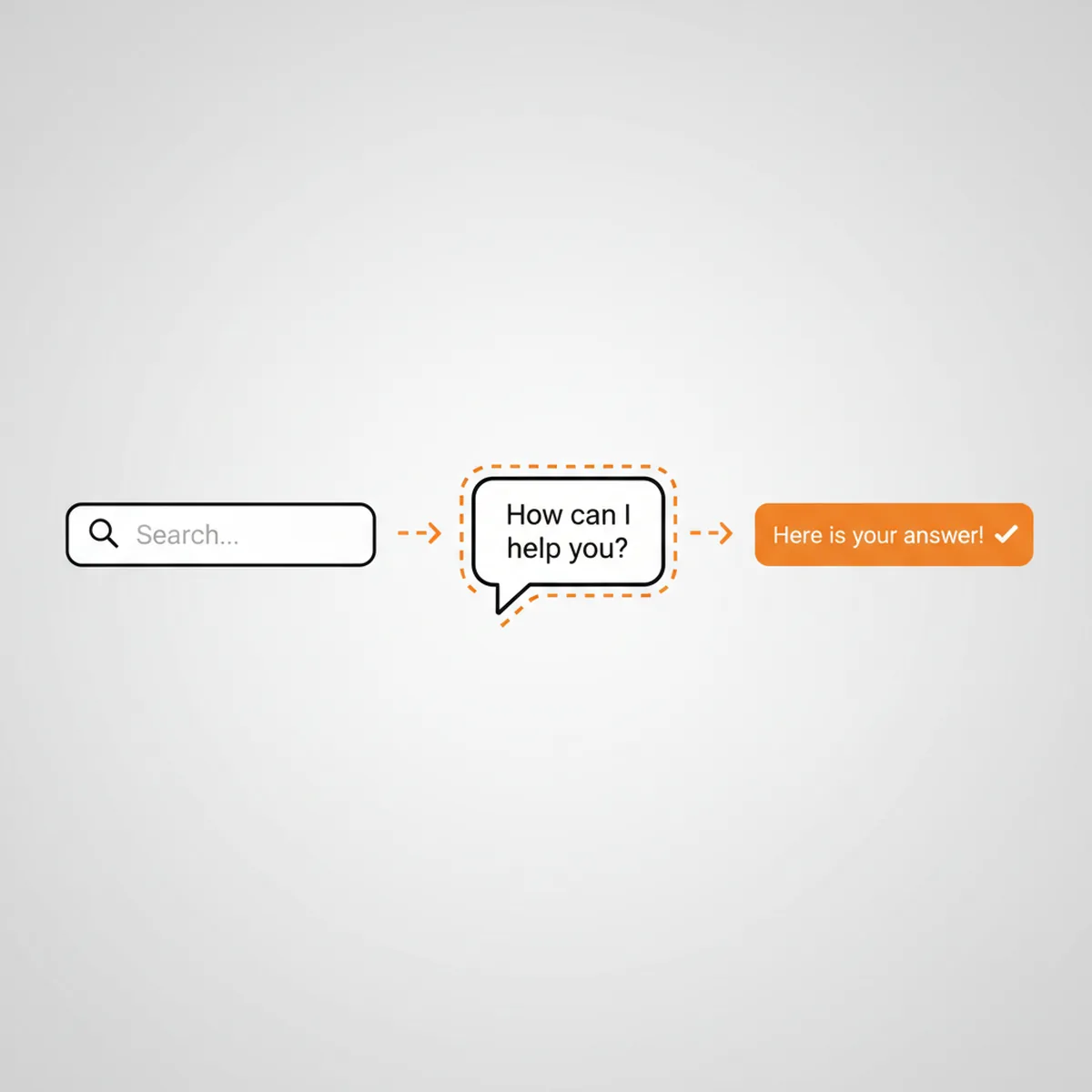
The evolution of search from keyword matching to intelligent answer synthesis.
Quick answer
AI search works by using Large Language Models to interpret user intent, retrieving relevant data via Retrieval-Augmented Generation (RAG), and synthesizing a natural language response. Unlike traditional search which lists links, AI engines process information from indexed sources to provide direct answers with cited references.
AI search works by processing natural language queries through Large Language Models to understand context, then retrieving relevant data via Retrieval-Augmented Generation (RAG) to synthesize a direct, conversational answer with citations. This shift from simple keyword matching to semantic understanding defines how information is discovered in 2026. Understanding this process is vital for any brand looking to remain visible. In 2025, we saw the definitive flip where more users began trusting synthesized answers over traditional blue links. To win today, you must optimize for the machines that do the reading for your customers.
Defining the Core of AI Search
To grasp how AI search works, you need to understand the underlying Entities—the distinct, well-defined objects or concepts that AI uses to categorize information. AI doesn't just see words; it sees relationships. If you mention "Python" in a paragraph about software, the AI identifies the entity as a programming language, not a snake. This disambiguation is the foundation of modern search.
First, let’s look at Large Language Models (LLMs). These are the "brains" of the operation, trained on massive datasets to predict the next token in a sequence, allowing them to communicate like humans. Then there is Retrieval-Augmented Generation (RAG). This is the framework that allows an AI to pull fresh, factual data from an external source (like your website) before generating an answer. This prevents the AI from "hallucinating" or making things up based on old training data. Think of the LLM as a brilliant student and RAG as an open-book exam. The student uses their brain to write, but they check the book to ensure the dates and facts are right.
We also have Vector Databases. These store information as mathematical coordinates (vectors). When a user asks a question, the AI converts that query into a vector and finds the closest matching content in its database. This process is called "embedding." Finally, there is Knowledge Graphs. These are structured representations of facts and the relationships between them. If the AI knows "Amir" is the "founder" of "EvronStudio," it’s because of a knowledge graph. These graphs help the AI understand hierarchy and authority across the web.
The Role of Transformers and Attention Mechanisms
Inside the LLM, a specialized architecture called the "Transformer" does the heavy lifting. It uses something called an "attention mechanism" to weigh the importance of different words in a sentence. When a user asks, "How do I fix a leaky faucet in an old Victorian home?", the attention mechanism focuses on "fix," "leaky faucet," and "Victorian." It understands that the age of the house changes the type of advice needed. This is why your content must be highly specific. Vague content gets ignored because the attention mechanism finds no "weight" or unique value to extract.
Why AI Search Architecture Matters in 2026
The search environment has changed more in the last 18 months than in the previous decade. By the end of 2025, Gartner projected that traditional search engine volume would drop significantly as users migrated to AI-first interfaces. This isn't just a trend; it's a fundamental shift in how your customers find answers. They no longer want to hunt; they want to be served.
Data from BrightEdge suggests that AI-generated results now appear for over 80% of high-intent B2B queries. If your content isn't formatted for these engines, you simply don't exist in the results. Furthermore, Search Engine Land has reported that click-through rates on citations within AI answers are often higher than traditional organic listings because the user intent is already pre-qualified by the AI. When an AI cites you, it is essentially giving a personalized recommendation to a user who is already deep in the funnel.
| Statistic Source | Data Point | Impact on B2B Strategy |
|---|---|---|
| Gartner | 25% drop in traditional search volume | Diversify traffic sources immediately |
| BrightEdge | 80% AI coverage for B2B keywords | Content must be "RAG-ready" |
| Ahrefs | 40% of AI answers feature new domains | Opportunity for smaller, niche experts |
| Pew Research | 60%+ users prefer synthesized summaries | Direct answers are now the priority |
How AI Search Works: A Step-by-Step Breakdown
Step 1: Query Processing and Intent Decoding
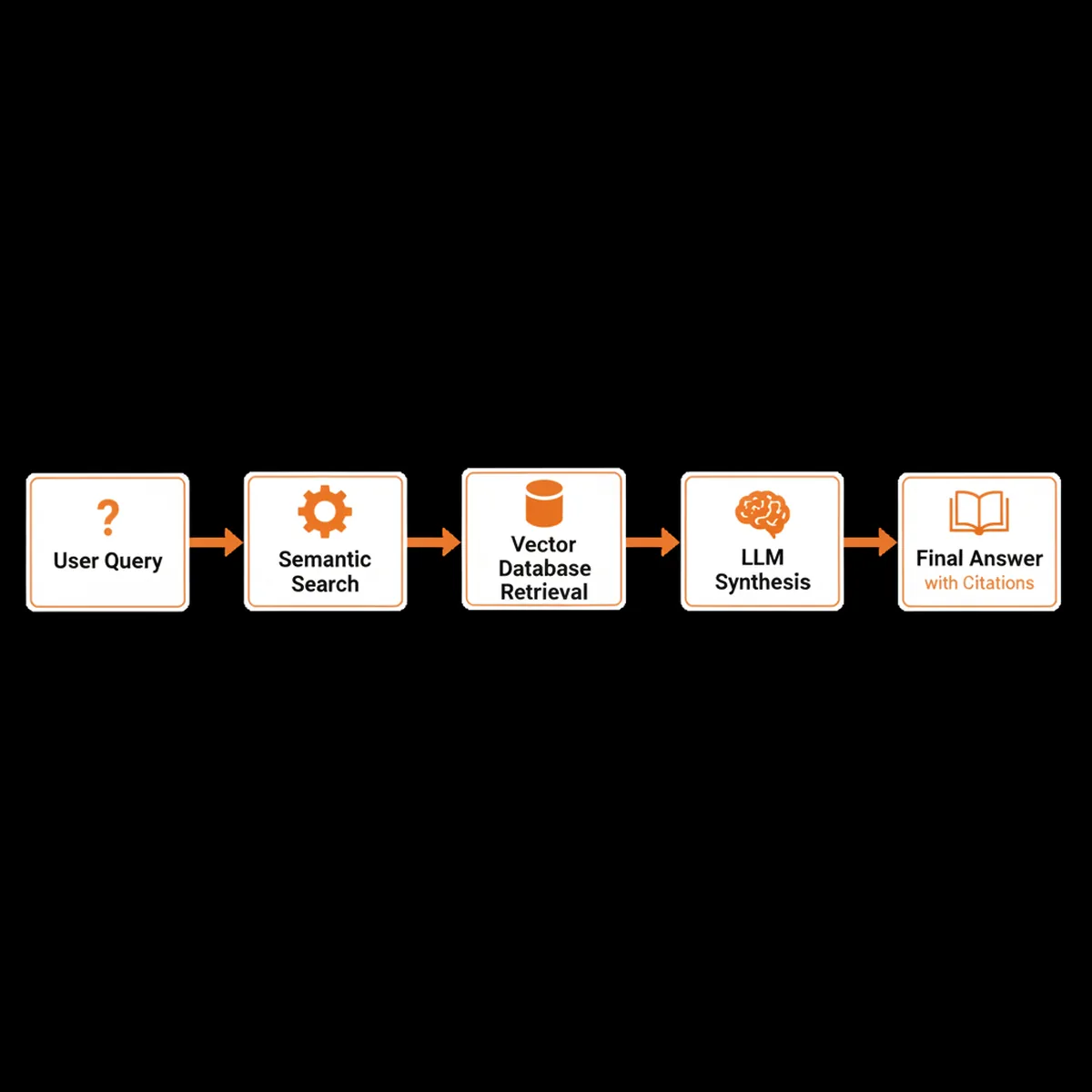
The process begins when a user enters a prompt. Unlike old-school Google, which looked for "best coffee beans," an AI search engine looks at the intent: "I want a light roast with fruity notes available in London." The AI uses Natural Language Understanding (NLU) to break this down. It identifies the product (light roast), the attribute (fruity notes), and the constraint (London).
Why it works: By understanding the "why" behind a search, the AI can filter out irrelevant noise. Common mistake: Writing content that is too broad or lacks a specific "point of view" that the AI can categorize. Pro tip: Use Answer Engine Optimization (AEO) techniques to clearly state your unique value proposition in the first paragraph of your pages.
Step 2: Semantic Retrieval via Vector Search
Once the AI knows what you want, it searches its index. It doesn't look for matching words; it looks for matching meanings. It scans its Vector Database for content that is mathematically similar to the query. If a user asks for "ways to improve team output," the AI will find your article titled "Maximizing Workforce Efficiency" even if the words don't match exactly.
Why it works: This allows the AI to find the "best" answer even if the exact keywords aren't present. Common mistake: Focusing purely on keyword density rather than topical depth. Pro tip: Structure your data using Schema.org to give the AI clear "hints" about what your content actually means.
Step 3: Information Synthesis and RAG
The AI doesn't just copy and paste. It takes the top results found in the retrieval stage and passes them back to the LLM. The LLM reads these snippets and writes a original summary that answers the specific prompt. It looks for consensus across multiple sources. If three different sites say your software costs $50 a month, the AI reports that as a fact.
Why it works: It provides a frictionless experience for the user who wants an answer, not a research project. Common mistake: Gating your most valuable insights behind PDF downloads or complex scripts that RAG bots can't read. Pro tip: Ensure your site speed and crawlability are perfect so that Generative Engine Optimization (GEO) bots can access your text instantly.
Step 4: Citation and Attribution
In the final step, the AI adds citations. It points back to the sources it used to build the answer. This is your new "organic traffic." These links are often embedded directly into the text or listed as "Sources" at the bottom.
Why it works: It builds trust with the user and provides a path for further exploration. Common mistake: Not having a clear brand name or author authority, which makes the AI less likely to credit you. Pro tip: Monitor how AI chooses sources to see if your brand is being cited as a primary authority in your niche.
Comparing Traditional Search vs. AI Search
| Feature | Traditional Search (Google 2020) | AI Search (2026) |
|---|---|---|
| Primary Goal | Indexing the web | Answering the user |
| Mechanism | Keyword matching & Backlinks | Semantic vectors & RAG |
| User Experience | List of links (10 blue links) | Synthesized narrative answer |
| Optimization Focus | Keywords and PageRank | Entity authority and Clarity |
| Success Metric | Click-Through Rate (CTR) | Brand Mention & Citation Share |
| Data Freshness | Crawl-dependent (days/weeks) | RAG-driven (near real-time) |
Common Mistakes to Avoid in AI Search
- Over-optimizing for outdated keywords. If you are still stuffing keywords into headers without providing actual substance, AI engines will ignore you in favor of more comprehensive guides.
- Neglecting technical "readability" for bots. If your site uses heavy Javascript that hides content until a user clicks, AI crawlers might miss the context entirely.
- Ignoring Entity-based SEO. AI cares more about who you are and what you are an expert in than how many backlinks you have.
- Failing to update content regularly. AI search engines prioritize "freshness" through RAG. If your data is from 2023, you will be replaced by a 2026 source.
- Lack of direct answers. If you bury the answer to a common industry question at the bottom of a 2,000-word post, the AI may not find it during the retrieval phase.
- Using passive voice. AI models prefer active, direct declarations. "Our software increases sales" is better than "Sales can be increased by the use of our software."
Best Practices for Dominating AI Results
- Adopt a "Direct Answer" framework. Start your articles with a 40-60 word summary that answers the primary question.
- Build Topical Authority. Create clusters of content around a single subject to prove to the AI that you are a definitive source. Use a pillar-and-cluster internal linking model.
- Use Structured Data. Go beyond basic Schema; use "about" and "mentions" properties to link your content to established entities.
- Optimize for Conversational Long-Tail Queries. People talk to AI differently than they type into Google. Use "How," "Why," and "Should I" as your content pillars.
- Audit your "Answer Share." Regularly check how often your brand appears in the synthesized responses of major AI engines.
How to Write for Semantic Extraction
When you write, think about how an AI "extracts" facts. Use clear subject-predicate-object structures. Instead of saying "We are a top-tier provider of solutions for the enterprise," say "EvronStudio provides Answer Engine Optimization for B2B SaaS companies." The second sentence identifies the subject (EvronStudio), the action (provides AEO), and the target (B2B SaaS). This clarity makes it much easier for the vectorization process to categorize your site correctly.
Visibility in ChatGPT, Gemini, Copilot, and Perplexity
Each major engine has a slightly different way of working. ChatGPT relies heavily on Bing's index and its own internal memory, prioritizing clear, authoritative voices. It tends to favor sources that provide a balanced perspective. Gemini integrates deeply with Google’s Knowledge Graph, making your Google Business Profile and YouTube presence more important than ever. If you have a video explaining a concept, Gemini is more likely to pull that into the AI Overview.
Copilot is built for productivity, often pulling from technical documentation and LinkedIn, while Perplexity acts as a real-time research assistant, favoring highly cited, data-driven journalism and white papers. To stay visible across all four, your content must be consistent, factual, and easily parsed. If you are struggling to show up, consider our AEO insights to see where you might be falling short in the retrieval phase.
Case Study: From "Invisible" to "Top Citation"
We recently worked with a B2B SaaS client in the fintech space. Despite having great SEO for years, their traffic started dipping in early 2025 as AI Overviews took over their primary keywords. They weren't being cited in the AI answers. The AI was instead citing their competitors who had shorter, more direct "What is" sections on their pages.
We shifted their strategy to focus on Entity-based AEO. We reorganized their blog to include "TL;DR" summaries, implemented advanced Schema, and focused on answering "unsearchable" questions—queries that required expert synthesis rather than just data. We also cleaned up their site architecture to ensure that the RAG bots could access their pricing and feature pages without hitting Javascript walls.
Within six months, their "Citation Share" in Perplexity and Gemini grew by 45%. While their traditional "blue link" clicks remained steady, their total lead volume increased by 22% because the traffic coming from AI citations was much higher intent. The users weren't just browsing; they were clicking through to verify a specific solution the AI had already recommended. This is the power of understanding what is Answer Engine Optimization.
Tools and Resources for AI Search Optimization
- GSC (Google Search Console): Essential for monitoring how Google’s AI Overviews are interacting with your site. Look at the "Search Appearances" tab. (Free)
- Perplexity Pages: Use this to see how a "pure" AI engine synthesizes your brand’s information. It acts as a mirror for your AI reputation. (Free/Paid)
- Claude (Anthropic): Great for testing your content’s "summarizability"—paste your text and ask Claude to answer a question based on it. If it fails, your text is too complex. (Free/Paid)
- Schema.org: The official documentation for the structured data you need to feed AI engines. Stick to JSON-LD format. (Free)
- Ahrefs/Semrush: Both now offer "AI Tracking" features to see which of your keywords are triggering AI responses. (Paid)
How to Measure Success in the AI Era
Measuring success is no longer just about ranking #1. You need to look at:
- Citation Share: How often is your URL cited in an AI answer for your target keywords?
- Sentiment Score: Does the AI speak about your brand in a positive or authoritative tone?
- Referral Traffic from AI: Check your analytics for "openai.com" or "perplexity.ai" as referrers.
- Assisted Conversions: How many leads interacted with an AI answer before landing on your site?
AEO Checklist:
- [ ] Direct answer provided in the first 50 words?
- [ ] Structured data (Schema) validated?
- [ ] Content free of "fluff" and "filler" phrases?
- [ ] Clear entity relationships established?
- [ ] Cited by other high-authority sources?
- [ ] Mobile-first performance (Core Web Vitals) optimized?
Testing and QA for AI Visibility
Before you roll out AEO changes site-wide, you must test how different models interpret your pages. We use a three-step QA process for our clients. First, we perform a manual prompt test. We ask ChatGPT and Perplexity specific questions that your content is designed to answer. We look for whether the AI uses our client's name or a generic competitor. If the AI gives a generic answer, we know our "entity signals" are weak.
Second, we use API-based extraction testing. We run the page content through the GPT-4o API and ask it to extract the three most important facts. If the facts it extracts don't align with our client’s value proposition, we rewrite the headers for better clarity. Finally, we conduct Vector Similarity audits. We compare the vector embeddings of our target keywords against the vector embeddings of the new content. If the mathematical distance is too high, the content won't trigger in a RAG-based search. This technical QA ensures that our optimizations actually work for the machines, not just for the human eye.
Where AI Search Optimization Fails: The Honest Trade-offs
AEO is not a magic bullet. There are specific scenarios where this approach will not work. First, if your brand is in a highly regulated or "YMYL" (Your Money Your Life) niche like experimental medicine or high-stakes legal advice, AI search engines are programmed to be extremely conservative. They may default to citing established government institutions or giant legacy brands regardless of how well you optimize your content. In these cases, AEO must be paired with aggressive traditional PR to build foundational authority.
Second, AI search fails on ultra-fresh, breaking news that hasn't been indexed by RAG bots yet. If an event happened 10 minutes ago, a keyword-based search might still beat an AI synthesis. Third, there is the "Zero-Click" problem. If you optimize your content to be perfectly summarized, the user might get all the information they need from the AI interface and never click your link. This is why we focus on "conversion-driven AEO"—giving the AI enough to cite you as the expert, but leaving the "how-to" implementation or the tool itself behind a click. You have to balance providing value to the machine with keeping a reason for the human to visit your site.
The Future of AI Search in 2026 and Beyond
As we move deeper into 2026, AI search will become even more personalized. Engines will not only look at the web but also at the user's specific context, past preferences, and even their current task. We are moving toward "Agentic Search," where the AI doesn't just give an answer but performs an action—like booking a demo or comparing pricing tiers for you. This means your site needs to be more than just readable; it needs to be "functional" for AI agents.
To stay ahead, brands must transition from being "content creators" to "knowledge providers." You aren't just writing articles; you are building a database of truth that AI agents can rely on. If your data is messy, inconsistent, or hidden, the agents will move on to a competitor who makes their job easier. If you want to see how your current site stacks up, we recommend starting with a free AEO audit.
The shift to AI search is the biggest change in digital marketing history. By understanding the mechanics of RAG, vectors, and intent, you can position your brand to be the answer the world is looking for. Our team is ready to help you navigate this transition through our specialized RevOps and AEO services.
Ready to dominate the new search era? [Explore our AEO Services and claim your spot at the top.](/services)
To get started, feel free to contact our experts or browse our full blog for more strategies.
Frequently asked questions
What is the difference between AI search and traditional search?+
AI search uses Large Language Models and Retrieval-Augmented Generation (RAG) to provide direct answers. Traditional search focuses on keyword matching and ranking a list of external links. AI search prioritizes intent and semantic meaning, while traditional search relies heavily on PageRank and backlink volume.
What is RAG in AI search?+
Retrieval-Augmented Generation (RAG) is a framework that allows an AI to pull factual, up-to-date information from an external database or the live web before generating a response. This ensures the answer is grounded in real data rather than just the AI's static training set, making it crucial for brand accuracy.
How do I get my website cited in ChatGPT or Perplexity?+
To appear in AI answers, focus on Answer Engine Optimization (AEO). This involves providing direct, concise answers to common questions, using structured data (Schema.org), building high topical authority, and ensuring your site is easily crawlable by AI bots like GPTBot. Clarity and factual accuracy are the highest priorities.
Do backlinks still matter for AI search?+
AI search engines primarily use vector databases to find 'semantically similar' content. They also look at knowledge graphs to understand the relationship between entities. While traditional backlinks still matter for overall authority, they are becoming less important than the actual relevance and quality of the content.
What is GEO and how does it relate to SEO?+
Generative Engine Optimization (GEO) is the practice of optimizing content specifically for generative AI models. This includes improving the 'synthesizability' of your text, using data-backed claims, and ensuring your brand is recognized as a key entity within your specific industry or niche.
How do I measure my visibility in AI search?+
You can track success by monitoring 'Citation Share' in tools like Perplexity, checking referral traffic from AI domains in your analytics, and using specialized AEO tracking tools. Look for your brand being mentioned as a primary source in AI-generated overviews for your target keywords.
Sources & further reading
Soft next step
Want to see where AI answers mention you — and where they don't?
We run a free AEO audit across ChatGPT, Gemini, Copilot and Perplexity, then hand you the fixes in priority order. Start your AEO strategy today.