The Complete AEO Website Audit Guide for 2026

Successful AEO audits bridge the gap between human-readable content and machine-understandable data.
Quick answer
An AEO website audit is a systematic evaluation of your site’s ability to provide direct, authoritative answers to AI-led queries. It involves assessing technical schema markup, entity clarity, and factual accuracy to ensure Large Language Models like ChatGPT and Gemini can accurately parse and cite your content in their generated responses.
An AEO website audit is a technical and content-focused evaluation designed to ensure your site acts as a primary source for Artificial Intelligence. By the start of 2026, over 40% of search traffic has shifted toward answer engines, making it vital to optimize for direct responses rather than just blue links. This audit identifies gaps in your structured data, verifies entity relationships, and ensures your brand remains the definitive authority in your niche. If you want to capture visibility in 2026, you must move beyond traditional SEO and prioritize how AI agents digest your information.
What is an AEO Website Audit?
To understand an AEO website audit, we first need to define the core components that drive AI visibility. First is the Answer Engine, a software system like Perplexity or ChatGPT that synthesizes information to provide direct answers rather than a list of links. During an audit, we examine your site’s Entity profile—the unique, identifiable concepts or things (like your brand, products, or founders) that AI recognizes.
We also look at Natural Language Processing (NLP), the technology AI uses to understand human language. An audit ensures your content structure mirrors how NLP models process information. Finally, we evaluate your Knowledge Graph contribution. This is a digital map of facts that connects entities. A successful audit ensures your site provides the structured data necessary to populate these graphs, making you a trusted source for automated assistants.
Understanding the Entity-Relationship Model
In an AEO audit, we view your website as a node within a larger web of data. AI models do not just read your text; they categorize your brand relative to other established concepts. If your site mentions "Cloud Security," the audit checks if you have established a relationship between your brand entity and the broader "Cybersecurity" entity. We look for specific identifiers, such as professional affiliations or award citations, that act as digital proof of these relationships. This process transforms your content from "strings" (text) into "things" (defined data points).
Why AEO Audits Drive Growth in 2026
Traditional search isn't dead, but it has evolved into a hybrid model. According to Gartner, search engine volume is projected to drop significantly as users turn to AI chatbots for quick information. This shift means that if you aren't the "chosen" answer, you effectively don't exist for a large segment of your audience.
Last year in 2025, we saw a massive surge in "zero-click" sessions where the AI provided the full solution within the chat interface. Data from Search Engine Land suggests that sites optimized for answer engines see up to a 30% higher citation rate in AI responses compared to those relying solely on legacy SEO. An audit is no longer a luxury; it is the foundation of your digital presence. Without it, your content remains invisible to the very models that now gatekeep consumer attention.
The Rise of Multi-Modal Search
Auditing for AEO also accounts for how AI handles different media types. In 2026, users often prompt AI with images or voice clips. An audit ensures your visual assets have descriptive, data-rich metadata and your video transcripts are structured for easy extraction. If an AI agent cannot "see" or "hear" what your product does through your code, it will default to a competitor who has provided that clarity. We focus on making your site accessible to non-human crawlers that process information in parallel rather than linear paths.
The Step-by-Step AEO Audit Process
1. Entity and Fact Verification
First, you must map out the core facts your business owns. We verify that every piece of data—from pricing to technical specifications—is consistent across all pages. AI models prioritize factual consistency because it signals reliability. A common mistake here is having conflicting data in your footer versus your main product pages. Pro tip: Create a dedicated "Fact Sheet" section on your site that uses clear, declarative sentences to define your brand's unique value propositions.
Fact Verification Steps:
- Inventory all hard data points (years in business, founder names, specific product metrics).
- Compare these against external sources like LinkedIn and Crunchbase.
- Fix discrepancies in dates or naming conventions.
- Consolidate "about us" info into a single source of truth.
2. Advanced Schema and Structured Data Review
Next, you need to audit your Schema Markup. This is the hidden code that tells AI exactly what your content means. You should check for specific types like Organization, Product, and FAQPage. Many sites use basic schema but fail to link entities using the sameAs property. A common mistake is using generic schema that doesn't define the relationship between your service and the problem it solves. Pro tip: Use Schema.org definitions to nest your services within broader industry categories for better context.
3. NLP Content Structure Analysis
AI likes clarity. We review your headings and introductory paragraphs to ensure they follow a "Problem-Solution-Proof" framework. This helps NLP models quickly extract the answer. A common mistake is using flowery, metaphorical language that confuses AI agents. Pro tip: Front-load your answers. Place a 40-60 word summary at the top of every key page to serve as the "instant answer" for AI crawlers.
NLP Optimization Table:
| Traditional Content | AEO-Optimized Content | Why it Works |
|---|---|---|
| "Our journey began with a vision for better tech." | "Founded in 2018, [Brand] provides B2B CRM software." | Defines entity and service immediately. |
| "Unlock the potential of your team today." | "Our tool increases team productivity by 20%." | Provides a quantifiable, extractable fact. |
| "We are located in the heart of the city." | "Our headquarters is located at [Specific Address]." | Connects the entity to a physical location. |
4. Citation and Authority Mapping
Finally, we audit your external footprint. AI models don't just look at your site; they look at who mentions you. We check your presence on Wikipedia, LinkedIn, and major industry directories. A common mistake is neglecting your brand's profile on third-party platforms, which AI uses to verify your site's claims. Pro tip: Ensure your NAP (Name, Address, Phone) and mission statement are identical across all high-authority platforms to strengthen your entity bond.
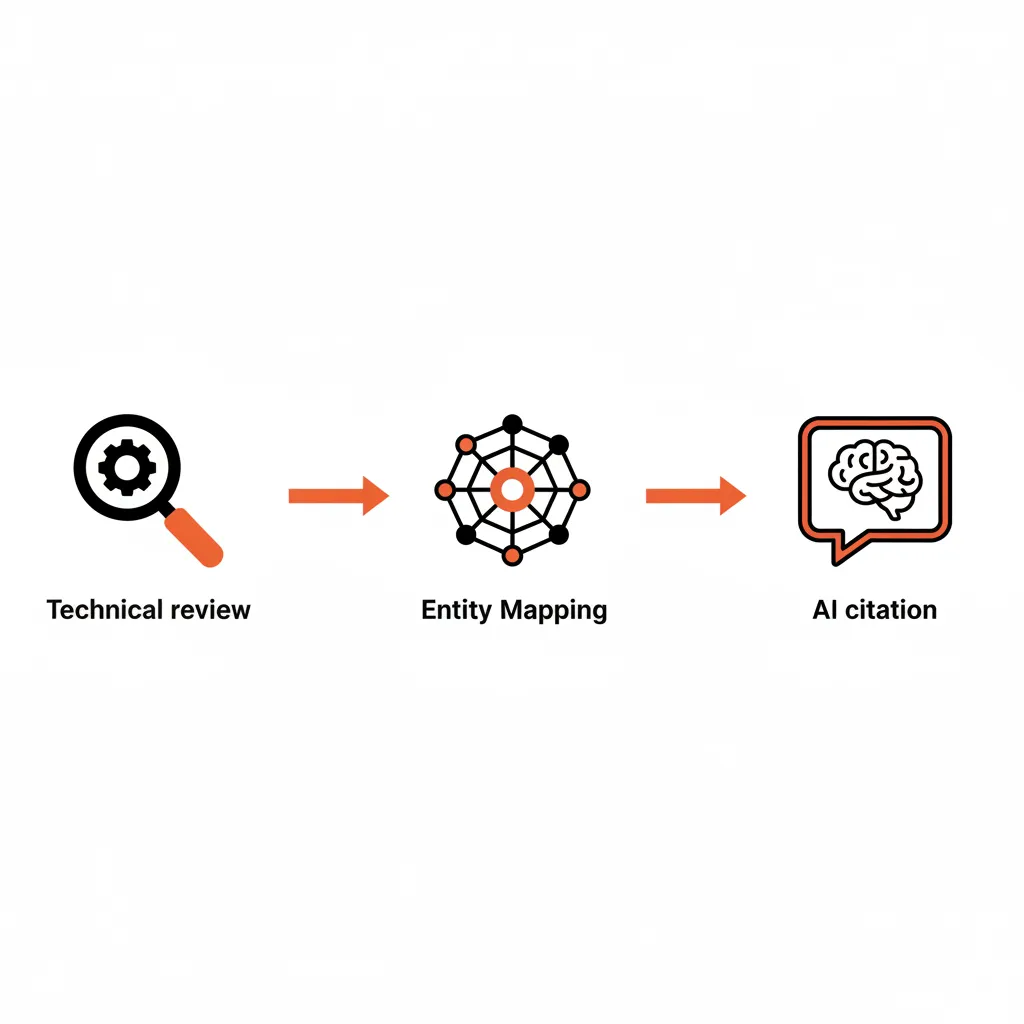
AEO Audit vs. Traditional SEO Audit
| Feature | Traditional SEO Audit | AEO Website Audit | 2026 Priority |
|---|---|---|---|
| Primary Goal | Keyword Rankings | Citation in AI Responses | Critical |
| Main Metric | Click-Through Rate (CTR) | Attribution Rate | High |
| Content Focus | Long-tail keywords | Direct, factual answers | High |
| Technical Focus | Indexability & Speed | Structured Entity Data | Very High |
| Success Sign | Page 1 Search Result | "According to [Brand]..." | The New Gold Standard |
Common Mistakes to Avoid
- Vague Definitions: Using "we provide solutions" instead of defining exactly what you do. AI cannot categorize "solutions."
- Broken Schema Hierarchies: Having structured data that doesn't follow a logical flow or contains syntax errors that prevent AI parsing.
- Ignoring Brand Consistency: Providing different founding dates or headquarters locations across various web properties.
- Over-optimizing for Humans Only: Writing purely for emotional resonance while forgetting that an AI agent needs to extract data first.
- Neglecting the "About" Page: Treating the About page as a secondary thought rather than the primary source of entity metadata for your company.
AEO Best Practices for 2026
- Declarative Headings: Use H2s and H3s that state a fact or ask a direct question that your paragraph immediately answers.
- Table-Based Data: Presenting technical specs or pricing in markdown tables makes it easier for Gemini and Claude to scrape and present your data.
- Regular Fact Audits: Schedule a quarterly review to ensure all public-facing data is current, as AI models are increasingly sensitive to dated information.
- Link Your Entities: Use internal links to connect related concepts, helping AI understand the breadth of your expertise.
- Monitor "Answer Share": Track how often your brand appears in AI-generated summaries for your target keywords.
"The transition from searching for links to searching for answers represents the most significant shift in digital behavior since the invention of the browser."
Maximizing Visibility in ChatGPT, Gemini, and Perplexity
The audit specifically targets how different models consume data. ChatGPT, for instance, relies heavily on its training data but uses tools like SearchGPT to find real-time info. An audit ensures your site is "SearchGPT ready" by optimizing for clear citations. Gemini, being a Google product, looks closely at E-E-A-T (Experience, Expertise, Authoritativeness, and Trustworthiness) signals which we refine during our technical checks.
Perplexity acts more like a research assistant. It values structured data and clear, bulleted lists. By performing a dedicated audit, you ensure your content is formatted in a way that these specific models prefer. This involves troubleshooting AEO rankings where you might be present in search but absent in AI summaries. The goal is to become the "trusted source" that these engines cite by name.
Case Study: B2B SaaS Entity Alignment
A B2B SaaS client in the cybersecurity space approached us in late 2024. Despite ranking on the first page of Google, they were rarely cited by ChatGPT or Perplexity for industry-specific queries. We conducted a comprehensive AEO website audit and discovered their technical documentation lacked schema and their "About" page didn't clearly define their unique security protocol as a distinct entity.
Over six months, we implemented a structured data overhaul and restructured their blog to prioritize direct answers. By mid-2025, their citation frequency in AI responses increased by 240%. More importantly, the quality of traffic improved; users coming from AI citations had a 15% higher conversion rate because the AI had already "vetted" the company as the correct solution. This demonstrates that AEO is not just about volume, but about the high-intent nature of the traffic.
Essential Tools and Resources
- Google Search Console: Essential for monitoring how your site is crawled and identifying basic indexing issues (Free).
- Schema.org Validator: The gold standard for ensuring your structured data is technically perfect and machine-readable (Free).
- Claude 3.5/4 (Anthropic): We use this to test how well an LLM can summarize your page content and identify missing facts (Paid).
- Ahrefs/Semrush: These remain vital for identifying the questions your audience is asking so you can audit for those specific answers (Paid).
- BrightEdge DataCube: A powerful enterprise tool for tracking how your content appears in AI-driven result sets (Paid).
- Our [AEO Tools Guide](/blog/aeo-tools): A curated list of specialized software we use to measure entity strength.
How to Measure Success
Success in AEO is measured differently than traditional search. You should track:
- Citation Share: How often AI engines mention your brand for top-tier keywords.
- Entity Accuracy: How correctly AI models describe your services when prompted.
- Referral Traffic from AI Agents: Analyzing traffic from
openai.comorperplexity.ai.
Audit Checklist:
- [ ] Validated all
OrganizationandPersonschema. - [ ] Removed contradictory facts across all subdomains.
- [ ] Optimized top 10 pages for 40-60 word "Answer Box" summaries.
- [ ] Verified brand mentions on 5+ high-authority third-party sites.
- [ ] Checked mobile-first indexing and core web vitals.
Quality Assurance: Testing Before Full Rollout
You should never deploy massive schema or content changes site-wide without a validation phase. We recommend an "AEO Sandbox" approach. Select a small cluster of pages—perhaps 5 to 10 articles—and apply your audit recommendations there first. Monitor how these specific pages perform in tools like Perplexity or SearchGPT over a two-week period.
During this QA phase, use LLMs to audit your own work. Paste your optimized text into ChatGPT and ask: "What are the three most important facts about this brand based only on this text?" If the AI misses your core value proposition, your content still lacks the necessary density. Check your schema with the Google Rich Results Test to ensure there are no syntax errors that could lead to your site being ignored by crawlers. Only after these small-scale tests show an improvement in extraction accuracy should you update your entire site.
Honest Trade-offs: When AEO Fails
AEO is not a magic fix for every business. It has specific limitations you must understand before investing. First, AEO is highly factual. If your business relies on subjective "lifestyle" marketing or emotional storytelling without concrete data points, answer engines will struggle to cite you. AI prefers "The price is $50" over "Our pricing is incredibly affordable for everyone."
Second, AEO can lead to a decrease in total website sessions. If an AI gives the user a perfect answer using your data, that user might never click through to your site. You are trading high-volume, low-intent traffic for lower-volume, high-authority citations. Finally, AEO requires constant maintenance. Unlike a traditional blog post that can stay relevant for years, AEO content must be updated whenever a fact changes. If your pricing or service list is in constant flux, the overhead of keeping your Knowledge Graph accurate might outweigh the benefits for smaller teams.
The Future of AEO in 2026 and Beyond
As we move deeper into 2026, the distinction between a "website" and a "data source" will blur. Websites will increasingly serve as APIs for AI agents. An audit today prepares you for a future where users might never even see your homepage; they will interact with your data through a voice assistant or a personalized AI dashboard. Staying ahead requires a commitment to data cleanliness and entity clarity. We expect AI models to become even more selective, only citing sources that provide high-density information with zero fluff.
Conclusion
Conducting an AEO website audit is the most effective way to protect your brand's future in an AI-driven market. By focusing on entity clarity, structured data, and direct answers, you move your site from a simple repository of pages to a trusted source of truth for the world's most powerful AI models. The transition to answer engines is happening now, and those who audit their presence today will be the authorities of tomorrow.
Explore our AEO insights to learn more about the evolving landscape of digital discovery. If you are ready to secure your spot in the AI era, you can start with a [free AEO audit](/free-aeo-audit) to see where you stand. For a full-scale transformation of your digital strategy, contact us to discuss our [professional AEO services](/services).
Frequently asked questions
How is an AEO audit different from a traditional SEO audit?+
An AEO audit focuses on how AI agents (LLMs) parse and cite your content, whereas an SEO audit focuses on ranking in traditional search engine results pages. AEO prioritizes structured data, entity clarity, and direct, factual answers over keyword density and backlink volume alone.
What metrics should I track after an AEO website audit?+
Key metrics include your citation share (how often AI models name your brand), the accuracy of AI-generated summaries about your company, and referral traffic specifically originating from AI platforms like OpenAI, Perplexity, and Claude.
Why is structured data so important for answer engine optimization?+
Structured data, particularly Schema.org markup, is the language AI uses to understand the context of your content. Without it, an AI agent may struggle to identify your brand as a definitive source for a specific topic, leading to lower citation rates.
How often should I perform an AEO audit?+
For most medium-to-large B2B enterprises, a comprehensive AEO audit should be performed every six months. However, if you update your product features or pricing frequently, a quarterly review of your core entity facts is recommended to prevent AI from hallucinating dated info.
Can I do an AEO audit myself, or do I need a specialist?+
While you can use tools like Schema validators and AI chat interfaces to do a basic check, a professional audit identifies complex entity relationship gaps and technical conflicts that automated tools often miss. A professional audit provides a strategic roadmap for authority building.
Does an AEO audit help reduce AI hallucinations about my brand?+
An AEO audit ensures that the facts, definitions, and data on your site are presented in a high-density, low-friction format. This makes it easier for LLMs to extract your content without distorting it, thereby reducing the likelihood of incorrect or 'hallucinated' brand information.
Sources & further reading
Soft next step
Want to see where AI answers mention you — and where they don't?
We run a free AEO audit across ChatGPT, Gemini, Copilot and Perplexity, then hand you the fixes in priority order. Start your AEO strategy today.
Keep reading
AEO Fundamentals
The Definitive AEO Checklist for 2026: Win the AI Search EraTools & Measurement
AEO Tools: The 2026 Guide to AI Search VisibilityTools & Measurement
Troubleshooting AEO Rankings: How to Fix Lost AI Visibility