The Essential AEO Tools for 2026: A Complete Guide to AI Visibility

Using the right AEO tools is critical for maintaining visibility in AI-driven search engines.
Quick answer
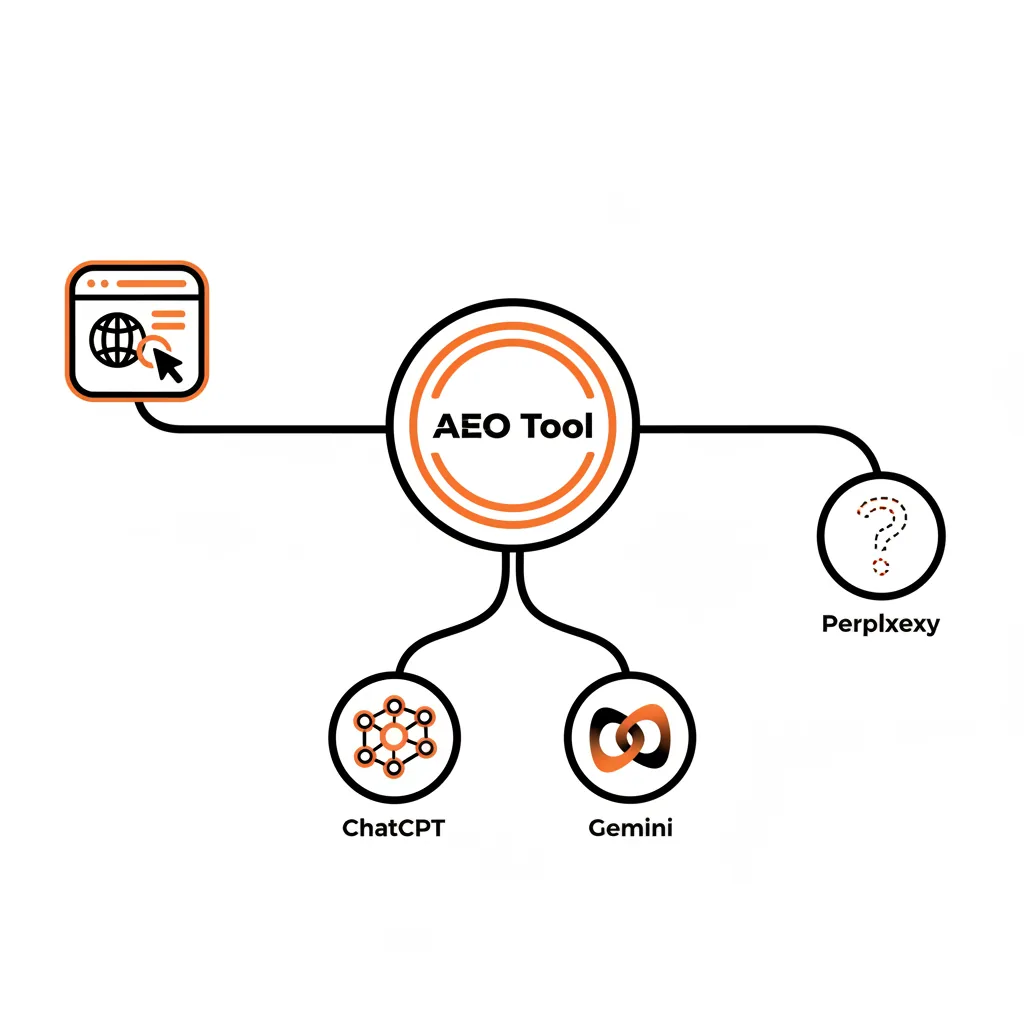
AEO tools are software platforms used to optimize content for AI-driven search engines. These tools identify intent-based keywords, track visibility across models like ChatGPT and Perplexity, and validate structured data. By using dedicated AEO tools, you ensure your brand appears as the authoritative answer in conversational AI responses.
AEO tools are specialized software applications designed to help you track, optimize, and improve your brand’s visibility within AI-driven search results. These platforms allow you to analyze how large language models (LLMs) interpret your content, monitor your "share of model" compared to competitors, and ensure your site uses the specific structured data required for AI recognition. Unlike traditional SEO software that focuses on rank, these tools prioritize your status as the definitive answer for user queries. Using these platforms in 2026 is no longer optional if you want to remain visible in a market where 40% of users now start their search journey in a chat interface rather than a standard search bar.
What is an AEO Tool?
To understand how these platforms work, we must first define the technical components they manage. At its core, an Answer Engine is any AI system, such as ChatGPT or Gemini, that provides a direct response to a user query instead of a list of links. An AEO Tool is the software used to manage your presence within these engines.
These tools typically interact with a Knowledge Graph, which is a programmatic representation of relationships between different entities like brands, people, and products. The tools help you feed these graphs by generating Schema Markup, a specific vocabulary of code tags you add to your HTML. Finally, they track your LLM Visibility, a metric that calculates how often a specific AI model mentions your brand when a user asks a relevant question.
The Role of Entity Linking in AEO
A modern AEO tool does more than just check keywords. It identifies "entities"—unique concepts or objects that the AI understands. If your website mentions "Project Management Software," an AEO tool helps the AI link that phrase to your specific brand entity. This process, known as entity reconciliation, ensures the AI doesn't just know what you sell, but who you are in the context of the global web of information. By strengthening these links, you move from being a "string" of text to a recognized "thing" in the AI’s memory.
Why Answer Engine Optimization Tools Matter in 2026
The shift from "searching" to "answering" is complete. Research from Gartner indicates that organic search traffic for many brands has decreased as AI Overviews take up more screen real estate. However, the quality of traffic coming from AI engines is often higher because the user has already been "pre-sold" by the AI’s recommendation.
In 2025, we saw a massive increase in "zero-click" searches where the user gets their answer directly from the AI. To survive this, you need data. You cannot optimize what you cannot see. Traditional trackers won't tell you why ChatGPT ignored your latest whitepaper, but dedicated AEO software will. It analyzes your content’s "entity density" and ensures you are providing the factual density that models crave. Without these tools, you are essentially flying blind in a conversational economy.
Attributed Data and Market Trends
BrightEdge recently reported that AI Overviews (formerly SGE) now appear for a significant portion of B2B queries, particularly those with informational intent. This means your traditional number one ranking might sit below a large AI-generated box that summarizes your content—or worse, your competitor's content. AEO tools monitor this "real estate" share. Furthermore, a study by Search Engine Land suggests that users are 3x more likely to trust a brand cited as a primary source by a chatbot compared to a standard sponsored ad. This trust is the new currency of the digital age.
How to Implement an AEO Tool Strategy in 4 Steps
Choosing a tool is only half the battle. You need a process to turn that data into higher visibility.
Step 1: Conduct an AI Visibility Audit
First, use your tool to run a baseline report on your current brand mentions across Perplexity, ChatGPT, and Gemini. You want to see which specific queries trigger your brand as a source. This works because it identifies your "low-hanging fruit"—topics where the AI already trusts you but needs more detail. A common mistake is only tracking your brand name; you should be tracking high-value "how-to" and "what is" queries related to your industry.
Procedure for a Visibility Audit:
- Input your top 50 "intent-based" keywords into an AEO tracker like WordLift or specialized LLM scrapers.
- Record which AI models cite your domain and which pages they prefer.
- Categorize results into "Cited," "Mentioned but not linked," and "Ignored."
- Export the "Ignored" list to prioritize for content restructuring.
Pro Tip: Look for "hallucination risks" where the AI mentions you but gets your pricing or features wrong.
Step 2: Identify Entity Gaps
Once you have your baseline, use the tool to compare your site’s Schema.org implementation against the top-performing competitor. The tool will highlight entities (concepts) that the AI associates with your competitors but not you. This works because AI models rely on these associations to build trust. A common mistake is ignoring the sameAs attribute in your code, which links your site to your official social profiles and Wikipedia pages.
How to Close Entity Gaps:
- Run a "Competitor Entity Gap" report in your AEO dashboard.
- Identify missing nodes (e.g., your competitor is linked to "Sustainability," but you are not).
- Update your
Organizationschema to include these missing attributes. - Create a "Cornerstone Page" for each missing entity to prove your relevance.
Pro Tip: Map your content to specific Schema.org types like "Service" or "FAQPage" to increase clarity for the crawler.
Step 3: Optimize for Factual Density
AEO tools often include a "content grader" that looks for objective facts rather than marketing fluff. Use this to rewrite your top-performing pages. AI models prefer sentences that follow a "Subject-Verb-Object" pattern because they are easier to parse into a knowledge graph. This works because it reduces the "noise" the AI has to filter through. A common mistake is using overly creative or metaphorical language that confuses the AI's natural language processing.
Improving Factual Density:
- Scan your page using a Natural Language Processing (NLP) tool to see your "confidence score."
- Replace adjectives like "cutting-edge" with specific specs like "10ms latency."
- Add a "Quick Facts" table at the top of long-form articles.
- Re-verify the page to see if the tool now recognizes more distinct entities.
Pro Tip: Use bulleted lists for all technical specifications to make data extraction easier for the model.
Step 4: Monitor and Refine Referral Traffic
Finally, use the tool’s integration with your analytics to track "AI Referrals." This is traffic that comes directly from a link inside an AI response. This works because it allows you to calculate the actual ROI of your AEO efforts. A common mistake is treating AI traffic the same as standard organic traffic; AI users usually arrive further down the funnel.
Monitoring AI Referrals:
- Set up custom segments in Google Analytics 4 (GA4) for traffic from
chat.openai.com,perplexity.ai, andgemini.google.com. - Compare the bounce rate of AI referrals against standard organic search.
- Adjust your landing page CTA to match the "problem-solving" intent of the AI user.
Pro Tip: Create specific landing pages for AI-referred users to maintain the conversational context they just came from.
Comparing Popular AEO Tools for 2026
| Tool Name | Primary Focus | Best For | Price Range | Integration Strength |
|---|---|---|---|---|
| WordLift | Entity Management | E-commerce & Knowledge Graphs | Mid-to-High | Excellent (WordPress/Shopify) |
| SparkToro | Audience Intelligence | Identifying AI Sources | Mid-Range | Good (Web-based) |
| BrightEdge | Enterprise SEO/AEO | Global Brands | High / Enterprise | Superior (Custom API) |
| Perplexity Pages | Content Creation | Identifying Citations | Free / Low | Minimal |
| Schema App | Structured Data | Technical AEO Implementation | Mid-Range | Excellent (Tag Manager) |
| HypeStat | Traffic Origins | Referral Analysis | Low | Basic |
Common Mistakes to Avoid When Using AEO Tools
- Over-optimizing for a single model: Focusing entirely on ChatGPT while ignoring Gemini or Perplexity can leave you vulnerable when users switch platforms.
- Ignoring the human reader: It is easy to get caught up in "writing for the bot," but if your content is unreadable for humans, your conversion rate will crater.
- Neglecting technical health: Even the best AEO tool can't help if your site has a slow "Time to First Byte" or broken links that prevent AI crawlers from accessing your data.
- Forgetting about non-text content: AI models increasingly process images and video. Ensure your tools can analyze your ALT text and video transcripts.
- Treating AEO as a one-time setup: AI models retrain constantly. A strategy that worked last month might fail today if the model’s weightings have shifted.
- Relying on AI-Generated Content for AEO: Using AI to write the content you want AI to rank often leads to a "circular logic" error where the content lacks the original insights models prefer.
Best Practices and Pro Tips for 2026
- Prioritize Authoritative Sources: Link out to high-authority domains like Gartner or OpenAI to provide context for your claims.
- Use Natural Language: Frame your H2 and H3 headings as questions. This mirrors how users speak to voice assistants and AI chatbots.
- Validate Your Markup: Always run your code through the Google Rich Results Test to ensure there are no syntax errors.
- Monitor Brand Sentiment: Use tools to see if AI models are describing your brand positively or negatively.
- Focus on "The Answer": Place your most direct answer to a query in the first 50 words of the relevant section.
- Refresh Frequently: AI crawlers love "freshness." Update your key data points every 30 days to ensure the models don't serve outdated info.
"The brands that win in 2026 won't be the ones with the most backlinks, but the ones that provide the most reliable, structured, and easily digestible facts to the AI models people trust."
AI Visibility in ChatGPT, Gemini, Copilot, and Perplexity
Each AI engine utilizes data differently. ChatGPT, powered by GPT-4o and its successors, tends to favor well-structured long-form content and official documentation. Gemini, being a Google product, relies heavily on the existing Google Knowledge Graph and "Search Generative Experience" data. Copilot integrates deeply with Bing’s index and LinkedIn data, making it critical for B2B brands. Perplexity acts more like a research engine, citing specific URLs for every claim it makes.
Using AEO tools allows you to tailor your content for these nuances. For instance, a tool might show you that while ChatGPT cites your blog, Perplexity prefers your "About Us" page for corporate facts. By adjusting your AEO insights, you can ensure that regardless of which tool the customer uses, your brand is the primary recommendation. The goal is to become the "preferred entity" in the model's latent space, ensuring you are the default answer for your category.
Why Multi-Model Testing is Critical
We often see brands that dominate Gemini but are invisible in ChatGPT. This usually happens because Gemini values Google Reviews and Maps data, while ChatGPT leans into high-authority text citations. AEO tools provide a "multi-view" dashboard. This helps you balance your resources. If you are a local service provider, you might focus your AEO tool settings on "Local Entity Visibility." If you are a global software company, you might focus on "Technical Documentation Parsing."
Case Study: B2B SaaS Client AEO Transformation
We worked with a B2B SaaS client in the fintech space who saw a 35% drop in traditional organic traffic during early 2025. After implementing a suite of AEO tools and a new measuring AEO success framework, we identified that their content was too "marketing-heavy" for AI models to parse effectively.
We spent three months restructuring their top 50 pages. We converted feature descriptions into clear "benefit-value" entities and implemented advanced Schema markup for their software reviews. By the end of the project, their brand mentions in Perplexity grew by 150%, and they became the "recommended solution" in ChatGPT for three high-volume industry keywords. While their raw "sessions" were lower than in 2024, their lead conversion rate increased by 22% because the traffic coming from AI engines was highly qualified and ready to buy. This demonstrates that AEO isn't just about traffic; it's about being the chosen answer.
Essential Tools and Resources for AEO
If you are just starting, here are the tools we recommend:
- WordLift: This is the gold standard for creating a knowledge graph for your site. It automates much of the heavy lifting for Schema. (Paid)
- Perplexity.ai: Use the "Pro" version to research how the engine cites sources in your niche. (Free/Paid)
- Google Search Console: Still vital for seeing which "AI Overviews" are driving clicks to your site. (Free)
- Ahrefs/Semrush: These now include features to track "AI Visibility" and "Snippet" wins. (Paid)
- Schema App: Best for enterprise-level structured data management without needing a developer for every change. (Paid)
How to Measure AEO Success
To know if your tools are working, you must track specific AEO checklist items:
- Share of Voice in LLMs: What percentage of queries in your niche result in a mention of your brand?
- Citation Accuracy: Is the AI providing correct information about your product?
- Referral Traffic from AI: Track "chat.openai.com" or "perplexity.ai" as referrers in your analytics.
- Sentiment Score: How does the AI describe your brand when asked for a comparison?
Success Checklist:
- [ ] Monthly audit of top 20 industry questions.
- [ ] Zero errors in Schema markup validation.
- [ ] Presence in the top 3 citations for core service queries.
- [ ] Updated "Knowledge Base" or "FAQ" section every 30 days.
Testing and QA: Verifying Your AEO Performance
Before you roll out an AEO strategy site-wide, you must test your changes in a controlled environment. AI models are unpredictable. A change that helps in ChatGPT might cause a drop in traditional search rankings if not handled carefully. We recommend a "canary deployment" approach for your content.
Establishing a Control Group
Select five pages to optimize and five similar pages to leave untouched. Apply your AEO tool’s recommendations to the first group—this usually involves injecting JSON-LD schema and restructuring headers. Wait 14 to 21 days for AI crawlers to re-index the content. During this time, use your AEO tools to ping the models or use indexing APIs where available.
Validation Methods
- Manual Prompting: Use a fresh browser or API connection to ask ChatGPT and Gemini questions that your content answers. See if the "new" pages are cited more often than the "old" ones.
- Schema Validation: Use the Schema Markup Validator to ensure your updated code is technically perfect. Even one misplaced comma can prevent an AI from reading your graph.
- Sentiment Analysis: Ask the AI to compare your brand to a competitor. If the AI uses the new "factual density" points you added, your QA is successful.
- Link Health Check: Ensure that any "citation-worthy" links are deep-linked and functional. AI models prefer links that point to specific data rather than generic homepages.
The Honest Truth: Where AEO Tools and Strategies Fail
AEO is not a magic bullet. While these tools provide incredible insights, they have limitations that you must understand before investing your entire marketing budget. AEO is a long game, and it relies on factors outside of your direct control.
The "Black Box" Problem
Even with the best tools, we cannot see exactly how an LLM weights a specific piece of information. Unlike Google's PageRank, which has decades of documentation and community testing, AI weights can change overnight during a model update. You might be the top answer on Monday and vanish by Tuesday because the model was retrained on a new dataset. AEO tools provide an educated guess, not a guarantee.
Content Homogenization
If everyone in your industry uses the same AEO tools to optimize for the same "factual density," everyone’s content starts to sound the same. This "dryness" can hurt your brand identity. You must find the balance between being readable for the bot and being engaging for the human. If your tool tells you to remove all your brand's unique voice to satisfy an entity requirement, you may be sacrificing your long-term brand equity for a short-term citation win.
Low Volume for Niche Queries
For very specific B2B niches, the AI may not have enough training data to provide a detailed answer at all. In these cases, AEO tools might show "zero visibility" simply because the engine isn't ready to answer those questions. Here, traditional SEO and thought leadership are still your best bets until the models catch up.
The Future of AEO Tools in 2026 and Beyond
As we move deeper into 2026, AEO tools will move from "reporting" to "predictive" capabilities. We expect to see tools that can simulate an AI model's training run to predict how new content will be indexed before it is even published. There will also be a greater focus on "Multi-Modal AEO," where tools help you optimize your video and audio content for AI discovery. The separation between SEO and AEO will continue to blur, but the focus will remain on one thing: providing the most trustworthy answer on the internet.
Conclusion
Mastering AEO tools is the key to maintaining brand relevance in an AI-first world. By moving beyond traditional keywords and focusing on entities, structured data, and factual density, you position your brand as a primary source for the world's most popular AI models. The transition from 2025 to 2026 has shown us that the "list of links" is fading, replaced by direct, conversational answers. If you want to stay ahead of this curve, you need to start using these specialized platforms to audit, optimize, and track your visibility today.
If you are ready to see how your brand performs in the age of AI, you can start with a free AEO audit to identify your biggest opportunities for growth. For a comprehensive strategy tailored to your specific industry, explore our full range of [AEO services](/services) and let us help you become the definitive answer in your market.
Frequently asked questions
How do AEO tools differ from traditional SEO tools?+
AEO tools allow you to monitor how often your brand is cited by AI models like ChatGPT and Perplexity. They provide specific insights into why a model might be ignoring your content, such as a lack of structured data or insufficient factual density, allowing you to make targeted improvements that traditional SEO tools might miss.
What are the best AEO tools for a B2B company in 2026?+
Most B2B brands should prioritize tools like WordLift for knowledge graph management, Schema App for structured data, and the new AI-visibility modules in Ahrefs or Semrush. These platforms provide the necessary data to understand how entities are connected in your industry.
Can I use AEO tools for free?+
Yes, many AEO tools have free versions or offer limited functionality for free. Perplexity can be used manually to check citations, and Google Search Console provides free data on AI Overviews. However, enterprise-level tracking and automated schema generation usually require a paid subscription.
How do I measure the ROI of AEO tools?+
Success is measured through 'Share of Model' (how often you are mentioned), citation accuracy, and referral traffic from AI platforms. We recommend setting a baseline for these metrics and tracking them monthly to see how your optimizations impact AI responses over time.
Do I still need SEO tools if I have AEO tools?+
While standard SEO tools track your ranking on a search results page, AEO tools track your presence within the AI's actual response. In 2026, these tools are merging, but AEO platforms focus more on 'entities' and 'facts' rather than just keywords and backlinks.
How fast will I see results after using AEO tools?+
Most tools provide immediate feedback on your content's structure, but it can take 2-4 weeks for AI models to crawl your updated site and reflect those changes in their responses. AI models retrain at different intervals, so patience is key.
Sources & further reading
Soft next step
Want to see where AI answers mention you — and where they don't?
We run a free AEO audit across ChatGPT, Gemini, Copilot and Perplexity, then hand you the fixes in priority order. Start your AEO strategy today.
Keep reading
Tools & Measurement
Top-Rated Answer Engine Optimization Platforms: 2026 Expert GuideTools & Measurement
Measuring AEO Success Metrics: The 2026 Guide to AI VisibilityAEO Fundamentals
The Definitive AEO Checklist for 2026: Win the AI Search Era