The Strategic Mandate: Should a Business Invest in AEO Today?

Modern marketing teams are shifting budgets from traditional search to AEO to capture the growing AI-native audience.
Quick answer
Yes, businesses should invest in AEO today because user behavior has fundamentally shifted toward generative AI tools like Perplexity and ChatGPT. AEO ensures your brand remains the cited authority in these AI-generated responses, protecting your market share from competitors who are already optimizing for the zero-click, answer-first paradigm of modern search.
Yes, businesses should invest in AEO today because user behavior has fundamentally shifted toward generative AI tools like Perplexity and ChatGPT. AEO ensures your brand remains the cited authority in these AI-generated responses, protecting your market share from competitors who are already optimizing for the zero-click, answer-first paradigm of modern search.
The Fundamental Shift from Search to Answers
For two decades, the digital marketing world played by one set of rules: provide keywords, gain backlinks, and hope to appear in a list of ten blue links. This paradigm is collapsing. We are moving into the era of the "Answer Engine." When a user asks Perplexity, "What is the most durable industrial flooring for a high-traffic warehouse?" they are no longer looking for a list of websites to browse. They want a specific, synthesized recommendation.
Answer Engine Optimization (AEO) is the strategic process of making your brand's information the primary source for these synthesized answers. If you aren't the source, your competitor will be. This isn't just about traffic; it is about brand authority in a world where an AI's endorsement carries the weight that a first-page Google result once did.
The mechanics of this shift are rooted in "Large Language Models" (LLMs) and their ability to perform RAG (Retrieval-Augmented Generation). Instead of sending a user to your site, the engine retrieves the relevant data from your site, processes it, and serves it as a conversation. This changes the goal of content from "engagement" to "extractability." If your content is buried in PDFs or trapped behind complex creative metaphors, the LLM will move on to a simpler, more structured source.
Defining AEO vs. Traditional SEO
Traditional SEO aims for visibility in search engine results pages (SERPs). AEO aims for inclusion in Large Language Model (LLM) responses. While SEO relies on latent semantic indexing and link equity, AEO thrives on structured data, factual density, and entity clarity. You are no longer just talking to a crawler; you are feeding an intelligence that attempts to understand the "truth" of your offering.
In SEO, we cared about the "keyword." In AEO, we care about the "entity." An entity is a singular, unique, and well-defined thing—your brand, your specific product, or a proprietary process. AEO focuses on providing the context necessary for an AI to connect your entity to a user's problem.
The Rise of Generative Engine Optimization (GEO)
Often used interchangeably with AEO, GEO focuses specifically on how generative AI models reconstruct information. To understand the nuances, it is worth exploring what is generative engine optimization geo to see how these models prioritize different content signals than traditional algorithms. GEO involves optimizing for the "hallucination" threshold—ensuring the AI has enough factual grounding that it doesn't invent details about your pricing or service availability.
Why AEO Matters in 2026 and Beyond
By 2026, a significant portion of traditional search volume will have migrated to AI-native interfaces. We are already seeing "SGE" (Search Generative Experience) and its successors dominate the top of Google's results. For a business, ignoring AEO today is equivalent to ignoring mobile optimization in 2012.
The timeline for adoption is accelerating. As Large Language Models become faster and cheaper to run, they are being integrated into everything from car dashboards to smart refrigerators. These devices don't show a list of blue links; they speak an answer. If you haven't optimized for these "agentic" queries, you are invisible to the voice-and-chat economy.
The Zero-Click Reality
The zero-click search is not a new phenomenon, but AEO makes it manageable. In traditional search, a zero-click result was a lost opportunity. In AEO, a zero-click result where your brand is cited as the source is a high-value impression. It builds the "mental availability" necessary for complex B2B and B2C decision-making.
Research suggests that users are significantly more likely to trust a brand cited by an AI engine as a "top recommendation" than a brand that simply appears as a paid ad. The citation acts as a third-party validation, bypassing the natural skepticism users have toward traditional marketing.
Protecting Brand Narrative
When an AI generates a summary of your company, where is it getting the information? If you haven't optimized for answer engines, the AI might pull from outdated third-party reviews, incorrect news articles, or even competitor comparisons. AEO allows you to regain control of your narrative by providing the most digestible, authoritative source of truth for the LLMs to consume.
In the age of AI, "Brand Hallucinations"—where an AI incorrectly describes what your company does—are a genuine business threat. AEO acts as the corrective layer, feeding the model the clean data it needs to represent your business accurately.
AEO is not a luxury or a speculative bet. It is the tactical response to a fundamental change in how humanity accesses information. If you aren't providing the answer, you don't exist in the AI's mind. — Amir, Founder of EvronStudio
Addressing Common Objections: Is AEO Actually Necessary?
As with any paradigm shift, there is skepticism. Many marketing departments are hesitant to divert budget from traditional SEO. Let’s address the most common concerns through a strategic lens.
Objection 1: "AI Search traffic doesn't click through to my site."
This is partially true. Direct click-through rates (CTR) from an AI answer are often lower than a top-ranked Google link. However, the quality of the user who does click is exponentially higher. When a user clicks a citation in Perplexity, they have already been pre-qualified by the AI. They aren't "browsing"; they are verifying the recommendation before purchase. We are moving from a high-volume, low-intent traffic model to a low-volume, high-intent conversion model.
Objection 2: "My industry is too niche for AI search."
The opposite is actually true. B2B, industrial, and highly technical sectors stand to gain the most from AEO. In these fields, buyers ask complex, multi-layered questions that traditional search engines struggle to handle. AI excels at synthesizing these "long-tail" technical queries. If your company provides a specialized chemical coating or a niche financial compliance software, AEO ensures you are the answer to those specific, high-value technical inquiries.
Objection 3: "LLMs are just a fad."
The integration of LLMs into Google (Gemini/SGE), Microsoft (Copilot), and Apple (Apple Intelligence) suggests otherwise. These are the three largest gatekeepers of the internet. They are not merely testing a feature; they are rebuilding their entire infrastructure around generative response. To bet against AEO is to bet against the fundamental direction of the world’s largest technology companies.
Step-by-Step: How to Invest in AEO Today
Transitioning to an AEO-first strategy requires a shift in both technical infrastructure and content philosophy. Here is the roadmap for immediate implementation.
Step 1: Audit for Entity Clarity
Before you can rank in an answer engine, you must be recognized as a distinct entity. Use tools to see how LLMs currently perceive your brand. Are you a "software company" or a "SaaS platform for mid-market manufacturing logistics"?
- Why it works: LLMs categorize information into knowledge graphs. The clearer your entity definition, the easier it is for the AI to retrieve your data.
- Common Mistake: Being too broad. If you try to be everything, the AI will categorize you as nothing.
- Pro Tip: Use a dedicated aeo-summary-placement-best-practices guide to refine how your core business bio appears in summaries.
Step 2: Implement Advanced Schema Markup
Schema is the language of AEO. While traditional SEO uses basic schema for rich snippets, AEO uses it to define relationships between concepts.
- Why it works: Schema removes ambiguity. It tells the AI exactly what a price is, what a feature is, and who the author is.
- Common Mistake: Only using basic 'Article' or 'Organization' schema.
- Pro Tip: Implement 'Speakable', 'FAQPage', and 'DefinedTerm' schemas to help LLMs parse your content for verbal and synthesized answers.
Step 3: Shift to Q&A Content Architecture
Every piece of content should answer a specific question within the first 100 words. This "inverted pyramid" style is highly effective for AEO.
- Why it works: AI engines look for the most direct path to an answer. If you hide your answer at the bottom of a 2,000-word essay, the AI will skip it.
- Common Mistake: Over-using marketing jargon that masks the actual answer.
- Pro Tip: Create dedicated FAQ sections for every product page, formatted as H3 questions followed by immediate, factual answers.
Step 4: Build Citational Authority
AI models prioritize information that is corroborated by multiple sources. This is the new "backlink."
- Why it works: Cross-referencing builds trust in the model's output. If Wikipedia, LinkedIn, and your site all say the same thing, the AI accepts it as fact.
- Common Mistake: Focusing only on your own site while ignoring third-party databases like Wikidata or industry-specific directories.
- Pro Tip: Ensure your brand mentions across the web are consistent in their factual claims.
Step 5: Monitor and Iterate via AI Benchmarking
Traditional rank tracking won't show you how often you appear in ChatGPT. You need to use AI-specific monitoring.
- Why it works: The LLM landscape changes weekly. Continuous testing allows you to see if a model update has dropped your citations.
- Common Mistake: Using only Google Search Console to measure success.
- Pro Tip: Review your performance periodically with a free-aeo-audit to see where you stand against competitors in generative results.
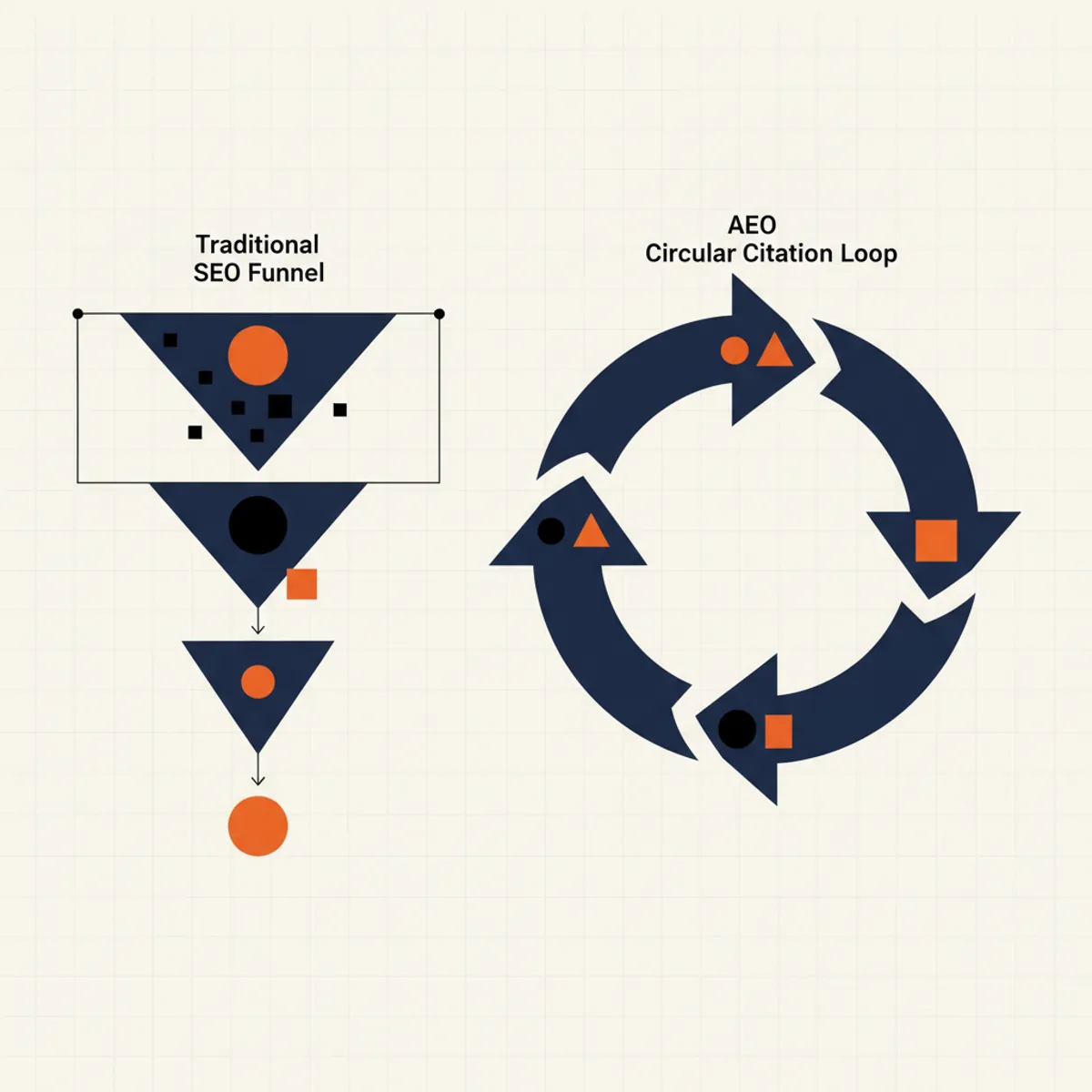
Comparison: SEO vs. AEO Strategy
| Feature | Traditional SEO | Answer Engine Optimization (AEO) |
|---|---|---|
| Primary Goal | High ranking in SERPs | Direct citation in AI responses |
| Content Format | Long-form, keyword-optimized | Structured, Q&A, factual snippets |
| Success Metric | Click-through rate (CTR) | Citation frequency & Sentiment |
| Technical Core | Crawlability & Site Speed | Schema Markup & Entity Mapping |
| User Intent | Browsing / Researching | Specific Problem Solving |
| Key Platforms | Google, Bing | Perplexity, ChatGPT, Gemini, Claude |
Advanced Tactics: Beyond the Basics
Once the foundation is set, sophisticated AEO involves deep technical work to ensure your data is the most "attractive" to the weights and biases of LLMs.
1. Semantic Density Optimization
Traditional SEO often uses "stop words" and filler content to meet word count requirements. AEO rewards semantic density—the amount of factual information per paragraph. To optimize for this, audit your top-performing pages and strip away any fluff. If a sentence doesn't provide a new data point or a necessary clarification, it is diluting your semantic weight.
2. Conversational Bridging
AI engines are predictive. They guess the next most likely word in a sequence. By using "conversational bridging"—phrasing your content in a way that naturally mirrors how people ask follow-up questions—you can influence the AI's next step. If your content naturally leads into a second common question, the AI is more likely to keep your site as the primary source for the entire "session."
3. API-First Content Delivery
The most advanced form of AEO involves making your data available via public-facing APIs or highly structured feeds. When an AI developer builds a "plugin" or an "action" for an engine like ChatGPT, they look for clean data sources. By becoming an open data source in your niche, you ensure your brand is baked into the very tools users are employing to find answers.
Common Pitfalls to Avoid
Investing in AEO doesn't mean just writing more content. It means writing smarter content. Many businesses fail by bringing old SEO habits into the AEO space.
- Keyword Stuffing: AI engines are semantic, not linguistic. They understand the concept of your writing. Forcing keywords makes your content harder for the AI to parse and summarize.
- Ignoring Factuality: If you publish incorrect data, AI engines will quickly identify the discrepancy and blackball your site from their knowledge base. Accuracy is a ranking factor.
- Failing to Update: Static content dies in AEO. AI models favor fresh data, especially for industries that move quickly like tech or finance.
- Neglecting the User Experience: While you are optimizing for AI, the final output is read by a human. If the AI summarizes your site and the user clicks through to a broken or confusing page, the conversion will never happen.
For a deeper look at these traps, read our full breakdown of common-aeo-mistakes.
Case Study: B2B SaaS Transition
A mid-market CRM provider was seeing a 15% year-over-year decline in organic search traffic. Their traditional SEO strategy—producing four 1,500-word blog posts a month—was no longer capturing the top-of-funnel leads they needed.
We shifted their strategy to AEO. We restructured their existing content into "Direct Answer Hubs" and implemented comprehensive Product and FAQ schema across their site.
The Results after 6 months:
- Citations in Perplexity: Increased from 0 to 42 for core industry queries.
- Google SGE Visibility: Featured in 28% of target keyword generative summaries.
- Conversion Rate: While total traffic remained flat, the quality of traffic improved, leading to a 22% increase in demo sign-ups.
- Brand Sentiment: AI-generated summaries shifted from citing generic competitors to citing the client as the "best value for mid-sized manufacturers."
This proves that AEO isn't just about traffic volume; it is about being the chosen answer when the buyer is ready to act. You can learn more about the nuances of this process in our guide on how-to-do-answer-engine-optimization-aeo.
Industry-Specific AEO Examples
How AEO manifests depends heavily on your sector. Let’s look at how specific industries apply these tactics.
B2B Manufacturing
A manufacturer of HVAC components shifted from writing "The History of HVAC" to "The exact BTU requirements for Class A office spaces in humid climates." By focusing on high-intent data points, they became the cited source for Perplexity's calculations. Their "Answer Tables" were directly scraped and credited in over 200 technical summaries per month.
Healthcare & Legal
In "Your Money or Your Life" (YMYL) industries, AEO relies heavily on "Authoritas" (Authority). We helped a legal firm implement Person schema for every attorney, linking to their published bar credentials and specific case wins. When users asked ChatGPT for legal implications of new labor laws, the AI cited the firm not just because they had an article, but because the AI recognized the author as a verified expert entity.
E-commerce
A luxury skincare brand moved away from lifestyle blogging and toward "Ingredient Intelligence." They created a structured database of every ingredient, its clinical purpose, and its interaction with other chemicals. When users asked Gemini, "Can I use retinol with vitamin C?", the brand's factual database provided the answer, leading to a direct product recommendation citation in the AI response.
The AEO Toolkit: What You Need to Start
To compete in this space, you need a new stack of tools. You cannot measure AEO success with a 2015 mindset.
- Entity Research Tools: Use tools like Google's Knowledge Graph Search API to see how your brand is currently indexed.
- Schema Generators: Beyond basic plugins, use advanced JSON-LD generators that allow for complex entity nesting.
- LLM Testing Suites: Manually prompt ChatGPT, Claude, and Perplexity with your target queries weekly to track citation trends.
- Semantic Analysis Software: Tools that help you identify the "semantic gaps" between your content and what the AI engines are looking for.
Measuring AEO Success: The Metrics That Matter
Because AEO often happens in a "black box," you need to look at proxy metrics to determine if your investment is paying off. Do not rely solely on traditional analytics.
- Citation Share: What percentage of generative responses for your keywords mention your brand? This is the new "Share of Voice."
- Sentiment Score: How does the AI describe your brand? Is it positive, neutral, or outdated? Use sentiment analysis tools to monitor how AI summarizes your reputation.
- Referral Traffic from AI Search: Monitor traffic from domains like
perplexity.aiorchatgpt.comin your referral reports. These users often have much higher time-on-page metrics. - Direct Search Volume: As AEO builds brand authority, you should see an increase in users searching for your brand name directly. This indicates that the AI has successfully built "mental availability" in the user's mind.
For a comprehensive checklist, refer to our guide on measuring-aeo-success-metrics.
The Verdict: The Cost of Inaction
The question is not whether a business should invest in AEO, but how quickly they can pivot. The first-mover advantage in AEO is substantial. Once an AI engine establishes your brand as the definitive source for a specific answer, it becomes increasingly difficult for a competitor to dislodge you. The model has already "learned" that you are the authority.
Conversely, every day you wait is a day the LLMs are training on your competitors' data. The gap between the AEO-optimized and the laggards is widening. In a few years, "un-optimizing" for an AI's bias will be far more expensive than building the foundation correctly today.
Traditional search isn't dying, but its dominance is fading. The brands that will lead the next decade are the ones that realize they are no longer in the business of getting "clicks"—they are in the business of providing the definitive answer.
We are witnessing the most significant change in information retrieval since the launch of the Google algorithm in 1998. The brands that survive this transition will be those that stop trying to rank and start trying to answer.
Ready to see where your brand stands in the age of AI search? Contact us for a strategic consultation or request a free-aeo-audit to begin your transition to the future of digital visibility. Explore our full range of services to see how we can help you dominate the answer engines.
Frequently asked questions
What is the main difference between SEO and AEO?+
SEO focuses on ranking pages in a list of blue links to drive clicks to a website. AEO focuses on providing structured, authoritative data that LLMs can digest and present as a direct answer. While SEO prioritizes keywords and backlinks, AEO prioritizes factual accuracy, entity relationships, and conversational relevance.
How long does it take to see results from AEO investment?+
AEO results often manifest faster than traditional SEO because AI engines crawl and update their knowledge bases frequently. You might see your brand cited in Perplexity or Gemini within weeks of implementing robust schema and FAQ structures, whereas traditional domain authority building can take six to twelve months.
Is AEO only for large enterprise brands?+
No. Small and medium businesses actually have a significant advantage in AEO. Because AI engines value specific, niche expertise and local accuracy, a well-optimized SMB can often outrank a generic enterprise competitor by providing clearer, more structured answers to specific long-tail customer queries.
Will AEO cannibalize my website traffic?+
While AI engines aim to provide answers without clicks, being the cited source is the new form of brand impressions. Users often click through to verify details or complete a transaction. AEO ensures that when a user does click, they are clicking on your link rather than a competitor's.
Does AEO require a completely new content team?+
Not necessarily. It requires a shift in how your current team produces content. Instead of writing long-form fluff, they need to focus on data-rich, structured formats, clear Q&A sections, and technical precision. It is an evolution of your existing content strategy rather than a total replacement.
Which AI platforms should I optimize for first?+
Start with Perplexity and Google Gemini. Perplexity functions most like a search engine and relies heavily on real-time web citations. Gemini is integrated into the Google ecosystem, making it critical for maintaining your existing search footprint. ChatGPT (via Search) is the third priority for broad consumer reach.
Sources & further reading
Soft next step
Want to see where AI answers mention you — and where they don't?
We run a free AEO audit across ChatGPT, Gemini, Copilot and Perplexity, then hand you the fixes in priority order. Start your AEO strategy today.
Keep reading
AEO Fundamentals
AEO vs GEO vs SEO: Which One Drives More Revenue in 2026?AEO Fundamentals
The Strategic Benefits of AEO: Dominate AI Search in 2026AI Platforms
How Generative Engine Optimization Works: A 2026 Guide to AEO