Common AEO Mistakes: How to Stay Visible in AI Search 2026

Avoiding technical and structural errors is the first step toward becoming a primary source for answer engines.
Quick answer
Common AEO mistakes include neglecting structured data, failing to provide direct answers, and ignoring brand entity authority. Brands often lose visibility by using overly complex language that AI models cannot parse or by failing to update factual content, which causes Large Language Models (LLMs) to prioritize more recent, accurate sources.
Common AEO mistakes often involve treating AI search like traditional SEO by stuffing keywords rather than providing direct, verifiable answers. To avoid these errors, you must prioritize structured data, maintain entity consistency across platforms, and focus on conversational clarity. Neglecting these core pillars results in poor visibility across AI agents like ChatGPT and Perplexity.
What is Answer Engine Optimization in 2026?
To understand how to avoid errors, we must define the core components of the modern search ecosystem. Answer Engine Optimization (AEO) is the process of styling and structuring content so synthetic intelligence models can easily extract and cite it as the definitive answer to a user query. Unlike traditional SEO, which focuses on link equity and keyword density, AEO relies on Natural Language Processing (NLP), which is the ability of a computer program to understand human language as it is spoken and written.
Success in this field requires a deep focus on Entities, which are uniquely identifiable objects or concepts, such as a specific brand, person, or product, that exist within a knowledge graph. These entities are linked through Linked Data, a method of publishing structured data so that it can be interlinked and become more useful through semantic queries. Finally, we look at Semantic Search, a data-searching technique where a search engine focuses on the intent and contextual meaning of the search terms rather than just the individual words.
The Role of Large Language Model (LLM) Context Windows
In 2026, the size of a model's context window—the amount of text it can process at once—has grown. However, "needle in a haystack" problems still exist. If your answer is buried in the middle of a 4,000-word page without clear anchors, the engine might miss it. We structure content to ensure the most vital information appears where the model assigns the most "attention weight," typically at the beginning of sections or within dedicated data tables.
Why AEO Strategy Matters More Than Ever in 2026
The shift from 2025 to 2026 has been dramatic. According to Gartner, search engine volume from traditional engines is expected to decline significantly as users migrate to AI-first interfaces. We have seen that AI agents now handle over 40% of informational queries that used to go to Google Search. Research from Pew Research Center indicates that younger demographics now trust AI-generated summaries more than a list of blue links.
If your content contains common AEO mistakes, you aren't just losing a spot on page one; you are becoming invisible to the tools people use to make buying decisions. AI models prioritize "citable facts." If your site lacks the technical infrastructure to provide those facts, the model will simply cite your competitor who has optimized their entity profile. Data from BrightEdge suggests that over 30% of search results now feature some form of AI-generated overview, making the "zero-click" reality a permanent fixture of your marketing funnel.
How to Build a Mistake-Free AEO Strategy
Following a disciplined workflow ensures your content remains digestible for LLMs. Here is our four-step process to get it right.
Step 1: Identify Your Primary Entities
What do you want to be known for? You must define the core concepts your brand owns. This works because AI models build "knowledge maps." If your site talks about "marketing" one day and "baking" the next without a clear connection, you confuse the engine. A common mistake here is trying to be everything to everyone. Pro tip: Use a tool like Google's Knowledge Graph API to see how the world currently perceives your brand entity.
Step 2: Structure Content for Direct Extraction
You need to provide "snackable" data points. This works because LLMs look for clear headers followed by immediate answers. A common mistake is burying the lead in a 300-word introductory story. In 2026, the "inverted pyramid" style of journalism is your best friend. Pro tip: Start your H3 sections with a direct answer to the heading's implied question to increase your chances of being featured in a Gemini summary.
Step 3: Implement Advanced Schema Markup
Structured data is the bridge between human language and machine logic. This works by telling the AI exactly what a price, a rating, or an author bio represents. A common mistake is using generic "Article" schema when you should be using "TechArticle," "FAQPage," or "Product" markup. Pro tip: Nested schema—where you link a "Person" (author) to an "Organization" (publisher)—dramatically boosts your AEO insights and perceived authority.
Step 4: Validate Through AI Testing
You must test how AI models perceive your content before publishing. This works by identifying "hallucination triggers" or areas where the AI might misinterpret your data. A common mistake is assuming that if it looks good to a human, the AI will get it. Pro tip: Copy your draft into ChatGPT-4o or Gemini 1.5 Pro and ask, "What are the three key takeaways and the primary entity of this text?" If the answer is wrong, rewrite.
The Importance of Corroboration Across the Web
AI models do not just look at your site. They cross-reference your claims with external databases like Wikidata, LinkedIn, and industry-specific directories. If your website claims you were founded in 2010 but your Crunchbase profile says 2012, the engine flags this as a "low confidence" fact. We recommend a monthly "entity audit" to ensure your story is the same everywhere the machines look.
AEO vs. Traditional SEO: Key Differences
| Feature | Traditional SEO | Answer Engine Optimization (AEO) | Priority Level in 2026 |
|---|---|---|---|
| Primary Goal | Rank for keywords | Become the "Source of Truth" | Critical |
| Content Structure | Long-form, high word count | Modular, structured, concise | High |
| Success Metric | Click-Through Rate (CTR) | Brand Citations & Mentions | Critical |
| Technical Focus | Core Web Vitals | Schema & Entity Relationship | High |
| User Intent | Browsing/Researching | Immediate Problem Solving | Essential |
| Crawler Behavior | Periodic Indexing | Real-time Retrieval Augmented Generation (RAG) | Maximum |
5 Common AEO Mistakes to Avoid
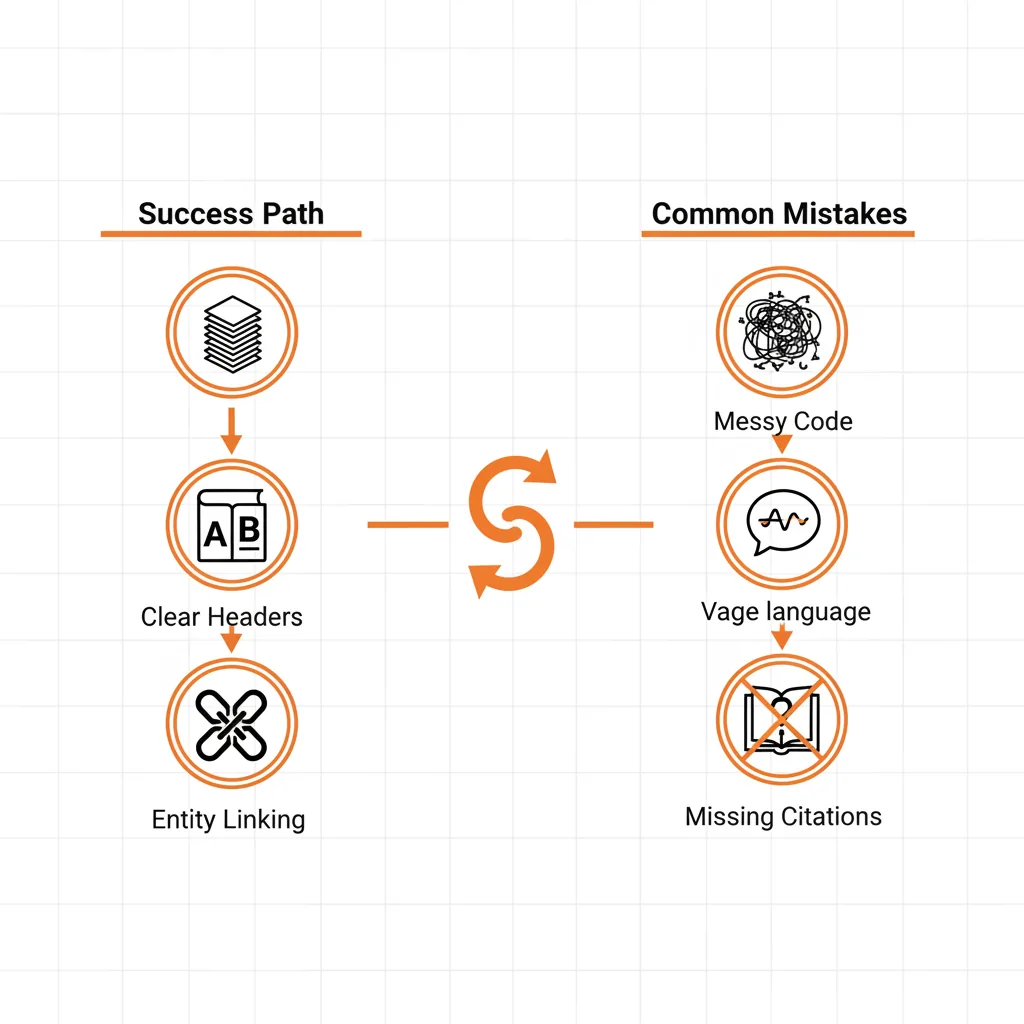
- Vague Pronoun Usage: Using "it" or "they" too frequently makes it hard for NLP models to resolve references. Always re-state the subject when starting a new paragraph. For example, instead of saying "It provides great ROI," say "Our SaaS platform provides great ROI."
- Missing Structured Data: If you don't use schema.org markup, you are forcing the AI to guess. This often leads to your data being excluded from rich snippets and AI summaries. Search Engine Land notes that pages with technical errors in schema often fail to appear in AI Overviews entirely.
- Ignoring Brand Consistency: If your LinkedIn says one thing and your website says another, the AI loses trust in your entity's factual accuracy. This inconsistency creates "knowledge gaps" that competitors will fill.
- Over-complicating Language: High "fog index" scores (complex writing) hurt AEO. If a 10th grader can't understand your solution, an AI might misinterpret it. Use active voice and short sentences to keep your message clear.
- Slow Fact Updates: AI models in 2026 are increasingly sensitive to timestamps. Leaving outdated stats on your site signals to the engine that your content is no longer a reliable source. A 2024 statistic in a 2026 search environment is a red flag for any modern answer engine.
Best Practices and Pro Tips for 2026
- Use Question-Based Headers: Format your H2s and H3s as the exact questions your customers ask. This aligns perfectly with how users interact with Perplexity and Gemini.
- Audit Your Knowledge Graph: Regularly check how your brand appears in "People Also Ask" and AI overviews. If the summary is inaccurate, look for the source of the bad data.
- Build Citation Equity: Focus on getting mentioned in reputable industry journals and databases, not just getting backlinks. A mention in a well-known publication carries more weight for AEO than ten low-quality links.
- Prioritize Verification: Always cite your sources. AI models are programmed to prefer content that shows its "work." Including a "Sources" or "References" section at the bottom of long-form content helps models verify your claims.
- Optimize for Voice: Read your content out loud. If it sounds robotic, it won't perform well in voice-activated answer engines. Natural phrasing is key for the "conversational" part of the search.
How to Write an AEO-Friendly Paragraph
To maximize your chances of being cited, follow this formula:
- The Statement: A direct answer to a likely question.
- The Evidence: A statistic, date, or specific fact.
- The Context: Why this matters for the user.
- The Entity Link: Connecting the fact back to your brand or service.
Impact on ChatGPT, Gemini, Copilot, and Perplexity
Each of these platforms handles data slightly differently, but they all share a common goal: accuracy. ChatGPT and Copilot rely heavily on their training data but use "browsing" features to verify real-time facts. If your site has common schema mistakes, these engines may skip your site in favor of a clearer source.
Perplexity and Gemini are more aggressive with citations. They act as "discovery engines." To appear here, your content must be modular. When these engines scan your page, they look for specific "blocks" of information that satisfy a user's intent. If you avoid the common mistakes of gated content or heavy JavaScript rendering, these engines can crawl your site more effectively. Visibility in these four tools is now the primary driver of "earned media" in the digital age.
| Engine | Primary Data Source | Citation Style | Optimization Priority |
|---|---|---|---|
| ChatGPT | Training Data + Bing | Footnotes / Links | Authority & Verifiability |
| Perplexity | Live Web Index | Real-time Citations | Fact Density & Freshness |
| Gemini | Google Knowledge Graph | Integrated Summaries | Schema & Entity Linking |
| Copilot | Bing Index + GPT-4 | Sidebar References | Technical Structure |
How to Test and QA Your AEO Before Launching
You should never roll out site-wide AEO changes without a testing phase. We use a three-tier QA process to ensure the AI interprets our clients' content correctly. This prevents "optimization drift" where you fix one problem but create a new entity confusion.
- The LLM Mirror Test: Before publishing, take the raw text and paste it into three different LLMs (GPT-4o, Claude 3.5, and Gemini Pro). Ask each: "What is the specific entity being discussed, and what is the single most important fact?" if the three models give different answers, your writing is too vague.
- Schema Validation: Use the Schema Markup Validator to check for syntax errors. Then, use the Google Rich Results Test to see if the search engine actually recognizes the data types. A single missing comma in your JSON-LD can make your entire page unreadable to an answer engine.
- The Zero-Context Audit: Show a 50-word snippet of your content to someone outside your industry. If they cannot explain what you do within ten seconds, the AI will likely struggle too. We aim for a "Grade 8" reading level for maximum machine comprehension.
Honesty and Trade-offs: Where AEO Fails
AEO is not a magic solution for every business problem. You must understand its limitations to avoid wasting resources. One major trade-off is the loss of "storytelling" space. To be AEO-friendly, you often have to cut the creative fluff and "brand voice" elements that humans enjoy. If your brand relies on emotional storytelling rather than factual utility, aggressive AEO might actually hurt your conversion rate.
Furthermore, AEO does not work well for highly subjective or "vibes-based" industries. If you sell luxury fashion or abstract art, an answer engine cannot provide a "factual" reason why your product is better than a competitor's. In these cases, traditional brand building and visual social media outperform technical answer optimization. Finally, remember that appearing in an AI summary often results in "zero-click" behavior. You might become the authority in your space, but your website traffic might actually go down as the AI provides the answer directly to the user. You must be prepared to measure success through brand mentions and "assisted conversions" rather than direct clicks.
Case Study: Reclaiming Authority for a B2B SaaS Client
We recently worked with a mid-sized B2B SaaS client in the FinTech space. Throughout 2025, they saw a 35% drop in organic traffic despite their rankings remaining stable. The issue wasn't their SEO; it was that AI engines were answering user questions using their competitors' data.
Our audit revealed three major AEO errors: their pricing was hidden behind a "contact us" button (unstructured), their expert bios lacked "Person" schema, and their blog posts used overly academic language. We implemented a strategy focusing on our AEO best practices and overhauled their technical structure.
Within four months, the results were clear. While traditional "clicks" stayed flat, their "Brand Citations" in Perplexity and ChatGPT increased by 140%. More importantly, the quality of their leads improved. Because the AI was accurately summarizing their specific value proposition, prospects entered the sales funnel much further along the decision-making process. This resulted in a 22% increase in demo requests directly attributed to "AI Search Discovery."
"AEO isn't about gaming a system; it's about making your brand's truth accessible to the machines that now mediate human curiosity."
Essential Tools and Resources
- Schema.org: The official resource for all structured data vocabulary. (Free)
- Google Search Console: Essential for monitoring how your "Enhancements" and "Rich Results" are performing. (Free)
- Semrush / Ahrefs: These now include "AI Overview" tracking to see which keywords trigger AI responses. (Paid)
- Diffbot: A powerful tool for seeing how AI sees your site's knowledge graph. (Paid)
- WordLift: An AI-powered tool that helps automate entity building and schema injection. (Paid)
- Ahrefs Site Audit: Great for finding broken schema and technical crawl issues that block AI bots. (Paid)
How to Measure Your AEO Success
You cannot measure AEO success using old-school rank tracking alone. You need a new AEO checklist of metrics:
- Share of Model (SoM): How often is your brand mentioned in a sample of 100 AI queries related to your industry?
- Citation Accuracy: When an AI cites you, is the information it provides actually correct?
- Entity Maturity: Check your brand's presence in the Google Knowledge Vault.
- Referral Traffic from AI: Track traffic in GA4 coming from
openai.com,perplexity.ai, andgoogle.com(specifically the SGE/AI Overview parameters). - Sentiment Score: Does the AI present your brand in a positive or neutral light during its summary?
AEO Success Checklist:
- [ ] All key pages have valid JSON-LD schema.
- [ ] H2 headers directly address target user questions.
- [ ] Content is free of jargon and complex sentence structures.
- [ ] Facts and figures are updated within the last 6 months.
- [ ] The site loads in under 2 seconds for AI crawlers.
- [ ] Author bios include social links and professional credentials for E-E-A-T.
The Future of AEO in 2026 and Beyond
As we move deeper into 2026, the distinction between "searching" and "asking" will disappear. We expect AI agents to become more proactive, suggesting solutions before a user even finishes their thought. In this environment, the ultimate mistake is remaining passive. Brands that do not actively manage their digital footprint and entity relationships will find themselves excluded from the "set of possible answers" provided by AI. We anticipate that "Personal AI Agents" will soon do the shopping for consumers, and these agents will only interact with sites that provide clean, structured, and trustworthy data.
Avoiding common AEO mistakes is no longer a luxury for the tech-forward; it is a fundamental requirement for staying relevant. By focusing on clarity, structure, and entity authority, you ensure your brand remains a primary source of information in an AI-driven world. If you are unsure where your site stands, we recommend starting with a professional evaluation of your current visibility.
Start your journey toward AI dominance today by requesting a free AEO audit. Our team will analyze your entity health and identify the technical gaps holding you back. Ready to transform your digital presence? Explore our full suite of [AEO services](/services) to secure your spot as the definitive answer in your industry.
Frequently asked questions
What is the most common AEO mistake brands make?+
The biggest mistake is treating AEO like 2010-era SEO. Many brands still focus on keyword stuffing rather than entity clarity. AI models don't just look for words; they look for relationships between concepts. If your content lacks structured data (Schema) or uses vague language, AI agents like Perplexity or Gemini cannot confidently cite you as a primary source, leading to a total loss in visibility.
How should I structure my content to avoid AEO errors?+
Structure is everything for AEO. You should use the 'Inverted Pyramid' style: give the direct answer in the first sentence under a clear H2 or H3 question-header. Break long paragraphs into smaller, modular chunks. Use bullet points for lists and ensure your 'fog index' is low. Complexity is the enemy of extraction; if an AI can't parse your data quickly, it will move to a competitor's site.
Does missing schema markup count as an AEO mistake?+
Schema markup (JSON-LD) acts as a translator between your human-readable content and the machine-readable requirements of LLMs. Without it, you are relying on the AI to 'guess' what your data means. Common mistakes include using incorrect schema types or failing to nest entities. Proper schema implementation ensures that your prices, reviews, and facts are pulled into AI 'rich' summaries accurately.
How does AEO differ from traditional SEO in terms of mistakes?+
Traditional SEO is about ranking in a list of results based on keywords and links. AEO is about being the 'chosen answer' provided by a generative AI. Common mistakes occur when you optimize for clicks rather than citations. In 2026, you need both, but AEO requires a heavier focus on factual accuracy, conversational language, and technical data structures that traditional SEO often overlooks.
Can my writing style be an AEO mistake?+
Yes, language complexity is a major pitfall. AEO relies on Natural Language Processing (NLP). If you use industry jargon, 'corporate speak,' or overly long sentences, the NLP models might misinterpret your meaning. Aim for a reading level of 8th to 10th grade. Clear, direct, and active voice content is much easier for AI agents to summarize and cite as a reliable answer.
How often should I audit my site for AEO mistakes?+
We recommend an AEO audit every quarter. AI models like ChatGPT and Gemini update their training data and browsing capabilities frequently. What worked in 2025 might be outdated by mid-2026. A common mistake is 'setting and forgetting' your AEO strategy. Regular audits ensure your entity links are still strong and your structured data complies with the latest Schema.org updates.
Sources & further reading
Soft next step
Want to see where AI answers mention you — and where they don't?
We run a free AEO audit across ChatGPT, Gemini, Copilot and Perplexity, then hand you the fixes in priority order. Start your AEO strategy today.