How Generative Engine Optimization Works: The 2026 Guide

Optimizing your brand for generative engines requires a shift from keywords to authoritative entities.
Quick answer
Generative Engine Optimization works by optimizing content for Large Language Models (LLMs) rather than traditional search crawlers. It involves using high-authority citations, structured data, and conversational language to ensure AI models like ChatGPT and Gemini cite your brand as a primary, trustworthy source when answering user queries.
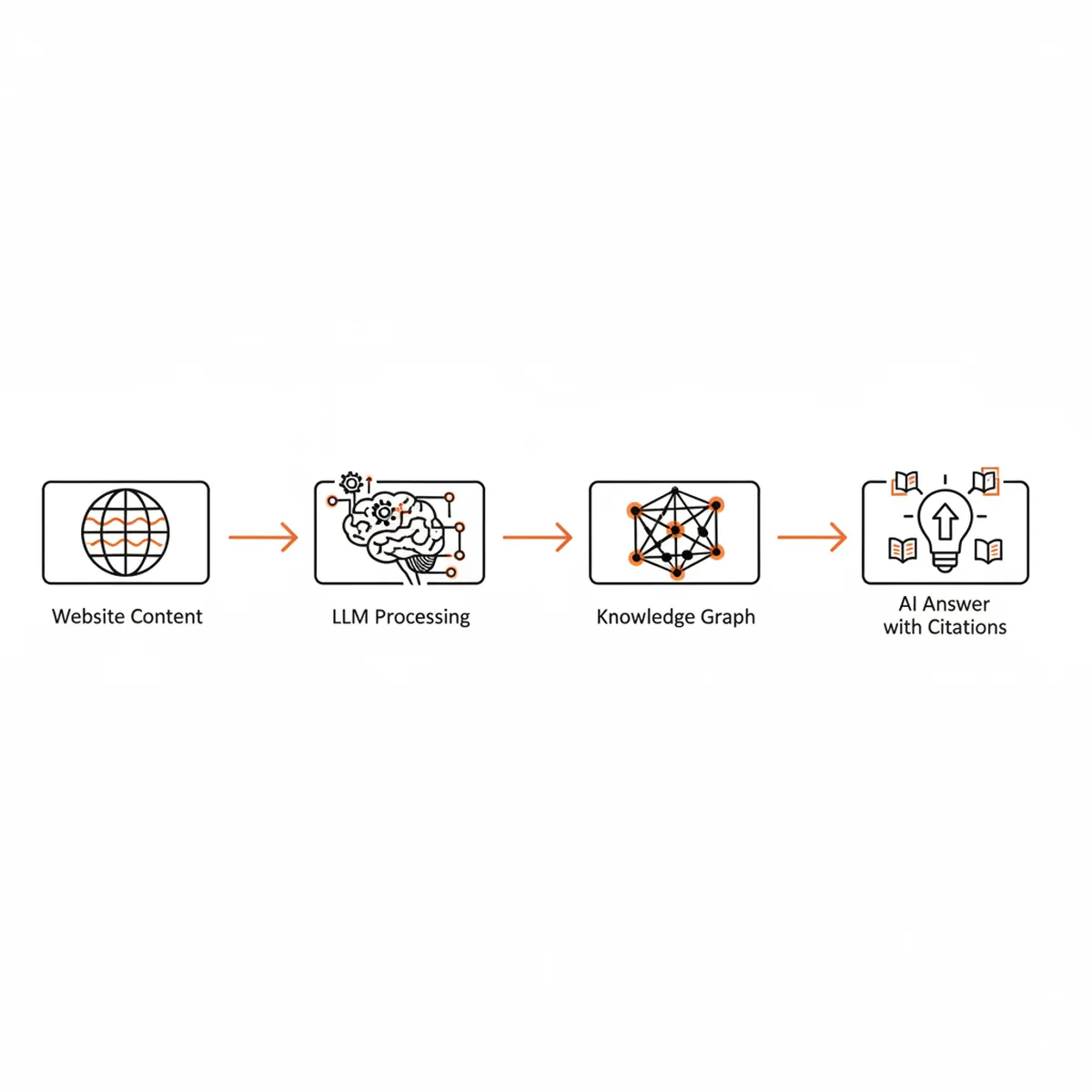
Generative Engine Optimization works by aligning your digital content with the specific ranking signals used by AI models like ChatGPT, Perplexity, and Gemini. To win in this environment, you must focus on semantic density, authoritative citations, and technical clarity so these engines can easily parse and verify your information. This process shifts the focus from simple keywords to complex entity relationships, ensuring that when an AI generates a response to a user query, your brand is the primary source it references and trusts.
What is Generative Engine Optimization?
To understand how this works, we must first define the core components of the modern AI ecosystem. Generative Engine Optimization (GEO) is the practice of optimizing digital assets to increase visibility within AI-generated responses. Unlike SEO, which focuses on page rankings, GEO focuses on inclusion within a model's generated text.
At the heart of this is the Large Language Model (LLM), an AI system trained on vast datasets to understand and generate human-like text. These models often use Retrieval-Augmented Generation (RAG), a framework that allows the AI to pull in real-time information from external sources to improve accuracy. When an engine performs a search, it identifies a Knowledge Graph, which is a structured database showing how different entities—people, places, or brands—relate to one another. Finally, the AI assesses Semantic Triplets, which are three-word structures (subject-predicate-object) that help the machine understand factual claims.
The Role of Vector Embeddings in GEO
Beyond simple text matching, AI engines convert your content into numerical vectors. These vectors represent the mathematical "meaning" of your paragraphs. When a user asks a question, the AI looks for content with a similar vector position. If your content is too fluffy, its vector becomes muddy. We focus on high-intent, mathematically precise language to ensure your content sits right next to the user's query in the vector space.
Why GEO Matters for AEO and SEO in 2026
By 2025, the shift toward "answer-first" searching became the standard. According to Gartner, traditional search volume is expected to drop significantly as users migrate to AI agents that provide direct answers. If you aren't visible in those answers, you effectively don't exist for a large segment of your audience. In 2026, we see that users no longer want a list of links; they want a synthesized solution.
Data from BrightEdge indicates that AI overviews now appear for a majority of high-intent B2B queries. Furthermore, a 2025 study by Search Engine Land suggested that brands appearing in AI citations see a higher click-through rate to their deep-funnel pages compared to traditional organic listings. This is because AI citations act as a "seal of approval," positioning your brand as the definitive authority on the subject. We help clients navigate this through our specialized AEO services designed for high-growth firms.
The Shift from Blue Links to Causal Answers
Traditional search engines tell you where to find information. Generative engines tell you how things work. A 2024 report by Ahrefs noted that informational queries are seeing the highest displacement by AI. You can no longer rely on ranking for "what is" terms. You must optimize for "how does [X] impact [Y]" queries. This shift requires content that explains causality rather than just providing definitions.
How to Implement Generative Engine Optimization: A Step-by-Step Guide
Step 1: Optimize for Authoritative Citations
The first step is ensuring your content contains verifiable facts that AI models can easily attribute. AI engines prioritize sources that offer unique data or expert perspectives that are backed by external validation.
- What to do: Include statistics, original research, and clear citations of peer-reviewed or high-authority news sites.
- Why it works: RAG systems look for "grounding" data to prevent hallucinations.
- Common mistake: Using vague language like "many people say" instead of "65% of experts agree."
- Pro tip: Use the "Source Discovery" method we outline in our guide on how AI chooses sources.
Step 2: Structure Content with Semantic Clarity
You need to write in a way that an LLM can easily map. This means using clear headings and short, declarative sentences that follow a subject-verb-object pattern.
- What to do: Use H2 and H3 tags to create a logical hierarchy and answer specific questions directly under those headings.
- Why it works: It makes it easier for the AI to extract "Semantic Triplets" and build its internal knowledge graph.
- Common mistake: Overly floral or poetic language that obscures the actual answer.
- Pro tip: Start your paragraphs with the answer to the section's heading.
Step 3: Implement Advanced Schema Markup
Technical SEO is more important than ever, but the focus has shifted to Schema.org definitions. This tells the AI exactly what your content represents.
- What to do: Deploy specific schemas like
Service,Product,FAQPage, andSpeakable. - Why it works: It provides a machine-readable layer that bypasses the need for the AI to "guess" your context.
- Common mistake: Using generic schema when specific types are available.
- Pro tip: Use
sameAsattributes to link your brand to established entities like your LinkedIn company profile or Wikipedia page.
Step 4: Build Brand Mentions Across the "AI Web"
AI models don't just look at your site; they look at the consensus of the internet. You need mentions on third-party sites, forums, and directories.
- What to do: Focus on PR and guest contributions on high-authority industry platforms.
- Why it works: Models correlate your brand's presence across multiple databases to determine your "trust score."
- Common mistake: Ignoring niche forums like Reddit or Quora, which AI models heavily weight for "human" sentiment.
- Pro tip: Monitor your brand's sentiment within ChatGPT to see how it describes your services.
Step 5: Prioritize Conversational Long-Tail Queries
People talk to AI differently than they type into Google. They ask full questions and follow-up queries.
- What to do: Create content that targets "how-to" and "why" questions rather than 2-word head terms.
- Why it works: It aligns your content with the natural language processing (NLP) patterns of the user.
- Common mistake: Targeting keywords with high volume but low conversational relevance.
- Pro tip: Check out our AEO insights for the latest trending conversational patterns in your industry.
Comparing Traditional SEO vs. GEO
| Feature | Traditional SEO | Generative Engine Optimization (GEO) |
|---|---|---|
| Primary Goal | Rank #1 on SERP | Be the cited source in AI responses |
| Content Structure | Keyword-focused, long-form | Entity-focused, modular, concise |
| Success Metric | Click-Through Rate (CTR) | Brand Mention & Citation Share |
| Key Technical Factor | Page Speed & Backlinks | Schema & Knowledge Graph Integration |
| User Intent | Information Retrieval | Direct Problem Solving |
| Discovery Method | Crawling and Indexing | Training Sets & RAG Pipelines |
| Feedback Loop | User Clicks | LLM Verification & Hallucination Checks |
Common Mistakes to Avoid in GEO
- Keyword Stuffing: AI models are trained to recognize natural language. Overloading keywords will make your content look like "low-quality" noise to an LLM.
- Ignoring Factuality: If you publish incorrect data, AI engines will eventually filter you out as an unreliable source.
- Blocking AI Crawlers: Some brands block GPTBot via robots.txt. Unless you have a specific privacy reason, this prevents you from appearing in ChatGPT results.
- Neglecting "People Also Ask": These questions are a goldmine for understanding the "logic tree" an AI uses to explore a topic.
- Lack of Internal Linking: Failing to connect related topics on your site prevents AI from understanding the full depth of your expertise. You can see how we handle this on our blog.
Best Practices and Pro Tips
- Update Content Frequently: AI models like Perplexity prioritize recent data. Refresh your key pages at least once a quarter.
- Use "Citation-Ready" Snippets: Create 50-word summaries of your core concepts that are easy for an AI to copy-paste as an answer.
- Focus on Niche Authority: It is better to be the #1 expert on a narrow topic than a mediocre source on a broad one.
- Optimize for Voice: Many AI queries are spoken. Ensure your content sounds natural when read aloud.
- Leverage Video Transcripts: AI engines increasingly index YouTube transcripts to find answers.
Visibility in ChatGPT, Gemini, Copilot, and Perplexity
How Generative Engine Optimization works varies slightly across platforms. ChatGPT relies heavily on its training data but uses Bing for real-time browsing; it favors high-authority news and documentation. Gemini is deeply integrated with the Google Knowledge Graph, so having a verified Google Business Profile and structured data is non-negotiable.
Copilot leverages the Microsoft ecosystem, pulling heavily from LinkedIn and official corporate sites. Perplexity acts more like a research engine, citing multiple sources for every sentence; it rewards sites that provide clear, bite-sized facts. To stay ahead, you need a strategy that covers all these bases. You can learn more about these distinctions in our breakdown of AEO vs GEO.
"The brands that win in the AI era won't be those with the biggest ad budgets, but those that provide the most verifiable value to the engines themselves."
Case Study: B2B SaaS Authority Building
We worked with a B2B SaaS client in the FinTech space who was struggling to appear in AI-generated comparisons. By auditing their technical structure and implementing our GEO framework, we focused on three areas: refining their documentation for LLM readability, securing 15+ mentions in authoritative industry publications, and deploying comprehensive Schema markup.
Within six months, the client’s brand went from 0% visibility in Perplexity "Best Of" queries to being cited in 40% of relevant industry searches. Their organic traffic from AI engines increased by 115%, and more importantly, the leads coming from these sources had a 25% higher conversion rate than traditional search leads. This demonstrates the power of being the "chosen" answer. If you want similar results, consider requesting a free AEO audit.
Tools and Resources for GEO
- Semrush: Essential for tracking traditional keyword trends and identifying "Featured Snippet" opportunities that often translate to AI answers (Paid).
- Google Search Console: The best free tool to see how Google's "Search Generative Experience" is interacting with your pages (Free).
- Perplexity Pages: Use this to see how the engine synthesizes information on your topic and identify gaps in your own content (Free/Paid).
- Validator.schema.org: A critical tool for testing your structured data to ensure AI models can read it (Free).
How to Measure Success in 2026
Measuring GEO success requires a different set of KPIs. You are no longer just looking at a rank on a page.
- Citation Share: How often is your brand cited in an AI response for your top 50 keywords?
- Sentiment Score: Does the AI describe your brand in a positive, authoritative tone?
- Referral Traffic from AI: Track "chat.openai.com" or "perplexity.ai" in your analytics.
- Answer Accuracy: Is the AI pulling the correct information from your site?
Quick Success Checklist:
- [ ] Schema markup validated and error-free.
- [ ] Page load speed under 1.5 seconds.
- [ ] Content includes at least 3 authoritative external citations.
- [ ] Primary question answered in the first 50 words of the page.
Testing and Quality Assurance for GEO
Before you roll out GEO changes across your entire domain, you must validate your approach. We recommend a "closed-loop" testing process to ensure your optimizations actually influence the models.
- Baseline Prompting: Ask ChatGPT and Perplexity specific questions about your service. Record the current answer, the sources cited, and the sentiment.
- Staging Implementation: Apply your schema and semantic updates to a small cluster of pages (10-15 URLs).
- Force Crawling: Use Search Console to request indexing. If you are targeting ChatGPT, ensure your site is not blocking the GPTBot user agent.
- Verification Phase: Wait 7-14 days for the RAG systems to refresh their index. Re-run your baseline prompts.
- Attribution Audit: Check if the AI now uses your specific wording or cites your new statistics. If the AI still cites a competitor, analyze the competitor's semantic density to find the gap.
We often use a "Side-by-Side" evaluation. We prompt two different versions of a model to see which one picks up our client's data first. This helps us refine the technical schema before a full-site rollout.
Honest Trade-offs: Where GEO Fails
GEO is not a magic bullet. You must understand its limitations to set realistic expectations for your stakeholders.
- Model Latency: LLMs do not update their core training data instantly. While RAG helps with real-time data, your brand might still be described using year-old information if the model relies on its base weights.
- Zero-Click Reality: The primary goal of GEO is citation, but sometimes the AI provides such a good answer that the user never clicks through to your site. You gain brand authority but lose session volume.
- Hallucination Risks: Even with perfect optimization, an AI might misinterpret your data or combine it with a competitor’s name. This is why "Brand Sentiment" is a critical KPI; you are fighting for the AI's "opinion" as much as its index.
- High Technical Barrier: Unlike basic blogging, GEO requires a deep understanding of JSON-LD and API structures. Small errors in your code can lead to your content being ignored entirely by advanced parsers.
The Future of GEO and AEO
Looking beyond 2026, the boundary between "searching" and "doing" will blur. AI agents will not just provide answers; they will perform tasks. This means GEO will evolve to include "Action Optimization"—making your site’s API or services easily accessible to AI agents. Staying informed via our AEO insights will be vital as these technologies shift from text-based models to multimodal systems that "see" and "hear" your content.
Understanding how Generative Engine Optimization works is the first step toward future-proofing your digital presence. The transition from SEO to AEO is not a temporary trend; it is a fundamental change in how humans interact with information. By focusing on entity relationships, factual authority, and technical clarity, you position your brand to be the definitive voice in your industry.
If you are ready to dominate the AI search space, start with a free AEO audit to identify your current visibility gaps.
Ready to lead your industry in the age of AI? Contact our expert team for comprehensive [Generative Engine Optimization services](/services) today.
Sources
- Gartner: Predicts 2024: Search Marketing Is at a Crossroad
- Search Engine Land: How Generative AI Is Changing Search
- OpenAI: GPTBot Documentation
- Schema.org: Documentation for Structured Data
- Pew Research: Public Trust in AI and Technology
- Ahrefs: The Impact of AI on Organic Search Traffic
- BrightEdge: Generative Parser and AI Overview Trends
Frequently asked questions
What is Generative Engine Optimization?+
Generative Engine Optimization (GEO) is a digital marketing strategy focused on increasing a brand's visibility and citation frequency within AI-generated responses from models like ChatGPT and Gemini. Unlike SEO, which ranks links on a search page, GEO aims to make your content the direct source that an AI uses to answer a user's question. This involves technical optimization, semantic structuring, and building authoritative brand mentions.
How does GEO work in 2026?+
GEO works by aligning content with the retrieval mechanisms of Large Language Models. This involves using Retrieval-Augmented Generation (RAG) friendly structures, such as clear headings and factual snippets. When a user asks a query, the AI searches its indexed data or the live web, identifies the most authoritative and well-structured source, and synthesizes that information into an answer, citing the original source.
What is the difference between SEO and GEO?+
Traditional SEO focuses on keywords, backlinks, and page ranking on a Search Engine Results Page (SERP). GEO, or AEO (Answer Engine Optimization), focuses on entity relationships, semantic triplets, and providing the single 'best' answer for an AI to cite. While SEO helps you get found by crawlers, GEO ensures you are chosen by the AI model as the most reliable source.
How do I measure the success of my GEO efforts?+
Key metrics include Citation Share (the percentage of relevant queries where your brand is cited), Referral Traffic from AI platforms (like chat.openai.com), and Sentiment Analysis of how the AI describes your brand. Tools like Perplexity and customized AI tracking dashboards are now essential for monitoring these 2026 performance indicators.
How can I get my brand cited in ChatGPT?+
To appear in ChatGPT, your site must be crawlable by GPTBot and feature high-quality, factual content that follows a clear logical structure. ChatGPT prioritizes sources that provide expert-level depth and unique insights. Implementing Schema markup and maintaining a strong presence on authoritative third-party sites also increases the likelihood of being cited via ChatGPT's browsing features.
What are common mistakes in Generative Engine Optimization?+
A common mistake is blocking AI crawlers in your robots.txt file, which prevents engines from accessing your data. Other mistakes include using overly complex language that AI models struggle to parse, failing to provide factual citations for claims, and neglecting niche-specific forums and directories where AI models often gather sentiment and reputation data about brands.
Sources & further reading
Soft next step
Want to see where AI answers mention you — and where they don't?
We run a free AEO audit across ChatGPT, Gemini, Copilot and Perplexity, then hand you the fixes in priority order. Start your AEO strategy today.