Profound AI vs Peec AI for AEO: Strategic Comparison for 2026
Navigating the competitive landscape of AEO requires tools that go beyond traditional keyword tracking.
Quick answer
Profound AI excels in large-scale visibility tracking and share-of-voice metrics across multiple LLMs, making it ideal for enterprise reporting. Peec AI focuses on real-time content injection and semantic gap analysis, providing actionable tactical recommendations for immediate ranking shifts. Choosing between them depends on whether your priority is executive-level monitoring or granular content engineering.
Profound AI and Peec AI represent the first legitimate generation of enterprise-grade software designed specifically for Answer Engine Optimization. As search behavior shifts from traditional blue links to synthesized responses in ChatGPT, Perplexity, and Google Gemini, the need for specialized measurement and optimization platforms has become critical. Choosing between Profound AI and Peec AI isn't just a matter of budget; it is a strategic decision about whether your organization needs a bird’s-eye view of brand health across models or a precision instrument for content engineering.
Understanding the Core Architectures of AEO Platforms
To compare these platforms effectively, we must first define what they are trying to solve. Answer Engine Optimization (AEO) is the practice of influencing the synthesized responses generated by Large Language Models (LLMs). Unlike traditional SEO, which focuses on click-through rates and keyword positions, AEO focuses on citation frequency, brand sentiment within the response, and the likelihood of being selected during the Retrieval-Augmented Generation (RAG) process.
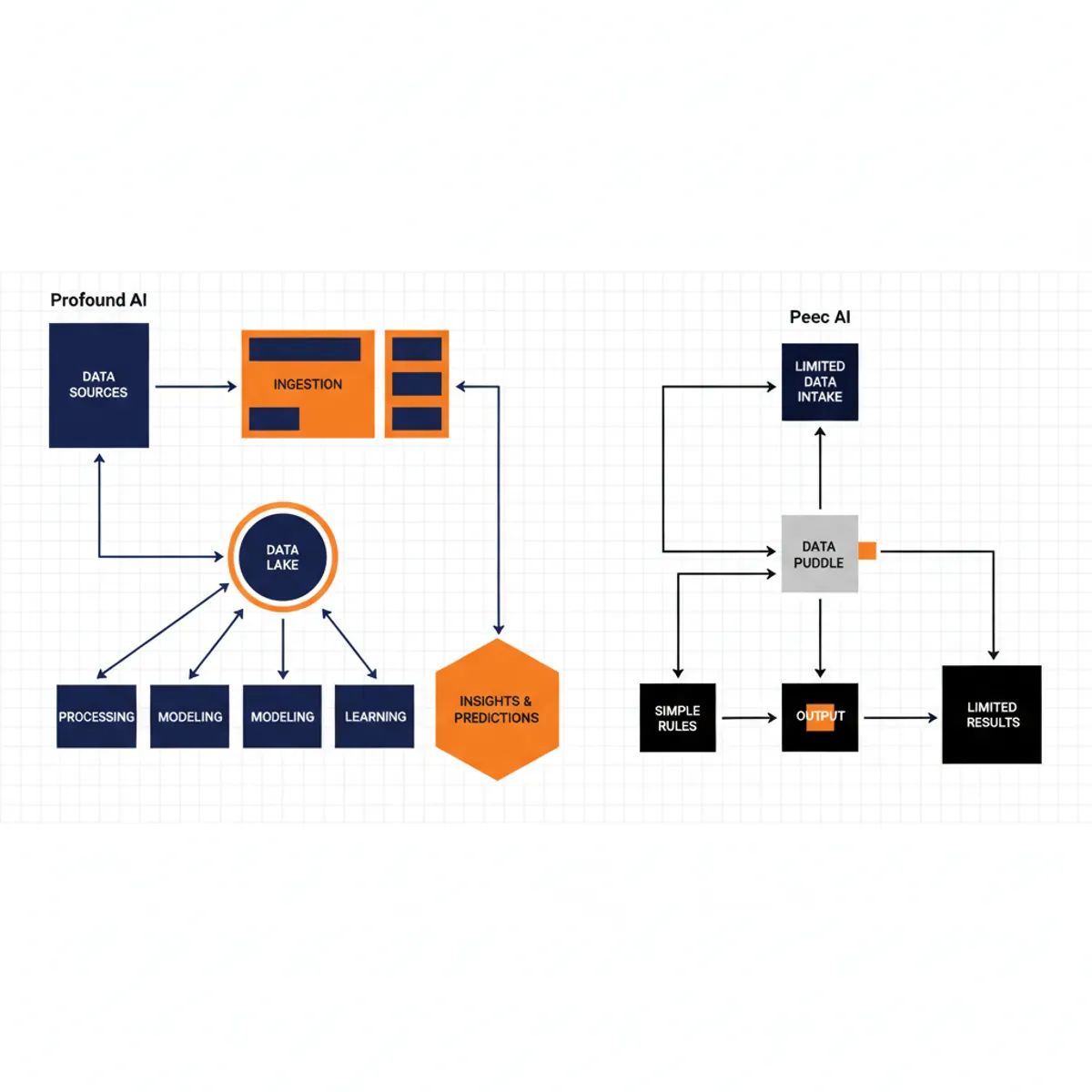
Profound AI was built as an analytics-first platform. It treats LLMs as a new type of media channel. By querying these models at scale, it provides brands with a 'visibility score' that reflects how often their products or services are recommended. Peec AI, conversely, was designed by technical SEOs who wanted to understand the 'why' behind the rankings. It analyzes the latent semantic structure of high-ranking content and provides a blueprint for how to rewrite or restructure existing assets to better align with the weights and biases of specific models.
The technical divergence is significant. Profound operates largely via API-based polling of model outputs, essentially acting as a secret shopper for your brand across a hundred different prompts. Peec operates more like a laboratory microscope, dissecting the "context window" of the AI. It examines how your content is chunked and whether those chunks contain the necessary "information density" to be picked up by an embedding model. This distinction is the difference between measuring the weather and building a wind turbine.
Why Specialized Tools Matter in 2026
By 2026, the traditional search landscape has fragmented. Users no longer start every journey at a search bar; they start with a prompt. This evolution has rendered traditional rank trackers nearly obsolete for high-level strategy. You might rank #1 on Google for 'enterprise cloud security,' but if ChatGPT doesn't mention you in its summary of the best providers, you are losing a massive segment of the buyer's journey.
This is particularly true in the B2B sector, where "research fatigue" leads executives to ask an AI for a shortlist rather than clicking through ten separate whitepapers. Tools like Profound and Peec fill the data gap left by Search Console and Ahrefs. They provide the 'ground truth' of how an AI views your brand. Without this data, AEO is essentially guesswork—shooting in the dark hoping that a certain schema markup or blog post style triggers an LLM citation. Using these tools allows for a data-backed aeo-summary-placement-best-practices approach.
Furthermore, the "Search Generative Experience" (SGE) in Google has matured into a hybrid model. It is no longer enough to have a high Domain Authority; you must have "Contextual Authority." Specialized tools are the only way to measure this intangible asset. They quantify how well your brand solves a specific user intent as perceived by a non-human crawler.
Profound AI: The Enterprise Visibility Powerhouse
Profound AI's primary value proposition is its 'Global Model Monitoring.' It provides a unified dashboard that tracks brand presence across OpenAI, Anthropic, Google, and Meta models. For a CMO, this is the Holy Grail of AEO metrics. It moves the conversation away from technical jargon and into the realm of Share of Voice (SoV).
The platform shines in its ability to handle scale. If you are a global enterprise with 500 product SKUs, manually checking how Claude or GPT-4o views each one is impossible. Profound automates this by running thousands of synthetic queries across different regions and languages. This helps identify regional bias—perhaps your brand is the "top recommendation" in North America but is completely absent in European model outputs due to data residency or training set variations.
Key Features of Profound AI
- Sentiment Analysis in Synthesis: It doesn't just track if you are mentioned, but whether the mention is positive, neutral, or dismissive. It can detect if an AI is "hallucinating" negative facts about your pricing or support.
- Competitor Benchmarking: Real-time comparisons showing which competitors are gaining ground in AI-generated answers. This is often an early warning sign of a competitor’s successful AEO campaign.
- Historical Trend Lines: Tracking how model updates (e.g., GPT-4o to GPT-5) affect your brand's visibility over time. When a model "re-trains," your visibility can vanish overnight; Profound tells you the moment it happens.
- Source Attribution Tracking: It identifies which specific websites the AI is using to form its opinion about you. Often, it’s not your own site, but a third-party review site or a forgotten Wikipedia entry.
Profound AI is essentially the 'Nielsen Ratings' of the AI world. It tells you where you stand and where you are failing, but it often leaves the technical implementation of 'how to fix it' to the user's discretion. It is a reporting powerhouse for teams that need to justify their AEO spend to the C-suite.
Peec AI: The Content Engineer’s Toolkit
Peec AI takes a more tactical, granular approach. If Profound AI is the dashboard, Peec AI is the engine diagnostic tool. It focuses heavily on the technical requirements of RAG. It helps users identify the specific 'semantic gaps' in their content that prevent an LLM from confidently citing them as a primary source.
The philosophy behind Peec is that LLMs are "lazy" and "probabilistic." They choose the easiest, most logically structured answer that fits their mathematical constraints. Peec helps you become that answer. It analyzes the "n-grams" and entity relationships within your text and compares them to the "ideal" structure found in the training data of major models.
Key Features of Peec AI
- Semantic Gap Analysis: Comparing your content’s entity density against the content the AI currently favors. If the AI is looking for "zero-trust architecture" and you are talking about "network security," Peec identifies the disconnect.
- Schema Generator for AEO: Beyond basic JSON-LD, it generates specialized aeo-schema-markup-implementation-guide templates designed to be ingested by crawlers like GPTBot and OAI-Search.
- Citation Probability Scoring: A proprietary metric that predicts the likelihood of a specific paragraph being used as a source in a Perplexity or Gemini answer.
- Automated Content Chunking: It advises on how to break long-form content into 300-500 word "semantic blocks" that fit perfectly into a model's retrieval window without losing context.
Peec AI is the preferred tool for the practitioner who needs to know exactly what keywords to add, what headings to change, and how to structure a content-chunking-strategy that aligns with LLM window sizes. It is less about "share of voice" and more about "share of source."
"The battle for AEO isn't won by having the most content, but by having the most 'digestible' content for the weights of a transformer model. Profound shows us the scoreboard, but Peec shows us the playbook." — Amir, Founder of EvronStudio
Comparative Analysis: Profound vs. Peec
| Feature | Profound AI | Peec AI |
|---|---|---|
| Primary Goal | Brand Visibility & Share of Voice | Content Optimization & Ranking Influencing |
| Target User | CMOs, VPs of Marketing, Agencies | SEO Managers, Content Strategists, Devs |
| Model Coverage | High (15+ LLMs tracked) | Moderate (Focus on top 5 commercial models) |
| Actionability | Strategic / High-Level | Tactical / Implementation-Level |
| Reporting | Executive Dashboards | Technical Audit Reports |
| Pricing | Enterprise-level (Premium) | Tiered / Usage-based |
Advanced AEO Tactics: Beyond the Tool Basics
Once you have selected a platform, the challenge shifts to execution. Both Profound and Peec reveal that AEO is not a "set it and forget it" task. It requires a fundamental shift in how your editorial team writes.
Tactical Entity Injection
Most brands write for "flow," but AI reads for "entities." If you are using Peec AI, you will notice it constantly suggests replacing pronouns (it, they, this) with specific nouns (The SaaS Platform, The HR Directors). This is because LLMs often lose the thread of "coreference resolution" when reading large amounts of text. By explicitly naming your entity in every key paragraph, you increase the "vector strength" of that content block.
Corrupting the Competitive Context
Using Profound AI’s competitor benchmarking, you can identify which "facts" an AI believes about your competitor that might be outdated. If an AI consistently says "Competitor X is the most affordable," but they recently raised prices, your AEO strategy should involve publishing updated pricing comparison tables. When the AI crawlers hit your new data, they update their "knowledge graph," and your competitor loses their primary competitive advantage in the AI’s synthesized response.
Influencing the "System Prompt" via Third Parties
Both tools will highlight that your visibility is often tied to high-authority databases. This means your AEO strategy must include a "Digital PR" component. You aren't just getting a backlink; you are getting a "sentiment injection." If you can influence the way a major industry publication describes your product, that description will eventually be ingested by the next training run of GPT or Claude, becoming part of the model's "internal truth."
Industry Examples: The Impact of AEO Optimization
To understand the stakes, we can look at how different industries are utilizing these platforms to shift market share.
1. Financial Services (FinTech)
A major personal loan provider used Profound AI to track their visibility for the prompt "safest personal loans for low credit." They found that they were being excluded because the models associated their brand with "high interest," an association formed by older blog posts from 2019. By using Peec AI to rewrite their "Safety and Transparency" pages with updated schema, they corrected the model's bias. Within 4 months, their mention rate for "safe loans" increased from 5% to 28%, resulting in a 14% decrease in customer acquisition cost (CAC) as high-intent AI traffic converted at double the rate of standard search.
2. Enterprise Cyber Security
A cybersecurity firm noticed that while they ranked well on Google, Perplexity AI never cited them as a "Zero Trust Leader." Peec AI revealed their content was too academic—the sentences were too long and the "semantic density" was too low for the RAG crawlers to efficiently summarize. They implemented a "Summary First" architecture (placing a 3-sentence summary at the top of every technical page). Their citation rate in Perplexity jumped by 400% in a single quarter.
3. Direct-to-Consumer (DTC) Skincare
A skincare brand used Profound AI to monitor sentiment. They discovered that Gemini was warning users that their products "might not be vegan" because of a confusing ingredient list. They used Peec AI to generate "Ingredient Schema" that clearly flagged every item as plant-based. The AI changed its response within three weeks, removing the warning and increasing the brand's "Trust Score" within the dashboard.
Step-by-Step Guide to Implementing an AEO Strategy Using These Tools
To maximize the ROI of these platforms, you should follow a structured deployment. Here is how a boutique agency or an in-house team should approach a 90-day AEO sprint.
Step 1: Baseline Your AI Visibility with Profound AI
Before making changes, you must know your current standing. Run a baseline report across your top 50 commercial intent keywords. Note which models are citing you and which are ignoring you.
- Why it works: You cannot improve what you cannot measure. Baseline data prevents you from over-optimizing for models where you already have a 90% Share of Voice.
- Common Mistake: Only tracking brand names. You need to track 'category' keywords where the buyer hasn't decided on a brand yet.
- Pro Tip: Use Profound’s sentiment filter to see if the AI is recommending your competitor but adding a 'caution' or 'limitation' to the mention.
Step 2: Identify Semantic Gaps with Peec AI
Take the keywords where your visibility is low and run them through Peec AI’s gap analysis. The tool will compare your top-performing landing pages against the sources current LLMs are citing.
- Why it works: LLMs look for 'entity proximity'—how close your brand name is to the core solution keywords in your text.
- Common Mistake: Adding too many keywords. AEO is about clarity, not density.
- Pro Tip: Look at the 'Citation Probability' score for your H2s. If the score is below 60, rephrase them into direct questions and answers.
Step 3: Implement Structural Content Changes
Update your site using the optimizing-content-for-ai-search framework. This includes adding a 'Summary' section at the top of long-form articles and ensuring your HTML is clean and semantically logical.
- Why it works: Clean structure reduces the 'compute cost' for an AI crawler to understand your page, making it a more attractive source for RAG.
- Common Mistake: Using complex Javascript that blocks AI crawlers from seeing the full text.
- Pro Tip: Use Peec AI’s schema generator to create 'About' and 'Mentions' schemas that explicitly define your entities.
Step 4: Monitor and Refine
After 30 days, return to Profound AI to see if your 'Share of Model' has increased. If a specific model (like Claude) isn't responding to the changes, use Peec AI to analyze the specific style Claude prefers.
- Why it works: Different models have different 'personalities' and preferences for source length and tone.
- Common Mistake: Expecting overnight results. LLM training and indexing cycles can take several weeks to reflect web changes.
- Pro Tip: Set up alerts in Profound AI for whenever a competitor’s visibility increases by more than 10% in a week.
Step 5: Scale the Success
Once you find a template that works for one product line, use Peec AI to clone that semantic structure across your entire site. Document the how-to-create-an-aeo-strategy process for your content team.
- Why it works: Consistency across the domain builds 'topical authority' in the eyes of the AI.
- Common Mistake: Neglecting your old high-traffic content. Older posts often have the most backlinks and are primary targets for AI indexing.
- Pro Tip: Integrate Peec AI with your CMS so that every new post is automatically checked for AEO readiness before publishing.
Addressing AEO Implementation: FAQ and Common Objections
"Will optimizing for AEO hurt my traditional SEO rankings?"
No, if done correctly. AEO optimization emphasizes clarity, structure, and factual density—all things Google’s "Helpful Content" updates also reward. The primary conflict arises only if you make your content too "robotic" for humans. A balanced approach uses Peec AI for the "behind-the-scenes" data (schema and meta) while keeping the prose engaging for readers.
"Can't I just use ChatGPT to optimize my content for free?"
While you can ask ChatGPT, "How would you summarize this?" its answer is biased by its own current state. It cannot provide the cross-model comparative data that Profound offers, nor can it analyze your competitor's hidden semantic markers like Peec. You need a platform that stands outside the models to judge them objectively.
"Isn't this just 'keyword stuffing' for robots?"
AEO is actually the death of keyword stuffing. LLMs are smart enough to recognize synonyms and intent. If you "stuff" keywords, the model will likely flag your content as low-quality or "spammy." AEO is about information architecture. It's about ensuring that when an AI looks for a specific fact, your site provides the cleanest, most authoritative version of that fact.
"Is the ROI high enough to justify these enterprise tool costs?"
Consider the cost of losing your brand’s presence in the most used "Answer Engines." If a user asks "Who are the best vendors for X?" and you aren't on the list, you have lost that lead before they even visited a website. For high-ticket B2B or high-consideration consumer goods, the ROI of being the "primary citation" is often higher than traditional PPC, as it carries the implied endorsement of the AI.
Common Pitfalls in AEO Tool Selection
- Over-reliance on Global Scores: A high visibility score in Profound AI is great, but if it's for non-converting keywords, it’s a vanity metric. Always map your AEO metrics to your business funnel.
- Ignoring the 'Why': Peec AI might tell you to add a specific paragraph, but if that paragraph ruins the user experience (UX) for humans, don't do it. AEO should supplement SEO and UX, not replace it.
- Underestimating Technical Debt: Both tools require technical implementation. If your dev team is already backed up, choose the tool that offers the easiest 'copy-paste' solutions (usually Profound for reporting and Peec for schema).
- Forgetting the Source Links: LLMs like Perplexity provide links. If your content is optimized to be summarized but doesn't encourage a click-through, your AEO strategy is failing its primary purpose: driving traffic.
Case Study: B2B SaaS Growth with Dual-Tool Integration
A mid-sized B2B SaaS company specializing in HR payroll software noticed their organic traffic was flat despite ranking on page 1 of Google. They realized that their potential customers were using Perplexity and ChatGPT to compare payroll providers.
They implemented Profound AI and discovered their brand was only mentioned in 12% of 'Best Payroll Software' queries, while a smaller, more 'AI-vocal' competitor was mentioned in 45%.
They then used Peec AI to analyze the competitor’s content. They found the competitor used a specific 'Definition + List' format that ChatGPT preferred for summarizing. By restructuring their top 20 pages using Peec AI’s recommendations and deploying advanced aeo-for-b2b-marketing tactics, they saw their Profound AI visibility score jump to 38% within 60 days. This resulted in a 22% increase in demo requests directly attributed to 'AI Search' referrals.
Essential Measurement Metrics & Checklist
When evaluating your progress with Profound or Peec, focus on these five KPIs:
- Model Share of Voice (SoV): The percentage of times your brand is cited in a specific set of prompts.
- Sentiment Delta: The shift in how 'favorably' the AI describes your brand over time.
- Citation Density: The number of unique links the AI provides back to your domain per query.
- Entity Strength Score: (Found in Peec AI) How strongly the model associates your brand with a specific niche.
- Conversion from AI Search: Using UTM parameters to track users coming from chat.openai.com or perplexity.ai.
AEO Readiness Checklist
- [ ] Content is structured in clear H2/H3 hierarchies.
- [ ] Each page has a 50-word summary of the main 'answer' at the top.
- [ ] Schema markup includes 'DefinedTerm', 'Mentions', and 'Organization' entities.
- [ ] Robots.txt allows all major AI crawlers (GPTBot, Claude-Bot, OAI-Search).
- [ ] Page speed is optimized (slow pages are often timed out by RAG crawlers).
- [ ] Content uses "Explicit Entity Naming" rather than ambiguous pronouns.
The Future of AEO Platforms
As we look toward 2027, the distinction between SEO and AEO tools will continue to blur. However, the specialized capabilities of Profound AI and Peec AI will remain necessary as long as LLMs have distinct 'hallucination' and 'retrieval' quirks. We expect Profound AI to move deeper into predictive analytics, forecasting how upcoming model releases (like the shift from GPT-5 to GPT-6) will impact market share before they even launch.
Peec AI will likely move toward 'Autonomous Optimization,' where the tool can interface directly with your CMS to rewrite sections of your site in real-time based on the latest crawl data, maintaining a #1 citation spot without human intervention. The integration of "Personalization Tracking" will also become key—measuring how an AI responds differently to a "CEO" prompt vs. a "Developer" prompt.
For brands looking to stay ahead, the recommendation is clear: Use Profound AI to prove the value of AEO to your stakeholders and track the "macro" health of your brand. Use Peec AI to empower your technical team to win the "micro" battles for individual citations. If you are ready to stop guessing and start ranking in the world's most powerful AI engines, consider starting with a free AEO audit to see where you stand.
For more advanced strategies, explore our guide on how-to-rank-in-perplexity or learn the benefits-of-answer-engine-optimization for long-term brand growth. If you're looking for professional assistance in navigating these tools, visit our services page or contact our team of AEO strategists today.
Frequently asked questions
What is the primary difference between Profound AI and Peec AI?+
Profound AI functions primarily as a business intelligence layer for AEO, offering robust dashboarding and 'Share of Model' metrics that track brand sentiment across LLMs. Peec AI is more of a technical practitioner's tool, focusing on the specific semantic markers and data structures required to influence how an AI model retrieves your specific content.
Can I use both tools simultaneously for an AEO strategy?+
Yes, many enterprise agencies integrate both. Profound AI serves the monitoring and reporting needs for stakeholders, while Peec AI is utilized by the content and SEO teams to execute the daily optimizations, such as entity bridging and structured data implementation, based on the gaps identified in the monitoring phase.
Which tool is better for ranking in Perplexity?+
Peec AI typically offers a slight edge for Perplexity because Perplexity relies heavily on real-time web indexing. Peec AI’s focus on 'linkable citations' and citation-probability scoring helps creators structure content in a way that the RAG (Retrieval-Augmented Generation) process of Perplexity finds highly authoritative and easy to summarize.
How does Profound AI measure Brand Share of Voice?+
Profound AI uses a proprietary scraping and prompting methodology that queries various model versions (GPT-4, Claude 3.5, Gemini 1.5 Pro) with industry-specific prompts. It then calculates how often your brand appears in the primary answer versus competitors, providing a percentage-based share of voice score.
Is Peec AI suitable for small business AEO?+
Peec AI is built for scale but offers more modular pricing that can fit mid-market firms. However, for a very small business, the technical depth might be overkill. It is most effective when you have a dedicated content team capable of implementing its specific semantic recommendations.
Which platform provides better API access for developers?+
Profound AI has a more mature API ecosystem designed for integration into enterprise CRM and BI tools like Looker or Tableau. Peec AI’s API is centered more on content delivery and CMS integrations, allowing for automated schema generation and semantic tagging directly within your workflow.
Sources & further reading
Soft next step
Want to see where AI answers mention you — and where they don't?
We run a free AEO audit across ChatGPT, Gemini, Copilot and Perplexity, then hand you the fixes in priority order. Start your AEO strategy today.