AEO for B2B Marketing: The 2026 Guide to AI Visibility

Modern B2B marketing requires a shift from keywords to AI-ready structured data.
Quick answer
AEO for B2B marketing is the process of optimizing your brand’s data to be the primary source for AI engines like ChatGPT, Gemini, and Perplexity. It involves using structured data and authoritative content to ensure LLMs provide your solutions as the direct answer to complex B2B buyer queries.
AEO for B2B marketing is the strategic process of structuring your content and digital footprint to be the primary source cited by AI models and Answer Engines. By focusing on intent-based facts and machine-readable data, you ensure that when B2B buyers ask AI for software recommendations or strategy advice, your brand provides the definitive answer. In 2026, this shift is critical because executive decision-makers increasingly use AI agents to shortlist vendors before ever visiting a website. Successful B2B AEO requires a blend of technical schema, high-authority thought leadership, and a verifiable presence across the digital entities that AI models trust most.
Why AEO for B2B Marketing is Non-Negotiable in 2026
The search world moved fast after 2025. Last year, we saw a massive migration of top-of-funnel traffic away from traditional search results and toward conversational interfaces. According to Gartner, search engine volume for brands could drop significantly as consumers pivot to AI-powered search. For B2B companies, this means your potential clients are no longer scrolling through ten blue links; they are asking ChatGPT to "compare the top three cybersecurity platforms for mid-market manufacturing."
In this environment, Answer Engine Optimization (AEO)—the practice of optimizing for conversational AI—becomes your primary lead generation engine. Search Engine Optimization (SEO)—the process of improving site visibility in traditional search—still matters for mid-funnel research, but AEO captures the initial intent. We also focus on Entity-Based Search, which treats your brand as a unique object in a knowledge graph rather than just a collection of keywords. Finally, Natural Language Processing (NLP)—the way AI understands human speech—dictates how you must phrase your solutions to be understood by models.
Data from Search Engine Land suggests that AI overviews now appear for over 80% of B2B-related informational queries. If your content isn't formatted for these models, you are effectively invisible to the most qualified segment of your market. Research from BrightEdge confirms that B2B queries are increasingly triggering multi-modal AI responses, including tables and synthesized summaries.
The Rise of the "Synthetic Journey"
In the past, a buyer might click your blog, read three more pages, and download a whitepaper. Today, the "synthetic journey" happens entirely within the LLM interface. The AI reads your site, summarizes your value proposition, and compares it against your competitor’s pricing—all without a single hit to your analytics dashboard. To win, you must feed the machine. We see this daily in B2B SaaS where the "Consideration" phase of the funnel has moved from the browser to the prompt bar.
How to Implement AEO for B2B Marketing: A Step-by-Step Guide
Step 1: Identify Your Core Brand Entities
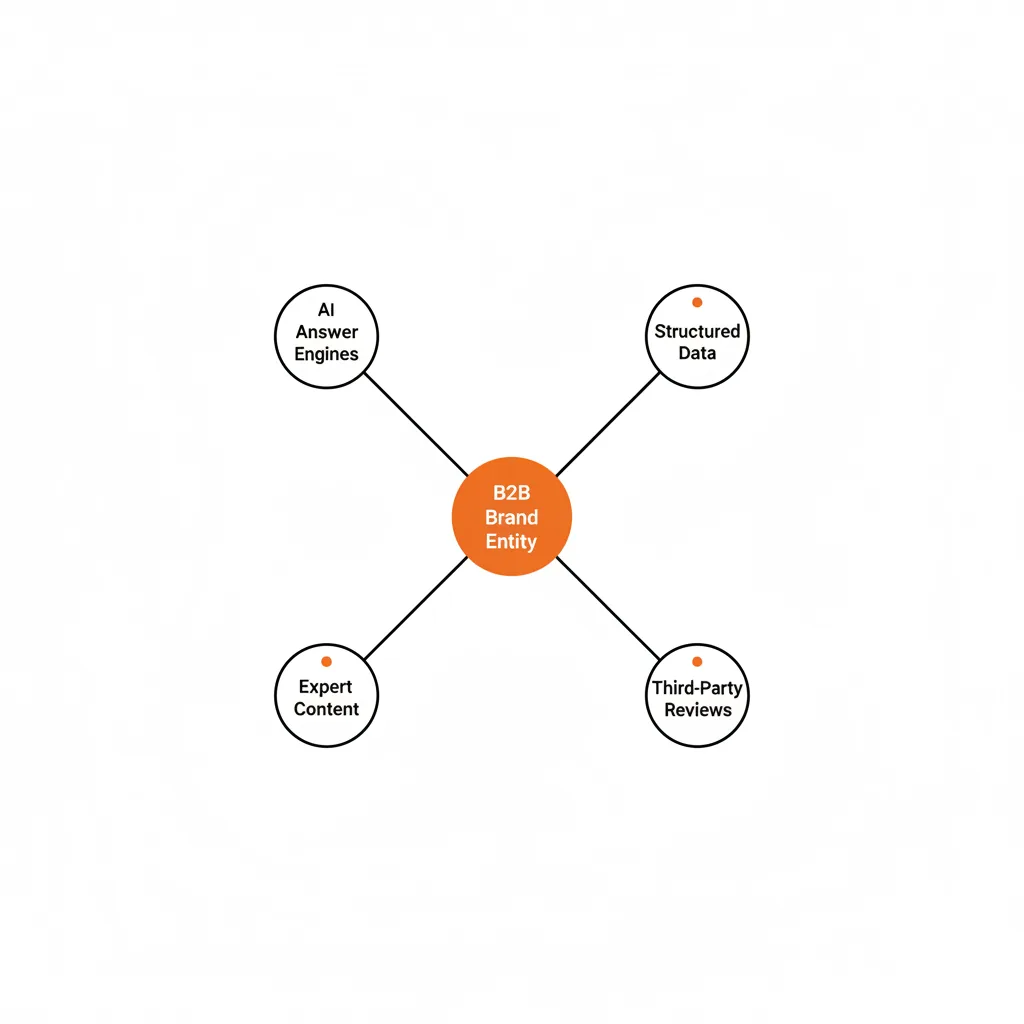
Before you can rank in an answer engine, the AI must know exactly who you are and what you do. Start by defining your brand, your key executives, and your core products as distinct entities. Use Schema.org markup to link these entities together in your site's code.
What to do: Create a dedicated "About" page and "Product" pages that use Organization and Product schema. Why it works: AI models like Gemini use these tags to build a "Knowledge Graph" of your business. Common mistake: Using generic descriptions that don't differentiate your service from competitors. Pro tip: Include your social media profiles and third-party review links in your sameAs schema properties to build cross-platform authority.
Specific Entity Procedure:
- Map your primary brand entity to a unique Wikidata ID if possible.
- Link your CEO’s Person schema to their verified LinkedIn and published guest posts.
- Define your "MainEntityOfPage" clearly in the JSON-LD of every service page.
- Ensure your physical address matches your Google Business Profile exactly.
Step 2: Structure Content in Question-Answer Formats
B2B buyers ask complex questions. To win the "answer box," your content must provide direct, concise answers followed by deep technical dives. This satisfies both the AI's need for a quick summary and the human's need for detail.
What to do: Audit your high-performing blogs and add "TL;DR" summaries at the top of every section. Why it works: LLMs are trained to look for high-information density at the beginning of paragraphs. Common mistake: Burying the answer at the bottom of a 2,000-word article to increase "time on page." Pro tip: Use H3 headers as specific questions (e.g., "How does [Product] integrate with Salesforce?") and start the first sentence of the following paragraph with the direct answer.
Step 3: Optimize for Third-Party Citations
AI models don't just trust your website; they look for consensus. They scan LinkedIn, G2, TrustRadius, and industry news sites to verify if your claims are true. If your brand is mentioned nowhere else, the AI will likely ignore your site as a source.
What to do: Launch a concerted PR and review acquisition campaign focused on niche B2B directories. Why it works: Models use "retrieval-augmented generation" (RAG) to pull data from multiple sources; more mentions equal higher confidence. Common mistake: Focusing only on your own blog while ignoring external brand mentions. Pro tip: When we develop an AEO strategy for businesses, we prioritize getting clients featured in "Best of" lists on high-authority industry sites.
Step 4: Enhance Technical "Readability" for Bots
Your site must be blazing fast and perfectly organized. If a bot struggles to crawl your site, it won't use you as a source. In 2026, this includes providing clean JSON-LD files that describe your pricing, features, and case studies.
What to do: Simplify your site architecture and remove heavy scripts that delay "First Contentful Paint." Why it works: Answer engines prioritize sources that provide clear, structured data without technical hurdles. Common mistake: Over-designing pages with interactive elements that hide text content from crawlers. Pro tip: Regularly test your pages using the Google Rich Results Test to ensure your markup is error-free.
The Role of Semantics in B2B Solutions
Answer engines use vector embeddings to understand how closely your content matches a user's intent. You cannot just repeat "B2B CRM software" ten times. You must use related terms like "sales pipeline management," "lead scoring automation," and "API integrations." This semantic richness helps the AI understand the depth of your expertise. When we optimize for B2B clients, we focus on the "Concept Density" rather than just keyword density.
AEO vs. Traditional SEO for B2B
| Feature | Traditional SEO | Answer Engine Optimization (AEO) |
|---|---|---|
| Primary Goal | Rank #1 in Google SERPs | Become the "Primary Source" for AI |
| Content Style | Long-form, keyword-optimized | Structured, factual, concise |
| Key Metric | Organic Traffic / Clicks | Brand Citations / AI Mentions |
| User Intent | Browsing and Researching | Direct Problem Solving |
| Tech Focus | Backlinks and Meta Tags | Schema and Entity Relations |
| Trust Signal | Domain Authority (DA) | Truthfulness and Consensus |
| Response Time | Days/Weeks to Index | Near Real-time (via RAG) |
Common Mistakes to Avoid in B2B AEO
- Ignoring the "Zero-Click" Reality: Many B2B marketers still optimize for clicks rather than impressions. In AEO, the goal is often to provide the answer within the AI interface to build brand authority, even if they don't click through immediately.
- Over-reliance on AI-Generated Content: If you use generic AI to write your AEO content, you end up in a "feedback loop" of mediocrity. AI engines prefer human-expert insights that offer new, proprietary data.
- Neglecting Structured Data: Failing to use JSON-LD schema is the fastest way to stay invisible to Copilot and Gemini. You must speak the machine's language.
- Weak Brand Narrative: If your brand doesn't have a clear "point of view," AI models will categorize you as a generic provider, reducing your chances of being recommended for specific, high-value problems.
- Failing to Monitor Mentions: Not knowing how AI models currently describe your brand is a major oversight. You should regularly check how Perplexity or ChatGPT summarizes your company.
- Vague Adjectives: Avoid words like "best," "innovative," or "cutting-edge" without proof. AI models look for specific attributes like "HIPAA-compliant" or "256-bit encryption."
Best Practices and Pro Tips
- Publish Original Research: AI models love statistics. By publishing original B2B industry surveys, you become a "statistical entity" that models cite frequently. Ahrefs notes that original data is one of the strongest drivers of passive link acquisition and AI citation.
- Use Active Voice: Write in a direct, authoritative tone. Avoid passive phrasing that makes it harder for NLP algorithms to identify the subject and action.
- Update "Dead" Content: B2B information changes. Ensure your technical specs and pricing are current, as AI engines are increasingly sensitive to date-stamps and fresh data.
- Invest in Video Transcripts: AI models now index video content. Providing clean, text-based transcripts of your webinars helps engines understand your expertise.
- Focus on "Niche" Keywords: Instead of trying to own "B2B Software," try to own "AI-driven supply chain forecasting for electronics." Specificity wins in the world of answer engines.
How AEO Affects Visibility in ChatGPT, Gemini, and Perplexity
In 2026, the "Big Four" AI engines—ChatGPT, Gemini, Copilot, and Perplexity—each have slightly different "tastes" for B2B content. ChatGPT (OpenAI) leans heavily on established web authority and recent news via search integrations. Gemini (Google) integrates deeply with your Google Business Profile and YouTube presence. Copilot (Microsoft) relies on the Bing index and is particularly powerful for B2B users working within the Office 365 ecosystem.
Perplexity acts as a hybrid, citing multiple sources for every sentence it generates. To be visible across all four, your B2B marketing must be consistent. If your website says one thing and your LinkedIn says another, these models will detect the inconsistency and lower your "truth score." We recommend a unified brand data strategy to ensure that no matter which engine a buyer uses, your value proposition remains clear and accurate. You can see more about this in our guide to measuring AEO success metrics.
The "Verifiability" Factor
Search engines used to look for backlinks. Answer engines look for verification. If Perplexity finds a fact on your site, it will cross-reference it with other B2B sources like Gartner, Forrester, or even specialized Reddit threads. If the data conflicts, the engine may exclude you to avoid "hallucinations." This is why maintaining a clean digital footprint across the web is no longer optional.
"The brands that win in 2026 won't be the ones with the most backlinks, but the ones that the most AI models trust to be factually accurate and contextually relevant."
Case Study: Scaling B2B Lead Quality via AEO
We worked with a B2B SaaS client in the HR technology space that was struggling with a 30% year-over-year decline in traditional organic search leads. Despite ranking for several high-volume keywords, their traffic wasn't converting because users were getting their initial questions answered by AI summaries before clicking.
Our team implemented a comprehensive AEO pivot. We restructured their entire resource center into an "Entity-First" knowledge base, adding specific schema for their white papers and webinars. We also focused on securing citations in three major industry publications that we knew the primary LLMs used as high-authority training sets.
Within six months, the results were clear. While traditional "organic clicks" only grew by 5%, their "Brand Mentions in AI Answers" increased by 240%. More importantly, the quality of their leads shifted. The sales team reported that prospects were entering the funnel already knowing the specific technical advantages of the platform—because the AI had already explained it to them. This led to a 15% reduction in the sales cycle length and a significant boost in ROI. This is why we advocate for specialized AEO for SaaS companies.
Tools and Resources for AEO
- WordLift: A powerful tool for automating schema markup and building a custom knowledge graph for your B2B site. (Paid)
- Perplexity.ai: Use this to search for your brand and see which sources the AI is currently citing. (Free/Paid)
- Google Search Console: Essential for monitoring how your structured data is being indexed and finding "Answer Box" opportunities. (Free)
- Schema App: A robust platform for managing complex schema deployments across large B2B enterprise sites. (Paid)
- Semrush: Useful for tracking "SERP Features" like AI Overviews and Featured Snippets. (Paid)
- Best Answer Engine Optimization Services Audit: Our proprietary tool for checking your AI visibility score. (Free via our free AEO audit page).
How to Measure AEO Success
Measuring AEO is different from traditional SEO tracking. You aren't just looking at a rank tracker; you are looking at "share of model."
- AI Citation Share: How often does an engine like Perplexity cite your domain vs. a competitor for a specific query?
- Sentiment Score: Is the AI describing your brand as a "leader," a "budget option," or "unreliable"?
- Conversational Click-Through Rate: The percentage of users who click the "Source" link in an AI response.
- Entity Health: Monitoring if your brand's knowledge panel is accurate and complete.
Monthly AEO Checklist:
- [ ] Verify schema integrity for all new product pages.
- [ ] Check ChatGPT/Gemini brand summaries for accuracy.
- [ ] Monitor for new "unlinked mentions" on industry sites.
- [ ] Update the "Frequently Asked Questions" section with new buyer queries.
Testing and QA: How to Validate Your AEO Deployment
Before rolling out site-wide changes, you must ensure your optimizations actually influence the models. AI engines have a "latency" period before they ingest new data, so testing requires patience and specific methods.
1. The Prompt Test (Perplexity/ChatGPT) Create a set of "control" prompts about your B2B service. Before you optimize a page, ask: "What are the best features of [Brand]?" and record the output. After updating your schema and content, wait 7-14 days for the index to refresh. Run the prompt again. Look for your new keywords or data points in the response.
2. Schema Validation Use the Google Rich Results tool, but don't stop there. Use a schema validator like the one from Schema.org to ensure your JSON-LD is syntactically perfect. Even a missing comma can prevent a bot from building the correct entity relationship.
3. Isolated Page Testing Select five low-traffic pages. Apply your AEO formatting: H3 questions, TL;DR summaries, and structured data. Monitor these pages for two weeks. If you see an increase in "Impressions" for long-tail queries in Google Search Console, your AEO structure is likely helping the bot parse the intent more effectively.
The Honest Trade-offs: Where AEO Fails
AEO is not a magic bullet. We believe in transparency, and there are situations where AEO will not yield the results you want.
Brand Dilution and Clicks The biggest drawback is the reduction in direct site traffic. If you provide the perfect answer, the user may never click through to your site. For B2B businesses that rely on pixel tracking and retargeting ads, this is a major hurdle. You are trading a website visitor for a "brand impression" in the mind of a user.
The Accuracy Barrier AI models can still hallucinate. Even if your site is perfectly optimized, a model might aggregate your data with a competitor’s and produce an inaccurate summary. You have less control over the final "output" than you do with a traditional webpage.
Resource Intensity True B2B AEO requires deep technical expertise. You cannot simply install a plugin and be "AI-ready." It requires consistent data monitoring across the web. If you have a small team with no technical bandwidth, the cost of implementing complex schema and maintaining an entity graph might outweigh the immediate lead generation benefits.
The Future of AEO in 2026 and Beyond
As we move deeper into 2026, we expect AI agents to become more autonomous. We are moving toward a world of "Agentic B2B Marketing," where your website doesn't just talk to a human, but to an AI agent acting on behalf of a procurement officer. These agents will be even more reliant on structured data and verifiable truth.
Brands that fail to adapt to AEO will find themselves excluded from the "hidden funnel"—the research phase where AI agents filter out 90% of vendors before a human ever sees a list. The future of B2B marketing is not just about being found; it's about being the most trusted answer in the machine's mind. You can explore more about these trends in our AEO insights section.
Conclusion
AEO for B2B marketing is no longer a futuristic concept; it is the current reality of how business decisions are made. By transitioning from a keyword-focused strategy to an entity-focused one, you ensure your brand remains relevant in an age dominated by artificial intelligence. The transition requires a commitment to technical excellence, structured data, and high-authority content that machines can easily parse and trust.
If you are ready to see how your brand stacks up in the world of AI search, we can help. Our team specializes in bridging the gap between traditional search and the new frontier of answer engines. You can start by requesting a [free AEO audit](/free-aeo-audit) to identify your current visibility gaps. For a comprehensive strategy tailored to your specific industry needs, explore our full range of [AEO services](/services) and let us help you own the answers in your market. For any other questions, feel free to [contact](/contact) us today.
Our team at the blog regularly updates these playbooks as the algorithms evolve, so stay tuned for more.
Frequently asked questions
What is the difference between B2B SEO and AEO?+
B2B AEO focuses on providing structured, authoritative data to AI models like ChatGPT and Gemini. Unlike traditional SEO, which targets search engine results pages (SERPs) and clicks, AEO aims to become the primary source cited in conversational AI responses. This is crucial for B2B because buyers now use AI to shortlist vendors before visiting websites.
How does entity-based search affect B2B marketing?+
In 2026, AI engines prioritize 'entities'—recognized, verifiable brands and concepts. By using Schema.org markup and ensuring consistent information across the web, you help AI understand that your company is a trusted authority. This increases the likelihood that your brand will be recommended when a user asks for a solution in your niche.
How do you measure AEO success for B2B companies?+
Key metrics for B2B AEO include AI Citation Share (how often AI mentions your brand), Brand Sentiment in AI responses, and the accuracy of your brand's Knowledge Graph. You should also track 'referral traffic from AI agents,' which is becoming a significant lead source in 2026. Standard rank tracking is no longer sufficient.
What are the first steps to optimize a B2B site for AEO?+
Start by implementing JSON-LD schema markup on your product and resource pages. Then, restructure your content to provide direct, factual answers to common industry questions at the top of your pages. Finally, focus on getting mentioned in high-authority third-party publications that AI models use for data verification.
Does AEO work differently for ChatGPT vs. Perplexity?+
Perplexity and ChatGPT rely heavily on recent web data and citations. To rank well there, you need frequent mentions in industry news and a clean, crawlable site. Gemini and Copilot are more integrated with Google and Microsoft ecosystems, meaning your Google Business Profile and LinkedIn presence play a larger role in their recommendations.
Can high-quality content improve my AI visibility?+
Yes, LLMs are trained to avoid 'hallucinations' by favoring sources with high expertise and proprietary data. B2B companies that publish original research, case studies, and deep technical whitepapers are cited more frequently than those that produce generic, surface-level content. Uniqueness and factual density are the keys to AEO authority.
Sources & further reading
Soft next step
Want to see where AI answers mention you — and where they don't?
We run a free AEO audit across ChatGPT, Gemini, Copilot and Perplexity, then hand you the fixes in priority order. Start your AEO strategy today.
Keep reading
Industry Playbooks
AEO for SaaS: Master AI Search Optimization in 2026Content Strategy
AEO Strategy for Businesses: The 2026 Guide to AI VisibilityTools & Measurement
Measuring AEO Success Metrics: The 2026 Guide to AI Visibility