Mastering AI-Driven Visibility Services in GEO and AEO Environments

AI-driven visibility connects brand data points to large language model knowledge graphs.
Quick answer
AI-driven visibility services in GEO and AEO represent specialized optimization strategies designed to make brand information retrievable by Large Language Models and Generative Engines. By combining structured data, semantic authority, and citation management, these services ensure your business appears in AI-generated answers across platforms like Perplexity, ChatGPT, and Google Gemini.
AI-driven visibility services in GEO and AEO represent specialized optimization strategies designed to make brand information retrievable by Large Language Models and Generative Engines. By combining structured data, semantic authority, and citation management, these services ensure your business appears in AI-generated answers across platforms like Perplexity, ChatGPT, and Google Gemini.
Understanding the Convergence of GEO and AEO
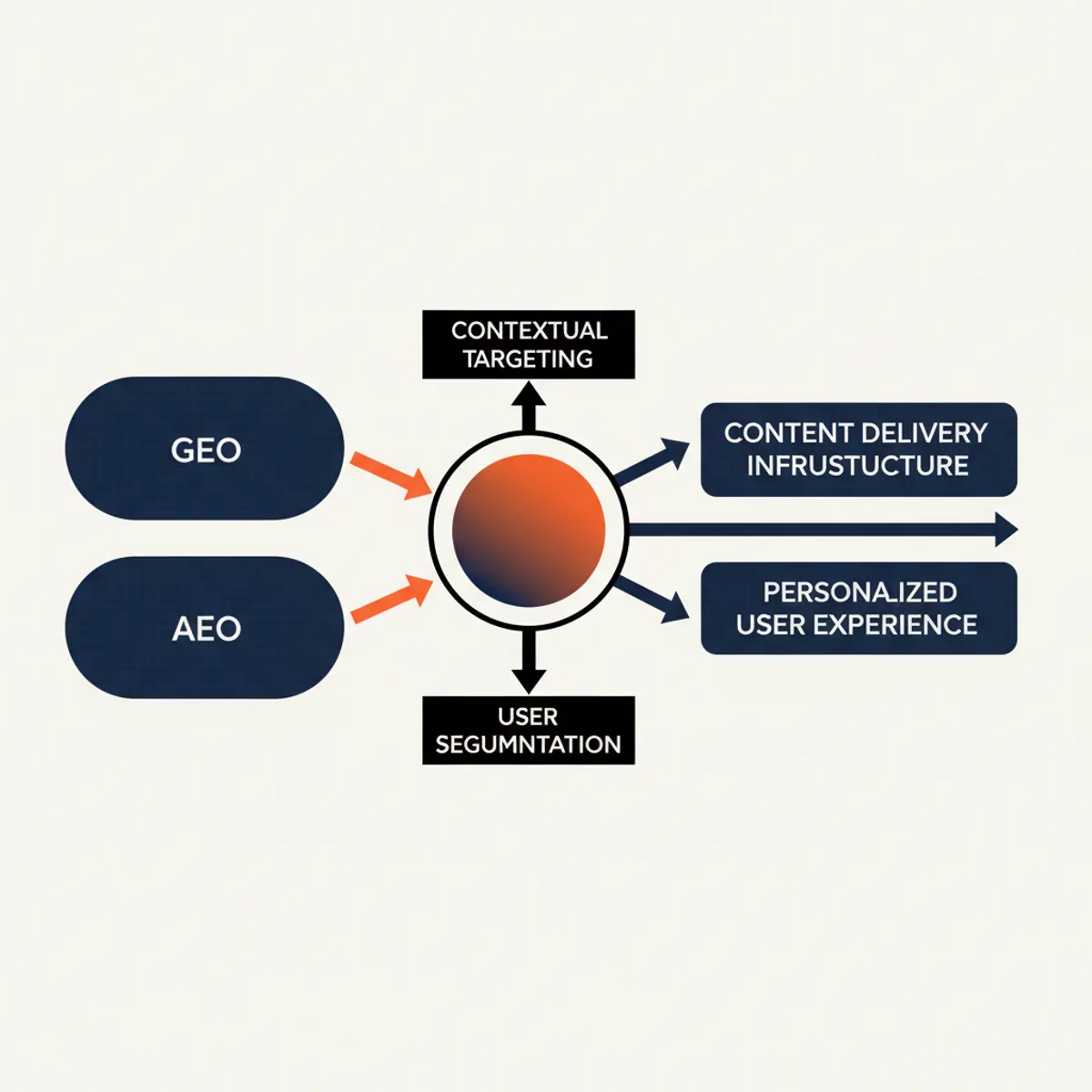
To navigate the current shift in digital discovery, one must distinguish between traditional search and generative search. Generative Engine Optimization (GEO) is the tactical process of adapting content so that Large Language Models (LLMs) can easily parse, summarize, and cite it. Answer Engine Optimization (AEO), while older, refers to the broader goal of providing direct answers to user queries, whether via voice search or AI summaries.
AI-driven visibility services act as the bridge between these two. They aren't just about keywords; they are about becoming a verified entity within a machine's knowledge graph. When a user asks an AI, "What is the best enterprise software for supply chain logistics?" the AI does not just look for keywords. It looks for trusted entities that have been cited by authoritative sources and are described in clear, semantically rich language.
Visibility in this new era requires a shift from 'traffic acquisition' to 'information dominance.' If your brand is the source of truth for a specific topic, the AI will default to mentioning you. This is the core of AI-driven visibility. By aligning content with the way transformers process tokens—the fundamental building blocks of LLM language—visibility services ensure that a brand's core value proposition is not lost in translation during the synthesis process.
Why AI Visibility Matters in 2026
By 2026, the traditional search engine results page (SERP) will be unrecognizable. We are moving toward a zero-click reality where the majority of informational queries are answered directly within the AI interface. If your brand is not part of that synthesized answer, you effectively do not exist for a significant portion of your target audience. This is not merely an incremental change; it is a total displacement of the user journey.
Traditional SEO focused on ranking #1. AEO focuses on being the only answer. The rise of agents—AI systems that perform tasks on behalf of users—further complicates this. An AI agent booking a flight or researching a software purchase will only present the top two or three options that meet the user's specific constraints. Visibility services ensure your brand meets the criteria these agents are programmed to value: reliability, proximity, and consensus.
Furthermore, the emergence of "Search Generative Experience" (SGE) in mainstream platforms means that even traditional searchers are being funneled into AI-curated environments. If your content is buried in a PDF or trapped behind a poorly structured wall, the generative engine will bypass it in favor of a competitor who has mapped their data for machine consumption.
Moreover, the cost of customer acquisition through traditional ads is skyrocketing. Brands that invest in organic AI visibility now are building a foundation of authority that is much harder for competitors to disrupt than a simple ad campaign. You can learn more about this in our guide on benefits of answer engine optimization.
The Technical Foundation: Schema and Semantics
At the heart of AI-driven visibility services is the technical architecture of your data. LLMs are excellent at pattern recognition, but they are prone to hallucination when data is ambiguous. Specialized visibility services use advanced Schema.org markups to remove this ambiguity. This technical layer acts as a "Rosetta Stone" for the AI, translating human-centric marketing copy into the structured format required for deterministic retrieval.
Entity Tagging and Knowledge Graphs
Beyond standard Organization or Product schema, GEO requires deep entity tagging. This involves linking your content to existing entities in the Google Knowledge Graph or Wikidata. By explicitly stating that your CEO is the same person mentioned in a specific industry whitepaper, you help the AI build a web of trust. This process, known as reconciliation, ensures that the AI doesn't confuse your brand with another entity sharing a similar name.
Semantic Relevance over Keyword Density
AI models use vector embeddings to understand the relationship between words. Visibility services optimize content not by repeating a keyword, but by including semantically related terms that demonstrate deep expertise. If you are writing about "AI-driven visibility services," you must also cover topics like latent semantic indexing, neural matching, and tokenization to prove your authority to the model. The objective is to occupy a specific coordinate in the LLM's vector space, making your content the most mathematically relevant answer for a given query cluster.
The Strategic Framework: 5 Steps to AI Visibility
Implementing a GEO-AEO strategy requires a systematic approach. It is not a one-time fix but a continuous cycle of optimization. As algorithms update and training data is refreshed, your brand’s position in the latent space can shift, necessitating a proactive posture.
- Comprehensive Entity Audit
- Why it works: You cannot optimize what you haven't defined. This identifies how the internet currently perceives your brand. It involves looking at common datasets like Common Crawl to see how your brand is represented in the archives that train LLMs. - Common Mistake: Focusing only on your website and ignoring third-party mentions, Wikipedia entries, or local citations. - Pro Tip: Use tools like Diffbot or Google’s Knowledge Graph API to see how an AI sees your brand's knowledge graph in its current state.
- Answer-Centric Content Restructuring
- Why it works: AI models favor content structured in a Q&A format or clear, declarative sentences. The closer your content is to the final "answer" provided to the user, the more likely the AI is to lift your text verbatim. - Common Mistake: Using flowery, metaphorical language or industry jargon that confuses the LLM’s tokenization process. - Pro Tip: Implement a 'Key Takeaways' section at the top of every long-form piece of content, using H3 tags to frame direct questions.
- Structured Data Overhaul
- Why it works: It provides a machine-readable layer to your human-readable content. By using mainEntityOfPage and about properties, you tell the engine exactly what the focus is. - Common Mistake: Using broken or incomplete Schema code, or neglecting to update schema when page content changes. - Pro Tip: Use Speakable schema to increase visibility in voice-based answer engines like Alexa and Siri.
- Authority and Citation Building
- Why it works: LLMs weight information based on where else it appears. High-authority backlinks are now high-authority citations. A mention in a high-authority journal is worth more than a hundred low-tier blogs because LLMs are trained to prioritize high-quality datasets. - Common Mistake: Chasing low-quality guest posts instead of industry-recognized whitepapers and primary research. - Pro Tip: Focus on getting cited in technical documentation, university repositories, or academic-style resources.
- Model Response Monitoring
- Why it works: You must track how AI models are actually talking about you in real-time. This involves "prompt engineering" tests to see if your brand is recommended for specific use cases. - Common Mistake: Using standard SEO rank trackers which can't see AI Overviews or personalized ChatGPT responses. - Pro Tip: Use a free AEO audit to baseline your current visibility across different LLMs and measure your "Share of Voice" in generative summaries.
Comparison: Traditional SEO vs. AI-Driven Visibility
| Feature | Traditional SEO | AI-Driven Visibility (GEO/AEO) |
|---|---|---|
| Primary Goal | Ranking in Top 10 | Inclusion in Generative Answer |
| Core Metric | Organic Traffic / CTR | Share of Model Response |
| Content Focus | Keywords and Backlinks | Entities, Facts, and Citations |
| User Intent | Click-through to site | Instant information delivery |
| Technical Base | Meta tags, Sitemap | Schema, JSON-LD, Knowledge Graph |
| Success Signal | High Ranking | Being the 'Cited Source' |
| Algorithm Basis | PageRank / Link equity | Neural matching / Transformer attention |
| Update Cycle | Monthly/Quarterly | Continuous/Training dependent |
Advanced GEO Tactics: The Influence of Retrieval-Augmented Generation (RAG)
Retrieval-Augmented Generation (RAG) is the specific process where an AI engine looks up external information to supplement its internal knowledge before generating an answer. This is where AI-driven visibility services reach their highest level of sophistication. To influence RAG, brands must focus on "chunkability."
When a generative engine retrieves information, it doesn't always pull the whole page. It pulls "chunks" of text that are most relevant to the query. If your content is one long, unbroken wall of text, the RAG process may grab irrelevant segments. Visibility services optimize for this by creating modular content blocks—definitions, step-by-step guides, and data tables—that are easily "digestible" for the retriever.
Another advanced tactic is Citation Reinforcement. LLMs often cross-reference information. If three different authoritative sites all cite your brand as the leader in "sustainable logistics," the LLM reaches a consensus. Visibility services work to orchestrate this consensus by ensuring your brand’s unique value propositions are consistently cited across a diverse array of digital properties, from news outlets to niche industry forums.
Industry Examples: GEO in Action
The impact of these services varies by sector, but the results are consistently measurable in terms of "Share of Model Response" (SOMR).
B2B Technology and Software
A cybersecurity firm found that while they ranked well for "firewall software," they were never mentioned in ChatGPT's comparisons for "best zero-trust architecture for healthcare." By restructuring their whitepapers into semantically tagged technical briefs and securing citations in three major security journals, their SOMR for the "zero-trust" category jumped from 0% to 22% within four months.
Local Services and Franchises
In the local space, GEO behaves differently. A national HVAC franchise implemented deep local schema and Geo-coordinates for every location. When users asked Gemini, "Who is the most reliable AC repair near me with 24/7 service?", the AI was able to verify their hours and reliability through their structured GMB (Google My Business) data and Yelp reviews, resulting in a 30% increase in voice-search-driven leads.
E-commerce and Retail
A luxury skincare brand used AI-driven visibility to target "ingredient-conscious" consumers. By mapping their product ingredients to scientific research via DefinedTerm schema, they became the top-cited source in Perplexity for queries related to "benefits of bakuchiol in night creams," bypassing traditional retailers who relied only on product descriptions.
Addressing Common Objections and FAQs
"If AI answers the question, won't I lose all my traffic?" This is the most common concern. While raw informational traffic may decrease, the traffic that does reach your site is significantly higher in intent. When a user clicks a "Source" link in a ChatGPT response, they are doing so to verify a specific detail or complete a transaction. They are already convinced of your authority. You are trading volume for value.
"Isn't this just Schema optimization?" Schema is the language, but GEO is the strategy. Simply having Schema doesn't guarantee visibility if the underlying content lacks semantic depth or if your brand lacks external consensus. AEO involves content design, technical data architecture, and PR-driven citation building.
"How long does it take to see results?" Unlike traditional SEO, which can take six months to show movement, GEO results can sometimes appear faster—or slower—depending on the model. Real-time engines like Perplexity or Google SGE update their indexes quickly. However, base models like GPT-4 may only "learn" about your brand during their next major training or through a RAG-enabled search tool. Consistency is key to being included in the next "knowledge snapshot."
Common Pitfalls in AI Visibility Strategies
Many brands rush into AEO without understanding the nuances, leading to wasted budget and potential brand damage. One major pitfall is over-automation. Using AI to generate the content intended to optimize for AI creates a feedback loop of mediocrity. The models prioritize unique, human-verified insights that they don't already have in their training data. If your content is just a rewrite of what's already out there, the AI has no reason to cite you as a new source of truth.
Another error is ignoring the source link. Even in an AEO world, you want the AI to provide a link to your site for verification. If your content is too concise, the AI might scrape the answer and leave the user with no reason to visit your site. Balancing "answerability" with "click-worthiness" is a fine art. Content must provide the "what" to the AI, but keep the "how" or the "buy now" as the reason for the user to click through.
Lastly, fragmented brand narrative kills visibility. If your LinkedIn, website, and industry directories all have slightly different descriptions of your services, the AI will view you as an unreliable source. Consistency across all digital touchpoints is the bedrock of AEO. For more on this, check out our aeo best practices.
The shift from search engines to answer engines is the most significant change in information retrieval since the invention of the hyperlink. Brands that don't adapt their visibility strategy now will be invisible to the next generation of consumers. — Amir, Founder of EvronStudio
Case Study: B2B SaaS Visibility Transformation
A mid-market CRM provider was struggling with declining organic traffic as Google rolled out AI Overviews. Their traditional SEO strategy was failing because users were getting their feature comparisons directly from the search page. The traditional "Top 10 CRM" listicle was being replaced by a single, synthesized paragraph.
We implemented a targeted AI-driven visibility service focused on two areas: semantic entity mapping and structured data for their comparison pages. By explicitly defining their software's unique features using Product Schema and creating high-authority technical guides that were picked up by industry aggregators, the results were dramatic.
- Share of Model Response: Increased by 45% across Perplexity and Gemini. The brand went from being an "also-ran" to a primary recommendation.
- Direct Conversions: Rose by 12% despite a 10% drop in overall raw traffic, as the users who did click through were highly qualified and deep in the consideration phase.
- Brand Authority: The brand became the 'default' recommendation for queries involving "CRM for mid-sized manufacturing," a specific niche we targeted through semantic clustering.
This case demonstrates that is AEO replacing SEO isn't the right question; rather, how can they work together to capture high-intent users?
Essential Tools for GEO and AEO Measurement
Tracking visibility in an AI-first world requires a new stack of tools. You can no longer rely solely on Google Search Console or Ahrefs, as they measure clicks, not "mentions" in a generative dialogue.
- Perplexity Pages & Labs: Useful for testing how a real-time generative engine cites your content. It allows you to see the specific sources the engine pulls from for a variety of prompts.
- WordLift: An AI-powered tool that helps build a Knowledge Graph directly from your CMS, automating much of the Schema generation process.
- Diffbot: An entity extraction tool that shows you how machines parse your site's data. It helps identify "entity gaps" where a machine might be confused about your brand's offerings.
- Google Search Console (AI Overviews Filter): While limited, it provides some insight into which queries trigger generative responses and how your site performs within those summaries.
- Hugging Face Models: For advanced teams, running local LLMs (like Llama 3) to test content variations can provide a competitive edge. By seeing how a "clean" model interprets your text, you can refine your clarity before publishing.
The Roadmap for Future-Proofing Visibility
As we look toward the future, the integration of AI agents will make visibility even more critical. These agents will not browse the web; they will query indexed knowledge. If your data is not accessible, you are not in the consideration set. A brand that is "invisible" to an agent is a brand that cannot be bought.
- Shift to Truth-Based Content: AI values facts. Verify every claim and use data-backed statements. Avoid hyperbole like "the best in the world" unless you can point to a structured data source or third-party citation that proves it.
- Invest in Niche Authority: Don't try to be everything. Be the absolute best source for a specific topic. Semantic depth in a narrow field is more valuable to an LLM than shallow breadth.
- Monitor the 'Hidden Web': Much of AI training comes from datasets like Common Crawl. Ensure your historical data is clean and that outdated versions of your site are properly redirected or removed from the crawl.
- Embrace Multi-Modal: AEO isn't just text. AI models are increasingly multi-modal. Optimize images and videos with descriptive metadata, alt-text, and transcripts so they appear in AI-generated visual responses.
To see how your brand stacks up, explore our services or read about semantic search and aeo to understand the underlying logic of modern search.
Conclusion and Next Steps
AI-driven visibility is no longer a luxury for forward-thinking brands; it is a requirement for survival. The transition from GEO to AEO is happening now, and the window for establishing early authority is closing. As these models become more entrenched, the "first-mover advantage" in the knowledge graph will become harder to overcome.
By focusing on structured data, semantic relevance, and authoritative citations, you can ensure that when the AI is asked a question, your brand is the answer. This is not about gaming an algorithm; it is about providing the highest quality, most accessible information to the machines that now mediate human curiosity.
Ready to take the next step? Request a contact today to discuss a custom AEO strategy for your business, or start with a free AEO audit to identify your biggest visibility gaps. The future of search is being written now—make sure your brand is part of the story.
Frequently asked questions
What is the primary difference between GEO and AEO?+
Generative Engine Optimization (GEO) focuses specifically on influencing the output of generative AI models like GPT-4 or Claude. Answer Engine Optimization (AEO) is a broader term encompassing any platform that provides direct answers to user queries, including voice assistants and featured snippets. Both rely on structured, highly relevant data to build brand authority within AI environments.
How do AI-driven visibility services track performance?+
Unlike traditional SEO which tracks organic clicks, visibility services measure 'Share of Model Response' and 'Brand Mentions.' They use specialized tools to see how often a brand is cited as a source in generative answers. Metrics also include sentiment analysis within AI outputs and the presence of links in platforms like Perplexity or Google AI Overviews.
Do these services replace traditional SEO?+
No, they complement it. Traditional SEO brings traffic from standard search results, while AEO ensures presence in the 'zero-click' and generative summary space. A robust digital strategy now requires both: SEO for discovery and AEO for authoritative verification within AI-synthesized responses. They share technical foundations like schema and site speed but differ in content structure.
Why is structured data critical for AI visibility?+
Structured data (Schema.org) acts as a roadmap for LLMs. While AI can read unstructured text, structured data provides explicit context about entities, relationships, and attributes. This reduces 'hallucination' risks, making it easier for the AI to confidently cite your information as a factual source. Without it, the AI may misinterpret your brand’s core offerings.
Is AEO more expensive than standard SEO services?+
The cost is comparable but the resource allocation differs. AEO requires deeper technical expertise in Knowledge Graphs and entity mapping, along with high-quality PR for citations. While standard SEO focuses on volume, AI-driven visibility focuses on precision and authority. Long-term, AEO offers higher ROI by future-proofing brands against shifts in search engine architecture.
Can small businesses benefit from GEO visibility services?+
Absolutely. Small businesses often have hyper-specific expertise that LLMs value. By optimizing for niche queries and maintaining clean citations, small brands can appear in generative answers alongside major competitors. AI models prioritize the 'most helpful' and 'most relevant' information, which levels the playing field for specialized local or boutique service providers.
Sources & further reading
Soft next step
Want to see where AI answers mention you — and where they don't?
We run a free AEO audit across ChatGPT, Gemini, Copilot and Perplexity, then hand you the fixes in priority order. Start your AEO strategy today.