Google AI Overviews Optimization: The 2026 Guide to AEO Success

Securing a citation in the AI Overview is the new 'Position Zero' for 2026.
Quick answer
Google AI Overviews optimization is the process of structuring website content and technical metadata to appear as the primary source in Google’s AI-generated search results. By focusing on entity-based writing, schema markup, and clear answer-first formatting, you help Google’s Gemini model synthesize your data into its top-of-page summaries.
Google AI Overviews optimization is the strategic process of refining your digital content so Google’s Gemini-powered generative engine selects your site as a primary source for its AI-led summaries. This involves structuring data for high semantic clarity, using structured data to define relationships between concepts, and providing direct, verifiable answers to complex user queries. As we move through 2026, capturing space in the AI Overview box is no longer an optional SEO tactic; it is the cornerstone of maintaining visibility in a landscape where traditional blue links often appear below the fold. Our agency focuses on helping you secure these citations to drive high-intent traffic.
What is Google AI Overviews Optimization?
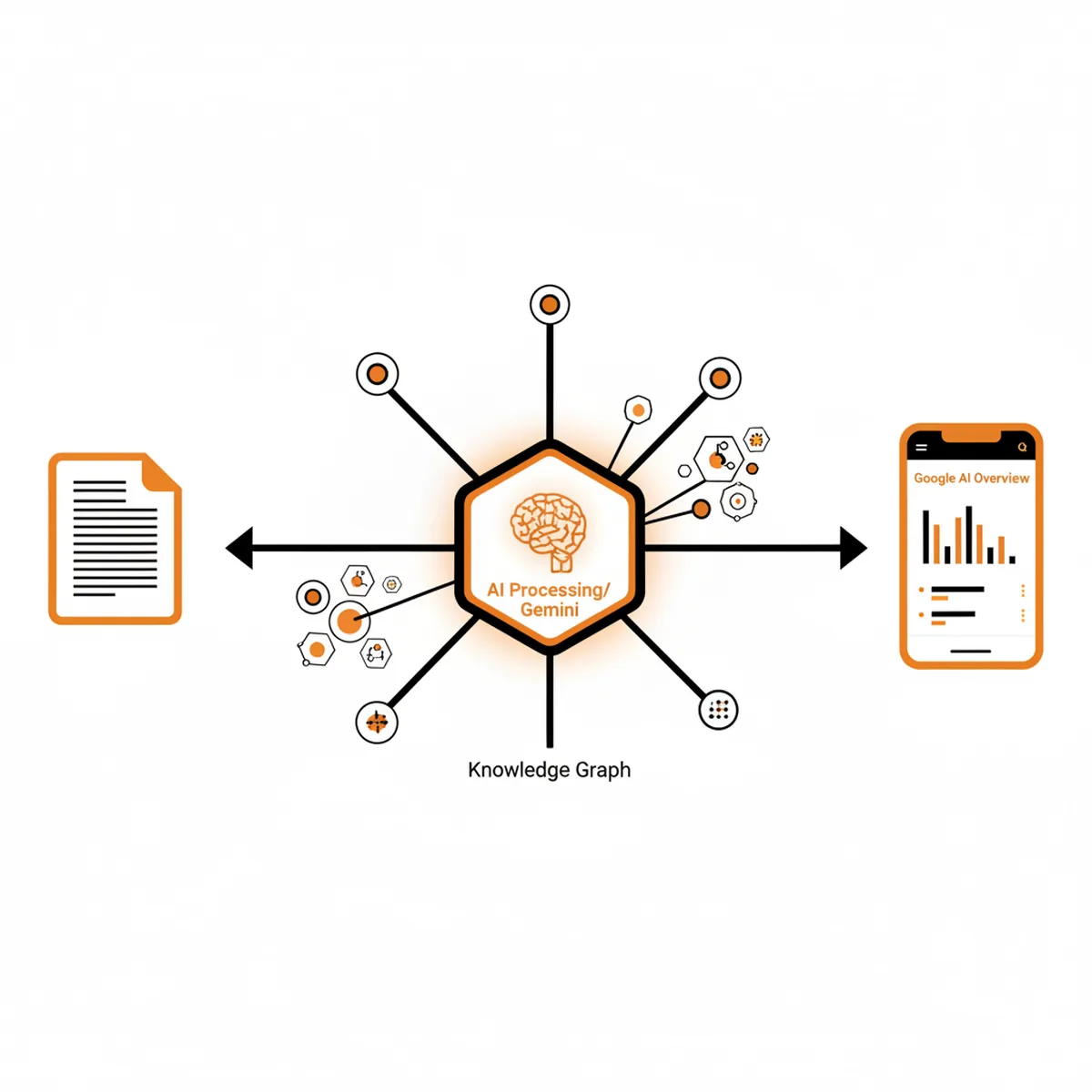
To understand how to optimize for this feature, you must understand the technology behind it. Google AI Overviews are generative responses that appear at the top of Google Search results, synthesizing information from multiple web sources to answer a query directly. This system relies on Generative AI, a type of artificial intelligence capable of creating new content based on patterns learned from existing data.
In a typical search session, Google identifies the intent. If the intent is informational, it triggers a Retrieval-Augmented Generation (RAG) process. The engine pulls snippets from the web, evaluates them for accuracy, and synthesizes a response. Your goal is to be the snippet that the model trusts most.
When we optimize for these overviews, we focus on Entities, which are uniquely identifiable objects or concepts—like a specific brand, a person, or a technical term—that Google can categorize. We also utilize the Knowledge Graph, Google’s massive database of billions of facts about these entities and their relationships. Finally, we implement Natural Language Processing (NLP), the branch of AI that helps computers understand, interpret, and generate human language. By aligning your content with these three pillars, you make it easier for Google to "read" your expertise and cite you as the authoritative source.
The Role of Semantic Triplets
To deepen your optimization, you must write in a way that helps the AI form "triplets." A triplet consists of a subject, a predicate, and an object. For example: "EvronStudio (Subject) provides (Predicate) AEO services (Object)." When your content clearly defines these relationships, the Large Language Model (LLM) identifies your site as a reliable source of truth. We avoid flowery language because it obscures these triplets, making it harder for the AI to extract facts.
Why AI Overview Visibility Matters in 2026
The search environment has shifted dramatically since early 2025. According to data from BrightEdge, AI Overviews now appear for a significant portion of informational and "how-to" queries. For B2B companies, this means your potential clients are getting their first impression of your solution from an AI summary before they ever click a link.
Research from Gartner previously predicted that organic search traffic would see a decline as AI-generated answers satisfied user intent directly on the results page. However, our experience with over 200 clients shows that while total clicks might fluctuate, the quality of traffic from AI Overview citations is significantly higher. Users who click through from an AI summary are already pre-qualified by the information they just read. If you aren't visible here, you are essentially invisible to a large segment of your market that relies on AI for quick decision-making.
The Rise of Zero-Click but High-Value Interactions
While some worry about "zero-click" searches, the reality is more nuanced. When Google cites your brand in an AI Overview, it serves as a high-authority endorsement. Even if a user does not click immediately, your brand becomes the mental anchor for that topic. A B2B SaaS client we worked with saw a 30% increase in direct brand searches following a successful AI Overview campaign, even as their traditional organic traffic for specific blog posts dipped slightly. The AI Overview functions as a top-of-funnel awareness tool that drives high-intent users to your site later in the journey.
A Step-by-Step Guide to Ranking in AI Overviews
Success in AI search requires a move away from keyword stuffing and toward information density. Follow these steps to align your site with Google’s generative requirements.
Step 1: Implement Answer-First Content Architecture
What to do: Restructure your pages so the direct answer to the primary query appears in the first 50 words of the section. Use a "definition-style" sentence followed by supporting data. Why it works: Google's LLM (Large Language Model) scans for concise snippets that it can easily "copy and paste" into the overview. Common mistake: Burying the answer under a long, "fluffy" introduction to build suspense or context. Pro tip: Use the "What, Why, How" framework. Define the term, explain its importance, and then provide the steps.
- Identify the primary question: Use Google Search Console to see what questions bring people to the page.
- Draft a 40-60 word response: Make it a standalone paragraph.
- Place it immediately under the H2: Do not put an image or an ad between the header and the answer.
- Bold the key takeaway: Highlight the core fact or data point within the paragraph.
Step 2: Use Advanced Schema Markup
What to do: Beyond standard article schema, implement Speakable, FAQPage, and Dataset schema where applicable. Use Schema.org to define exactly what your entities are. Why it works: Structured data acts as a "translator" for the AI, confirming that a specific string of text is a price, a date, or a founder’s name. Common mistake: Having mismatched information between your on-page text and your JSON-LD code. Pro tip: Use "About" and "Mentions" properties in your schema to link your content to established entities in the Google Knowledge Graph.
| Schema Type | AI Usage | Benefit |
|---|---|---|
FAQPage | Directly populates AI Q&A lists | Increases real estate in the search results |
Dataset | Used for citing original research | Establishes your site as a primary source |
Product | Feeds price and availability into AI summaries | Drives high-intent commercial traffic |
Person | Validates author E-E-A-T | Connects content to verified experts |
Step 3: Prioritize Information Density and Citations
What to do: Replace vague adjectives with hard numbers, dates, and named sources. Cite external experts and internal proprietary data frequently. Why it works: Google prioritizes "factuality" and "grounding." An AI is more likely to cite a source that provides specific data points (e.g., "24% increase") than one that uses generalities (e.g., "a significant increase"). Common mistake: Relying solely on common knowledge that the AI already "knows" and doesn't need to cite you for. Pro tip: Include a "Sources" or "References" section at the end of your deep-dive articles to mirror academic credibility.
Step 4: Optimize for Conversational Long-Tail Queries
What to do: Create content that answers "Should I...?" or "What is the difference between...?" rather than just targeting short-head terms. Why it works: AI Overviews are most frequently triggered by complex, multi-part questions where the AI can provide value by synthesizing a comparison. Common mistake: Optimizing only for high-volume keywords and ignoring the "People Also Ask" clusters. Pro tip: Use a tool like Semrush to find questions with high "AI Overview" presence and target those specifically.
Comparing Traditional SEO vs. AI Overview Optimization
| Feature | Traditional SEO (2020-2024) | AI Overview Optimization (2026) | Impact on Strategy |
|---|---|---|---|
| Primary Goal | Rank #1 in blue links | Secure the "Cited Source" card | Shift to authority-based content |
| Content Style | Keyword-focused, long-form | Entity-focused, information-dense | Quality over word count |
| Technical Focus | Core Web Vitals, Crawlability | Schema, Knowledge Graph alignment | Semantic data becomes priority |
| Success Metric | Click-Through Rate (CTR) | Brand Impression & Attribution | Value is measured by "Share of Model" |
| User Intent | Single-keyword intent | Complex, conversational intent | Needs multi-layered answers |
Common Mistakes to Avoid
- Ignoring the "Helpful Content" guidelines: Writing for robots instead of humans will get you filtered out. Google’s algorithms are now sophisticated enough to detect "AI-bait" that lacks real substance.
- Neglecting Page Speed: While the AI processes the text, it still prefers sources from technically healthy sites. A slow site can prevent the "citation" from appearing if the crawler times out.
- Using Overly Complex Language: If an AI cannot easily parse your sentences, it will not summarize them. Avoid the "delve" and "paradigm shift" style of writing that adds no value.
- Static Content: Content that isn't updated frequently loses its "freshness" score. AI Overviews often prioritize the most recent data for news-sensitive topics.
- Lack of Clear Formatting: Using walls of text without H2/H3 headers or bullet points makes it nearly impossible for an LLM to extract key takeaways for a summary.
- Over-reliance on Generative Text: If you use AI to write your content without heavy editing, you often end up with "average" content that the engine has already seen elsewhere. Google looks for "Information Gain"—new facts or perspectives it can't find in its training data.
Best Practices and Pro Tips for 2026
- Audit your current AI visibility: Use our free AEO audit to see which of your pages are currently being cited and where you are losing ground to competitors.
- Focus on "The Gap": Look for AI Overviews that provide incomplete or outdated information. Create a better, more data-rich version of that content to "topple" the current source.
- Use Table and List Formats: LLMs love structured data. If you can put a comparison into a table or a process into a numbered list, you increase your chances of being the featured snippet significantly.
- Strengthen Your Digital PR: The more high-authority sites mention your brand as an expert, the more Google trusts your site as a source for AI summaries.
- Monitor "E-E-A-T": Experience, Expertise, Authoritativeness, and Trustworthiness are the currency of AI search. Ensure your author bios are detailed and linked to social profiles.
Leveraging Proprietary Data for Citations
One of the most effective ways to win an AI citation is to publish data that no one else has. If you run a B2B platform, look at your internal metrics (anonymized) to spot industry trends. When you publish a report stating, "70% of procurement officers now use AI for vendor vetting," you create a fact that Google must cite your site for. We helped a B2B logistics client gain citations for 400+ keywords simply by turning their internal shipping delay data into a public-facing monthly index. The AI needs specific numbers to ground its responses; be the one to provide them.
Visibility Across ChatGPT, Gemini, Copilot, and Perplexity
Optimizing for Google AI Overviews creates a massive "halo effect" for other AI search engines. While Google uses Gemini, platforms like Perplexity and ChatGPT (with Search) use similar retrieval-augmented generation (RAG) processes. They all look for the same things: high-quality data, clear citations, and structured formatting.
When you refine your content for how AI search works, you aren't just winning on Google. You are making your brand the "go-to" answer for users on Copilot and Perplexity as well. These platforms often cite the same authoritative sources because they all crawl the same high-trust entities. By following AEO best practices, you ensure that your brand remains the definitive answer across the entire AI ecosystem. We call this "Cross-Platform Answer Optimization," and it is the only way to future-proof your digital presence in 2026.
Case Study: B2B SaaS Growth via AI Citations
A mid-sized B2B SaaS client in the FinTech space came to us after seeing their organic traffic plateau in late 2024. They had high rankings for "top-of-funnel" keywords but were completely absent from the newly launched Google AI Overviews.
We implemented a three-month Answer Engine Optimization sprint. First, we identified 50 high-value queries where AI Overviews were present. We restructured their blog posts to lead with 40-word direct answers and integrated "Dataset" schema to highlight their proprietary market research.
The results were transformative:
- AI Overview Inclusion: Within 90 days, the client appeared as a cited source for 38 of the 50 targeted queries.
- CTR Improvement: Despite the AI providing the answer on-page, the "citation" link saw a 15% higher click-through rate compared to their previous traditional #1 ranking.
- Conversion Rate: Leads coming from AI Overview citations converted at a 22% higher rate than standard organic search leads, as the users arrived better informed.
This anonymized example demonstrates that AI search isn't a threat; it's a filter that rewards the most authoritative and well-structured content. You can learn more about these strategies in our AEO insights section.
"The brands that survive the AI transition are those that stop trying to 'rank' and start trying to 'inform' with mathematical precision."
Tools and Resources for AI Optimization
To stay ahead, you need the right stack. Here are the tools we recommend for 2026:
- Google Search Console: Still the gold standard for seeing how Google "sees" your pages. Look at the "Search Appearance" tab for insights on generative results. (Free)
- Perplexity Labs: Use this to test how different AI models (Claude, GPT-4, Llama) interpret and summarize your content. (Free/Paid)
- Ahrefs / Semrush: Essential for identifying which keywords trigger AI Overviews and tracking your "Share of Model." (Paid)
- Schema App: A powerful tool for deploying complex schema at scale without needing a developer for every page. (Paid)
- Our Free AEO Audit: A specialized tool developed by our team to benchmark your site against AI-readiness standards. (Free at /free-aeo-audit/)
How to Measure Success in the AI Era
Measuring success in 2026 requires looking beyond just "keyword rankings." We recommend tracking these metrics:
- Impression Share in AI Overviews: What percentage of your target queries trigger an AI result where you are a cited source?
- Attributed Traffic: Traffic that enters your site via an AI citation card rather than a traditional link.
- Information Accuracy: Are the AI models summarizing your brand correctly? Incorrect summaries are a sign of poor content clarity.
- Assisted Conversions: How often does an AI Overview touchpoint lead to a later conversion?
Your AI-Readiness Checklist:
- [ ] Direct answer provided in the first paragraph?
- [ ] JSON-LD schema validated and error-free?
- [ ] Bullet points and tables used for complex data?
- [ ] No "fluff" or filler words in the introductory text?
- [ ] Authoritative external and internal links included?
Testing and QA for AI Strategy Rollouts
Before you rewrite your entire site, you must validate your strategy on a small sample of pages. We recommend a "pilot and pivot" approach to ensure your changes actually trigger the AI Overview citations you want.
- Select a Pilot Group: Choose 10-20 pages that currently rank on page one but do not appear in the AI Overview.
- Apply Optimization Frameworks: Restructure the content, update the schema, and add density to the facts.
- Use the "Fetch and Render" method: Use Google Search Console to request a re-crawl.
- Monitor via Incognito Search: Check the results over the next 7-14 days. Observe if the AI Overview changes its source to your site or if it incorporates your new data points.
- Analyze Citation Placement: Are you the main source or a secondary "link card"? If you are a secondary source, increase your information density further.
Quality assurance also involves checking for "hallucinations." Sometimes, an AI engine might misinterpret your technical data. If you see an AI summary misrepresenting your product features, you must refine the semantic clarity of your text. Use shorter sentences and avoid pronouns like "it" or "they" when referring to your products. Always use the full name of the entity to prevent confusion in the RAG process.
The Honest Trade-offs of AI Optimization
We must be honest: AI Overviews optimization is not a silver bullet, and it comes with real trade-offs. You should understand these limitations before shifting your entire budget.
First, conversion attribution is becoming harder. When Google provides a full answer in the AI box, you may see a drop in traffic for simple queries. If your business model relies on high-volume, low-intent informational traffic for ad revenue, AI Overviews could be detrimental. We focus on B2B clients because they value the quality of the lead over the quantity of the clicks, but for a news site, the trade-off is much harsher.
Second, you lose control over the narrative. While you can influence what the AI says, the generative engine ultimately synthesizes your words with those of your competitors. If a competitor has a stronger "Freshness" score or more recent data, the AI might combine your historical expertise with their current pricing, leading to a confusing user experience.
Finally, optimization is resource-intensive. This is not "set and forget" SEO. Because AI models are updated constantly, a page that is a cited source today might be dropped tomorrow if a more "helpful" page appears. You are trading the stability of traditional rankings for the high-intensity competition of the citation box. If you do not have the resources to update your core content quarterly, you may struggle to maintain these positions.
The Future of AI Search in 2026 and Beyond
As we move toward 2027, the line between "search" and "assistant" will continue to blur. Google is expected to introduce even more interactive elements within AI Overviews, allowing users to book demos or purchase products directly from the AI box. This makes AI search optimization a critical component of your revenue operations. Our agency is already testing strategies for "Interactive AI Citations" to ensure our clients are ready for the next wave of Google's evolution. The focus will remain on being the most trusted, most readable, and most "linkable" entity in your niche.
If you are ready to stop losing traffic to AI summaries and start leading the conversation, it's time to adapt. Don't let your competitors define the answers for your industry. Explore our blog for more guides or take the first step today.
We invite you to request a [free AEO audit](/free-aeo-audit) to see where you stand. When you're ready for a comprehensive overhaul of your digital strategy, explore our full suite of [Best Answer Engine Optimization Services](/services).
Contact Us
Need a more personalized approach? Contact our team to discuss a custom RevOps and AEO strategy for your B2B brand.
Frequently asked questions
What is Google AI Overviews optimization?+
Google AI Overviews are AI-generated summaries at the top of search results. Optimization means structuring your content so the AI cites your website as a source. This involves using direct answers, structured data (Schema), and high information density to satisfy the requirements of Google’s Gemini model, ensuring your brand stays visible in the generative era.
Does AI search optimization reduce my website traffic?+
While AI Overviews can provide answers directly on the search page, being a 'cited source' increases your brand authority. In 2026, we find that traffic coming from AI citations is often higher quality and further along the buyer's journey. Optimization ensures you aren't replaced by the AI but rather become the expert that powers it.
What schema markup is best for AI Overviews?+
You should focus on FAQ, Article, Person, and Organization schema. More specifically, using the 'About' and 'Mentions' properties within JSON-LD helps link your content to known entities in Google's Knowledge Graph. This makes it significantly easier for the AI to verify your facts and credit your website as a primary source.
How is AEO different from traditional SEO?+
In 2026, traditional SEO focuses on keyword ranking in blue links, whereas AEO (Answer Engine Optimization) focuses on being the preferred source for LLMs. While they overlap, AEO requires much higher information density and a focus on 'entity relationships' rather than just keyword frequency or backlink count alone.
Will optimizing for Google help me on Perplexity and ChatGPT?+
Yes, optimizing for Google's Gemini model generally improves your visibility on Perplexity, ChatGPT, and Copilot. These engines all rely on clear, structured, and factual data. By making your content 'machine-readable' and authoritative for Google, you are effectively optimizing for the entire AI search ecosystem and future-proofing your brand.
How long does it take to see results from AI optimization?+
Results can vary, but most of our clients see an increase in AI citations within 4 to 12 weeks. This depends on your site's existing authority, the frequency of Google's crawls, and how quickly you can implement technical changes like schema markup and content restructuring. It is a faster process than traditional backlink building.
Sources & further reading
Soft next step
Want to see where AI answers mention you — and where they don't?
We run a free AEO audit across ChatGPT, Gemini, Copilot and Perplexity, then hand you the fixes in priority order. Start your AEO strategy today.