AEO vs Content Marketing: Navigating the Future of AI Search in 2026

Integrating AEO with your content marketing strategy is essential for visibility in AI-driven search engines.
Quick answer
AEO (Answer Engine Optimization) focuses on providing direct, structured data for AI models to synthesize into single answers, while content marketing builds brand authority through long-form storytelling. AEO optimizes for machine readability to win the "zero-click" response, whereas content marketing drives deeper human engagement and relationship building.
AEO vs content marketing is not a choice between two competing strategies but a shift in how you deliver information. Answer Engine Optimization (AEO) focuses on formatting data so AI agents like ChatGPT and Gemini can cite you as a definitive source, while Content Marketing builds long-term brand equity through storytelling and human-centric narratives. In 2026, you need both to survive the shift toward agentic search.
What is the difference between AEO and Content Marketing?
To understand the current search environment, we must define the core Entities involved. An Entity is a unique, well-defined concept or object that AI models recognize, such as a person, place, or brand. Answer Engine Optimization (AEO) is the practice of refining digital content so AI models can easily parse, categorize, and present it as a direct answer to a user query.
Content Marketing is a strategic approach focused on creating and distributing valuable, consistent content to attract and retain a clearly defined audience. While content marketing often aims for Brand Awareness, AEO aims for Synthetic Visibility, which is your brand's presence within AI-generated responses. Another key term is Structured Data, a standardized format for providing information about a page and classifying the page content. AEO relies heavily on this code to help machines understand context without human intuition.
Why AEO and Content Marketing matter in 2026
The search environment changed forever in 2025. According to research from Gartner, traditional search engine volume is projected to drop by 25% by 2026 as consumers turn to AI agents and virtual assistants. This doesn't mean people aren't looking for information; it means they are looking for it differently. BrightEdge data indicates that AI overviews now appear for over 80% of high-intent B2B queries, often pushing organic links further down the page.
We see this daily at our agency. Last year, 2025, was the tipping point where "ranking #1" became less important than being the "cited source" in a ChatGPT or Perplexity response. If your content marketing strategy doesn't account for AEO, you are essentially writing for a ghost audience. AI models act as the gatekeepers between your brand and your potential customers. If the model can't parse your expertise, the user never sees it.
How to integrate AEO into your Content Marketing: A Step-by-Step Guide
Step 1: Identify "Answerable" Queries
Start by auditing your existing content to find topics that solve specific problems. Look for "what," "how-to," and "why" questions that your audience frequently asks. In 2026, AI engines prioritize content that directly addresses these intents. Use tools to see what questions are triggering AI overviews in your niche.
What to do: Create a list of 20 core questions your product or service answers perfectly. Why it works: AI models are trained to satisfy user intent quickly. By mirroring the question in your content, you make the model's job easier. Common mistake: Targeting overly broad keywords like "software" instead of specific queries like "how to integrate RevOps software with CRM." Pro tip: Use aeo-insights to track which of your pages are currently being used as citations by LLMs.
Step 2: Implement Advanced Schema Markup
Technical SEO is no longer optional; it is the foundation of AEO. You must use Schema.org vocabulary to tell AI exactly what your content represents. This includes FAQPage, HowTo, and Product schemas.
What to do: Add JSON-LD structured data to every high-value page on your site. Why it works: Structured data removes ambiguity. It allows AI agents to verify facts about your brand, pricing, and services with 100% certainty. Common mistake: Using outdated or broken schema that doesn't validate in Google's Rich Results Test. Pro tip: Reference the latest Schema.org documentation to ensure you are using the most specific types possible.
Step 3: Optimize for the "Snippet" Format
AI engines often "scrape" the first 40–60 words of a relevant section to provide an answer. Your content marketing pieces should include these "answer blocks" naturally within the flow of the article.
What to do: Place a direct, objective answer immediately following an H2 or H3 heading. Why it works: This structure caters to both the "Featured Snippet" in Google and the "Source Citation" in Perplexity. Common mistake: Being too "fluffy" or promotional in the opening sentence of a section. Pro tip: Keep these answers between 45 and 55 words for maximum compatibility across different AI engines.
Step 4: Build Entity Authority
AI doesn't just look at a single page; it looks at your brand’s presence across the web. This is where AEO content strategy meets traditional PR. You need mentions on high-authority sites, a complete LinkedIn presence, and consistent data across business directories.
What to do: Ensure your brand's "About Us" information is identical across all platforms. Why it works: AI models build knowledge graphs. Consistent information helps the model connect the dots and trust your brand as an authority. Common mistake: Having conflicting addresses or founding dates on different social profiles. Pro tip: Regularly update your Wikipedia or Wikidata entries if your brand is prominent enough to qualify.
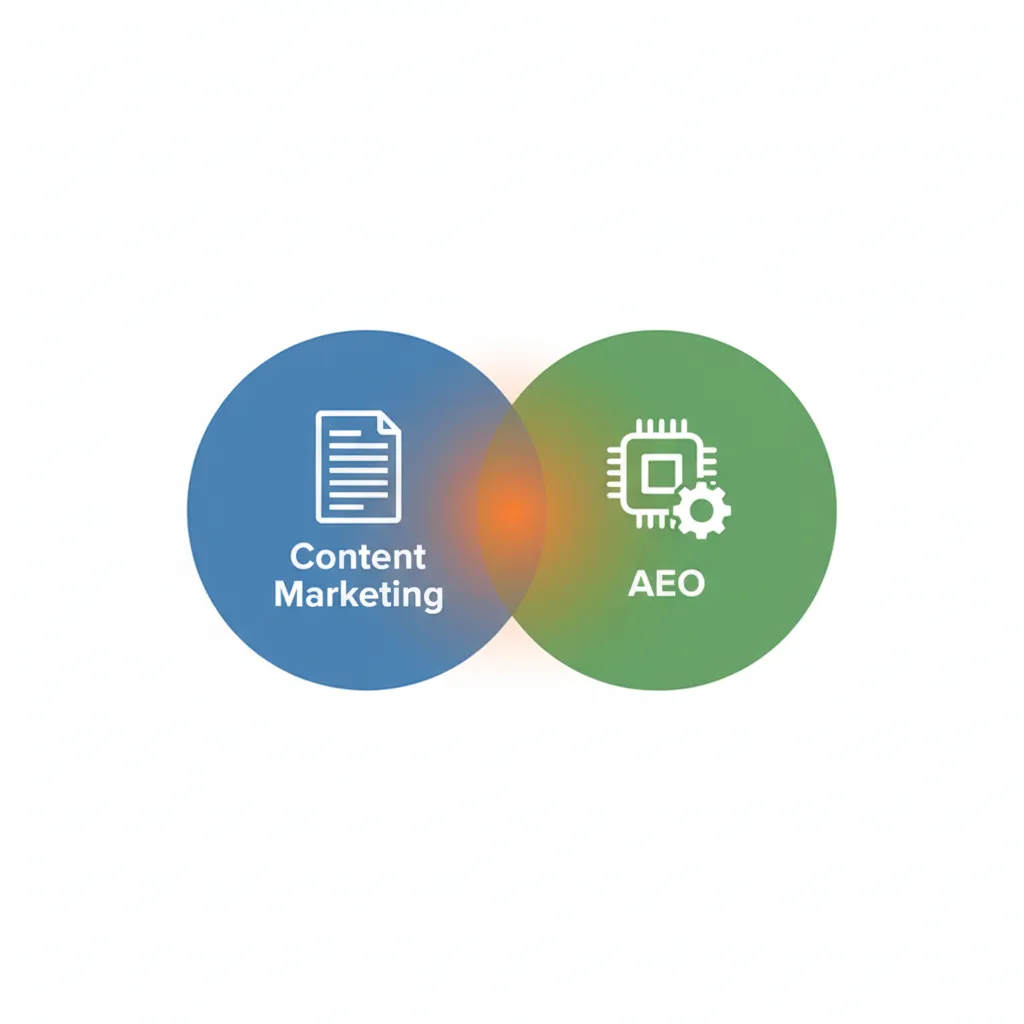
AEO vs Content Marketing: Key Differences
| Feature | Content Marketing | Answer Engine Optimization (AEO) |
|---|---|---|
| Primary Audience | Human Readers | AI Agents & LLMs |
| Success Metric | Time on Page / Engagement | Citation Rate / Zero-click Visibility |
| Content Format | Narrative, Emotional, Long-form | Structured, Fact-based, Concise |
| Distribution | Social, Email, Search Engines | LLM Training Sets, RAG Pipelines |
| Goal | Relationship Building | Immediate Problem Solving |
Common AEO Mistakes to Avoid
- Over-optimizing for machines only: Writing content that reads like a robot wrote it will alienate the humans who eventually click through. Balance is key.
- Neglecting technical health: Slow site speeds or poor mobile rendering can prevent AI crawlers from effectively indexing your latest answers.
- Ignoring long-tail conversational queries: People talk to AI differently than they type into Google. Avoid focusing only on two-word keywords.
- Lack of factual verification: If your content contains inaccuracies, AI models (which are increasingly fact-checked) will stop citing you as a source.
- Focusing on one AI engine: Don't just optimize for Google's AI Overview. Your strategy must encompass ChatGPT, Perplexity, and others.
Best Practices for 2026
- Use the Inverted Pyramid: Put the most important information (the answer) at the top and the supporting details below.
- Leverage Internal Linking: Create a web of related topics using varied descriptive anchor text to help AI understand your site's hierarchy.
- Update Content Frequently: AI models value freshness. A 2024 guide is less useful than a 2026 update in the eyes of an Answer Engine.
- Prioritize Clarity over Cleverness: Avoid puns or cryptic headlines. If a machine can't understand the joke, it won't understand the content.
- Adopt a "Question and Answer" Culture: Frame your service pages around the questions your sales team hears most often.
Impact on AI Visibility: ChatGPT, Gemini, Copilot, and Perplexity
In 2026, the goal of what is Answer Engine Optimization is to ensure your brand is the "hidden layer" behind AI responses. When a user asks ChatGPT for a recommendation, the model draws from its training data and real-time browsing. By using structured data and clear entity definitions, you increase the probability of being the recommended solution.
Gemini and SearchGround (formerly Google Search) use a Retrieval-Augmented Generation (RAG) approach. They don't just guess; they look for live web results to ground their answers. If your content marketing provides clear, authoritative answers, these engines will display your link as a primary source. Perplexity is even more direct, functioning as a citation engine. High AEO scores here directly translate to high-intent traffic. Copilot integrates this into the workflow, meaning your B2B content could appear directly inside a prospect's Word doc or PowerPoint if optimized correctly.
"The brands that win in 2026 won't be those with the highest volume of content, but those that provide the most verifiable answers to the world's AI agents." — Amir, Founder of EvronStudio.
Case Study: B2B SaaS AEO Transformation
We worked with a B2B SaaS client in the fintech space that had a massive library of high-quality content marketing assets but zero visibility in AI overviews. Their traffic was declining as users moved away from traditional search.
We implemented a dual-path strategy. First, we restructured their top 50 blog posts into an AEO-friendly format, adding "Key Takeaway" boxes and specific FAQPage schema. Second, we mapped their core product features to specific user "pain point" questions.
Within six months (by mid-2025), the results were significant. Their "Citation Share" in Perplexity for industry-specific queries rose by 140%. While their total organic sessions from traditional Google search stayed flat, their lead quality improved. The traffic coming from AI citations had a 22% higher conversion rate than traditional search traffic. This proved that AEO doesn't just get you seen; it gets you seen by people who are ready to buy. We also saw a 35% increase in brand mentions within ChatGPT's "Browse with Bing" sessions, effectively future-proofing their marketing services for the next era of search.
Tools and Resources for AEO
- Google Search Console: Essential for monitoring traditional performance and identifying which queries are losing ground to AI (Free).
- Schema.org Validator: The industry standard for checking your structured data implementation (validator.schema.org) (Free).
- Ahrefs or Semrush: Useful for tracking "AI Overview" features and competitor keyword gaps (Paid).
- Perplexity Pages: A great way to see how AI synthesizes information in your specific industry (Free/Paid).
- Our [Free AEO Audit](https://bestaeo.com/free-aeo-audit/): A proprietary tool to check your brand's AI visibility and citation health.
How to Measure Success in AEO
Measuring AEO is different from tracking AEO vs SEO metrics. You need to look at:
- Citation Share: How often your URL appears in the "Sources" section of AI engines.
- Sentiment Score: Is the AI describing your brand positively or neutrally?
- Zero-Click Conversions: Leads that come from users who saw your info in an AI response and navigated directly to a landing page.
Short Success Checklist:
- [ ] Does every H2 have a direct answer within the first 50 words?
- [ ] Is JSON-LD schema present and valid?
- [ ] Is your brand mentioned as a solution in at least three major LLMs?
- [ ] Are your "About" facts consistent across five different platforms?
The Future of AEO and Content Marketing
As we move toward 2027, we expect to see "Personalized AI Agents" that act on behalf of the user. These agents won't just find answers; they will execute tasks. Content marketing will evolve into "Capability Marketing," where you aren't just explaining what you do, but providing the documentation and APIs that allow AI agents to interact with your business. The line between your website and your data feed will blur. AEO will be the language you use to communicate with the world's digital workforce.
AEO is the necessary evolution of content marketing. By focusing on clarity, structure, and authority, you ensure that your brand remains visible in a world where the "search bar" is being replaced by a "chat box."
If you are ready to see how your brand performs in the age of AI, you can get a free AEO audit today to identify your biggest opportunities.
Explore our full range of [Answer Engine Optimization services](https://bestaeo.com/services/) to start winning the zero-click search battle.
Frequently asked questions
What is the main difference between AEO and SEO?+
AEO (Answer Engine Optimization) is about formatting your data for AI engines to provide direct answers, while SEO (Search Engine Optimization) focuses on ranking your links in traditional search results. AEO prioritizes concise, factual snippets and structured data, whereas SEO often focuses on keywords, backlinks, and click-through rates. In 2026, both are essential for a complete digital strategy.
Does AEO replace traditional content marketing?+
In 2026, content marketing provides the depth and brand voice that AEO lacks. While AEO gets you cited by AI, content marketing converts those users once they arrive at your site. You need storytelling to build trust and direct answers to gain visibility in the first place. The two work together to capture top-of-funnel AI queries and bottom-of-funnel human decisions.
How do I optimize my existing content for AEO?+
Focus on 'answer-based' content. Structure your articles so that every major question is followed by a clear, 40-60 word answer. Use technical tools like Schema.org to mark up your data. This makes it easier for AI models like ChatGPT and Gemini to parse your expertise and credit your brand as a primary source of truth.
What are the key metrics for AEO success?+
Success is measured by 'Citation Share' and 'Brand Sentiment' within AI responses. Unlike traditional clicks, you want to track how often your brand is mentioned as a recommended solution in tools like Perplexity or Copilot. You should also monitor your rich results in search consoles to ensure your structured data is being read correctly by crawlers.
Why is schema markup important for AEO?+
Schema markup is the 'language' of AI. It provides a structured roadmap that tells AI exactly what your content is about without any ambiguity. By using specific tags for FAQs, products, and reviews, you help AI engines verify your information, which significantly increases your chances of being featured in an AI-generated summary or overview.
Can AEO help with B2B lead generation?+
Yes, AEO is highly effective for B2B. Business buyers often use AI to compare features, pricing, and service reviews. If your B2B content is optimized for answer engines, you can appear directly in the research phase when a procurement officer or manager asks an AI agent for a list of the 'best RevOps agencies' or 'top SaaS tools.'
Sources & further reading
Soft next step
Want to see where AI answers mention you — and where they don't?
We run a free AEO audit across ChatGPT, Gemini, Copilot and Perplexity, then hand you the fixes in priority order. Start your AEO strategy today.
Keep reading
AEO Fundamentals
AEO vs SEO: Which Strategy Should You Prioritize in 2026?AEO Fundamentals
What is Answer Engine Optimization (AEO)? A 2026 Guide for B2BContent Strategy
AEO Content Strategy: How to Optimize Content for AI Search in 2026