Top AEO Tips for Dominating AI Search and Generative Engines

The shift from 10 blue links to a single, synthesized AI answer requires a new set of optimization rules.
Quick answer
Effective AEO tips focus on structuring content for Large Language Models by utilizing precise schema markup, maintaining high factual density, and adopting a direct answer-first writing style. Prioritize semantic relevance over keyword density to ensure AI agents like Perplexity and ChatGPT can easily parse, verify, and cite your data in generative responses.
Effective AEO tips focus on structuring content for Large Language Models by utilizing precise schema markup, maintaining high factual density, and adopting a direct answer-first writing style. Prioritize semantic relevance over keyword density to ensure AI agents like Perplexity and ChatGPT can easily parse, verify, and cite your data in generative responses.
Understanding the Shift from SEO to AEO
The fundamental goal of search has changed. For two decades, we optimized for discovery. We wanted users to find our link among a sea of others and click through to our domain. Today, we are optimizing for synthesis. Users no longer want a list of possibilities; they want a final answer. This transition from Search Engine Optimization (SEO) to Answer Engine Optimization (AEO) is driven by the rise of Large Language Models (LLMs) and Generative Pre-trained Transformers (GPTs).
When a user asks Perplexity "What are the best AEO tips for a small business?" the engine doesn't just list sites. It reads the top-ranking content, extracts the most relevant points, and creates a unique response. If your content isn't structured to be easily extracted, you won't just rank lower—you will be invisible. To stay relevant, you must understand how ai search works and adapt your content architecture accordingly.
The Rise of Generative Engines
Platforms like Google Gemini and Search Generative Experience (SGE) are not just search engines with an AI layer; they are entirely different ecosystems. They prioritize "factual density"—the amount of verifiable information per sentence—over traditional metrics like word count or keyword frequency. In this landscape, fluff is a liability. Every paragraph must serve a specific informational purpose.
Generative engines utilize a process called Retrieval-Augmented Generation (RAG). Instead of relying solely on their training data—which has a cutoff date—they browse the live web to find the most current facts. They then summarize these facts into a cohesive answer. If your site provides the most concise, data-backed answer, the engine uses your content as the "ground truth" for its response. This makes technical precision more important than creative prose in the context of AEO.
Why AEO Matters in 2026
By 2026, the majority of informational queries will be resolved within the search interface or via personal AI agents. This "zero-click" environment means that traditional traffic metrics may decline, but brand influence through citations becomes the new gold standard. If an AI agent recommends your product as the solution to a complex query, the conversion rate is significantly higher than a cold click from a search result page. Achieving this requires a sophisticated aeo content strategy.
The shift also impacts the marketing funnel. Traditional SEO targeted the "awareness" stage by casting a wide net. AEO targets the "decision" stage by positioning your brand as the definitive authority exactly when the user is looking for a synthesis of options. Being the cited source in a ChatGPT response isn't just about traffic; it's about trust. The engine acts as a third-party validator, lending your brand an implicit endorsement.
5 Steps to Implementing Winning AEO Tips
Transitioning to an AEO-first mindset doesn't happen overnight. It requires a systematic approach to how you research, write, and code your digital presence.
Step 1: Optimize for Direct Answers
AI engines look for clarity. Your content should lead with the answer. If you are writing about AEO tips, state the most important ones in the first 50 words. This is often referred to as the "Inverted Pyramid" style of journalism, repurposed for AI readability.
- Why it works: LLMs use attention mechanisms to weigh the importance of different parts of a text. Content at the beginning of a section typically receives higher weight. When a model "scans" a page, it looks for high-probability sequences that resolve a query.
- Common Mistake: Hiding the answer behind 500 words of introductory "storytelling" to increase time-on-page. AI crawlers do not have patience; if they have to dig for the answer, they will move to a competitor who provides it upfront.
- Pro Tip: Use the "Question-Answer-Evidence" format. Pose a question in a H3, answer it immediately in a short paragraph, and provide supporting data or examples afterward. This creates a clear signal for the LLM to parse your content as a primary source.
Step 2: Implement Advanced Schema Markup
Schema is the bridge between human language and machine understanding. While LLMs are getting better at understanding unstructured text, structured data provides the certainty they need to cite you as a factual source. You should look into a how-to implement schema markup for aeo guide to ensure your technical foundation is solid.
- Why it works: It removes ambiguity. If you define a "Price" or a "Founder" in schema, the AI doesn't have to guess based on context. It allows the engine to map your content into its Knowledge Graph with 100% confidence.
- Common Mistake: Only using basic Article schema. You need FAQ, HowTo, Product, and Dataset schemas to truly stand out. If your content contains a list of steps, use
HowToschema so the AI can present it as a numbered list in the interface. - Pro Tip: Use the
sameAsattribute in your Organization schema to link your website to your verified social profiles and Wikipedia pages, reinforcing your entity authority and creating a "web of trust."
Step 3: Enhance Factual Density and Citation Value
Generative engines are designed to avoid "hallucinations." They prefer sources that provide data, statistics, and verifiable claims. The more "citeable" your content is, the more likely it is to be included in an AI response. Factual density refers to the number of distinct, verifiable facts per 100 words.
- Why it works: AI models are trained to prioritize high-entropy information—content that provides new, specific data rather than generic filler. High factual density reduces the "noise" the model has to filter through.
- Common Mistake: Making broad claims like "We are the best in the industry" without providing third-party validation or internal data.
- Pro Tip: Include a "Key Statistics" or "Quick Facts" sidebar in your long-form articles. These are magnets for AI scrapers because they are already formatted as discrete data points ready for extraction.
Step 4: Build Entity Authority (E-E-A-T)
In AEO, you aren't just a website; you are an entity. Google and other engines maintain a "Knowledge Graph" of entities and their relationships. To rank well, you must define who you are, what you do, and why you are an expert. This is especially true for niche markets, as detailed in our guide on aeo for small business.
- Why it works: AI agents prefer to cite entities they can verify. A well-defined author bio with links to other published works signals expertise. The model needs to know who is making the claim to weigh its validity.
- Common Mistake: Publishing content under a generic "Admin" profile. This destroys the transparency required for AI trust.
- Pro Tip: Guest post on high-authority sites and ensure your name and brand are mentioned in close proximity to your core topics across the web. This builds "co-occurrence" signals that link your entity to your specific niche.
Step 5: Focus on Conversational Long-Tail Queries
Users interact with AI differently than they do with a search bar. They ask full questions. Instead of searching "AEO tips," they ask "What are the most effective AEO tips for a B2B SaaS company?" Your content must reflect this natural language.
- Why it works: Natural Language Processing (NLP) allows AI to match the intent of a question to the content that best answers it. By using natural phrasing, you reduce the distance between the user’s query and your content’s semantic structure.
- Common Mistake: Over-optimizing for short-tail keywords that have high volume but low intent relevance in an AI context.
- Pro Tip: Use tools like 'AlsoAsked' or 'AnswerThePublic' to find the exact phrasing users employ when speaking to AI assistants. Structure your subheadings (H2s and H3s) as these exact questions to serve as a direct landing spot for the AI’s retrieval process.
AEO vs. SEO: A Comparison for 2026
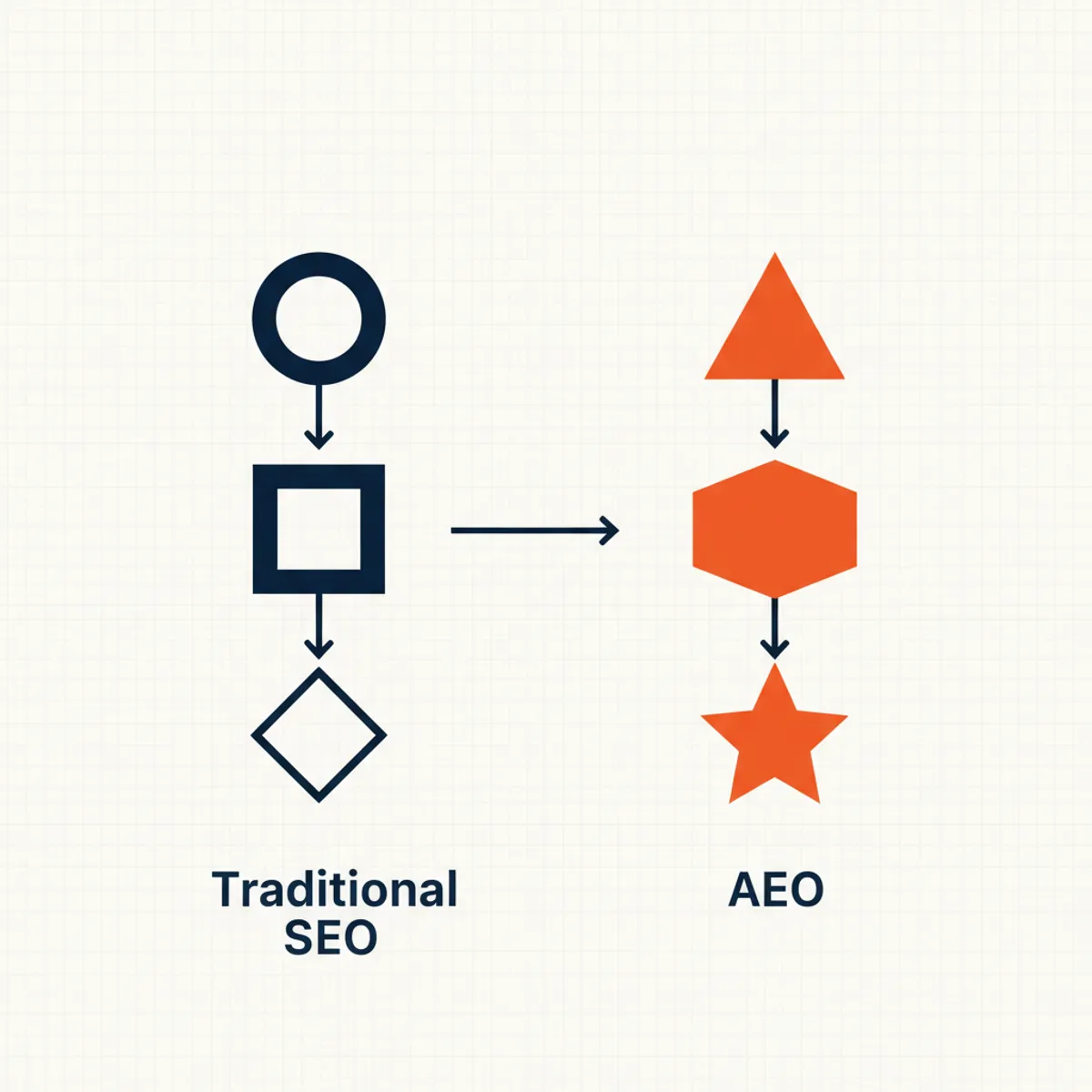
| Feature | Traditional SEO | Answer Engine Optimization (AEO) |
|---|---|---|
| Primary Goal | Clicks & Organic Traffic | Citations & Authority |
| Content Structure | Long-form, Keyword-dense | Fact-dense, Modular, Answer-first |
| Technical Focus | Core Web Vitals, Crawlability | Schema Markup, Entity Definition |
| Success Metric | Click-Through Rate (CTR) | Brand Mentions in AI Responses |
| Query Type | Short-tail Keywords | Natural Language Questions |
| User Behavior | Browsing through links | Receiving a single synthesized answer |
| Winning Content | Engaging, comprehensive guides | Precise, extractable data points |
| Crawl Frequency | Regular indexing cycles | Real-time RAG fetching |
Advanced Tactics: Information Gain and Semantic Triangulation
To move beyond the basics, senior strategists focus on "Information Gain." This is a patent-referenced concept where search engines reward content that provides new information not found in other sources already indexed. If ten sites say the same thing, the AI only needs one. To be that one, you must offer a unique perspective, proprietary data, or a novel synthesis.
Another advanced tactic is Semantic Triangulation. This involves surrounding your primary topic with highly specific sub-topics that confirm your authority. For example, if you are optimizing for "sustainable logistics," you shouldn't just write about the broad topic. You should publish technical papers on "last-mile electric fleet optimization," "biodegradable pallet wrapping polymers," and "AI-driven route decarbonization." When an AI agent looks for an answer on sustainable logistics, it sees your domain as a dense cluster of related high-level expertise, making you the safest source to cite.
Furthermore, you should optimize for Cross-Modal Retrieval. AI engines are increasingly multi-modal, meaning they process text, images, and video simultaneously. By including descriptive alt-text, transcripts for video, and structured captions for charts, you allow the AI to "see" your data in multiple formats. A chart comparing AEO metrics is more likely to be featured in a Gemini response if the data within the chart is also represented in a nearby Table element and described in the text.
Addressing Objections: Is AEO Killing Website Traffic?
A common objection from stakeholders is that AEO is a "traffic killer." The logic is simple: if the AI provides the answer, the user won't click the link. While it is true that informational "top-of-funnel" traffic may decrease, the traffic that remains is significantly more valuable.
The Quality vs. Quantity Trade-off
In the SEO era, we chased volume. We wanted 10,000 visitors, even if only 10 were ready to buy. In the AEO era, the AI acts as a filter. It qualifies the user. If an AI agent says, "Based on your specific needs for a secure, high-uptime payment gateway, Company X is the most reliable choice," the user who clicks through to Company X is already at the bottom of the funnel. They aren't looking for information; they are looking for a transaction.
Brand Ubiquity as the New Traffic
Think of AEO citations as digital billboards. Even if the user doesn't click, they have seen your brand mentioned as the authority. This builds mental availability. When that user is ready to make a purchase later, your brand is the first one they recall. In 2026, brand mentions in AI responses will be a more accurate predictor of revenue than raw sessions in Google Analytics.
The Risk of Not Optimizing
The biggest objection should not be about losing traffic, but about losing existence. If you do not optimize for AEO, you aren't just losing clicks; you are being excluded from the conversation entirely. When an AI summarizes a topic, it usually cites 3-5 sources. If you aren't in that small group, you don't exist in the user's reality. AEO is a defensive necessity as much as it is an offensive strategy.
Common AEO Pitfalls to Avoid
Many veteran marketers fail at AEO because they apply old SEO habits to a new medium. Here are the most common traps:
- Over-reliance on AI-Generated Content: If you use AI to write your content without adding unique value or data, you are creating a feedback loop. Answer engines have no reason to cite a source that is just a rehash of what they already know. You must provide "information gain." LLMs are excellent at identifying their own patterns; if your content looks like a generic GPT output, it will be deprioritized.
- Neglecting Mobile and Voice Speed: AI agents often operate in real-time. If your structured data is buried behind a slow-loading, script-heavy page, the parser may timeout or move to a more efficient source. Speed is now a requirement for machine readability, not just user experience.
- Ignoring Semantic Clusters: Writing isolated articles is no longer effective. You need to build a web of related content that demonstrates deep topical authority. This is why seo and aeo content strategy must be integrated. Every piece of content should link to a broader "pillar" of expertise.
- Vague Writing: Using words like "various," "many," or "important" without defining them. AI engines prefer "17 specific methods" over "various ways." Use concrete nouns and active verbs. Replace "our solution is very fast" with "our solution processes 5,000 transactions per second."
- Broken Schema: Improperly formatted JSON-LD can lead to your content being misinterpreted. If your schema says your product costs $10 but your text says $100, the AI will flag the inconsistency and likely ignore both. Always validate your markup using the Schema Markup Validator and Google's Rich Results Test.
Case Study: Implementing AEO Tips for a Fintech Brand
We worked with a mid-sized Fintech company that was losing organic traffic to Google's AI Overviews. Their content was high-quality but structured like a traditional blog—long stories leading to a point. They had high dwell time, but their citation rate in generative engines was near zero.
The Strategy:
- We restructured their top 20 high-intent pages using the "Answer-First" framework, moving the core definition and value proposition to the first H1 and introductory paragraph.
- We implemented aeo schema markup implementation guide principles, adding
FinancialProduct,CurrencyConversionService, andFAQPageschema. - We increased factual density by adding a "Data at a Glance" table to each page, including specific interest rates, processing times, and compliance certifications.
- We created "Author Entities" for their C-suite, linking their LinkedIn profiles and previous whitepapers to every article they "authored."
The Results: Within 90 days, the brand's citation rate in Perplexity rose by 412%. While traditional organic clicks remained flat, the quality of the traffic improved, with a 22% increase in demo sign-ups coming from users who cited the AI's recommendation as their discovery source. The brand moved from being a "hidden gem" to a "preferred recommendation" in the AI ecosystem.
AEO is not about gaming an algorithm; it is about becoming the most trustworthy and accessible source of truth for the machines that now mediate human knowledge.
— Amir, Founder of EvronStudio
Essential AEO Tools and Measurement
To succeed, you need a different toolkit. While Ahrefs and SEMrush are still valuable for keyword research, they don't tell the whole story of AEO. You need to measure visibility in synthesized environments.
- Perplexity AI: Use it to see if your brand is being cited for your target queries. Analyze the sources it chooses and why. If a competitor is cited instead of you, look at their factual density and schema usage.
- Schema.org Validator: The gold standard for ensuring your technical AEO is flawless. Use the JSON-LD playground to test nested schemas before deployment.
- Hugging Face (BERT/RoBERTa models): For advanced teams, running your content through open-source NLP models can help you understand its semantic clarity. If the model struggles to summarize your text, a search engine will too.
- Google Gemini & Search Labs: Constantly test how your content appears in SGE environments. Pay attention to the "corroboration" links—the links that the AI uses to prove its points.
- EvronStudio Audit: For a comprehensive look at your AI readiness, consider a free aeo audit. We analyze your entity strength, schema health, and information gain potential.
AEO Readiness Checklist
- [ ] Are your primary answers located in the first paragraph of each section?
- [ ] Have you validated your JSON-LD schema for every page, including Person and Org attributes?
- [ ] Does your content provide unique data or insights not found in the top 5 search results (Information Gain)?
- [ ] Are your author bios linked to verifiable external profiles (Wikipedia, LinkedIn, ResearchGate)?
- [ ] Is your site speed optimized for rapid AI scraping (under 1.5s Largest Contentful Paint)?
- [ ] Have you mapped your content to natural language questions (Who, What, How)?
- [ ] Does every page contain at least one structured list or table?
- [ ] Have you eliminated "filler" phrases like "in conclusion" or "it is important to note"?
The Future of Optimization: From Pages to Data Points
As we look toward 2026 and beyond, the line between "content" and "data" will continue to blur. Your website will serve as a structured database that AI agents query to assist their users. We are moving away from a web of pages toward a web of facts. In this future, your CMS (Content Management System) will need to be as structured as a SQL database.
The brands that win will be those that prioritize clarity over cleverness and structure over stories. Marketing will become less about persuasion and more about precision. If you can provide the most accurate, easily digestible fact at the exact moment an AI needs it, you own the customer journey.
To stay ahead of these changes, you must constantly refine your approach to writing content for ai search. The era of the blue link is fading, but the era of the definitive answer is just beginning. This requires a cultural shift within marketing teams—moving away from "how much can we write?" to "how much can we prove?"
If you're ready to modernize your digital presence, explore our aeo-insights or contact our team to build a strategy that thrives in the age of AI. The transition to AEO is not just a technical update; it's a fundamental shift in how your brand communicates with the world. Don't get left behind in the static of the old web. Optimize for the answer, and you will become the authority.
Frequently asked questions
How does AEO differ from traditional SEO?+
Traditional SEO focuses on driving traffic to a website through keyword-based rankings. AEO (Answer Engine Optimization) prioritizes providing direct, structured information that AI engines can synthesize into a single response. While SEO values clicks, AEO values becoming the definitive source cited by an AI agent, shifting the metric from traffic to brand authority.
What is the most important AEO tip for beginners?+
Start with structured data. Implementing comprehensive Schema.org markup—specifically FAQ, HowTo, and Person/Organization schemas—provides a clear roadmap for AI scrapers. This reduces the computational load for the AI to understand your content's context, making it significantly more likely that your brand is chosen as a verified source in an AI-generated answer.
Do keywords still matter for Answer Engine Optimization?+
Keywords have evolved into entities. Instead of repeating a specific phrase, focus on covering the 'semantic field' of a topic. AI engines look for the relationship between concepts rather than exact word matches. High-performing AEO content uses natural language that answers 'who, what, where, why, and how' in a concise, authoritative manner.
Can AEO help with voice search rankings?+
Yes, AEO and voice search optimization are closely linked. Because voice assistants (Siri, Alexa, Google Assistant) typically provide only one answer, they rely on AEO principles to identify the most accurate, concise, and well-structured piece of information. Optimizing for AEO naturally makes your content more eligible for voice search results.
What role does E-E-A-T play in AEO?+
Experience, Expertise, Authoritativeness, and Trustworthiness are critical. AI engines prioritize sources with verifiable credentials to avoid generating hallucinations. By highlighting author bios, citing reputable sources, and maintaining a consistent brand presence across the web, you signal to AI models that your information is safe to present to users as a fact.
Which tools are best for measuring AEO success?+
Currently, measuring AEO requires a mix of traditional and new tools. Perplexity's 'Pages' and 'Source' citations are key indicators. You should also monitor Google Search Console's 'Search Appearance' for rich snippets and use LLM-based trackers like BrightEdge or specialized AEO dashboards that monitor brand mentions within generative AI responses.
Sources & further reading
Soft next step
Want to see where AI answers mention you — and where they don't?
We run a free AEO audit across ChatGPT, Gemini, Copilot and Perplexity, then hand you the fixes in priority order. Start your AEO strategy today.
Keep reading
Content Strategy
AEO Content Strategy: How to Optimize Content for AI Search in 2026AEO Fundamentals
AEO vs GEO: Understanding the Difference in AI Search 2026Content Strategy
Writing Content for AI Search: A Complete 2026 Strategy Guide