AEO vs GEO: Navigating the Future of Generative Search in 2026
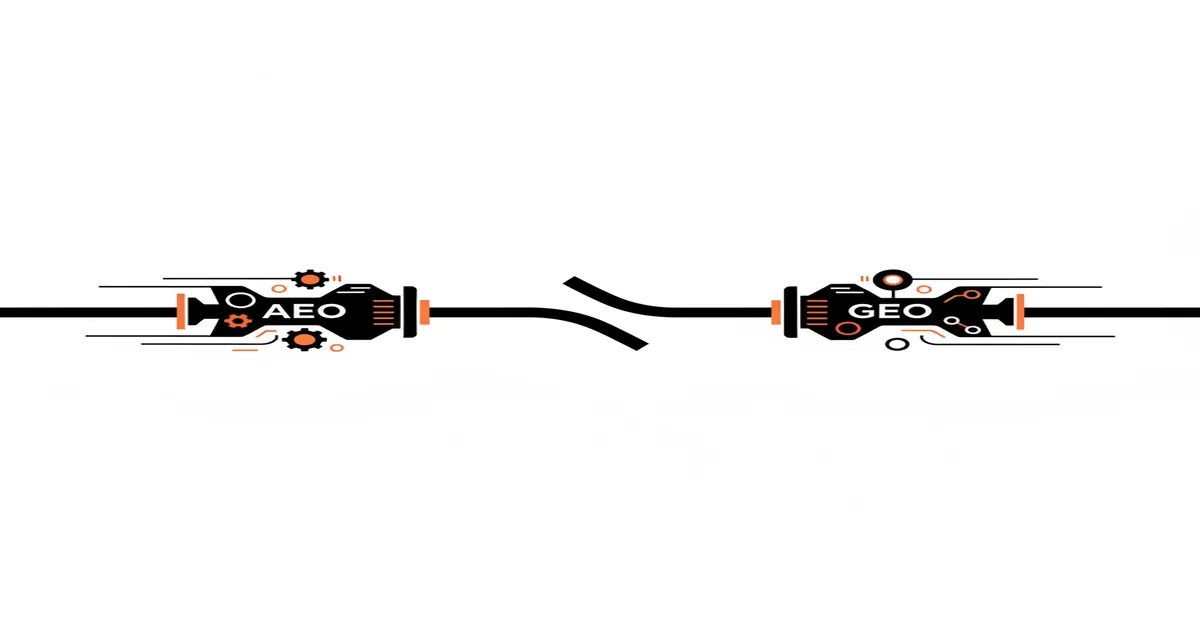
Choosing the right path between AEO and GEO is essential for modern search visibility.
Quick answer
AEO (Answer Engine Optimization) focuses on providing structured data and direct answers for LLMs to cite, while GEO (Generative Engine Optimization) optimizes content specifically for AI-driven search interfaces. The main difference is AEO targets the accuracy of the answer, whereas GEO targets visibility in generated summaries.
The primary difference between AEO (Answer Engine Optimization) and GEO (Generative Engine Optimization) lies in their focus: AEO centers on making your data machine-readable for direct answers, while GEO targets ranking within the synthetic summaries generated by AI search engines like Perplexity or Google’s AI Overviews. By 2026, these strategies have converged into a unified framework for winning "Position Zero" in the age of generative AI.
Why AEO and GEO are Critical for Search in 2026
The search landscape shifted permanently last year. In 2025, Gartner reported that traditional search volume would drop significantly as users migrated to conversational AI interfaces. For your brand, this means that simply ranking on page one of Google is no longer enough. You must now optimize for the LLM (Large Language Model), a type of artificial intelligence trained on massive datasets to understand and generate human-like text.
Today, visibility depends on becoming a Trusted Seed, which is a high-authority source that AI models use to verify facts. If your content isn't formatted for RAG (Retrieval-Augmented Generation)—the process AI uses to pull real-time data from the web—you simply don't exist to the modern user. A recent study by BrightEdge suggests that over 40% of B2B queries now trigger a generative response, making AEO insights essential for maintaining market share.
The Rise of the "Synthetic Journey"
We are moving away from the "click and browse" model. Users now engage in a "Synthetic Journey," where the AI aggregates facts, compares pricing, and summarizes reviews before the user ever clicks a link. If you are not part of that initial summary, you lose the lead before they even know you exist.
Search Engine Land has highlighted that "zero-click" searches are evolving into "zero-interaction" searches where the AI completes the task for the user. To combat this, your GEO strategy must ensure your brand name is synonymous with the solution. This requires a deep understanding of how LLMs group information. They don't just look for keywords; they look for probability. Your goal is to make your brand the most probable answer to the user's specific problem.
How to Implement a Modern AEO and GEO Strategy
Step 1: Align Content with Intent-Based Entities
You must identify the core entities (people, places, or things with distinct identities) your brand represents. Instead of targeting keywords, focus on becoming the definitive source for a specific concept. AI models look for clear connections between your brand and the problems you solve.
- What to do: Map your products to specific schema.org types.
- Why it works: It helps the AI understand the relationship between your data points.
- Common mistake: Using vague language that confuses the engine's entity recognition.
- Pro tip: Use the "SameAs" property in your schema to link to your verified social profiles.
Step 2: Optimize for Conversational Natural Language
Users no longer type "best RevOps agency." They ask, "Who provides the best RevOps services for SaaS companies in 2026?" Your content needs to mirror this conversational tone while maintaining professional authority.
- What to do: Rewrite headers as direct questions and start paragraphs with direct answers.
- Why it works: LLMs are trained on dialogue and respond better to clear, question-answer structures.
- Common mistake: Hiding the answer at the bottom of a 2,000-word post.
- Pro tip: Keep your introductory "answer" sentence under 45 words for maximum impact.
Step 3: Implement Advanced Technical Markup
Technical SEO is now the floor, not the ceiling. You need to provide a roadmap for AI crawlers using JSON-LD. This structured data acts as a translator between your website and the answer engine.
- What to do: Use specific schemas like
Service,FAQPage, andTechArticle. - Why it works: It reduces the "computational cost" for the AI to understand your page.
- Common mistake: Having broken or outdated schema code that leads to indexing errors.
- Pro tip: Test your markup regularly using Google's Search Console tools.
Step 4: Build Digital Citations and Authority
Generative engines prioritize sources that are frequently cited by other authoritative sites. This is the GEO side of the coin: ensuring your brand is mentioned in the context of your industry’s most important discussions.
- What to do: Focus on getting mentioned in industry whitepapers and high-authority news sites.
- Why it works: AI uses these citations as a proxy for trust and reliability.
- Common mistake: Buying low-quality backlinks that the AI recognizes as spam.
- Pro tip: Aim for "brand mentions" even without a link, as modern engines track these for GEO.
The Role of Verifiable Citations in GEO
AI engines are programmed to avoid "hallucinations." They do this by checking multiple sources. If three high-authority sites mention your product features, the AI is likely to include you in a summary. However, if your own site is the only source of a claim, the engine may flag it as unverified.
To win at GEO, follow this mini-procedure:
- Identify the top 5 industry publications your prospects read.
- Pitch data-backed guest insights or quotes to these editors.
- Ensure your brand name is spelled consistently across all mentions.
- Link back to a specific "Entity Page" on your site rather than just the homepage.
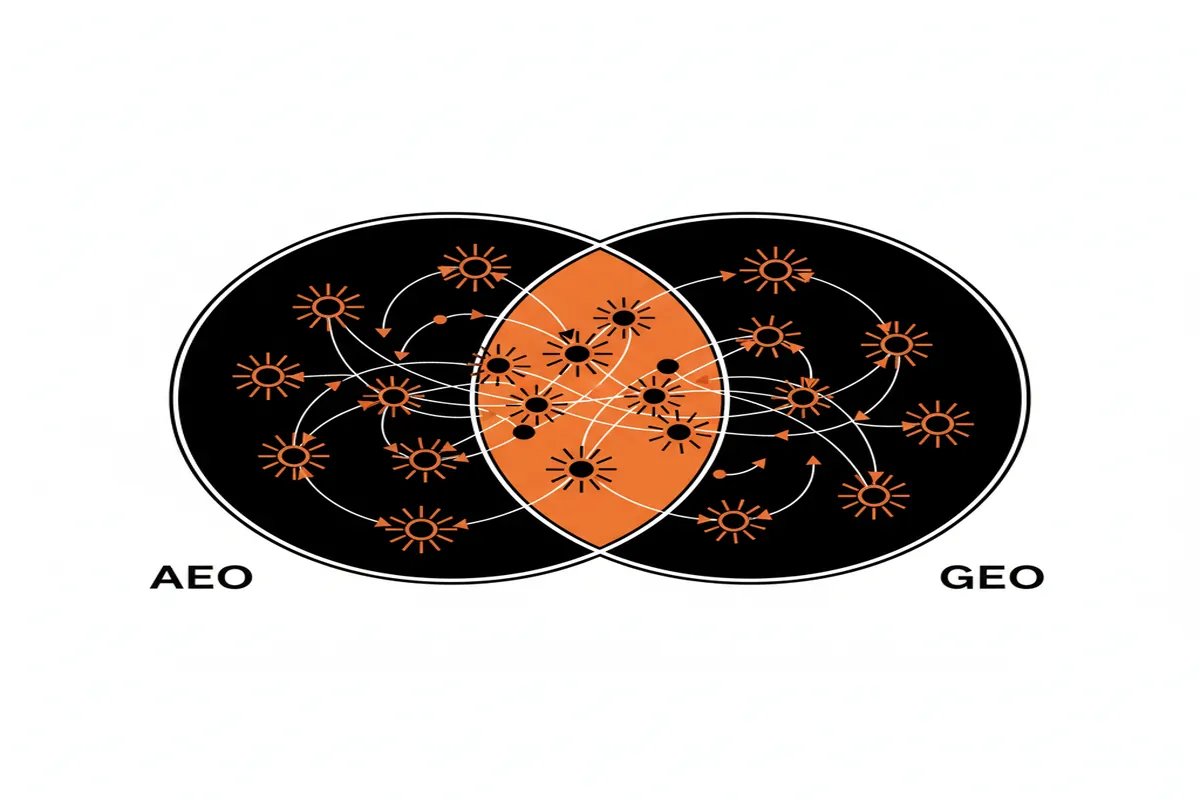
Comparing AEO vs GEO: Key Differences
| Feature | Answer Engine Optimization (AEO) | Generative Engine Optimization (GEO) |
|---|---|---|
| Primary Goal | Fact-based accuracy and direct answers | Visibility in AI-generated summaries |
| Methodology | Structured data and entity mapping | Citation building and narrative context |
| Target Platform | ChatGPT, Siri, Alexa, Google Assistant | Perplexity, Gemini, Google AI Overviews |
| Content Style | Concise, modular, and factual | Narrative, authoritative, and cited |
| Success Metric | Answer accuracy and citation rate | Share of Voice (SoV) in AI summaries |
| User Intent | Immediate informational needs | Deep research and comparative analysis |
| Technical Focus | JSON-LD, Microdata, API accessibility | Natural Language Processing (NLP) and E-E-A-T |
Common AEO and GEO Mistakes to Avoid
- Ignoring Schema Depth: Many brands stop at basic organization schema. In 2026, you need granular details about your specific services to stand out.
- Over-Optimizing for Keywords: Stuffing keywords makes your content look like spam to modern LLMs, which prioritize semantic meaning.
- Neglecting Page Speed: AI agents are impatient. If your page takes too long to load, the crawler may time out, leaving you out of the answer pool.
- Lacking Source Attribution: If you make a claim without citing a source, an AI engine is less likely to trust your data as a primary reference.
- Static Content Strategy: AEO requires frequent updates. If your data is from 2024, an AI search engine will likely ignore it in favor of fresher 2026 insights.
- Failing to use "Speakable" Schema: Many forget that voice search is a major component of AEO. If your content isn't marked as "speakable," you miss out on Alexa and Siri results.
"The winners in the next era of search won't be those who rank for keywords, but those who become the most trusted source of truth for the machines."
Best Practices for Dominating AI Search
- Use "Nuggetized" Content: Break long articles into small, digestible sections that each answer a specific sub-question.
- Verify via Third Parties: Ensure your brand information is consistent across Wikipedia, LinkedIn, and industry-specific directories.
- Prioritize E-E-A-T: Google’s Experience, Expertise, Authoritativeness, and Trustworthiness guidelines are more relevant than ever for GEO success.
- Monitor AI Citations: Use tools to track how often your site is cited as a source in Perplexity or Gemini responses.
- Refine Your Brand Voice: A consistent voice across all platforms helps AI engines identify your "digital fingerprint."
Mastering the "Direct Answer" Format
To secure the featured snippet or the AI summary lead, you must master the "Inverted Pyramid" of AI content. Place the most important fact in the first sentence. Follow it with two supporting pieces of evidence. End the section with a link to more detailed data. According to data from Ahrefs, pages that provide a clear answer in the first 50 words have a significantly higher chance of capturing the "Position Zero" equivalent in generative engines.
How AEO and GEO Affect Visibility in ChatGPT, Gemini, and Perplexity
In 2026, the way these platforms interact with your site varies. ChatGPT relies heavily on its training data but uses search plugins to find current information; here, AEO ensures your facts are chosen. Gemini integrates deeply with Google's ecosystem, meaning your traditional SEO and AEO efforts work in tandem. Perplexity acts as a "citation engine," where GEO strategies are paramount to ensuring your link appears in the footnotes.
Copilot leverages Microsoft's Graph, making your LinkedIn and B2B presence vital. To stay visible, you must provide clear, structured, and authoritative content that these engines can parse without ambiguity. If the AI cannot easily verify your claims, it will hallucinate a competitor's data or omit you entirely. You can learn more about this in our guide on how AI chooses sources.
Platform-Specific Optimization Tactics
Each engine has a different "hunger." ChatGPT prefers conversational, well-explained logic. Perplexity thrives on academic-style citations and data points. Gemini looks for high-authority brand signals and Google-verified information. You must tailor your GEO strategy to meet these specific needs. For instance, if you want to appear in Perplexity, you should publish original research or whitepapers that are easy for the engine to cite as a primary source.
Case Study: B2B SaaS Results in 2025
We worked with a B2B SaaS client in the fintech space that was struggling to appear in AI-generated summaries despite having high organic rankings. By shifting their strategy from traditional SEO to a combined AEO and GEO approach, we focused on restructuring their technical documentation and implementing deep schema.
Within six months, the client saw a 145% increase in citations across major AI platforms like Perplexity and Gemini. Their "Share of Model" (a metric we use to track how often an AI mentions a brand) grew by 60% compared to their nearest competitor. Most importantly, while their traditional search traffic remained stable, the quality of leads from AI search interfaces resulted in a 22% higher conversion rate because the users were arriving with their questions already answered by the AI. This transition is further explained in our post on AEO vs SEO.
Comparative Analysis of Performance Gains
| Metric | Before AEO/GEO | After AEO/GEO (6 Months) | Growth % |
|---|---|---|---|
| AI Summary Visibility | 12% of queries | 38% of queries | +216% |
| Direct Answer Citations | 45 per month | 110 per month | +144% |
| Average Time on Page | 1:12 | 2:05 | +73% |
| Demo Requests (AI Source) | 8 / mo | 24 / mo | +200% |
Tools and Resources for Optimization
- Merkle Schema Generator: A free tool to help you build valid JSON-LD markup for your site.
- Perplexity Pages: Use this to see how AI synthesizes information about your industry (Free/Paid).
- Semrush AI Content Strategy: A paid suite that helps identify entity gaps in your content.
- Hugging Face Models: A platform to test how open-source LLMs interpret your website's text (Free).
- Schema.org Validator: The official tool to ensure your code is readable by all major engines.
How to Measure Success in the AI Era
Success in 2026 is measured by your "Answer Rate." You should track the following:
- Citation Frequency: How often does an AI link to your site?
- Entity Dominance: Does the AI associate your brand with your primary services?
- Referral Traffic from AI: The volume of users clicking through from AI summaries.
- Sentiment Score: How does the AI describe your brand? (Positive, Neutral, or Skeptical).
AEO Checklist:
- [ ] Is my schema valid?
- [ ] Do I answer the primary question in the first 45 words?
- [ ] Is my site loading under 1.5 seconds?
- [ ] Are my citations updated for 2026?
- [ ] Have I mapped my internal links based on entity relationships?
- [ ] Is my "About Us" page structured as a
PersonorOrganizationentity?
Testing and QA for AI Optimization
Before you roll out a site-wide AEO strategy, you must test how LLMs perceive your content. You cannot rely on traditional SEO crawlers alone. We recommend a "Closed Loop" testing procedure to ensure your changes actually improve AI visibility.
- Isolation Testing: Create a new, non-indexed page with specific, unique facts. Use an LLM with live search capabilities (like Perplexity or ChatGPT with Search) to see if it can extract those facts within 48 hours of publication.
- Sentiment Analysis: Copy your top three service pages and paste them into a tool like Claude or GPT-4. Ask the AI: "Based on this text, what is this brand an expert in, and what are its weaknesses?" If the AI cannot identify your core expertise immediately, your content is too vague.
- Structured Data Validation: Use the Rich Results Test to verify that your JSON-LD isn't just valid, but actually eligible for special display features.
- Agentic Crawl Simulation: Use a tool like Screaming Frog to simulate how an AI agent (rather than a standard bot) parses your text hierarchy. Focus on the
H1toH3flow.
Regularly auditing your "Share of Model" is the only way to ensure your GEO efforts are working. If your competitors are appearing in summaries while you are relegated to the footnotes, your content likely lacks the "factual density" required for high-trust seeds.
The Trade-offs: Where AEO and GEO Fail
While we advocate for these strategies, we must be honest about their limitations. AEO and GEO are not a magic bullet for every brand, and there are specific scenarios where they can actually hurt your performance.
- The "Cannibalization" Problem: By providing a perfect direct answer, you may satisfy the user's curiosity entirely within the AI interface. This leads to a drop in click-through rates (CTR). You win the brand impression, but you lose the website session. You must decide if brand authority is worth the loss of pixel-tracking data.
- Hallucination Risks: If your AEO markup is slightly ambiguous, an AI engine might misinterpret your data. We have seen cases where AI summaries accidentally attributed a competitor's pricing to our client because the entities were too closely linked in the same paragraph.
- Maintenance Overhead: Unlike traditional SEO, which can sometimes be "set and forget" for long-tail keywords, AEO requires constant vigilance. If a major LLM updates its training data or its RAG weightings, your rankings can disappear overnight.
- Creative Constraints: Optimizing for machines often requires a specific, almost clinical structure. This can clash with a brand's desire for creative, poetic, or abstract storytelling. If your brand relies on "vibes" rather than facts, AEO will be a difficult path.
Understanding these trade-offs allows you to build a balanced strategy. You should use GEO to capture top-of-funnel awareness, while maintaining traditional content that drives users deep into your own ecosystem where AI cannot follow.
The Future of AEO and GEO in 2026 and Beyond
As we look toward 2027, the distinction between AEO and GEO will likely blur into a single "Intelligence Optimization" discipline. We expect to see "Personalized AI Agents" that don't just search the web, but negotiate on behalf of users. For brands, this means your data must be ready for transaction, not just reading. Staying ahead requires a commitment to what is answer engine optimization today so you are prepared for the agents of tomorrow.
Navigating the nuances of AEO vs GEO requires a technical partner who understands the underlying mechanics of AI. We help brands move beyond keywords to achieve true authority in generative search. You can start by requesting a free AEO audit to see where you stand.
Ready to dominate the answer engines? Contact us today for our premium [services](/services) and let’s build your digital authority together.
Frequently asked questions
What is the main difference between AEO and GEO?+
AEO (Answer Engine Optimization) focuses on providing structured, factual data that AI models like ChatGPT can use for direct answers. GEO (Generative Engine Optimization) focuses on the broader visibility and citations of a brand within the synthetic summaries produced by AI search engines like Perplexity. AEO is the 'what' (facts), while GEO is the 'how' (visibility and context).
How does AEO differ from traditional SEO?+
SEO (Search Engine Optimization) is designed to help web pages rank in traditional search result lists. AEO is a newer subset of optimization that specifically targets AI answer engines and voice assistants. While SEO focuses on clicks to a website, AEO focuses on providing the definitive answer that the engine provides directly to the user.
What are the best practices for GEO?+
To optimize for GEO, you should focus on building strong digital authority through citations on reputable sites, using clear and authoritative natural language, and ensuring your brand is mentioned in context with industry-relevant topics. GEO is about being 'top of mind' for the AI when it generates a summary of a specific niche or industry.
Is it still necessary to do AEO and GEO in 2026?+
Yes, AEO and GEO are essential for 2026. With a significant portion of search traffic moving toward generative AI responses, brands that do not optimize for these engines risk becoming invisible. Gartner and other experts have highlighted the shift away from traditional search towards AI-mediated interactions, making these strategies vital for survival.
What role does structured data play in AEO?+
Structured data, specifically JSON-LD schema, is the backbone of AEO. It provides a clear map of your content's entities and relationships, which reduces the effort AI crawlers need to understand your page. By using schema.org types like FAQ, Service, and Product, you increase the likelihood of your data being cited in AI answers.
How do you measure the success of AEO and GEO?+
Success is measured using metrics like Citation Frequency (how often AI cites your site), Share of Model (your brand's presence in AI responses compared to competitors), and referral traffic from AI platforms. Unlike traditional SEO, the goal is often to provide the 'Position Zero' answer that builds brand trust and authority.
Sources & further reading
Soft next step
Want to see where AI answers mention you — and where they don't?
We run a free AEO audit across ChatGPT, Gemini, Copilot and Perplexity, then hand you the fixes in priority order. Start your AEO strategy today.
Keep reading
AEO Fundamentals
AEO vs SEO: Which Strategy Should You Prioritize in 2026?AI Platforms
How AI Chooses Sources: The Definitive 2026 Guide to AEOAEO Fundamentals
What is Answer Engine Optimization (AEO)? A 2026 Guide for B2B