The Ultimate Guide to a Combined SEO and AEO Content Strategy in 2026

Mastering the dual-path approach to modern digital visibility.
Quick answer
A combined SEO and AEO content strategy integrates traditional search visibility with optimization for AI answer engines. It involves creating high-authority, structured content that helps your brand rank in Google search results while simultaneously being cited as the primary source by AI models like ChatGPT, Gemini, and Perplexity.
A combined SEO and AEO content strategy is the unified process of optimizing digital content for both traditional search engines and generative AI models. By the start of 2026, the lines between these disciplines have blurred. You must now create content that satisfies Google’s ranking algorithms while feeding the large language models that power answer engines. This dual-path approach ensures your brand remains visible whether a user types a query into a browser or asks a voice assistant for a recommendation. We focus on building topical authority through structured data and conversational clarity to capture traffic from every digital entry point.
We see this shift as a transition from "visibility" to "verifiability." In the past, ranking was about popularity and relevance. Today, it is about accuracy and accessibility. If a machine cannot verify your claims through cross-referenced data, it will not risk citing you. Our approach treats every page as a data source for AI and a resource for humans.
What is a Combined SEO and AEO Content Strategy?
To win in 2026, you must understand the core components of a modern strategy. First, Search Engine Optimization (SEO) remains the practice of improving your website's visibility in organic search results through technical health, backlinks, and keyword relevance. Answer Engine Optimization (AEO) is the newer discipline of tailoring content so AI models can easily parse, understand, and cite your brand as a definitive source.
A successful strategy relies on Structured Data, which refers to standardized code (Schema.org) you add to pages to help machines understand your content's context. We also prioritize Entity-Based Content, where you build pages around specific concepts or "entities" rather than just strings of keywords. Finally, Generative AI Search (SGE) represents the evolved search interface where AI provides a direct answer alongside traditional links. Combining these allows you to capture the "zero-click" answer and the high-intent click-through simultaneously.
The Role of Natural Language Processing (NLP)
Inside this strategy, NLP serves as the bridge. AI models use NLP to determine if your content actually answers the prompt or just circles around it. To optimize for this, you must shift your writing style. We move away from "marketing speak" and toward "declarative clarity." This means using simple subject-verb-object sentences that leave no room for machine misinterpretation. When you define a service, do not call it a "synergistic solution for modern paradigms." Call it "a software tool that automates payroll for small businesses."
Why it Matters for AEO and SEO in 2026
The search environment changed rapidly between 2025 and 2026. According to Gartner, search engine volume is projected to drop significantly as users shift toward AI-powered conversational interfaces. This doesn't mean search is dead; it means the way people find information has fragmented.
Data from Search Engine Land suggests that over 60% of consumers now use a mix of traditional search and AI chat to make B2B purchasing decisions. If your content only ranks on page one of Google but never appears in a ChatGPT citation, you lose half your potential audience. Our clients see that optimizing content for AI search preserves brand equity in an era where the "blue link" is no longer the only goal.
Furthermore, Google’s own evolution into an "Answer Engine" via AI Overviews (formerly SGE) means that traditional SEO real estate is shrinking. The top of the page is now dominated by AI-generated summaries. If you are not the source for that summary, you are buried under a "Read More" button.
Building Your Combined Strategy: A Step-by-Step Guide
Step 1: Perform a Dual-Intent Keyword Audit
Start by mapping your current keyword list to both search volume and "answerability." Not every query needs an AI summary, and not every conversational question drives a website click. You need to identify which terms trigger AI Overviews and which ones still drive traditional organic traffic.
- Export your top 500 keywords from Ahrefs or Semrush.
- Manually test a sample of 50 in Gemini and Perplexity.
- Categorize them into "Informational (AI Target)" or "Transactional (SEO Target)."
- Identify "Answer Gaps" where competitors are cited but you are not.
Why it works: It prevents you from wasting resources on content that AI will simply "scrap" without giving you credit. Common mistake: Focusing solely on high-volume keywords while ignoring long-tail, natural language questions. Pro tip: Use tools to see which of your target terms currently generate citations in Perplexity or Gemini.
Step 2: Structure Content for Extraction
AI models prefer clear, hierarchical structures. Use H2 and H3 tags not just for aesthetics, but to create a logical flow that a machine can crawl. Each section should lead with a direct answer to a specific sub-topic before expanding into detail.
- H2: The broad question or topic.
- Paragraph 1: Direct, factual answer (the "Snippet").
- H3s: Supporting details, steps, or features.
- Bullet Points: Lists that summarize complex data.
Why it works: It increases the likelihood of your text being pulled into a "featured snippet" or an AI summary. Common mistake: Writing long, rambling intros that bury the main point. Pro tip: Keep your primary answer to a query within the first 50 words of a section to help AEO vs SEO performance.
Step 3: Implement Advanced Schema Markup
Go beyond basic Article schema. Use Organization, FAQ, Product, and Speakable schemas to define the relationships between your data points. This provides the "proof" AI engines need to trust your information.
| Schema Type | Purpose | AEO Benefit |
|---|---|---|
| SameAs | Links your site to official profiles (LinkedIn, Crunchbase). | Establishes Entity Authority. |
| FAQ | Maps specific questions to specific answers. | Increases chance of AI citation. |
| Product | Provides price, availability, and review data. | Feeds shopping AI engines. |
| Speakable | Identifies sections for voice assistants. | Captures Siri and Alexa traffic. |
Why it works: Schema acts as a translation layer between your human-readable text and the machine's database. Common mistake: Using outdated or broken schema code that results in "unparsable data" errors in Google Search Console. Pro tip: Use the Schema.org validator regularly to ensure your code matches the latest 2026 standards.
Step 4: Build Topical Authority via Clusters
Instead of individual posts, create "content hubs." Link a central pillar page to multiple specific sub-pages. This tells both Google and AI models that you are a comprehensive expert on the subject, not just a one-hit wonder.
The "Nodal" Content Approach
In 2026, we view clusters as a network of nodes. Each node must serve a unique purpose. If you have a pillar page about "B2B Lead Generation," your sub-nodes should cover "LinkedIn Lead Gen," "Email Outreach Tech," and "Lead Scoring AI." Do not repeat the same definitions across these pages. Instead, use cross-links to show the AI how these topics connect. This maps your site as a mini-knowledge graph.
Why it works: Search engines and AI both use "link graphs" to determine who the true experts are in a niche. Common mistake: Creating "thin" pages that don't add new value to the cluster. Pro tip: Audit your AEO content strategy every quarter to fill gaps in your topical coverage.
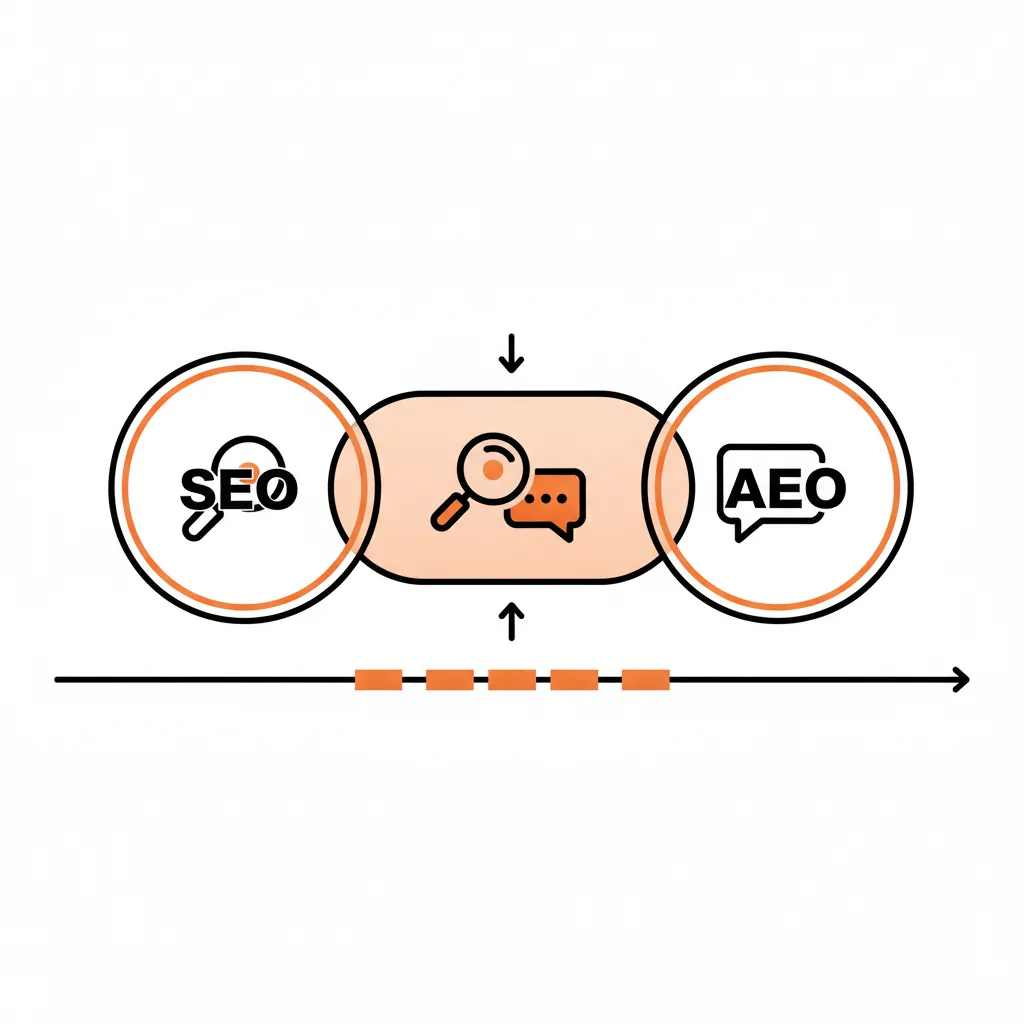
Comparing SEO and AEO Priorities
| Feature | Traditional SEO Focus | Modern AEO Focus | Combined Strategy Goal |
|---|---|---|---|
| Primary Goal | Ranking #1 in SERPs | Becoming the LLM "Cited Source" | Maximum brand visibility |
| Content Format | Long-form, keyword-rich | Concise, Q&A, structured | Hybrid modular content |
| Technical Requirement | Page speed & mobile-first | Schema & JSON-LD | Performance + Machine Readability |
| Success Metric | Organic Click-Through Rate | Citation Share & Share of Voice | Total Brand Mentions |
| User Intent | Browsing / Researching | Immediate Problem Solving | Full Funnel Coverage |
| Crawling Frequency | Weekly/Monthly (Bot dependent) | Real-time / API-driven | Constant data freshness |
Common Mistakes to Avoid
- Ignoring Brand Voice: Many teams strip away their personality to please AI, resulting in bland content that no human wants to read.
- Over-Optimizing for Bots: If you write strictly for LLMs, your Google rankings will suffer because your "Helpful Content" scores will drop.
- Neglecting Backlinks: AI engines still use traditional signals like authority and mentions from other sites to verify your claims.
- Forgetting the CTA: Getting the "answer" is great, but if you don't guide the user to your services, the traffic is vanity.
- Static Content: Failing to update your "facts" leads AI to cite your competitors who have more current data.
- Using AI to Write Everything: If you use AI to write content intended for AI, you often end up with a feedback loop of generic information that lacks the "Experience" required by Google's E-E-A-T guidelines.
Best Practices and Pro Tips
- Use the Inverted Pyramid: Put the most important information at the top of every page to satisfy fast-moving AI crawlers.
- Verify All Facts: AI models are trained to detect hallucinations; if your content contains factual errors, you will be de-indexed from answer engines.
- Optimize for Voice: Read your content out loud. If it sounds unnatural, it won't perform well in voice-based AEO.
- Claim Your Entities: Use Google Knowledge Studio and social profiles to ensure your brand is recognized as a unique entity.
- Monitor AI Citations: Use specialized AEO insights tools to see how often ChatGPT or Copilot mentions your brand name.
- Diversify Media: Use original images and videos with descriptive alt-text. AI models increasingly use multi-modal search, meaning they "see" your images as part of the answer.
"In 2026, the winner isn't the one with the most content, but the one who provides the most verifiable, structured, and accessible truth to the machines that guide human decisions."
Impact on ChatGPT, Gemini, Copilot, and Perplexity
Each AI engine has a slightly different way of sourcing information, but a combined strategy covers them all. ChatGPT relies heavily on high-authority web crawls and partnerships. By maintaining a strong SEO profile, you remain in its training data. Gemini is integrated directly with Google Search, so your traditional SEO rankings directly influence your visibility there.
Copilot uses Bing’s index and prioritizes structured data and clear citations. Finally, Perplexity acts more like a real-time research assistant; it favors recent, factually dense content with clear outbound links. By following a combined SEO and AEO content strategy, you ensure your brand is the "common denominator" across all these platforms. If you aren't visible here, you are effectively invisible to a third of your market.
Recent observations from Ahrefs suggest that Perplexity is particularly sensitive to "Freshness." If you update a page today, Perplexity often reflects that data within 24 to 48 hours. Gemini, however, tends to rely on the broader Google index, which might take longer to refresh but carries more weight for established brand authority.
The Testing and QA Process
Before rolling out an AEO-heavy strategy across your entire site, you must test your assumptions. Content that looks good to a human editor might be incomprehensible to an LLM.
The AEO Sandbox Method
We recommend a three-step QA process for all new content modules:
- Machine Readability Check: Run your text through a simplified NLP tool. If the sentiment or topic categorization is off, the AI will likely misrepresent you.
- The "Prompt Test": Copy your raw text into ChatGPT-4o or Claude 3.5. Ask the AI: "Based only on this text, what is the answer to [Target Question]?" If the AI struggles to find the answer or hallucinates, your structure is weak.
- Schema Validation: Use the Rich Results Test tool. A single missing bracket in your JSON-LD can prevent an entire page from being indexed by answer engines.
Monitoring for "Citation Decay"
AEO is not "set and forget." AI models update their weights regularly. We suggest a monthly QA check on your top 10 most important "Answer" queries. If you notice a competitor has taken your spot in the AI summary, analyze their sentence structure and data points. They likely provided a more concise or more recent fact than you did.
Honest Trade-offs: When AEO Fails
A combined strategy is powerful, but it is not a silver bullet. You will face specific trade-offs that can be frustrating for traditional marketers.
The Conversion Gap
The biggest risk of AEO is the "Zero-Click" phenomenon. If an AI gives the user the perfect answer using your content, the user might never click your link. This results in high brand impressions but lower website traffic. You must decide if being the "hidden expert" is worth the loss in direct hits. For top-of-funnel queries, it usually is. For bottom-of-funnel queries, you may want to withhold just enough information to trigger a click.
Technical Overhead
Implementing advanced schema and modular content requires more dev time than traditional blogging. You cannot simply write a 500-word post and hit publish. You have to code it, verify it, and link it correctly. If your team is small, the overhead of AEO can slow down your content production volume.
LLM Hallucinations
No matter how well you optimize, AI models can still get it wrong. You might be the perfect source, but ChatGPT might attribute your quote to a competitor. This is a platform-side error that you cannot always fix. Relying too heavily on AEO means placing your brand reputation in the hands of an algorithm you do not control.
Case Study: B2B SaaS Growth in 2025-2026
We worked with a B2B SaaS client in the fintech space that was struggling with declining organic traffic as AI Overviews took over their top-performing keywords. Their original strategy was purely traditional SEO, focusing on long-form guides that were 3,000+ words long but lacked clear structure.
We implemented a combined strategy. First, we modularized their content, breaking those long guides into specific, answer-based sections. We added comprehensive FAQ schema and defined their product as a specific entity within the fintech ecosystem.
- Month 1: Audited 200 pages for "Snippet potential."
- Month 2: Rewrote intros to be "declarative" (Answer-first).
- Month 3: Deployed Organization and FAQ schema site-wide.
- Month 6: Measured citation growth in AI engines.
Within six months, the results were clear. While their traditional organic traffic stabilized, their "Citation Share" in Perplexity and Gemini increased by 45%. More importantly, the leads coming from AI search interfaces had a 20% higher conversion rate than traditional search leads. The users were arriving better informed because the AI had already "vetted" our client as the top solution. You can see more about these approaches on our blog.
Tools and Resources
- Semrush / Ahrefs: Essential for traditional keyword research and monitoring your SEO health (Paid).
- Google Search Console: The best free tool to monitor how Google sees your structured data and indexed pages (Free).
- Perplexity Pages: Use this to see how AI synthesizes information in your niche and where the gaps are (Free/Paid).
- Schema.org: The official documentation for all types of structured data you need to implement (Free).
- Hugging Face NLP Tools: Useful for checking how machines categorize your text (Free).
- Best Answer Engine Optimization Services Audit: Our proprietary tool for measuring your current AI visibility.
How to Measure Success
Measuring a combined strategy requires looking at two sets of KPIs. You cannot rely on clicks alone anymore.
- Traditional Metrics: Organic sessions, keyword rankings, and bounce rate.
- AEO Metrics: Share of Voice in AI responses, number of citations in LLMs, and "Zero-Click" visibility.
- Conversion Metrics: Leads attributed to AI search referrals and total brand search volume.
Success Checklist:
- [ ] Are your H2s framed as questions or clear topics?
- [ ] Does every page have at least one block of Schema markup?
- [ ] Is your "Quick Answer" within the first paragraph?
- [ ] Have you checked your brand's reputation in ChatGPT this month?
- [ ] Is your content free of "fluff" that confuses NLP models?
The Future of Content Strategy in 2026 and Beyond
As we move deeper into 2026, the "Search" button will continue to be replaced by the "Ask" button. We expect AI models to become even more selective about the sources they trust. The focus will shift from "content volume" to "information density." Brands that provide the most value in the fewest words—while backed by technical schema—will dominate the market. Personalization will also play a larger role, where AI engines provide different answers based on the user's specific history, making your brand's overall authority even more critical.
According to research from BrightEdge, AI-led search experiences now account for a significant portion of all informational queries. This trend will only accelerate as hardware—like AI-integrated smartphones and wearable tech—removes the browser entirely from the equation. Your content must be ready to live outside of a website container.
Integrating your SEO and AEO efforts is no longer a luxury; it is a requirement for survival. By starting now, you position your brand as a leader in the next generation of the internet. If you are ready to see how your site stacks up, start with a free AEO audit.
Our team at Best Answer Engine Optimization Services is ready to help you navigate this transition and ensure your content stays at the top of every result, whether it's a link or a chat bubble.
[Explore our full range of AEO and SEO services](/services) to start winning in 2026.
Frequently asked questions
Why do I need both SEO and AEO in 2026?+
A combined strategy ensures you capture traffic from both traditional search engines (Google) and AI-driven answer engines (ChatGPT, Perplexity). In 2026, users split their time between these platforms. If you only optimize for one, you miss half your potential leads. SEO builds your foundation and long-term authority, while AEO ensures you are the direct answer provided to conversational queries.
How do I start a combined SEO and AEO content strategy?+
Start by auditing your content for 'answerability.' Structure your pages with clear headers (H2s and H3s) and use Schema.org markup to help AI understand your data. Focus on providing direct, factual answers early in your content. Finally, monitor your 'Citation Share' in AI tools to see how often your brand is mentioned as a source compared to competitors.
Is SEO still relevant if I am focusing on AEO?+
No, SEO is not dead, but it has evolved. While traditional search volume for simple questions has decreased, high-intent searches and complex research still happen on Google. SEO provides the authority signals (like backlinks and technical health) that AEO engines use to decide which sources to trust. They work together rather than one replacing the other.
What content formats perform best for AI answer engines?+
AI engines like Perplexity and Gemini prioritize structured data, factual accuracy, and topical authority. They look for content that is easy to parse and comes from a verified 'entity.' By using JSON-LD schema and clear, hierarchical writing, you make it easier for these models to extract your information and credit your brand as the expert.
How do I measure the ROI of AEO?+
Success is measured through a mix of traditional and new metrics. Track your organic traffic and keyword rankings for SEO. For AEO, monitor your 'Share of Voice' in AI responses and the frequency of citations your site receives in models like ChatGPT. Tools like our AEO audit can help quantify your visibility in these conversational interfaces.
Does AEO require shorter content than traditional SEO?+
Content length is less important than 'information density.' While SEO still values comprehensive guides, AEO favors content that can be broken into modular, direct answers. Your strategy should include 'Pillar Pages' for SEO authority and 'Response Blocks' within those pages for AEO extraction, ensuring you satisfy both humans and machines.
Sources & further reading
Soft next step
Want to see where AI answers mention you — and where they don't?
We run a free AEO audit across ChatGPT, Gemini, Copilot and Perplexity, then hand you the fixes in priority order. Start your AEO strategy today.
Keep reading
AEO Fundamentals
AEO vs SEO: Which Strategy Should You Prioritize in 2026?Content Strategy
AEO Content Strategy: How to Optimize Content for AI Search in 2026Content Strategy
Optimizing Content for AI Search Engines: A 2026 Guide