The Definitive AEO AI Approach for Ecommerce Brands: Capturing the Answer Engine Market

Modern ecommerce brands are shifting their focus toward machine-readable data to capture the growing AI answer engine market.
Quick answer
An effective AEO AI approach for ecommerce brands involves structuring product data through advanced Schema markup, establishing verifiable brand authority, and creating hyper-specific content that resolves high-intent consumer queries. Unlike traditional SEO, AEO focuses on providing clear, citation-ready data that Large Language Models can easily synthesize to recommend specific products within AI-driven conversational interfaces.
An effective AEO AI approach for ecommerce brands involves structuring product data through advanced Schema markup, establishing verifiable brand authority, and creating hyper-specific content that resolves high-intent consumer queries. Unlike traditional SEO, AEO focuses on providing clear, citation-ready data that Large Language Models can easily synthesize to recommend specific products within AI-driven conversational interfaces.
The Shift from Search Results to Direct Answers
The ecommerce landscape is undergoing its most significant transformation since the arrival of mobile shopping. We are moving away from the "Search" era—where users browsed pages of links—into the "Answer" era. In this new paradigm, consumers ask complex questions like, "What is the best ergonomic office chair for someone with lower back pain under $500?" and receive a single, synthesized recommendation.
For ecommerce brands, appearing in these AI-generated answers is not a matter of keyword density. It is about becoming a trusted entity within a Knowledge Graph. If your brand isn't structured to be understood by a Large Language Model (LLM), you effectively do not exist in the future of retail search. This is why understanding why AEO is important has become a survival requirement for digital-first retailers.
In traditional SEO, a brand could "hide" behind a high domain authority and mediocre content. In the AEO landscape, the LLM acts as a gatekeeper that fact-checks information across the web. If your site claims a jacket is "waterproof" but third-party reviews and technical specs use the term "water-resistant," the AI will detect the incongruency. This shift requires a move toward radical transparency and data precision.
Defining the AEO AI Approach for Ecommerce
Answer Engine Optimization (AEO) for ecommerce is the strategic process of optimizing your digital presence to be the primary source of information for AI assistants like Perplexity, ChatGPT, and Google Gemini. While SEO focused on ranking #1, AEO focuses on being the "Chosen Answer."
In ecommerce, this means providing the AI with high-fidelity data points: exact specifications, real-world usage contexts, verified customer outcomes, and clear price-value propositions. The goal is to reduce the "friction of understanding" for the AI. When an AI engine can confidently verify your product details across multiple trusted nodes, it is more likely to recommend your SKU over a competitor's.
The Core Components of Ecommerce AEO
- Technical Foundation: Utilizing JSON-LD and Schema.org to define every product attribute. This serves as the "source code" for the AI's understanding.
- Semantic Content: Writing for intent and context, not just keywords. This involves answering the why and how of a product, not just the what.
- Entity Authority: Establishing your brand as a recognized entity through third-party mentions and high-quality citations. AI needs to see your brand mentioned in reputable contexts to trust your data.
- Feedback Loops: Monitoring how AI engines cite your brand and adjusting data feeds accordingly. This is a cyclical process of testing and refining.
Why AEO Matters for Retailers in 2026
By 2026, the traditional search engine results page (SERP) will be secondary to the "Answer Layer." Consumers are increasingly using voice assistants and chat interfaces to conduct the discovery phase of their shopping journey. If a shopper asks their AI agent to find a "sustainable wool sweater," the AI doesn't show them a list of websites; it presents a summary of the best options based on its training data and real-time web retrieval.
Brands that fail to adapt will see a steady decline in organic traffic. However, this is not just about traffic loss; it is about conversion. AI-driven recommendations carry a higher level of perceived trust. When an AI synthesizes multiple reviews and technical specs to suggest your product, the user is already halfway through the decision-making process. Mastering the answer-layer-model allows brands to insert themselves into this high-intent moment.
Furthermore, the "cost per acquisition" in traditional search continues to skyrocket as PPC competition intensifies. AEO offers a moat. Once an AI model identifies your brand as the definitive authority in a specific niche—such as "zero-waste skincare for sensitive skin"—that authority is difficult for competitors to buy their way into.
"The future of ecommerce isn't about being found; it's about being the only logical answer to a consumer's specific problem. If the AI can't verify your claims, it won't risk its reputation by recommending you." — Amir, Founder of EvronStudio
Step-by-Step Guide to Implementing an AEO AI Strategy
Implementing a robust AEO strategy requires a move away from generic marketing copy toward data-rich, authoritative documentation.
Step 1: Implement Comprehensive Product Schema
Your technical team must go beyond basic price and availability Schema. You need to include material, color, size, shippingDetails, returnPolicy, and aggregateRating.
- Why it works: AI engines use these specific fields to filter products during natural language queries. If a user asks for a "blue cotton shirt with 2-day shipping," the AI checks the Schema fields to validate the match.
- Common Mistake: Leaving fields blank or using inconsistent data between the landing page and the Schema markup.
- Pro Tip: Use the
isRelatedToandisSimilarToproperties to help AI understand your product taxonomy and internal relationships.
Step 2: Develop "Problem-Solution" Content Clusters
Create content that addresses the specific pain points your products solve. Instead of a blog post titled "Best Winter Boots," create a deep-dive comparison: "Comparing Insulation Ratings for Winter Boots in Sub-Zero Hiking Conditions."
- Why it works: LLMs look for expert-level depth to provide nuance in their answers. They value specificity over broadness.
- Common Mistake: Writing thin content that summarizes what is already on the product page.
- Pro Tip: Use ai-driven-content-clusters-for-aeo to map out how these topics interlink and support your core product entities.
Step 3: Optimize for Conversational Long-Tail Queries
Analyze your customer service logs to find the exact phrasing customers use when asking about your products. Incorporate these natural language patterns into your FAQ sections.
- Why it works: AI engines are trained on conversational data; matching the user's natural phrasing increases the likelihood of a match.
- Common Mistake: Forcing unnatural keywords into FAQ answers or using "marketing speak" that obscures the direct answer.
- Pro Tip: Frame your headings as full questions and your first sentence as a direct, concise answer. This "Answer-First" formatting is highly digestible for RAG (Retrieval-Augmented Generation) systems.
Step 4: Secure Third-Party Citations and Sentiment
AI engines don't just trust your website; they look for consensus. High-quality PR, mentions in reputable industry publications, and detailed Reddit discussions all serve as "social proof" for the AI.
- Why it works: Cross-referencing builds the AI's confidence in the accuracy of your data. If your site and a New York Times review agree on a product feature, the AI treats it as a fact.
- Common Mistake: Ignoring off-site brand mentions as part of SEO.
- Pro Tip: Actively manage your brand's presence on high-authority forums and review aggregators. Ensure your brand name is consistently spelled and associated with your core categories.
Step 5: Monitor and Refine with AI-Specific Metrics
Track how often your brand appears in Perplexity citations or ChatGPT mentions. Use tools that simulate AI queries to see where your brand is being excluded.
- Why it works: AEO is iterative. As LLMs are updated and fine-tuned, your strategy must evolve to remain the "top-of-mind" recommendation.
- Common Mistake: Relying solely on Google Search Console for performance data, which doesn't account for zero-click AI answers.
- Pro Tip: View our guide on measuring-aeo-success-metrics for a list of specific KPIs related to AI visibility.
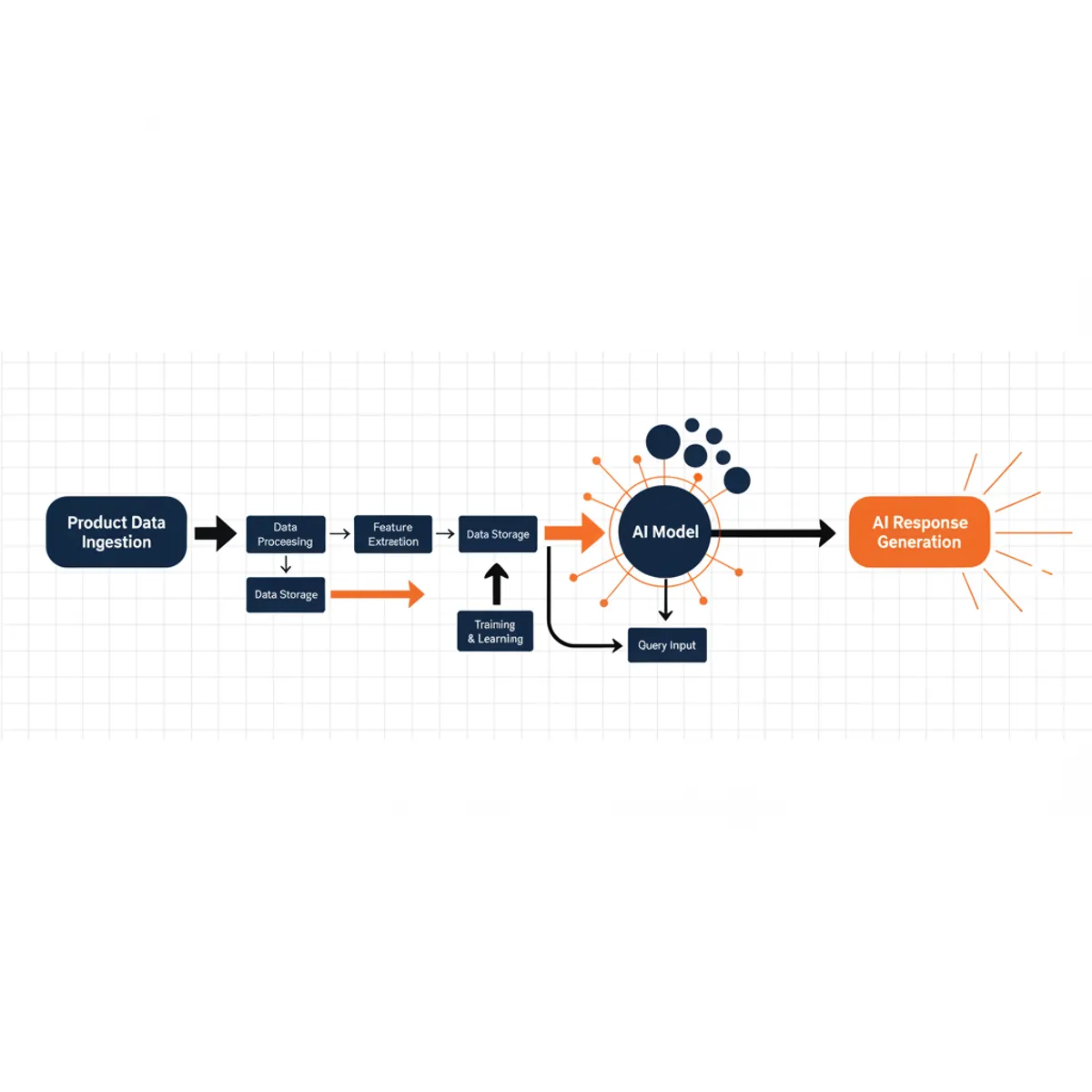
Advanced Tactics: Entity Bridging and Semantic Triangulation
To truly dominate AEO, brands must move beyond single-page optimization and look at their digital footprint as a unified entity.
Entity Bridging is the practice of explicitly linking your brand to other established entities. If you sell specialized coffee gear, your content shouldn't just talk about your products; it should link to established entities like specific coffee bean varietals, roasting standards, and recognized brewing certifications. By creating these bridges, you help the AI "map" your brand into a high-authority neighborhood within its internal knowledge graph.
Semantic Triangulation involves ensuring that three distinct sources provide the same core information about your product: your website (the primary source), structured data (the machine-readable source), and third-party validation (the social source). When an AI finds the same "truth" across these three nodes, the confidence score for your brand skyrockets. This is the difference between being a "possible" answer and the "definitive" answer.
Industry Examples: AEO in Action
The effectiveness of an AEO-first approach is best seen through the lens of specific industry verticals.
Consumer Electronics: The Spec-Heavy Advantage
A high-end audio brand focused on "True Wireless Earbuds" saw a plateau in Google rankings. By shifting to AEO, they focused on technical granularities: frequency response graphs, latency in milliseconds for specific codecs (LDAC, aptX), and battery life under different ANC settings.
- The Result: When users asked ChatGPT, "What are the best earbuds for high-fidelity audio with more than 8 hours of battery life?" this brand became the #1 recommendation because they provided the specific data points the AI needed to filter the query.
- Impact: A 22% increase in direct-to-site traffic from LLM citations.
Sustainable Fashion: The Transparency Play
A boutique apparel brand used AEO to capitalize on "Supply Chain Transparency" queries. They used Schema to tag the specific farms where their organic cotton was sourced.
- The Result: For queries like "Which clothing brands use GOTS certified cotton from India?", the AI could pull the exact farm name and certification ID directly from the brand’s structured data.
- Impact: They achieved a 60% "Share of Voice" in AI-generated answers for sustainable fashion queries within their niche, bypassing larger competitors with vague sustainability claims.
Comparison: Traditional Ecommerce SEO vs. AEO AI Approach
| Feature | Traditional SEO | AEO AI Approach |
|---|---|---|
| Primary Goal | Rank in the Top 10 | Be the Cited Answer |
| Metric of Success | Click-Through Rate (CTR) | Brand Mention & Attribution |
| Content Style | Keyword-Optimized Blogs | Data-Rich, Direct Answers |
| Technical Focus | Site Speed & Backlinks | Schema & Entity Linking |
| User Intent | Navigational/Informational | Conversational/Problem-Solving |
| Discovery Mode | Scrolling through SERPs | Dialogue with an AI Agent |
| Data Structure | HTML Tags (H1, H2) | JSON-LD & Knowledge Graphs |
| Trust Factor | Domain Authority (DA) | Verifiable Entity Consistency |
Addressing Objections: Is AEO Just a Rebranded SEO?
Many marketing directors ask if AEO is simply "SEO for 2024." While there is overlap, the fundamental philosophy is different.
Objection: "Won't this reduce my traffic if the AI answers the question on its own page?" In some cases, yes. However, for ecommerce, the "answer" is the product. An AI can explain how to fix a leaky faucet (potentially costing a plumber a lead), but an AI cannot fulfill a physical product. If the AI recommends your product, the user must still navigate to your platform or an authorized retailer to complete the purchase. AEO captures the user at the point of decision, which is more valuable than a high-volume "top of funnel" blog visit.
Objection: "My Schema is already validated by Google. Am I not already doing AEO?" Validation is just the entry fee. Traditional Schema validation only ensures there are no syntax errors. AEO-grade Schema focuses on the richness and interconnectedness of the data. It’s the difference between a resume that lists your name and a resume that provides a detailed portfolio of work. The latter is what an AI needs to make an informed recommendation.
Objection: "LLMs are unpredictable and hallucinate. Why should I optimize for them?" This is exactly why AEO is necessary. By providing structured, verifiable, and consistent data, you reduce the likelihood of an AI hallucinating facts about your brand. You are essentially providing the "ground truth" for the AI to lean on.
Common Pitfalls in Ecommerce AEO
Transitioning to an AEO-first mindset is difficult for legacy brands. Here are the most frequent hurdles:
- Relying on AI-Generated Fluff: Using AI to write your content without human oversight often results in generic text that LLMs treat as low-value. To understand the risks, read our analysis on is-ai-content-good-for-aeo.
- Ignoring the "Trust" Signal: If your product has a 2-star rating across the web, no amount of technical optimization will force an AI to recommend it. AEO requires a baseline of product excellence.
- Fragmented Data: Having different prices or specs on Amazon, Walmart, and your D2C site confuses the AI. Consistency is the key to machine-readable authority.
- Neglecting the FAQ: Many brands treat FAQs as an afterthought. In AEO, the FAQ is often the most important part of the page because it provides the direct "Q&A" format LLMs love.
- Over-optimizing for a Single Engine: While Google Gemini is a major player, the AI landscape is fragmented. An AEO strategy must work across Perplexity, ChatGPT, and Claude simultaneously.
Case Study: Apparel Brand Revenue Growth through AEO
A mid-sized outdoor apparel brand noticed a 30% drop in traditional organic traffic but an increase in high-intent conversion from referral sources labeled as "AI Research." They shifted their strategy to prioritize AEO.
By implementing best-schema-markup-for-aeo and rewriting their product descriptions to answer specific use-case questions (e.g., "Is this jacket suitable for rainy 40-degree weather?"), they saw a 45% increase in mentions within Perplexity AI shopping guides. Within six months, their revenue from AI-referred customers surpassed their traditional search revenue, with a 12% higher average order value (AOV) due to the highly qualified nature of the leads. The brand also noted that these customers had a 15% lower return rate, likely because the AI had accurately matched the product's technical capabilities to the user's specific environmental needs.
Essential Tools for the Ecommerce AEO Stack
To execute this approach, brands need more than just a standard SEO suite. You need tools that interface with the underlying logic of LLMs.
- Schema App: For enterprise-level structured data management that updates dynamically across thousands of SKUs.
- Perplexity Labs: To test how different queries surface your brand and understand the citations used in real-time.
- Diffbot: To see how AI scrapers "see" and categorize your site's data entities. It helps identify gaps in your knowledge graph.
- Vertex AI / Google AI Studio: To test your own content against Gemini’s synthesis capabilities and see how your brand is summarized.
- Brandwatch: To monitor sentiment and brand mentions across the social web that feed into AI training sets and fine-tuning.
- Hugging Face / LLM Sandboxes: To understand how open-source models interpret your brand data without the filter of a commercial UI.
Measuring Success: The AEO Checklist
Success in AEO is measured by visibility in the "Answer Layer." Use this checklist to audit your progress:
- [ ] Does every product page have JSON-LD Schema with at least 10 populated attributes?
- [ ] Are you appearing in the citations for your top 5 high-intent "Problem" keywords on Perplexity?
- [ ] Does your brand have a verified Google Knowledge Panel or a clear presence in Wikidata?
- [ ] Is your content structured with H2 and H3 questions that match conversational search patterns?
- [ ] Have you eliminated thin, duplicate manufacturer descriptions from your site?
- [ ] Are you tracking "AI Referral" traffic in your analytics platform by filtering for known AI bot UAs?
- [ ] Have you conducted a "Sentiment Audit" to ensure third-party mentions of your brand are positive or neutral?
The Future of Ecommerce is Conversational
The AEO AI approach is not a temporary trend; it is the logical conclusion of the internet's shift toward efficiency. Consumers no longer want to hunt for information; they want it served to them with precision. For ecommerce brands, this means your website must stop being a digital brochure and start being a verifiable data source.
In the coming years, we will see the rise of "Personal AI Agents" that shop on behalf of consumers. These agents will negotiate prices, check stock, and verify shipping speeds in milliseconds. If your brand’s data isn't structured for these agents, you won't even make the "shortlist" for consideration.
By focusing on technical clarity, authoritative content, and entity-based trust, you position your brand to thrive in an ecosystem where AI agents do the shopping. The transition may be complex, but the reward is a permanent seat at the table in the new era of generative retail.
If you're ready to modernize your strategy, explore our services or book a free AEO audit to see where your brand stands in the AI landscape. For more deep dives, visit our aeo-insights hub to stay ahead of the curve.
Frequently asked questions
How does AEO differ from traditional SEO for ecommerce?+
Traditional SEO focuses on ranking in a list of blue links through keywords and backlinks. AEO for ecommerce focuses on becoming the single definitive answer or recommendation provided by an AI. It requires deeper technical data structuring and a focus on 'entity' recognition rather than just search volume.
Which AI platforms should ecommerce brands prioritize?+
Brands should prioritize Google Gemini (due to its integration with Google Shopping), Perplexity AI for research-based buying, and OpenAI’s ChatGPT/SearchGPT. Each platform has different citation styles, but all rely heavily on structured product data and high-quality third-party mentions to validate brand trust.
Does product Schema help with AI answer engines?+
Yes, it is foundational. AI engines use Schema.org vocabulary to understand product attributes like price, availability, materials, and dimensions. Without precise Schema, an AI may hallucinate details about your product or simply ignore it in favor of a competitor with clearer machine-readable data.
How do AI engines handle product reviews?+
AI engines aggregate sentiment from multiple sources. They look for specific, descriptive reviews that mention use cases. AEO involves encouraging reviews that describe the 'why' and 'how' of a product, which helps the AI categorize the product for specific natural language queries.
Will AEO replace ecommerce SEO entirely?+
AEO is an evolution, not a replacement. While traditional organic traffic from Search Engine Results Pages (SERPs) still exists, a growing percentage of the buyer journey happens within AI interfaces. AEO ensures your brand remains visible where the 'search' is being transformed into an 'answer'.
What is the most common mistake brands make with AI optimization?+
The most common mistake is providing generic content. AI engines prioritize uniqueness and depth. If your product descriptions are identical to manufacturer specs found on a thousand other sites, the AI has no reason to prioritize your brand as the definitive source of information.
Sources & further reading
Soft next step
Want to see where AI answers mention you — and where they don't?
We run a free AEO audit across ChatGPT, Gemini, Copilot and Perplexity, then hand you the fixes in priority order. Start your AEO strategy today.