Why AEO is Important for SEO: Dominating Search in 2026

The evolution of search from keyword lists to direct AI answers.
Quick answer
AEO is important for SEO because search engines now prioritize providing direct answers over a list of blue links. By optimizing for Answer Engines, you increase your visibility in AI-generated snapshots, voice search results, and featured snippets, ensuring your brand remains authoritative as search behavior shifts toward conversational queries.
AEO is important for SEO because it aligns your content with how modern search engines and AI models process information. By optimizing for direct answers, you ensure your brand appears in AI snapshots, voice search results, and featured snippets, capturing traffic that traditional SEO strategies might miss in a conversational search world. In 2026, the traditional search engine result page (SERP) has evolved into a hybrid interface. Users no longer want to click through five different websites to find a simple answer. They expect the platform to do the heavy lifting for them. This shift means that if you are not visible in the "answer box" or the AI-generated overview, you are effectively invisible to a large portion of your target audience.
According to research from Gartner, search volume from traditional engines is expected to see a significant shift as users gravitate toward AI-powered assistants. This isn't just a trend for early adopters. It represents a fundamental change in how humans retrieve facts. When you ignore AEO, you essentially hand your market share to competitors who are willing to speak the language of machines.
What is Answer Engine Optimization?
To understand why this matters, we must define the core components of the current search ecosystem. Answer Engine Optimization (AEO) is the process of synthesizing and formatting content so that Answer Engines—platforms like ChatGPT, Perplexity, and Google Gemini—can easily ingest and cite it. An Entity is a well-defined object or concept, such as a brand, person, or product, that AI models use to build relationships between data points.
We also focus heavily on Structured Data, which refers to standardized code (often JSON-LD) that helps search bots understand the context of a page. Finally, Natural Language Processing (NLP) is the technology AI uses to interpret human speech and writing. In 2026, these elements form the foundation of how information is discovered. You can learn more about these AEO insights to see how they interact with traditional search strategies.
Understanding the RAG Cycle
Most answer engines utilize a process called Retrieval-Augmented Generation (RAG). Instead of just generating text from their training data, they "retrieve" live information from the web to provide current answers. If your content is structured correctly, the engine pulls your data into its working memory. It then generates a response that cites your URL as the primary source. This makes your website an essential part of the AI's cognitive process.
Why AEO is Vital for SEO in 2026
The search world changed significantly over the last year. According to data from Gartner, search engine volume is projected to drop as users shift toward AI-powered conversational interfaces. Furthermore, a 2025 study by BrightEdge indicated that over 40% of B2B search queries now trigger an AI-generated summary at the top of the page.
AEO is important because it protects your organic traffic from this "zero-click" trend. When you optimize for answers, you aren't just trying to rank #1; you are trying to be the source that the AI cites. If OpenAI’s SearchGPT or Google’s AI Overviews use your content to answer a user, they provide a link back to your site. This is the new "Page 1." Without a dedicated AEO strategy, your traditional SEO efforts may result in high rankings for pages that no one ever scrolls down far enough to see.
The Rise of Multi-Modal Discovery
Search is no longer just text-in, text-out. Users now upload photos of broken parts to Gemini or ask Siri to explain complex tax codes while driving. AEO ensures your technical specifications, instructional videos, and price lists are readable across these different modes. If a user asks, "Show me how to install this," and your content is formatted as a clear "HowTo" schema, you become the definitive guide for that specific moment of need.
A Step-by-Step Guide to Implementing AEO
Building a bridge between your current SEO and AEO requires a structured approach. Follow these steps to ensure your content is ready for the AI era.
1. Identify Question-Based Keywords
Start by finding the exact questions your customers ask. Use tools like Semrush or Ahrefs to filter for "who, what, where, why, and how" queries. You want to target long-tail phrases that indicate a specific information need. Why it works: Answer engines are designed to satisfy specific intents. By targeting questions, you mirror the conversational way people speak to AI. Common mistake: Targetting broad, one-word keywords that have too much competition and vague intent. Pro tip: Use "People Also Ask" boxes in Google to find secondary questions that AI models often group together.
2. Structure Content with Fragmented Clarity
Break your content into clear, digestible sections. Use H2 and H3 tags that mirror the questions you identified in step one. Each section should provide a direct answer within the first two sentences before expanding into detail. Why it works: AI models "chunk" information. Clear headings help the model identify which part of your page answers a specific query. Common mistake: Hiding the answer at the bottom of a long, narrative paragraph. Pro tip: Keep your introductory "answer" sentences between 40 and 60 words to fit the typical featured snippet length.
3. Implement Advanced Schema Markup
Use Schema.org vocabulary to tell search engines exactly what your content represents. Go beyond basic "Article" markup and use "FAQPage," "HowTo," and "Dataset" schemas where applicable. Why it works: Structured data acts as a translator between your human-readable text and the machine-readable database the AI uses. Common mistake: Using outdated or broken schema code that causes crawl errors in Google Search Console. Pro tip: Use the "sameAs" attribute in your Organization schema to link your website to your official social profiles and Wikipedia pages, reinforcing your entity authority.
4. Build Entity Authority and Trust
AI models prioritize sources they perceive as trustworthy. This means your brand needs to be mentioned across the web in high-authority contexts. Focus on guest posting, PR, and getting listed in reputable industry directories. Why it works: The more "nodes" the AI finds connecting your brand to a specific topic, the more likely it is to recommend you as a credible source. Common mistake: Focusing only on backlinks while ignoring brand mentions and citations on non-linking sites. Pro tip: Ensure your "About Us" page clearly defines your expertise and lists the credentials of your authors.
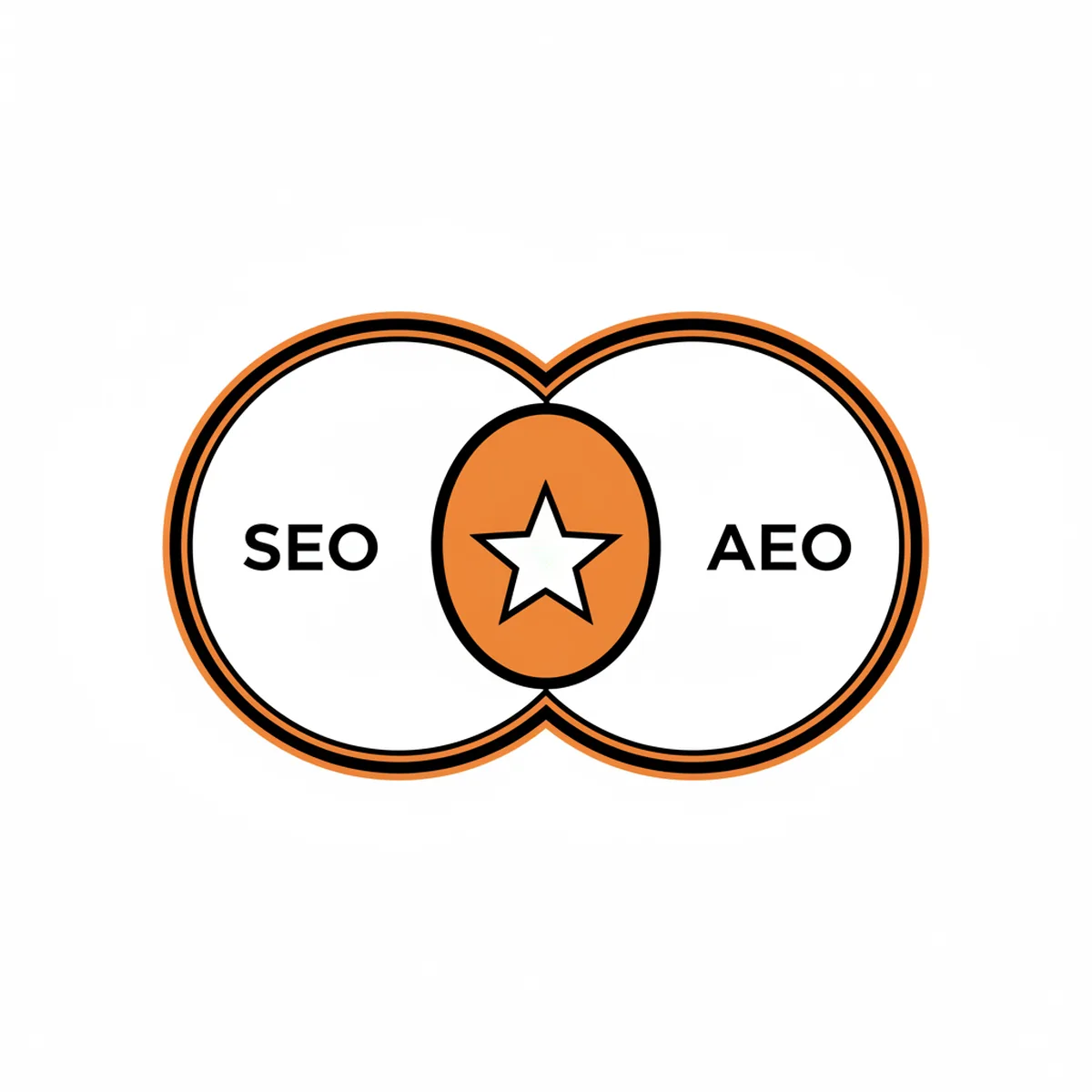
Comparing SEO vs. AEO Objectives
Understanding the difference between these two disciplines helps you balance your marketing budget. While there is overlap, the goals differ slightly. We often see clients focus too much on one while neglecting the other. Use this table to audit your current balance.
| Feature | Traditional SEO | Answer Engine Optimization (AEO) |
|---|---|---|
| Primary Goal | Rank in the top 10 blue links | Become the cited source in AI answers |
| Content Format | Long-form articles and blogs | Structured, concise, Q&A style |
| Success Metric | Click-through rate (CTR) | Brand mentions and citation volume |
| User Intent | Browsing and research | Immediate problem-solving |
| Key Technology | Keyword matching | Natural Language Processing (NLP) |
| Target Audience | Human readers | LLM crawlers and human readers |
| Update Frequency | Monthly/Quarterly | Real-time or weekly |
Common AEO Mistakes to Avoid
- Ignoring conversational tone: Writing in a dry, overly academic style can make it harder for NLP models to parse your content as a direct answer to a natural query.
- Neglecting technical speed: Even though the AI summarizes your content, it still needs to crawl your site quickly. A slow site can prevent AI bots from indexing your latest updates. According to Search Engine Land, page speed remains a critical factor for bot efficiency.
- Over-optimizing for robots: If your content becomes unreadable for humans because you are trying to "hack" the AI, you will lose the conversions that happen after the click.
- Forgetting to update old content: Information changes fast. If an AI cites your outdated 2023 data in 2026, it hurts your brand's reputation for accuracy.
- Lack of internal linking: Failing to link related answers together makes it harder for engines to understand the full depth of your expertise. Make sure to audit your internal link structure regularly.
- Vague Definitions: Failing to define industry terms clearly. AI models look for "is-a" or "part-of" relationships. If you don't define what your service is in simple terms, the AI might categorize you incorrectly.
AEO Best Practices and Pro Tips
- Use the "Inverted Pyramid" style: Put the most important information (the answer) at the top and the supporting details below.
- Verify your facts: AI models are increasingly sensitive to hallucinations. Cite your sources clearly to prove your data is grounded in reality.
- Optimize for voice: Read your content out loud. If it sounds clunky, it won't perform well on smart speakers or mobile voice assistants.
- Monitor "Share of Model": Move beyond tracking keyword rankings and start tracking how often your brand is mentioned in ChatGPT or Perplexity responses.
- Diversify your media: Include images and videos with descriptive alt text, as AI models are becoming multi-modal and can "see" this content.
The Power of Table Data
AI models love tables. They are the easiest way for an LLM to extract comparative data. If you are discussing pricing, features, or specifications, always include a markdown table.
Quick Task List for Tables:
- Identify a comparison point in your article.
- Create a 3-column table summarizing the data.
- Ensure the header row uses clear, descriptive nouns.
- Place the table immediately following a descriptive H3.
AI Visibility: ChatGPT, Gemini, Copilot, and Perplexity
In 2026, your visibility on these platforms is a primary driver of brand awareness. These engines don't just search the web; they synthesize it. ChatGPT and Perplexity, for instance, rely on "Retrieval-Augmented Generation" (RAG). This means they look for the most relevant documents in their index and then write a summary.
If your site is the primary source for a Gemini response, you gain massive "mental availability" with the user. To win here, your content must be the "best" answer—not just the longest or most keyword-dense. These platforms prioritize clarity and factual density. Our AEO services focus specifically on making your data "ingestible" for these specific LLMs (Large Language Models), ensuring that when a user asks a high-intent question about your industry, your brand is the one provided as the solution.
We focus on the "Citation Loop." When an engine cites your site, it increases your authority within that model's weights. Over time, this creates a flywheel effect. The more you are cited, the more the model trusts you as a primary node for that topic.
Case Study: B2B SaaS Authority Building
We worked with a B2B SaaS client in the fintech space who was seeing a steady decline in organic traffic despite ranking for their main keywords. The problem was that "What is" queries in their industry were being swallowed by Google's AI Overviews.
We implemented an AEO-first strategy over six months. First, we restructured their knowledge base into a clear Q&A format. Second, we added comprehensive JSON-LD schema to every page. Finally, we focused on building their "Entity" by securing mentions in top-tier financial publications.
"The shift from ranking for keywords to becoming the 'definitive source' for AI answers changed our entire lead generation funnel. We stopped worrying about the blue links and focused on the citations."
By the end of the project, the client saw a 45% increase in citations within AI-generated snapshots. While their total "traditional" organic traffic stabilized, the quality of traffic improved, resulting in a 22% increase in demo sign-ups. This proves that AEO vs SEO isn't a zero-sum game; they work together to drive higher-value actions.
Tools and Resources for AEO
- Google Search Console: Essential for monitoring how Google sees your structured data and which queries lead to your site. (Free)
- Schema.org Validator: The industry standard for checking if your JSON-LD code is correct and readable by search engines. (Free)
- Perplexity AI: Use this as a research tool to see who is currently being cited for your target keywords. (Free/Paid)
- Semrush / Ahrefs: Both have now introduced features to track "AI visibility" and featured snippet wins. (Paid)
- SurferSEO: Useful for optimizing the NLP "entities" within your content to match what top-ranking pages are doing. (Paid)
How to Measure AEO Success
Measuring AEO is different from traditional SEO. You can't just look at a ranking position. You need to look at "Answer Share."
- Citation Count: How many times does an AI engine link to your site in a summary?
- Featured Snippet Ownership: Monitor how many "Position Zero" spots you hold in Google.
- Branded Query Growth: As your entity authority grows, more people will search for you by name.
- Zero-Click Attribution: Use specialized analytics to estimate how much brand exposure you get from AI answers that don't result in a click.
Success Checklist:
- [ ] Direct answer provided in the first 50 words of the page.
- [ ] Valid FAQ or HowTo schema applied.
- [ ] Page loads in under 1.2 seconds.
- [ ] Content includes at least 3 external citations to high-authority sites.
How to Test and QA Your AEO Strategy
Before you roll out AEO across your entire site, you must validate that the changes actually help engines parse your data. You do not want to break existing SEO rankings while chasing AI citations. We recommend a staged QA process.
The Sandbox Testing Method
Pick five pages that currently rank on page one but do not trigger a featured snippet or AI overview. Apply your AEO optimizations—direct answer headers, schema, and bulleted lists—to these pages only. Wait 14 days and monitor the "Enhancements" report in Google Search Console. If you see a rise in impressions without a drop in average position, your framework is solid.
Manual Verification in AI Engines
Open ChatGPT Plus (with browsing), Perplexity, and Gemini. Prompt them with the specific questions your five test pages are designed to answer. Ask the models: "What is the best source for [Topic]?" or "How do I do [Process]?" If the models do not cite your site, analyze who they are citing. Look at the structure of the cited page. Does it use a table you lack? Does it have a more concise summary? Use these insights to refine your template before the site-wide rollout.
The Trade-offs: When AEO Fails or Flops
AEO is not a magic bullet, and it comes with specific risks you must manage. Honesty about these trade-offs will help you set realistic expectations for your stakeholders.
The "Zero-Click" Revenue Gap
The biggest risk of AEO is success. If you provide a perfect answer that the AI displays in full, the user might never click through to your website. If your business model relies heavily on display ad impressions or top-of-funnel newsletter signups, AEO could technically lower your on-site conversion metrics. You are trading traffic for brand authority. You must ensure your brand name is embedded within the answer itself so you gain "mental real estate" even if you don't get the click.
Over-Simplification Risks
Some topics are too complex for a 50-word summary. In fields like medical advice or complex legal structures, trying to force an answer into a "fragmented clarity" format can lead to dangerous over-simplification. If the AI misinterprets your concise summary, you could be cited for inaccurate information. In these cases, it is better to optimize for "referral" intent—telling the AI that "The answer depends on factors X and Y, which are detailed in this comprehensive guide."
The Maintenance Burden
AEO requires constant updates. Traditional SEO content can sometimes stay relevant for years. AEO content, however, feeds into models that value the most recent "truth." If your competitor updates their stats for 2026 and you are still using 2025 data, the AI will immediately switch its citation to them. You are committing to a higher frequency of content maintenance.
The Future of AEO in 2026 and Beyond
As we move deeper into 2026, the line between "searching" and "asking" will disappear. We expect to see more personalized answer engines that take a user's past behavior into account. This means AEO will eventually involve "Personalization Optimization," where you tailor content for specific user segments. Furthermore, multi-modal AEO—optimizing for video and audio answers—will become a standard requirement for brands that want to remain competitive. Staying ahead means constantly refining your benefits of AEO to adapt to these shifting technologies.
We also anticipate the rise of "Agentic SEO." This involves optimizing for AI agents that perform tasks on behalf of users, such as booking a flight or buying a software subscription. To be the chosen vendor, your API documentation and pricing tables must be perfectly structured for these agents to read.
Conclusion
Understanding why AEO is important for SEO is the first step in future-proofing your digital presence. In a world where AI summaries are the new front page of the internet, your ability to provide clear, structured, and authoritative answers determines your brand's survival. Traditional SEO gets you into the library; AEO ensures the librarian recommends your book first. By focusing on entity authority, structured data, and direct answer formatting, you can capture high-intent traffic that your competitors are losing.
Ready to see how your site performs in the age of AI? Start with a free AEO audit to identify your biggest opportunities. If you are ready to dominate the answer engines and scale your visibility, explore our full suite of expert **AEO services** today.
Frequently asked questions
Why is AEO important for SEO in 2026?+
AEO is important because search behavior has shifted from browsing lists of links to asking AI for direct answers. If your content isn't optimized for these engines, you risk losing visibility in AI Overviews and voice search results. AEO ensures your brand remains the primary source for information in a zero-click environment.
How does AEO differ from traditional SEO?+
AEO focuses on providing direct, structured answers that AI models like ChatGPT and Gemini can easily cite. Traditional SEO focuses more on ranking for specific keywords in a list format. While SEO aims for traffic, AEO aims for authority and citations within AI-generated responses. Both are necessary for a modern digital strategy.
What are the key elements of an AEO strategy?+
To optimize for answer engines, you should use clear Q&A headings, provide concise answers (40-60 words) at the start of sections, and implement robust schema markup. Additionally, focus on building entity authority by getting mentioned in reputable industry sources, which helps AI models trust your information.
How does structured data affect AEO?+
Structured data, specifically JSON-LD schema, helps AI engines understand the context and relationship of your data. It acts as a bridge between your human-written content and the machine-learning models. Without schema, engines may struggle to accurately interpret and cite your content in answer boxes.
Can AEO help with voice search rankings?+
Yes, AEO significantly impacts voice search. Most voice assistants (like Alexa, Siri, and Google Assistant) pull their answers from the same sources used by AI answer engines. By optimizing your content for natural, conversational questions, you increase the likelihood of being the voice response for a user query.
How do I measure the ROI of AEO?+
Success in AEO is measured through 'Answer Share,' which includes the number of citations your brand receives in AI summaries, your ownership of featured snippets, and the growth of branded searches. You should also monitor your visibility on platforms like Perplexity and ChatGPT to see if your site is a cited source.
Sources & further reading
Soft next step
Want to see where AI answers mention you — and where they don't?
We run a free AEO audit across ChatGPT, Gemini, Copilot and Perplexity, then hand you the fixes in priority order. Start your AEO strategy today.
Keep reading
AEO Fundamentals
What is Answer Engine Optimization (AEO)? A 2026 Guide for B2BAEO Fundamentals
The Strategic Benefits of AEO: Dominate AI Search in 2026AEO Fundamentals
AEO vs SEO: Which Strategy Should You Prioritize in 2026?