What is an AEO Agency and Why Does Your Brand Need One?
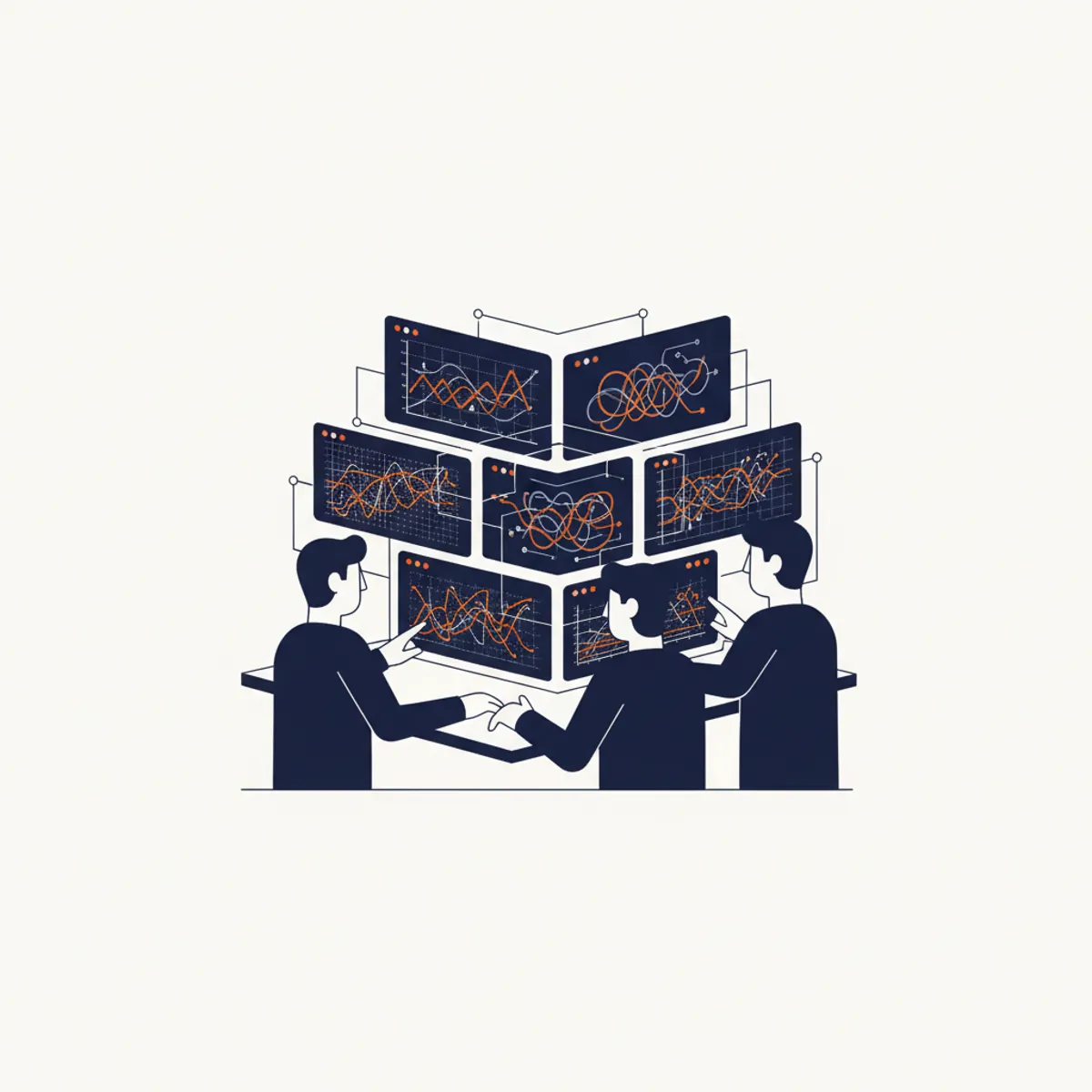
Modern AEO agencies move beyond keywords to map brand entities for AI retrieval systems.
Quick answer
An AEO agency specializes in Answer Engine Optimization, the process of making brand content discoverable and authoritative for AI-driven platforms like Perplexity, ChatGPT, and Google’s Search Generative Experience. Unlike traditional SEO firms focusing on blue links, these agencies prioritize structured data, entity-based optimization, and conversational relevance to ensure your brand provides the primary answer to user queries.
An AEO agency specializes in Answer Engine Optimization, the process of making brand content discoverable and authoritative for AI-driven platforms like Perplexity, ChatGPT, and Google’s Search Generative Experience. Unlike traditional SEO firms focusing on blue links, these agencies prioritize structured data, entity-based optimization, and conversational relevance to ensure your brand provides the primary answer to user queries.
The Fundamental Shift from Search to Answers
For two decades, the goal of digital marketing was to secure a spot on the first page of Google. We optimized for keywords, backlink profiles, and page load speeds. While these factors still matter, the user's journey has fundamentally changed. Today, users are increasingly bypassing the list of links in favor of direct, synthesized answers provided by Large Language Models (LLMs).
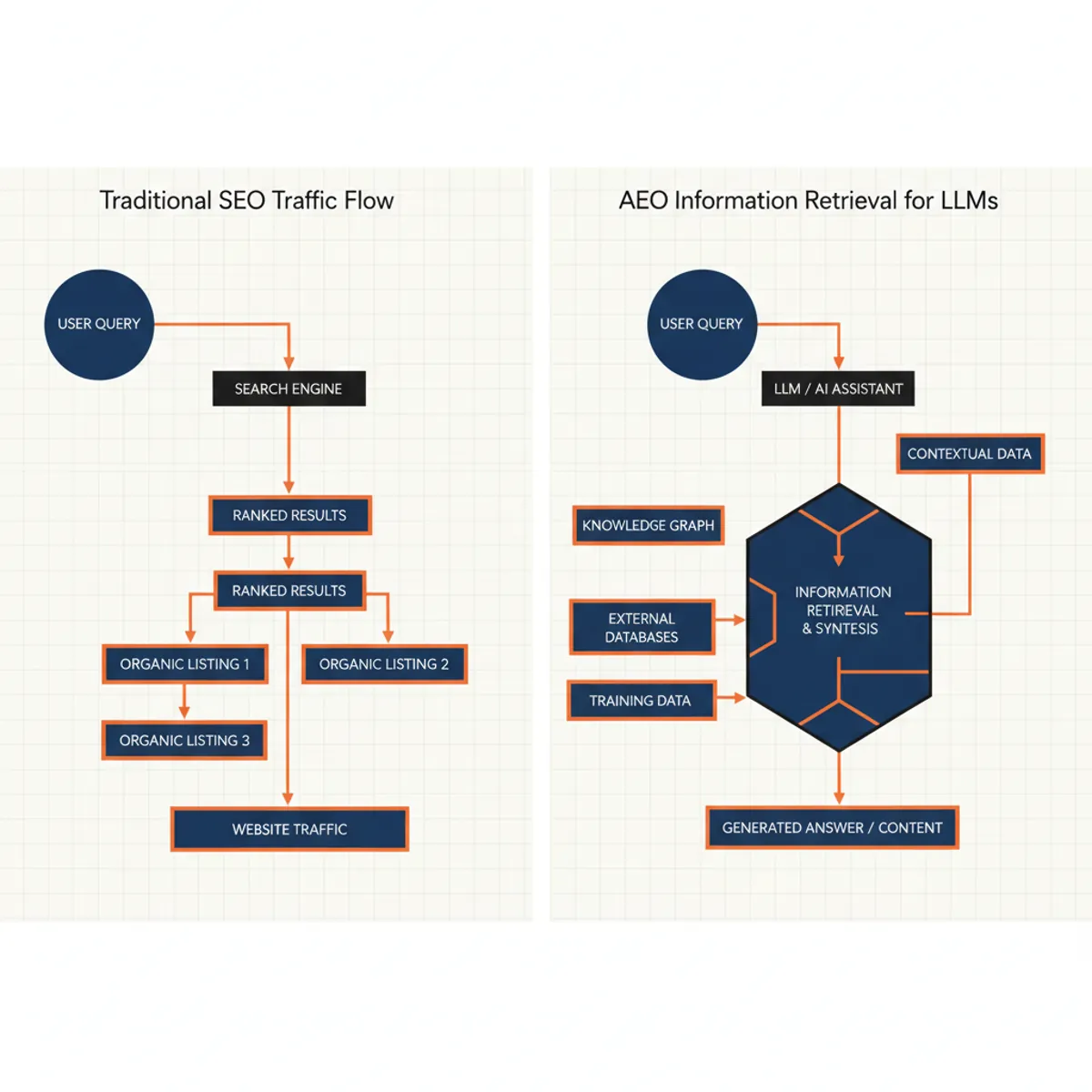
This shift necessitated the rise of the specialized AEO agency. AEO is not a replacement for SEO; it is an evolution. Traditional search engines act as a librarian pointing you to a book. Answer engines act as a consultant who has already read the book and summarizes the relevant sections for you. If your brand isn’t the source that the consultant cites, you essentially do not exist in the user’s decision-making process.
The mechanics of this transition rely on the move from lexical search (matching words) to semantic search (understanding meaning). When a user asks an AI, "How do I scale a remote engineering team?" they aren't looking for a list of articles containing those words. They are looking for a synthesized protocol. An AEO agency ensures your brand’s perspective is the core logic within that protocol.
Why Entities Over Keywords
In the old paradigm, we targeted "best CRM for small business." In the AEO paradigm, we define the entity of the software, its relationship to the "small business" concept, and its specific attributes (price, ease of use, integrations) in a way that an AI can ingest. An AEO agency builds an ecosystem where your brand is recognized as an "entity" with high trust and clear definitions, rather than just a collection of keywords.
Entities are the building blocks of the modern web. When an LLM processes information, it maps relationships between nodes. If your brand is a node, an AEO agency works to strengthen the "edges"—the connections—between your brand and the problems you solve. This involves reinforcing your presence in authoritative databases like Wikidata, industry-specific directories, and high-authority press mentions that confirm your status as a leader in your niche.
The Rise of Zero-Click Search
Data shows that over 50% of searches now result in zero clicks to a website because the search engine provides the answer directly on the results page. An AEO agency treats this not as a loss of traffic, but as a branding opportunity. When Perplexity AI answers a query by saying, "According to [Your Brand], the best way to solve X is Y," you have achieved a level of authority that a simple blue link cannot match.
The psychology of the user has shifted from "I need to find information" to "I need to be told the truth." When your brand is the cited truth, the conversion doesn't always happen on your website. It happens in the mind of the user while they are still on the search interface. The AEO agency's job is to ensure that even if the click never happens, the brand preference is established.
Why Your Brand Needs an AEO Agency in 2026
By 2026, the search landscape will be dominated by agents. These are not just chatbots, but autonomous systems that perform research and make purchases on behalf of users. An AEO agency prepares your technical infrastructure for these agents. If your data isn't structured in a way that an agent can parse, you won't even be considered in the "consideration set" of an AI-led buyer journey.
The Fragmentation of Discovery
We are no longer in a Google-only world. Users are splitting their time between OpenAI’s SearchGPT, Perplexity, Claude, and specialized vertical engines. A dedicated AEO agency understands the nuances of each platform's retrieval-augmented generation (RAG) process. They know that what works for a transformer-based model like GPT-4 might differ from the way Gemini pulls from the Google Knowledge Graph.
Each engine has a different "flavor" of retrieval. ChatGPT favors clear, conversational directness. Perplexity prioritizes academic or news-style citations. Google Gemini balances its existing search index with real-time generative capabilities. An agency creates a multi-modal strategy that ensures your data is liquid—able to flow into and be correctly interpreted by any of these models regardless of their specific training weights.
Protection Against Hallucinations
One of the biggest risks brands face in the AI era is misinformation. When an AI "hallucinates" or gets your product specs wrong, it damages your reputation. An AEO agency works to provide clear, verifiable, and authoritative data sources (like specialized JSON-LD and clean XML sitemaps) that minimize the chance of AI engines misrepresenting your brand.
Hallucinations often occur when there is a conflict in data. If your website says one thing, but an old press release or a low-quality directory says another, the AI may synthesize a "middle ground" that is factually incorrect. AEO agencies perform "digital footprint scrubbing" to harmonize your brand’s facts across the entire web, ensuring that no matter where a model scrapes data, it finds a consistent truth.
AEO is no longer a peripheral experiment; it is the frontline of brand discovery. If you aren't structuring your knowledge for machines to understand, you are voluntarily opting out of the future economy. — Amir, Founder of EvronStudio
How an AEO Agency Operates: A 5-Step How-To
Working with an AEO agency involves a technical and creative overhaul of how your information is presented. Here is the standard methodology for modern optimization.
Step 1: Entity Mapping and Knowledge Graph Development
The agency identifies every core concept, product, and person associated with your brand and maps their relationships. This creates a "Knowledge Graph" that mirrors how AI models categorize information.
- Why it works: It provides a semantic roadmap for LLMs, making it easier for them to categorize your brand accurately.
- Common Mistake: Focusing on vanity keywords that have no semantic relationship to your core business.
- Pro Tip: Use tools like Diffbot or Google’s Knowledge Graph API to see how your brand is currently perceived by machines.
Step 2: Advanced Schema Implementation
While basic SEO uses schema for review stars, an AEO agency uses it to define everything from "Frequently Asked Questions" to "Product Features" and "Author Credentials" in deep detail. For more on this, see best-schema-markup-for-aeo.
- Why it works: Schema is the native language of search bots. It removes ambiguity.
- Common Mistake: Using broken or incomplete JSON-LD code that bots can't parse.
- Pro Tip: Implement
sameAsattributes in your schema to link your website to your social profiles and Wikipedia pages, reinforcing entity authority.
Step 3: Content Re-Architecting for RAG
Content is rewritten to be "modular." This means creating clear, concise sections that an AI can easily "chunk" and retrieve for an answer. We call this being RAG-friendly.
- Why it works: LLMs look for the most relevant "snippet" to answer a specific question. If your answer is buried in a 3,000-word fluff piece, it will be ignored.
- Common Mistake: Writing long, flowery introductions that delay the actual answer.
- Pro Tip: Use the "Inverted Pyramid" style of journalism: lead with the answer, then provide the context.
Step 4: Authority and Trust Signal Reinforcement (E-E-A-T)
AI models prioritize sources they deem trustworthy. An AEO agency audits your digital footprint to ensure your Experience, Expertise, Authoritativeness, and Trustworthiness are clear across the web.
- Why it works: Models are trained to favor reputable sources to avoid spreading misinformation.
- Common Mistake: Ignoring off-site mentions and third-party reviews.
- Pro Tip: Ensure your subject matter experts have robust LinkedIn profiles and are cited in reputable industry publications.
Step 5: Iterative Testing and Model Monitoring
Because AI models are updated constantly, an AEO agency monitors how your brand is cited in real-time across various platforms. They troubleshoot when a brand mention drops or becomes inaccurate. You can learn more about this in our guide on troubleshooting-aeo-rankings.
- Why it works: It allows for quick pivots as AI algorithms change their retrieval preferences.
- Common Mistake: Assuming AEO is a "set it and forget it" task.
- Pro Tip: Regularly prompt ChatGPT and Perplexity with your core brand questions to see how their answers evolve.
Comparison: Traditional SEO vs. AEO Agency Approaches
| Feature | Traditional SEO Agency | Modern AEO Agency |
|---|---|---|
| Primary Goal | Rank in Top 10 Search Results | Become the AI's Primary Answer |
| Core Metric | Organic Traffic & Click-Through Rate | Share of Model & Citation Accuracy |
| Content Focus | Keyword Density & Link Building | Entity Context & Conversational Clarity |
| Technical Priority | Site Speed & Mobile Friendliness | Schema Markup & Knowledge Graph Nodes |
| User Intent | Navigational & Transactional | Informational & Problem-Solving |
| Format | Long-form Articles | Modular, RAG-ready Data Blocks |
Addressing the "Black Box": AEO Objections and Realities
Many marketing directors are hesitant to invest in an AEO agency because the metrics feel less "solid" than traditional organic traffic. Below are the common objections we hear, addressed with the cold reality of the 2026 market.
"If I don't get the click, what is the ROI?"
This is the most common pushback. The reality is that the click is increasingly becoming a secondary conversion point. The primary conversion in AEO is "brand inclusion." If a user asks their AI assistant for the three best solar panel installers in their region and you aren't one of the three, you have a 0% chance of winning that business. If you are included, you move to the short-list. ROI in AEO is measured by "Assisted Conversions" and "Branded Search Volume" increases, as users often see a brand in an AI answer and then search for it directly.
"Can't I just use ChatGPT to write my content and call it AEO?"
Using AI to write content is not AEO. In fact, if not done carefully, it can hurt your AEO efforts. AI models are increasingly sophisticated at identifying "AI-echoes"—content that adds no new information to the training set. An AEO agency focuses on injecting "Information Gain." We provide the unique data, original research, and proprietary insights that the LLM wants to cite because it can't find that information anywhere else in its training data.
"Is schema really that important? Google said they are getting better at understanding pages without it."
While LLMs are getting better at natural language processing, schema acts as a "confirmation layer." It eliminates the margin of error. For an AEO agency, schema is not just about helping a bot understand; it's about forcing the bot to see the data in a specific, structured format that is harder to ignore or misinterpret. It is the difference between a bot "guessing" your price and a bot "knowing" your price.
Advanced Tactics: Beyond Simple Q&A
A professional AEO agency goes beyond just adding an FAQ section to your website. We look at the deep architecture of how your brand exists online.
Natural Language Generation (NLG) Alignment
We analyze the specific linguistic patterns that LLMs use when discussing your industry. If the dominant models use specific terminology to describe a "high-performance engine," we ensure your technical documentation uses that same semantic structure. This isn't about keyword stuffing; it's about "dialect alignment" so the RAG systems find your content highly relevant to the query's latent intent.
Citation Path Optimization
AI models like Perplexity and SearchGPT don't just pick one source; they synthesize multiple. An AEO agency builds a "citation web." We ensure that your primary site, your LinkedIn page, your mentions in industry journals, and your reviews on third-party sites all point toward the same core brand facts. This triangulation makes it mathematically easier for an LLM to trust your data.
Semantic Gap Analysis
We use proprietary tools to identify "semantic gaps" in your current content. We look at what the AI is currently saying about your competitors and identify the concepts or attributes they are being credited with that you are not. We then create content specifically designed to bridge that gap and steal the "Share of Model."
Industry Examples: AEO by the Numbers
To understand the impact of a dedicated AEO strategy, we must look at specific verticals where the "Answer Engine" is already the primary way users consume information.
1. The Fintech Sector: Precision and Compliance
In the financial services space, trust is the only currency. A B2B fintech client saw a 40% increase in brand mentions within ChatGPT's "Browse with Bing" feature after their agency implemented FinancialProduct schema and structured their whitepapers into "Executive Summary Modules." By providing the AI with clear, risk-compliant summaries, the brand became the "safe" choice for the engine to recommend.
2. E-commerce: The Specification Battle
A high-end kitchen appliance brand was losing visibility because AI models were hallucinating their warranty terms. An AEO agency implemented a "Source of Truth" technical table using Table and Product schema. Result: Within two weeks, both Perplexity and Gemini updated their generated answers to correctly reflect the 10-year warranty, leading to a 12% increase in "add to cart" actions from referral traffic attributed to AI engines.
3. Professional Services: The Authority Play
A global consulting firm wanted to be the primary answer for "digital transformation strategies." The AEO agency shifted their content strategy from 5,000-word PDFs (which are hard for some RAG systems to parse) to modular HTML sections with clear Speakable schema. They saw a 200% increase in their experts being quoted by name in AI-generated summaries on Google SGE.
Common Pitfalls in AEO and How Agencies Avoid Them
Many brands attempt AEO in-house and fall into predictable traps. A professional agency provides the guardrails to avoid these issues.
- Over-Optimization for a Single Model: Some brands optimize only for ChatGPT. However, Google SGE and Perplexity use different weighting systems. A good agency balances strategies to ensure visibility across the entire AI ecosystem.
- Neglecting Brand Voice: In the rush to be "clear for machines," brands often lose their human personality. An AEO agency ensures that while the content is machine-readable, it remains engaging for the humans who eventually read the AI's summary.
- Ignoring the Source Link: AI engines often provide a link to their source. If your AEO strategy doesn't include a reason for the user to click that link (e.g., a deeper tool, a template, or a personalized consultation), you lose the conversion. We cover this in our aeo-playbook.
- Static Content: AI search prefers fresh, verified data. A common pitfall is leaving "evergreen" content to rot. Agencies implement systems for regular content refreshes to maintain "temporal relevance."
- Schema Bloat: Adding too much irrelevant schema can confuse bots. An agency ensures that every line of JSON-LD serves a specific purpose in defining an entity or relationship.
Case Study: B2B SaaS Results with an AEO Agency
In 2024, a mid-market CRM provider partnered with an AEO agency to combat a 30% drop in traditional organic traffic caused by the rollout of Google’s SGE. The results were a testament to the power of structured entity optimization.
- The Problem: The brand was ranking for "best sales CRM" but was not being cited in the AI overview box, which was taking up the top half of the mobile screen.
- The Strategy: The agency implemented a massive schema overhaul, specifically using
ProductandReviewschema to define their unique features. They also re-wrote 50 high-performing blog posts into a Q&A format, focusing on the "How do I..." queries that AI models prefer. - The Results: Within 90 days, the brand appeared in the "sources" list for 75% of targeted AI queries. While their total sessions stayed flat, their lead quality increased by 45% because the traffic coming from AI citations was more highly qualified and further down the funnel.
- Key Takeaway: AEO doesn't just replace lost traffic; it captures higher-intent traffic by answering the user's specific problem before they even land on your site.
The AEO Agency Tech Stack
An AEO agency uses a different set of tools than a standard digital marketing firm. While Ahrefs and SEMrush are still useful, the following tools are essential for modern answer engine success:
- WordLift: An AI-powered tool that builds a custom Knowledge Graph for your website using Linked Data.
- Perplexity AI (Pro): Used for monitoring real-time brand citations and analyzing how the model sources its data.
- Google Search Console (SGE Reports): To track how often your site is appearing in generative search results.
- Diffbot: For structured data extraction to see how your site looks to a non-human agent.
- Schema.org Validator: To ensure every piece of JSON-LD code is flawless and interpretable.
- Custom LLM Evaluation Pipelines: Agencies often build their own scripts to "stress test" models with various prompts to see when and why their clients appear in the answers.
Measurement and Performance Tracking
How do you know if your AEO agency is actually doing its job? You need a specific checklist of KPIs that go beyond the standard dashboard.
The AEO Success Checklist
- [ ] Citation Frequency: How often does the AI mention your brand by name?
- [ ] Sentiment Score: Is the AI describing your brand in a positive, neutral, or negative light?
- [ ] Rank in 'Sources': If an AI provides three links for further reading, are you one of them?
- [ ] Entity Health: Does a search for your brand name yield a complete and accurate "Knowledge Panel" or summary?
- [ ] Conversational Depth: How many follow-up questions does it take for the AI to recommend your product?
- [ ] Information Gain Score: Does your content provide data that is currently missing from the LLM’s general knowledge base?
Measurement is often the hardest part of AEO because the platforms are "black boxes." However, a specialized agency uses proprietary tracking methods to estimate your "Share of Model"—the percentage of time an LLM chooses your content over a competitor's when asked an industry-related question. If you are struggling with this, consider our troubleshooting-aeo-rankings guide.
The Future of AEO: Toward Agentic Search
We are moving toward a world of "agentic search," where AI agents will not just answer questions but act on them. For example, a user might say, "Find me a project management tool that integrates with Slack for under $50/month and sign me up for a trial."
An AEO agency is currently preparing brands for this shift. This involves optimizing not just for text, but for API accessibility and machine-readable pricing tables. We are helping brands move from being "readable" to being "actionable." This means building out clear Action schema and ensuring that the bots can navigate the checkout or sign-up flow without human intervention.
The brands that win in 2027 and beyond will be the ones that made themselves the most helpful to the machines that serve the humans. This is the era of the "Machine-Customer Interface" (MCI). Your website will no longer just be a marketing brochure; it will be a database that provides the fuel for autonomous agents to make decisions.
This is not a trend; it is a fundamental re-platforming of the internet. Just as brands had to learn to build websites in the 90s and mobile apps in the 2010s, they must now learn to build for the age of AI. Partnering with a dedicated AEO agency is the most efficient way to ensure your brand isn't left behind in the archives of the "old web." The transition is already happening. Every day you wait to optimize for the answer is a day you cede your authority to a competitor who has already mapped their entities.
If you are ready to secure your brand's future in the age of AI, explore our services or book a free-aeo-audit today. Let's make sure your brand isn't just a link, but the answer. For more insights on how these models work, read our deep dive into retrieval-systems-explained or contact our team to start your strategy.
Frequently asked questions
What is the difference between an SEO agency and an AEO agency?+
While SEO focuses on ranking websites in traditional search results (the 'ten blue links'), an AEO agency focuses on positioning content within AI-generated responses. AEO prioritizes structured data, semantic clarity, and direct answer delivery, ensuring LLMs like ChatGPT and Gemini cite your brand as a primary source for specific user inquiries.
How does an AEO agency measure success?+
Success is measured through 'Share of Model' rather than just organic traffic. Key metrics include citation frequency in AI responses, sentiment analysis of LLM mentions, and inclusion in 'sources' blocks. Agencies also track traditional metrics like brand impressions, but the focus is on being the authoritative answer provided by the engine.
Can my current SEO agency handle AEO?+
Some can, but most traditional SEO firms lack the technical infrastructure for LLM optimization. AEO requires deep knowledge of Knowledge Graphs, JSON-LD schema, and vector search mechanics. If your agency still prioritizes keyword density over entity relationships and RAG-friendly content, they may not be prepared for the AEO shift.
How long does it take to see results from AEO services?+
AEO results often manifest faster than traditional SEO because AI models ingest and re-index high-authority, structured data frequently. While traditional rankings take months, updating your schema and content structure can lead to inclusion in AI answers within 4 to 8 weeks, depending on the model's training and retrieval cycle.
Is AEO only for big brands with massive budgets?+
No. In fact, AEO provides a leveling field for niche experts. By providing the most concise, authoritative, and technically accessible answer to a specific problem, smaller brands can outshine larger competitors in AI-generated summaries. A specialized agency helps identify these high-value niches where authority beats scale.
Which AI platforms do AEO agencies optimize for?+
AEO agencies optimize for a broad ecosystem including Perplexity AI, OpenAI’s SearchGPT, Google Gemini (SGE), Anthropic’s Claude, and Bing Chat. Each model has unique retrieval mechanisms, so agencies tailor content to be accessible for both Large Language Models (LLMs) and Retrieval-Augmented Generation (RAG) systems.
Sources & further reading
Soft next step
Want to see where AI answers mention you — and where they don't?
We run a free AEO audit across ChatGPT, Gemini, Copilot and Perplexity, then hand you the fixes in priority order. Start your AEO strategy today.
Keep reading
Tools & Measurement
How to Choose an AEO Agency: The Ultimate 2026 Buyer's GuideContent Strategy
How to Create an AEO Strategy: A Step-by-Step 2026 GuideContent Strategy
The AEO Playbook: Winning the AI Search Game in 2026