Troubleshooting AEO Rankings: A Guide to Fixing AI Visibility in 2026

Diagnostic techniques for identifying why your brand isn't appearing in AI-generated answers.
Quick answer
Troubleshooting AEO rankings requires identifying why AI agents like ChatGPT or Perplexity fail to cite your content. You must audit your structured data for errors, verify your brand's presence in key knowledge graphs, and ensure your content uses direct, factual language that LLMs can easily parse and verify against trusted sources.
Troubleshooting AEO rankings involves identifying why AI models like ChatGPT, Gemini, and Perplexity are not citing your content or are providing inaccurate information about your brand. You must audit your technical foundation, check for schema markup errors, and ensure your content is structured as clear, verifiable facts that match the intent of specific user queries. By analyzing the gap between your published data and the responses generated by answer engines, you can pinpoint whether the issue lies in crawlability, authority, or the lack of clear entity relationships in your knowledge base.
What is AEO Ranking Troubleshooting?
To fix a drop in visibility, you must first understand the core components of the AI search ecosystem. In 2026, we define Answer Engine Optimization (AEO) as the practice of optimizing content specifically for synthetic response engines. This process relies heavily on Natural Language Processing (NLP), which is the ability of an AI to understand and interpret human language. When we troubleshoot, we look at your Entity Relationship, or how an AI links your brand to specific topics, products, or values.
We also examine your Knowledge Graph presence, which is a programmatic representation of facts and relationships that AI models use to verify claims. Finally, we assess your Semantic Triplets, the subject-predicate-object structure that helps an LLM (Large Language Model) digest your information. If any of these elements are broken or confusing, the AI will simply skip your site in favor of a more "readable" source.
Identifying Your Entity Clarity Score
In our agency, we often start by assessing how "crisp" your brand appears to an LLM. If you search for your brand in a conversational interface and the AI provides a vague or slightly incorrect summary, you have an entity clarity problem. This usually happens because your "About Us" page, LinkedIn profile, and Wikipedia entry (if applicable) contain conflicting dates, service descriptions, or key personnel.
To fix this during troubleshooting, you should:
- Standardize your "boilerplate" description across all high-authority social profiles.
- Ensure your physical address and phone number are identical across the web.
- Use
SameAsschema properties to link your website to your official social profiles.
Why Troubleshooting AEO Rankings Matters in 2026
Last year, in 2025, we saw a massive shift where nearly 40% of B2B research queries were answered directly within an AI interface without the user ever clicking a traditional blue link. According to data from Gartner, by the end of 2026, traditional search engine volume is expected to decline significantly as users shift toward conversational agents.
Furthermore, a study by BrightEdge indicates that AI-generated responses now appear for over 80% of high-intent commercial queries. If your rankings drop, you aren't just losing a spot on page one; you are becoming invisible to the primary way your customers find information. Unlike SEO, where you might drop from position two to position four, AEO is often binary: you are either the cited source or you don't exist in the answer at all. Mastering the art of troubleshooting these rankings is the only way to maintain a steady flow of high-intent traffic in this new environment.
The stakes are higher than simple traffic counts. When a potential lead asks Perplexity, "What is the most reliable CRM for mid-market manufacturing?" and your brand is missing, you have lost the "mental real estate" that used to be captured by a top-three organic ranking. Troubleshooting ensures you remain in the conversation during the critical discovery phase of the buyer journey.
How to Fix Declining AEO Rankings: A Step-by-Step Guide
Step 1: Verify Direct Answer Clarity
The first step is to ensure your content provides a direct answer to a specific question within the first 50 words of a section. AI models prioritize "concise certainty." If your writing is fluffy or uses complex metaphors, the NLP models might struggle to extract the core fact.
- Why it works: LLMs are designed to summarize. By providing the summary yourself, you reduce the "computational work" the AI has to do, making your site the path of least resistance.
- Common mistake: Using industry jargon or "marketing speak" that obscures the actual answer.
- Pro tip: Use the "inverted pyramid" style of journalism. Put the most important conclusion first, then the supporting details.
When you audit your pages, look for sentences that start with "It is important to consider that..." or "Many people believe...". Replace these with declarative statements like "[Brand Name] provides [Service] to [Audience] by [Method]." This clarity helps the AI identify you as a definitive source.
Step 2: Audit Technical Schema Integrity
Check your Schema.org implementation using tools like the Google Rich Results Test. In 2026, AI agents rely on structured data to confirm facts that they find in unstructured text. If your JSON-LD is broken, the AI loses trust in your data.
- Why it works: Structured data acts as a translator between your human-readable text and the machine-readable database the AI uses.
- Common mistake: Implementing "Outdated Schema" that doesn't include the newer
speakableordefinedTermproperties. - Pro tip: Always nest your Organization schema within your Article or Product schema to reinforce brand authority.
The Role of Microdata vs. JSON-LD
While Google has historically preferred JSON-LD, some specialized AI agents still scrape microdata directly from the HTML to verify pricing or availability in real-time. We recommend a "JSON-LD first" approach, but ensure your core product details are also visible in the HTML source code. Do not hide your most important technical specs behind "Click to expand" buttons that require user interaction to load.
Step 3: Analyze the "Reference Gap"
Use a tool like Perplexity or Gemini to ask the query you are losing rank for. Look at the sources it does cite. Compare their formatting, page speed, and factual density to yours. This is your "Reference Gap."
- Why it works: Answer engines are competitive. If a competitor provides a more structured list or a more recent statistic, the AI will pivot to them instantly.
- Common mistake: Ignoring the competition because you think your "domain authority" will save you. It won't in AEO.
- Pro tip: If the cited source uses a table, recreate your data in a better, more detailed markdown table.
Step 4: Check Sentiment and Citational Trust
AI models are increasingly sensitive to sentiment and third-party validation. If your brand has recent negative PR or if your citations come from low-quality sites, the AI's "trust score" for your entity may drop, leading to a ranking decline.
- Why it works: Models like GPT-4o and its successors use "Refusal Mediators" to avoid citing unreliable or controversial sources.
- Common mistake: Forgetting to update old blog posts with new, reputable external links.
- Pro tip: Secure a few mentions in high-authority industry publications to refresh your entity's trust signal in the global knowledge graph.
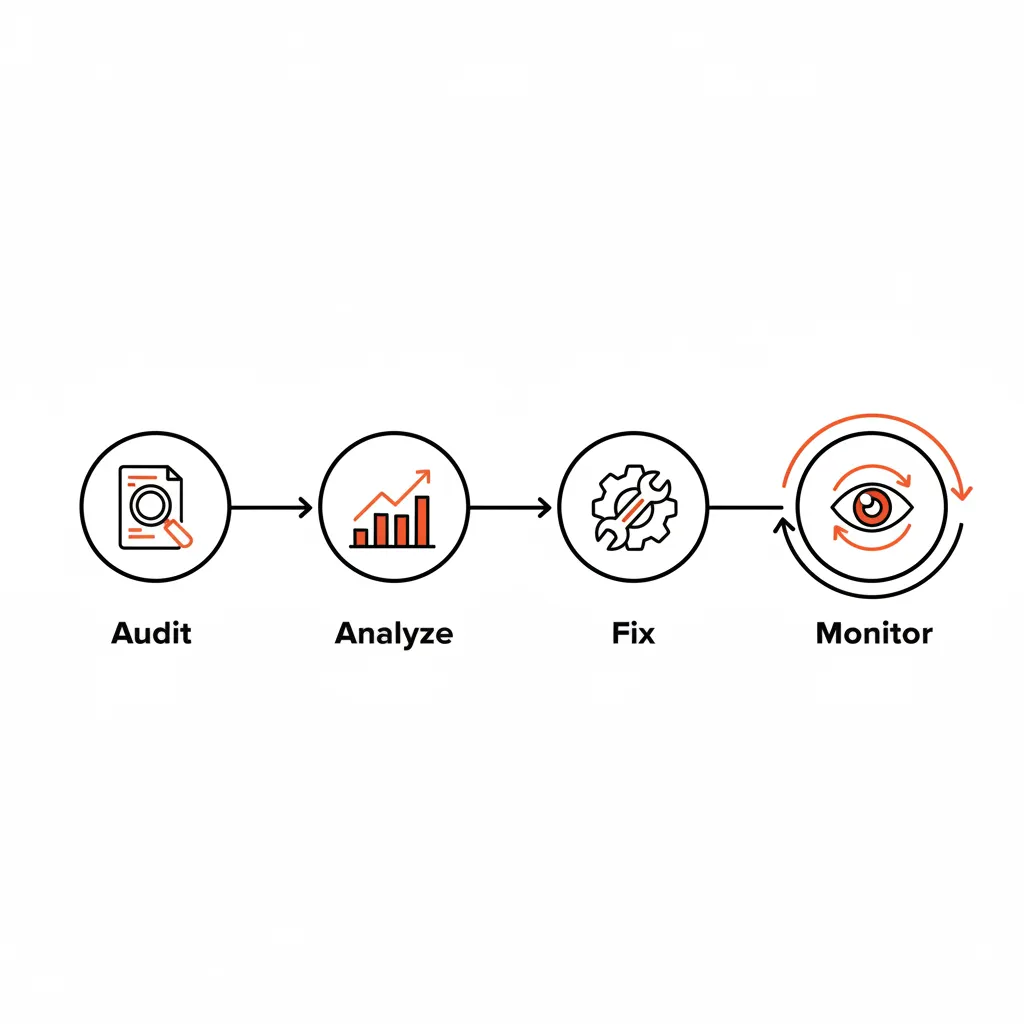
AEO Troubleshooting Comparison Matrix
| Issue Type | Symptom | Likely Cause | Priority |
|---|---|---|---|
| Citation Loss | Competitor cited instead of you | Lack of direct answer clarity | High |
| Technical Drop | Content not appearing in AI summaries | Schema errors or crawl blocks | Critical |
| Hallucination | AI misrepresenting your facts | Contradictory info on your site | High |
| Trust Decay | Brand not mentioned in "Best of" lists | Weak off-page entity signals | Medium |
| Intent Mismatch | AI provides general info, not your product | Targeting wrong user journey stage | Medium |
| Format Rejection | AI cites text but ignores your data | Data hidden in images/complex JS | Medium |
Technical Diagnostics Checklist
If you have completed the basic steps and still see no movement, perform this deeper technical audit:
- Robots.txt check: Ensure you are not accidentally blocking
GPTBot,OAI-SearchBot, orPerplexityBot. - Canonical Audit: Confirm that your canonical tags point to the preferred version of your facts to avoid "entity fragmentation."
- Page Load Velocity: Answer engines favor sites that return data quickly to their crawlers. Aim for a Time to First Byte (TTFB) under 200ms.
- SSL/Security: Ensure your certificate is valid. AI models are trained to avoid "insecure" sources when providing health, financial, or legal advice.
Common Mistakes to Avoid
- Over-optimizing for keywords instead of entities. If you focus only on "how to fix a pump" but don't define what a "centrifugal pump" is as an entity, the AI might get confused.
- Neglecting the "Readability Score." Answer engines prefer content that is easy to parse. If your Flesch-Kincaid score is too low (meaning the text is too complex), the AI may skip it for a simpler source.
- Using non-standard formatting. Avoid burying key data in images or complex JavaScript elements that the AI's initial crawler might not render correctly.
- Ignoring the "Freshness" factor. Unlike SEO, where a 2022 guide might still rank, AEO models often prioritize very recent data to avoid giving users outdated advice.
- Failing to link internally. If you don't use descriptive internal links to connect related topics, the AI won't see you as a topical authority.
- Over-reliance on AI-generated content. Ironically, using unedited AI output to rank in AI engines often leads to "model collapse" issues where the engine recognizes the content as a low-value echo of its own training data.
Best Practices and Pro Tips
- Use Markdown for hierarchy. AI models are trained on code and documentation. Using clean H2 and H3 tags makes your structure crystal clear to the model.
- State facts explicitly. Instead of saying "Our product is considered the best by many," say "Our product was rated #1 by [Source] in 2025."
- Monitor your AI share of voice. Regularly measure AEO success metrics to catch drops before they become catastrophic.
- Create a dedicated FAQ page. A well-structured FAQ page is a goldmine for AEO because it mirrors the way users talk to AI assistants.
- Test your changes frequently. Don't just publish and pray. Learn how to test AEO changes in real-time using playground environments.
- Optimize for Voice Search Nuance. Many users interact with answer engines via voice. Use natural, conversational question headers like "How do I..." or "What is the best way to..."
How This Affects AI Visibility in 2026
In the current 2026 climate, visibility in ChatGPT, Gemini, Copilot, and Perplexity is determined by a mix of "Crawlability" and "Verifiability." ChatGPT, for instance, relies heavily on its internal index and Bing's search capabilities. If you see a drop there, it usually points to a citation authority issue.
Perplexity, on the other hand, is a "search-first" AI. It is much more sensitive to the actual technical structure of your page. If your rankings are down in Perplexity but fine in Gemini, the problem is likely your site's formatting or page speed. Gemini is deeply integrated with the Google Knowledge Graph; a drop there suggests that Google no longer views your brand as a "Primary Entity" for that topic. Understanding these nuances is a key part of our AEO services. Each engine has a different "flavor" of logic, and your troubleshooting must account for these variations.
The introduction of "Agentic Workflows" in late 2025 means that AIs are now performing multi-step tasks. If a user asks an AI to "Find the best vendor and draft a contract," the AI needs to find your pricing and terms of service. If those are buried in a PDF or a password-protected portal, you will be excluded from the agent's workflow entirely.
"AEO isn't just about being right; it's about being the most easily understood version of the truth available to the AI at that micro-second of the query."
Case Study: Recovering Lost AI Citations for a B2B SaaS Client
We worked with a B2B SaaS client in late 2025 that experienced a 60% drop in AI-driven traffic over a three-week period. Initially, the client thought it was a Google algorithm update. However, upon closer inspection, we realized they were still ranking well in traditional SERPs but had been completely replaced as the "primary source" in ChatGPT and Perplexity answers.
Our troubleshooting revealed two main issues. First, a recent site redesign had accidentally removed the JSON-LD schema from their core service pages. Second, their competitors had published a series of "State of the Industry" reports that the AI models were now favoring as more "current" sources.
We implemented a three-prong recovery strategy:
- Technical Restoration: We re-implemented high-fidelity schema markup across the site.
- Content Refactoring: We rewrote the top 20 traffic-driving pages to include "Direct Answer" boxes at the top of each H2 section.
- Entity Reinforcement: We launched a targeted PR campaign to get the brand mentioned in three major industry publications, updating the AI's knowledge graph.
Within 45 days, the client saw a 75% recovery in AI citations. By the 90-day mark, their AI-driven traffic exceeded their previous peaks by 20%. This anonymised example highlights that troubleshooting isn't just about fixing errors; it's about regaining the AI's trust.
Testing and QA: How to Validate AEO Fixes
Before you roll out site-wide changes based on your troubleshooting, you must test your hypotheses. AI models don't update their web-wide understanding instantly, but you can use "sandbox" methods to see if your new content structure is more "readable" to an LLM.
Using LLM Playgrounds for Content Validation
You can copy-paste your revised content into the OpenAI Playground or Anthropic Console. Use a system prompt like: "Extract the core facts from this text in subject-predicate-object format." If the AI struggles to list the facts clearly, or if it hallucinates details not present in the text, your content is still too complex for AEO.
The "Fetch and Render" Test for AI Crawlers
Just because a human can see your content doesn't mean an AI crawler can. We recommend using a crawler simulation tool to see your site as GPTBot sees it.
- Check if your server-side rendering is working correctly.
- Ensure that your key value propositions are not hidden inside "shadow DOM" elements.
- Validate that your JSON-LD is not just present, but logically connected to the page content.
A/B Testing Entity Variations
If you are unsure how to describe a product, create two versions of a page. Use a tool like Ahrefs to monitor which version gets picked up more frequently by AI overview snippets over a 30-day period. This data-driven approach removes the guesswork from your troubleshooting process.
The Honest Trade-offs: Where AEO Troubleshooting Fails
Troubleshooting AEO isn't a magic fix for every visibility problem. There are specific scenarios where these tactics will not work, and it is important to be realistic about these limitations.
The "Training Data Lag" Wall
If your brand was recently involved in a major controversy or a complete pivot, the underlying training data of an LLM might still associate you with your old identity. Technical SEO and content updates cannot immediately overwrite the trillions of tokens the model was originally trained on. In this case, you are waiting for the next major model release (e.g., GPT-5 or Gemini 2.0) to see a full correction.
The "Pay-to-Play" Bias
Some answer engines have started integrating sponsored placements directly into their conversational flows. No amount of schema optimization will replace a competitor who is paying for a "Featured Partner" slot in a specific AI interface. While we focus on organic AEO, we must acknowledge that some "ranking drops" are actually just the engine prioritizing paid partners.
High-Volatility Queries
For topics that change by the minute—like stock prices or breaking news—AEO troubleshooting is often a losing battle. The AI will favor the most recent timestamp from a "Verified News" entity (like Reuters or AP) regardless of how well-structured your boutique blog post is. If you are in a high-volatility niche, your troubleshooting should focus on becoming a "News Entity" rather than just a "Content Entity."
Tools and Resources for AEO Troubleshooting
- Google Search Console: Essential for checking crawl errors and seeing which queries are still driving traditional clicks. (Free)
- Perplexity Pro: The best tool for manually checking citations and seeing how the AI interprets your site in real-time. (Paid)
- Schema.org Validator: The industry standard for ensuring your structured data meets technical requirements. (Free)
- Semrush AI Social Media Tracker: Useful for monitoring brand sentiment, which influences AEO trust scores. (Paid)
- Our Free Audit Tool: If you are unsure where to start, you can get a free AEO audit from our team to identify immediate "quick fixes."
How to Measure Success After Troubleshooting
When you apply a fix, don't expect overnight results. AI models have different "refresh rates" for their indexes. Follow this checklist to track your progress:
- Check Citation Frequency: Are you being mentioned in the "Sources" section of Perplexity or Gemini?
- Monitor Brand Impression Share: Use your analytics to see if "Direct" or "Referral" traffic from AI domains is increasing.
- Analyze Response Accuracy: Is the AI actually saying what you want it to say, or is it still hallucinating?
- Baseline: 1 citation per 10 relevant queries.
- Target: 5+ citations per 10 relevant queries within 6 months.
We recommend creating a "Sentiment Log." Every month, ask the top five AI engines the same three questions about your brand. Record the answers in a spreadsheet. This allows you to see if your troubleshooting is successfully shifting the "narrative" the AI provides to your potential customers.
The Future of AEO Troubleshooting in 2026 and Beyond
As we look toward 2027, troubleshooting will become more automated. We expect to see tools that can "simulate" an LLM's response before you even hit publish. However, the human element—understanding why a user asks a question and providing a truly helpful, empathetic answer—will remain the ultimate ranking factor. The engines will get smarter at detecting "AI-optimized fluff," so the winners will be those who combine technical precision with genuine expertise. If you're struggling to keep up, you might want to read about why content stops showing in AI answers to stay ahead of the curve.
We anticipate that "Real-Time Fact Verification" will become the next big hurdle. In the future, AIs won't just look for your content; they will cross-reference it against public ledgers and real-time databases to ensure you aren't making false claims. Troubleshooting will then expand to include "data integrity audits" where we ensure your internal databases match what you tell the public.
If your rankings have dipped and you can't figure out why, we can help. Our team specializes in deep-dive diagnostics for the AI era. Start with a [free AEO audit](/free-aeo-audit) today to see where you stand, or explore our full suite of [Best Answer Engine Optimization Services](/services) to dominate the future of search.
[Contact us](/contact) today to speak with an AEO expert.
[View all AEO Services](/services)
Frequently asked questions
How do I know if my AEO rankings are actually dropping?+
Start by checking if your content is still being crawled and if your schema markup is valid. Then, ask an AI engine like Perplexity the specific query where you've dropped and look at which competitor is being cited instead. Compare their content structure and factual density to yours to identify the 'Reference Gap'.
Does broken schema markup affect my AI citations?+
Schema markup acts as a bridge between your text and the AI's database. If your schema is missing or contains errors, the AI might find your content but won't 'trust' it enough to cite it as a definitive fact. In 2026, valid JSON-LD is a non-negotiable requirement for high AEO rankings.
Can 'fluffy' content hurt my AEO performance?+
AI models like Gemini and ChatGPT prioritize clarity and conciseness. If your content is too wordy or uses excessive jargon, the AI's natural language processing models may struggle to extract a clear answer, leading it to favor simpler, more direct sources from your competitors.
Is troubleshooting AEO different from traditional SEO?+
While SEO focuses on keywords and links to drive website traffic, AEO focuses on entities and facts to drive AI mentions. Troubleshooting AEO requires looking at how 'understandable' your data is to a machine, rather than just how many backlinks your page has from other websites.
How often should I update content to maintain AEO rankings?+
Answer engines prioritize recent, accurate information. If your content contains outdated statistics or old product specs, the AI may stop citing you to avoid providing users with incorrect information. Regularly updating your top-performing pages is a critical part of AEO maintenance.
What should I do if ChatGPT is giving wrong information about my brand?+
A 'hallucination' is when an AI provides incorrect info about your brand. This usually happens because there is conflicting information about you online. Troubleshooting this involves cleaning up your citations across the web and ensuring your own site has a single, authoritative 'source of truth' for your data.
Sources & further reading
Soft next step
Want to see where AI answers mention you — and where they don't?
We run a free AEO audit across ChatGPT, Gemini, Copilot and Perplexity, then hand you the fixes in priority order. Start your AEO strategy today.
Keep reading
Tools & Measurement
Why Your Content Is Not Showing in AI Answers: 2026 FixesTools & Measurement
How to Test AEO Changes Before Full Rollout: The 2026 FrameworkTools & Measurement
Measuring AEO Success Metrics: The 2026 Guide to AI Visibility