Retrieval Systems and RAG Explained: The Future of AEO in 2026
Optimizing for RAG is the most critical step for AI visibility in 2026.
Quick answer
Retrieval systems and RAG (Retrieval-Augmented Generation) are frameworks that allow AI models to fetch real-time, external data before generating an answer. This process ensures AI responses are accurate, current, and grounded in specific facts rather than just relying on pre-trained information from a static database.
Retrieval systems and RAG (Retrieval-Augmented Generation) are frameworks that allow AI models to fetch real-time, external data before generating an answer. This process ensures AI responses are accurate, current, and grounded in specific facts rather than just relying on pre-trained information from a static database. By connecting a Large Language Model (LLM) to an external knowledge base, RAG prevents "hallucinations" and provides verifiable citations. In 2026, understanding these systems is vital for any brand that wants to appear as a cited source in AI-driven search results like ChatGPT, Gemini, and Perplexity. We see these technologies as the bridge between your static website content and the fluid answers generated by modern search engines.
Understanding Retrieval Systems and RAG Definitions
To grasp how modern AI finds your content, we must define a few core entities. First, Retrieval-Augmented Generation (RAG) is an architectural approach that optimizes the output of an LLM by referencing a trusted knowledge base outside its training data. Think of it as an "open-book exam" for AI. Instead of guessing, the AI looks at a specific set of documents you provide to find the answer.
Next, we have Vector Databases. These are specialized storage systems that turn text into numerical arrays called embeddings. When a user asks a question, the system compares the mathematical "distance" between the query and the stored content to find the best match. This is the heart of a Retrieval System, which is the broader infrastructure responsible for searching, ranking, and delivering relevant document chunks to the generative model.
Finally, Semantic Search is the technology that powers these retrievals. Unlike old keyword matching, semantic search understands intent and context. If you search for "how to fix a flat," the system knows to look for tire repair guides even if those exact words are missing. By mastering these components, you position your brand to be the "trusted document" that the RAG process selects.
The Anatomy of an Embedding
When we discuss vector databases, we are really talking about high-dimensional geometry. A retrieval system takes a sentence like "Our software automates B2B payroll" and converts it into a string of numbers. These numbers represent the "meaning" of the sentence in a space with hundreds or thousands of dimensions.
If a user asks about "tools for streamlining corporate salary payments," the vector for that query will sit very close to your payroll content in that mathematical space. This is why word choice matters less than topical clarity. You want your content to be "centered" in the right neighborhood of the vector space. If your writing is too flowery or vague, the system might place your data in the wrong category, making it invisible to the RAG process.
Why RAG Dominates AEO and SEO in 2026
In 2025, we saw a massive shift toward "answer-first" browsing. According to Gartner, search engine volume for traditional links is expected to drop significantly as AI agents take over primary information gathering. This makes RAG the gatekeeper of your visibility. If a retrieval system cannot find, parse, or trust your content, your brand simply does not exist to the AI.
Data from Search Engine Land suggests that over 60% of Gen Z users now prefer starting their search journey on conversational platforms. These platforms rely heavily on RAG to provide "grounded" answers. Without a RAG-friendly content structure, you lose the opportunity to be the cited source that drives high-intent traffic to your site. We focus our aeo-insights on helping you bridge this gap by making your data "retrievable" by design.
The Trust Gap and Source Verification
RAG systems do not just look for the best answer; they look for the most verifiable one. Search engines like Google now use a "Double Check" feature that compares LLM outputs against indexed web data. If the RAG process pulls data from your site, but other high-authority sites contradict you, the AI may discard your information.
This creates a new competitive theater. You aren't just competing for keywords. You are competing for "consensus." When multiple reputable sources point to the same fact, the RAG system gains confidence in that answer. We recommend building content that not only answers the prompt but also cites third-party data to align with this consensus-seeking behavior.
How to Optimize Your Content for RAG: A Step-by-Step Guide
Step 1: Implement Granular Content Chunking
Content chunking involves breaking your long-form articles into smaller, self-contained units of information. Most RAG systems struggle with 3,000-word walls of text because they only "retrieve" small snippets to feed the AI. By creating distinct sections with clear headings, you make it easier for the vector database to index specific answers.
You should do this because retrieval systems rank specific segments, not whole pages. A common mistake is using vague H3 titles like "More Info" or "Discussion." Instead, use descriptive, question-based headers. Our content chunking strategy recommends keeping chunks between 200 and 400 words to maximize relevance scores in vector space.
A Simple Chunking Procedure:
- Identify the primary intent of each 300-word block.
- Rewrite the subheading as a direct question (e.g., "What is the ROI of RAG?").
- Start the first sentence with a direct declaration.
- End the block with a summary sentence that links to the next logical concept.
- Apply specific HTML
idattributes to each header to allow precise deep-linking.
Step 2: Enrich Your Technical Metadata
While AI models read your text, retrieval systems often use metadata to filter results for freshness and authority. You must ensure your HTML includes high-quality schema markup and "lastmod" tags in your sitemap. This helps the system determine if your information is more current than a competitor's.
This works because RAG pipelines often prioritize the "most recent" or "most authoritative" document when multiple sources say the same thing. A common mistake is neglecting your datePublished and author schema. Pro tip: use Schema.org to define your organization and its topical authority clearly so the AI knows you are a primary source.
| Metadata Type | RAG Function | Impact Level |
|---|---|---|
| Speakable Schema | Identifies sections for voice/audio retrieval | High |
| FAQPage Schema | Helps LLMs parse Q&A pairs directly | Critical |
| Organization Schema | Connects content to a verified brand entity | High |
| Citation Schema | Links your claims to external research | Medium |
| ArticleBody | Clearly defines the core text for crawlers | Critical |
Step 3: Optimize for Semantic Resonancy
Semantic resonancy means using the language, terminology, and phrasing that your target audience uses when speaking to an AI. Since RAG relies on vector similarity, your content needs to "mathematically" match the user's prompt. You achieve this by including natural language questions and direct, jargon-free answers.
This works because it reduces the distance between the user’s query and your content in the vector database. A common mistake is over-optimizing for "exact match" keywords, which can actually hurt you in a semantic environment. Pro tip: analyze your services pages to ensure you explain "what it is" and "how it works" in the first two sentences of every section.
Step 4: Build a Verifiable Citation Network
AI models are trained to look for consensus. If a retrieval system finds your information, it will often look for secondary sources to verify the claim. You must link to high-authority external research and maintain a clean internal linking structure that reinforces your topical clusters.
This builds the "trust" component of the RAG process. A common mistake is orphan pages—content with no internal links—which retrieval bots often ignore. Pro tip: use descriptive anchor text that tells the AI exactly what the linked page contains. Check our guide on how AI chooses sources for deeper details on this verification process.
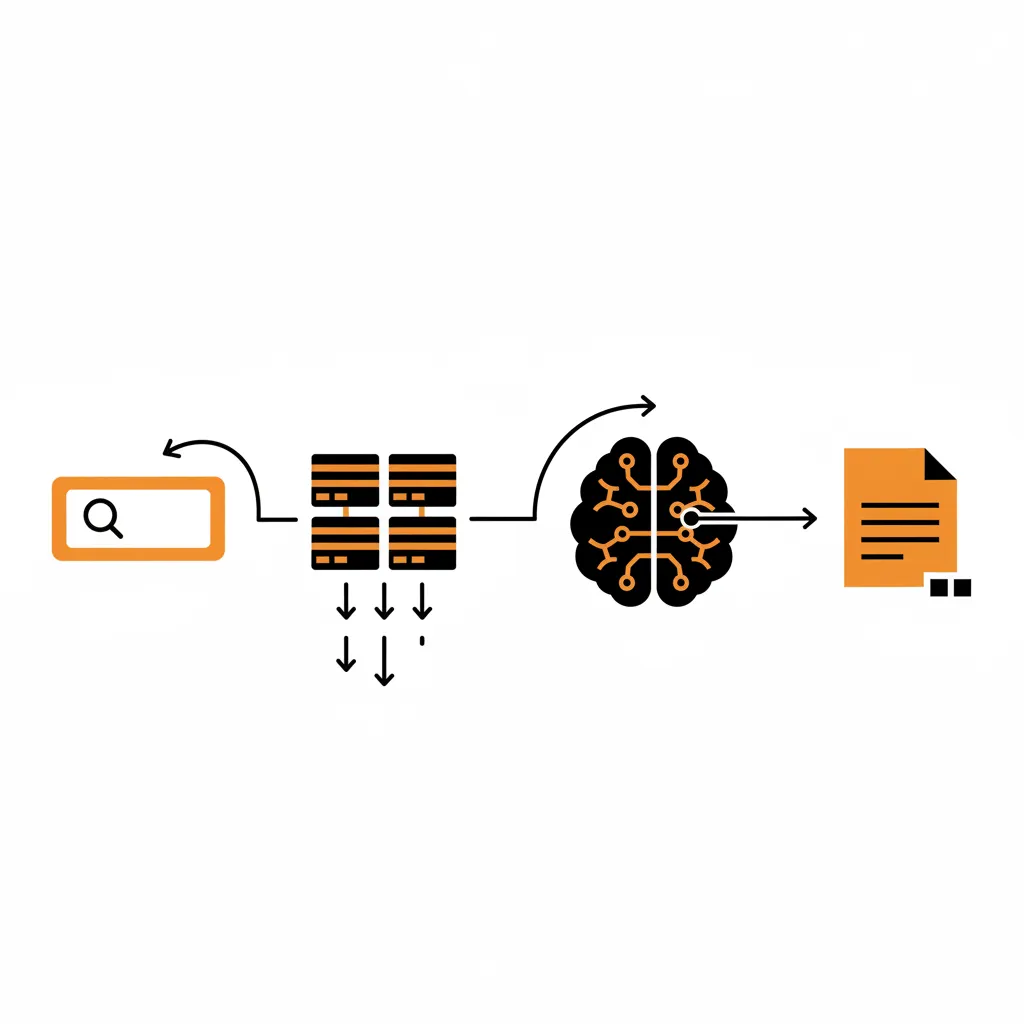
Comparison: Traditional Search vs. RAG-Powered AI Search
| Feature | Traditional SEO (Google 2020) | RAG-Powered AEO (AI Search 2026) |
|---|---|---|
| Primary Goal | Ranking for 10 Blue Links | Being the Selected Context Source |
| Search Logic | Keyword Matching & Backlinks | Semantic Similarity & Trust Scores |
| Content Format | Long-form "Everything" Pages | Structured, Chunked Data Units |
| Result Type | List of Websites | A Single Generative Answer with Citations |
| Success Metric | Click-Through Rate (CTR) | Brand Mention & Citation Share |
Common RAG Optimization Mistakes to Avoid
- Vague Header Hierarchies: Using creative but non-descriptive headers makes it impossible for a retrieval system to categorize your content "chunks" accurately.
- Ignoring Latency and Page Speed: While RAG happens on the AI side, search bots still need to crawl your site quickly to update their vector indexes; slow sites get indexed less frequently.
- Over-reliance on Gated Content: If your best insights are behind a PDF or a lead magnet, RAG systems usually can't "see" them, meaning you won't be cited in AI answers.
- Neglecting Entity Relationships: Failing to link your brand to specific concepts (entities) via structured data prevents the AI from recognizing you as an expert in your niche.
- Circular Internal Linking: Excessive internal links with generic "click here" text confuse the semantic mapping of your site’s architecture.
- Over-Optimization via AI: Using AI to write all your content can lead to a "generic" vector signature. If your content sounds exactly like the LLM's own training data, the RAG system might view it as redundant and skip it.
Best Practices for AI Visibility
- Direct Answer Positioning: Place the most important fact in the first 40 words of a section to capture the "quick answer" slot in RAG pipelines.
- Use Markdown for Structure: AI models are natively trained on markdown. Using clear
#and##structures helps the AI understand your document's hierarchy better than complex CSS. - Regular Content Refreshes: Because RAG systems prioritize recent data, updating your key pages every 90 days is now a requirement for maintaining visibility.
- Natural Language FAQ Integration: Include questions that users actually ask their voice assistants or chatbots to align with modern query patterns.
- Verified Author Profiles: Link your content to real human experts with verifiable footprints online to increase the "authority" score of your retrieved chunks.
"In a world of generative AI, your website is no longer just a destination for humans; it is a specialized library for retrieval systems that synthesize the world's information."
How RAG Affects Visibility in ChatGPT, Gemini, and Perplexity
When a user asks ChatGPT a question, the system doesn't just "know" the answer. It uses a retrieval system to browse the web (via tools like SearchGPT) or its internal index. It pulls 3-5 relevant snippets and uses them as "context" to write the final response. If your content is the most relevant, clear, and authoritative, you become the primary citation.
Gemini and Copilot operate similarly, though they lean more heavily on their respective ecosystems (Google Search and Bing). Perplexity is perhaps the most "pure" RAG engine, as its entire value proposition is based on providing cited sources for every claim. To win in these environments, you must ensure your content is "ingestible." This means having high AI visibility by avoiding complex JavaScript wrappers that hide text and focusing on clean, semantic HTML. If these engines can’t "scrape and chunk" your page in milliseconds, they will move to a competitor who has optimized for retrieval.
We also see a trend toward "citation persistence." Once an AI engine cites you for a specific query, it tends to keep that citation in its short-term cache for subsequent similar queries. This means the first brand to provide a clear, RAG-friendly answer often enjoys a "first-mover advantage" in the conversational thread.
Case Study: Boosting AI Citations for a B2B SaaS Client
We recently worked with a B2B SaaS client in the cybersecurity space who was struggling to appear in AI-generated comparisons. Despite having high-quality long-form blogs, they were rarely cited by Perplexity or ChatGPT.
Our team implemented a two-pronged RAG strategy. First, we performed a site-wide content chunking audit, transforming 50 "ultimate guide" posts into 350 specific, question-answering modules with clear H3 headers and dedicated schema markup. Second, we optimized their technical architecture to ensure their "Knowledge Hub" was fully accessible to AI crawlers without the interference of heavy tracking scripts.
Within four months, the client saw a 140% increase in brand mentions across major AI platforms. More importantly, their "citation share" for high-intent queries—like "best firewall for remote teams"—rose from near zero to 22%. By making their content easier for retrieval systems to parse, we turned their existing expertise into a source of truth for the AI engines. This resulted in a 35% increase in organic leads directly attributed to users coming from AI search summaries.
Tools and Resources for Retrieval Optimization
- Google Search Console: Essential for monitoring how Google's "AI Overviews" interact with your site. (Free)
- Semrush AI Social Content Tool: Useful for identifying the semantic gaps in your current content compared to AI-preferred answers. (Paid)
- Ahrefs: Their "Site Audit" tool helps identify technical blocks that might prevent retrieval bots from indexing your chunks correctly. (Paid)
- OpenAI API (Playground): You can use this to test how a RAG system might interpret your content by feeding specific snippets to a model and asking it to summarize them. (Paid/Usage-based)
- Structured Data Testing Tool: A critical resource for validating the schema that tells retrieval systems who you are. (Free)
- BrightEdge Generative Parser: A tool that helps you see which parts of your content are being pulled into AI summaries. (Paid)
How to Measure Success in the RAG Era
Measuring success in 2026 requires looking beyond simple traffic numbers. You must track your Share of Model (SoM). This is a metric that calculates how often your brand is cited as a source in generative AI responses for your target keywords.
Success Checklist:
- [ ] Monitor "Referrer" headers for traffic coming from
openai.com,perplexity.ai, andgoogle.com/ai. - [ ] Track your citation count for top 50 industry-relevant questions.
- [ ] Audit your content "chunk" indexability using a specialized free AEO audit.
- [ ] Measure the "Semantic Distance" between your top pages and common user prompts.
- [ ] Verify that your Schema markup passes the Rich Results Test without warnings.
Testing and Quality Assurance Before Rollout
You should never push RAG optimizations to your entire site without testing a small sample first. AI models are sensitive to formatting changes. A small tweak in your Markdown structure could either make you the top source or cause the AI to ignore you entirely. We recommend a "pilot" approach where you optimize 5 to 10 high-performing pages and monitor them for 30 days.
During this period, use the OpenAI API to simulate a RAG environment. Create a "system prompt" that instructs the model to only use your provided content to answer questions. If the AI can answer accurately using only your content, your chunking is effective. If it struggles or asks for more context, your chunks are likely too vague or too short.
Check for "readability" by humans as well. Sometimes, optimizing for a vector database results in dry, repetitive text. Your goal is to find the balance where the AI can parse the data, but a human reader still finds the tone engaging. We suggest using a secondary QA layer to ensure your "Answer Engine" content still converts traffic into customers.
Where RAG Fails: Honest Trade-offs and Limitations
RAG is not a magic bullet for every type of content. It fails significantly in areas that require deep emotional nuance or subjective opinion. Because retrieval systems look for "facts" and "data points," they often strip away the personality and storytelling that builds brand loyalty. If your business relies on a unique "voice" or creative storytelling, a strict RAG optimization strategy might actually dilute your brand equity.
Furthermore, RAG systems are highly dependent on the quality of the "retriever" component. If the underlying search technology (like a basic vector search) is poorly configured, the LLM will receive irrelevant chunks. This leads to "garbage in, garbage out." You might do everything right on your website, but if the AI agent's retrieval algorithm is weak, you still won't get the citation.
There is also the risk of "attribution decay." Some AI models are getting better at summarizing information without providing clear links. If you optimize your content to be perfectly "chunkable," you might find that AI models use your data to answer questions but never actually send the user to your site. This is a trade-off we must manage by ensuring your brand name is woven into the factual chunks themselves.
The Future of Retrieval Systems in 2026 and Beyond
Looking ahead, retrieval systems will become even more personalized. We expect to see "User-Centric RAG," where the AI retrieves information not just based on the query, but also on the user's specific history, preferences, and professional context. This means your content will need to be tailored for different "segments" of AI users.
Furthermore, the integration of multi-modal RAG—where AI retrieves images, videos, and data tables alongside text—will become the new standard. Brands that invest in structured data for their media today will be the ones that dominate the generative search results of tomorrow. The era of writing just for humans is over; you are now writing for the systems that help humans think.
Conclusion
Navigating the world of retrieval systems and RAG is no longer optional for businesses that want to stay relevant. By understanding how vector databases, semantic search, and content chunking work together, you can ensure your brand remains a primary source of truth in an AI-dominated world. The transition from traditional SEO to a comprehensive AEO strategy is the single most important move you can make for your digital presence this year.
If you are unsure where to start, we can help you map out your content architecture to meet these new technical demands. You should start by evaluating your current site's readiness for AI crawlers. Check out our blog for more tips or get a comprehensive look at your current standing with a [free AEO audit](/free-aeo-audit). To build a custom retrieval strategy that puts your brand in front of ChatGPT and Gemini users, explore our [full range of AEO services](/services) today.
Frequently asked questions
What is RAG in simple terms?+
RAG stands for Retrieval-Augmented Generation. It is a process that allows an AI model to look up information from a specific, external source (like your website) before it answers a question. This makes the AI's response more accurate and provides citations, which is essential for businesses that want to be cited as experts by AI engines.
Why is RAG important for my website's SEO?+
In 2026, AI engines like ChatGPT and Gemini use retrieval systems to find the best evidence for their answers. If your content isn't optimized for these systems—meaning it isn't easy to find, chunk, and verify—the AI will ignore your brand and cite a competitor instead. AEO focuses on making your data 'retrievable.'
How does a vector database work in retrieval?+
A vector database stores text as numerical values (embeddings) that represent the meaning of the words. When a user asks a question, the retrieval system finds the 'closest' numerical match in the database. This allows the AI to understand the intent behind a search rather than just matching keywords.
What is content chunking for AEO?+
Content chunking is the practice of breaking large articles into smaller, focused sections with clear headers. It helps RAG systems because AI models typically only 'retrieve' small pieces of information at a time. Well-chunked content has a much higher chance of being used as a citation in an AI answer.
Can RAG help prevent AI hallucinations about my brand?+
Hallucinations happen when an AI makes up facts because it doesn't have the right data in its training. RAG fixes this by forcing the AI to read a specific document first. If you provide the AI with clear, structured facts, it uses those facts instead of guessing, resulting in accurate brand mentions.
What are the top requirements for a RAG-ready website?+
To be RAG-ready, you need structured data (Schema), clear markdown headings, fast-loading pages, and content organized into specific Q&A formats. You should also ensure your technical SEO allows AI bots to crawl your site without being blocked by complex scripts or paywalls.
Sources & further reading
Soft next step
Want to see where AI answers mention you — and where they don't?
We run a free AEO audit across ChatGPT, Gemini, Copilot and Perplexity, then hand you the fixes in priority order. Start your AEO strategy today.