Profound vs Writesonic for AEO/GEO: The Strategic Comparison
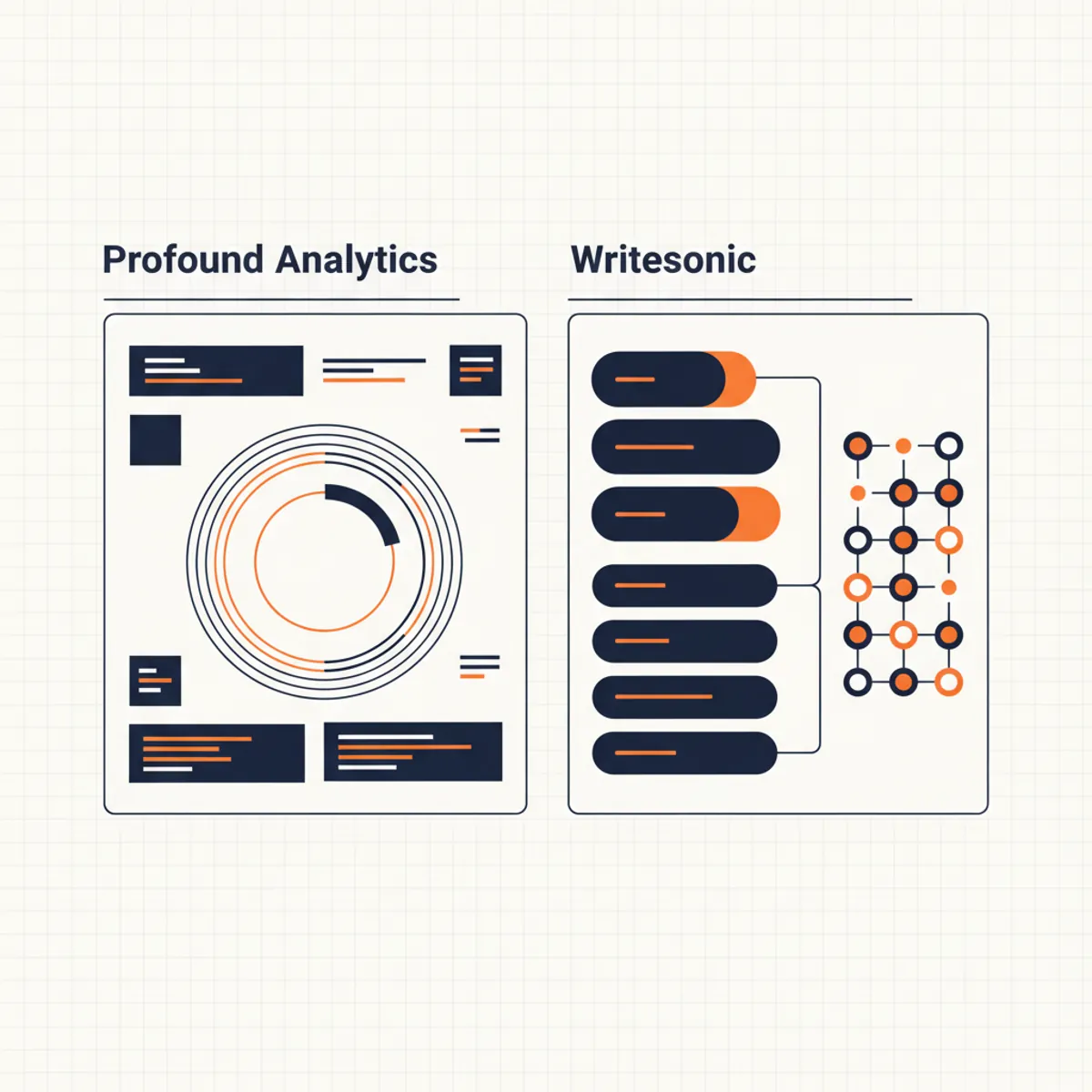
The technical gap between AI measurement and AI content generation is narrowing, but their core functions remain distinct.
Quick answer
Profound and Writesonic serve distinct roles in AEO/GEO strategies: Profound is a measurement and analytics platform designed to track visibility across LLMs like Perplexity and Gemini, whereas Writesonic is a generative content suite focused on producing SEO-friendly text. For technical optimization and ranking data, Profound is superior; for scaling volume, Writesonic leads.
Profound and Writesonic serve distinct roles in AEO/GEO strategies: Profound is a measurement and analytics platform designed to track visibility across LLMs like Perplexity and Gemini, whereas Writesonic is a generative content suite focused on producing SEO-friendly text. For technical optimization and ranking data, Profound is superior; for scaling volume, Writesonic leads.
Understanding the Shift to Answer Engine Optimization
The transition from Search Engine Optimization (SEO) to Answer Engine Optimization (AEO) and Generative Engine Optimization (GEO) represents the most significant pivot in digital marketing since the mobile revolution. In this new paradigm, the goal is no longer just to rank on page one of Google; it is to become the definitive source cited by an AI agent. When a user asks Perplexity, "What is the best enterprise CRM for mid-sized healthcare firms?" the winner is not the site with the most backlinks, but the brand that the AI chooses to synthesize into its answer.
Traditional search relies on information retrieval—matching keywords to an index. Generative search relies on information synthesis—understanding concepts and reconstructing them into a coherent narrative. This shift necessitates a move away from "keyword stuffing" and toward "semantic richness." Answer engines like Perplexity, Claude, and ChatGPT search for clarity, authority, and consensus. If the web is a library, SEO was about being the book with the brightest cover; AEO is about being the book the librarian quotes from memory.
Defining AEO vs. GEO
AEO is the overarching discipline of making your content easily digestible for answer engines. This includes structured data, clear hierarchy, and authoritative declarations. GEO is more specific to generative models. It focuses on the linguistic and structural triggers that cause a model like GPT-4o to select one source over another.
GEO often involves "generative engineering"—the process of styling content so that it mirrors the internal weights of a Large Language Model (LLM). For example, models favor content that includes expert quotes, statistical data, and technical terminology relevant to the niche. Profound and Writesonic operate at different ends of this spectrum. Profound tells you how you are performing in these results, while Writesonic helps you create the assets needed to compete.
Why 2026 is the Year of AEO Maturity
By 2026, the zero-click search phenomenon has evolved into the zero-visit search. AI Overviews (SGE) and independent platforms like Claude are the primary touchpoints for informational intent. Brands that fail to optimize for these interfaces lose visibility entirely. To succeed, companies must move beyond the "keyword density" mindset and into "information density" and "citation reliability."
The maturity of the market in 2026 means that "first-mover advantage" is waning. Simply having a blog is no longer enough. You need a data-backed strategy that accounts for the specific hallucination thresholds of various models. This is where the intersection of measurement (Profound) and execution (Writesonic) becomes critical for survival.
Profound: The Analytical Backbone of AEO
Profound emerged as a response to the "black box" nature of AI search. Historically, marketers could use Ahrefs or Semrush to see their rankings. With ChatGPT, there was no dashboard—until Profound. It provides a unique lens into how brands are perceived by different models.
Specialized Tracking for LLMs
Profound doesn't just look at SERPs. It queries LLMs directly. It measures "Brand Share of Voice" (SOV) within the generative responses themselves. For a SaaS company, this means seeing how often your product is recommended in a "top 10" list generated by Gemini compared to a competitor. This data is the foundation of any serious ai-search-ranking-factors analysis.
Profound’s engine simulates thousands of prompts across various personas and locations. This is vital because LLM responses are non-deterministic; they can change based on the phrasing of the question. Profound provides the statistical significance required to prove that your visibility isn't just a one-off fluke, but a systemic preference by the model's weights.
Identifying Attribution Gaps
One of Profound’s most powerful features is identifying where your brand should be mentioned but isn't. By analyzing the sources the AI is currently using, Profound helps you understand the authority gap. If an AI is citing a five-year-old blog post from a competitor, Profound flags this as an opportunity to inject a more current, structured, and authoritative piece of content into the ecosystem.
This "Attribution Gap Analysis" allows marketers to stop guessing. Instead of writing 100 blog posts and hoping one gets cited, you can target the specific "knowledge nodes" where the LLMs are currently lacking information. This is precision-guided AEO.
Writesonic: Scaling the Content Engine
While Profound is the map, Writesonic is the vehicle. Writesonic has evolved from a simple GPT wrapper into a sophisticated content suite with specific tools for SEO and AEO. Its Chatsonic feature, which integrates Google Search data, allows for the creation of content that is factually grounded—a requirement for being cited by LLMs.
Fact-Checked Generation
LLMs are prone to hallucination, but they are also trained to avoid citing sources that hallucinate. Writesonic’s focus on integrating real-time data ensures that the content you produce is not just syntactically correct, but factually accurate. This is vital for aeo-vs-geo strategies where the goal is to be a trusted source.
The "Brand Voice" feature in Writesonic also ensures that as you scale, the content doesn't lose its unique perspective. For GEO, maintaining a consistent, authoritative tone is a signal to the engine that the source is a legitimate entity, not just another AI-generated farm site.
Structuring for Readability
Writesonic’s templates are increasingly optimized for the "inverted pyramid" style of writing that answer engines love. By putting the most important information first and using clear, bolded headers, Writesonic-generated content aligns with the technical requirements of AEO. It makes the job of the AI's crawler significantly easier.
The tool’s ability to generate "Semantic Clusters" helps in building topical authority. When an answer engine looks for a source, it doesn't just look at one page; it looks at the relationship between pages. Writesonic enables the rapid creation of these interconnected hubs of information.
Comparison: Profound vs. Writesonic
| Feature | Profound | Writesonic |
|---|---|---|
| Primary Function | Measurement & Analytics | Content Generation & Scaling |
| AEO Focus | Tracking Brand Citations in LLMs | Creating AEO-optimized text |
| GEO Capabilities | Analyzing Model Attribution | Formatting for LLM digestibility |
| Data Source | Live LLM Queries (GPT, Gemini, etc.) | Real-time Web Search Integration |
| Best For | Strategy & Auditing | Execution & Production |
| Pricing Model | Enterprise/Usage-based | Subscription-based tiers |
5 Steps to Implementing an AEO Strategy Using Both Tools
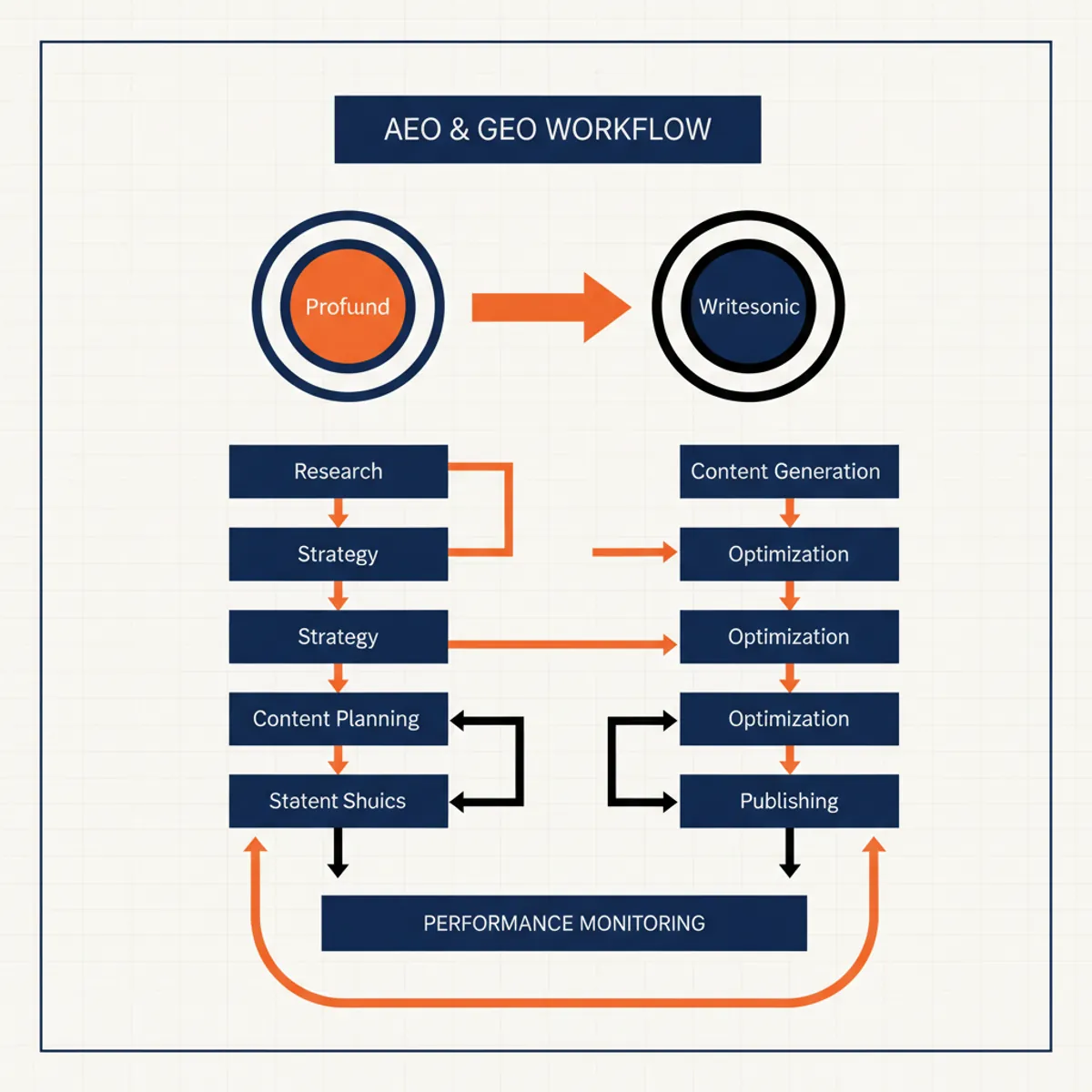
To dominate the AI search landscape, you need a workflow that bridges the gap between insight and action. Here is how to combine these tools effectively.
Step 1: Establish Your Baseline with Profound
Before writing a single word, use Profound to audit your current brand visibility across Perplexity and ChatGPT.
- Why it works: You cannot improve what you cannot measure. You need to know which models already like you and which ones ignore you.
- Common Mistake: Assuming your high Google rankings automatically translate to AI citations.
- Pro Tip: Look for "unlinked mentions" in AI responses where the model talks about you but doesn't cite your site. This indicates that you are a known entity but lack the "citation-worthy" structured content the model needs to link to.
Step 2: Identify Competitor Citation Sources
Use Profound to see which third-party sites are being cited as sources for your target queries.
- Why it works: LLMs often rely on a small cluster of authoritative sites. If you can't be the primary source, you should be featured on the sites the AI trusts.
- Common Mistake: Focusing only on your own domain rather than the broader ecosystem.
- Pro Tip: Use this data to inform your PR and backlink strategy. If a specific industry forum is cited 40% of the time by Gemini, you need a presence there.
Step 3: Generate Structured Content with Writesonic
Take the gaps identified in Step 2 and use Writesonic to draft comprehensive, data-rich articles.
- Why it works: Writesonic allows you to produce the volume of content needed to cover a wide array of long-tail questions that AI engines frequent.
- Common Mistake: Generating low-effort content without manual oversight.
- Pro Tip: Use the "Article Writer 5.0" to ensure your content follows a specific seo-and-aeo-content-strategy. Direct the AI to use "Direct Answer" formatting—putting the core answer in the first 50 words.
Step 4: Optimize with Technical Schema
Once the content is generated, ensure it is wrapped in the correct best-schema-markup-for-aeo. While Writesonic helps with the text, the technical metadata is what helps the engines categorize the information.
- Why it works: Schema provides a clear roadmap for AI crawlers.
- Common Mistake: Neglecting FAQ and How-to schema, which are primary targets for answer engines.
- Pro Tip: Use JSON-LD to explicitly define the entities mentioned in your content. If you mention "Project Management Software," ensure the schema identifies your product as a
SoftwareApplicationentity.
Step 5: Monitor and Iterate
Re-run your Profound reports 30 days after publishing your new content to see if your Share of Voice has increased.
- Why it works: AEO is not a one-time setup; it is a cycle of optimization.
- Common Mistake: Quitting after one month; LLMs take time to update their internal weights.
- Pro Tip: If visibility hasn't improved, check if the LLM is citing your competitors' more recent data. Use Writesonic to update your statistics and re-publish.
Advanced Tactics: Leveraging Knowledge Graphs and Citations
Beyond simple content production, winning in AEO requires influencing the "Knowledge Graph" of the LLM. Profound helps you track how your brand is mapped as an entity. If an LLM perceives your brand as a "luxury retailer" when you are actually a "discount warehouse," your content will never be cited for the right queries.
Entity Reinforcement with Writesonic
Use Writesonic to create "Entity-First" content. This involves writing definitive guides on your core topics that use "is" statements (e.g., "Our Software is an AI-driven solution for..."). These declarative sentences are easier for LLMs to extract into their training data or retrieval-augmented generation (RAG) pipelines.
The "Citation Loop" Strategy
One advanced tactic involves identifying the "Seed Sources" for an LLM. Most generative engines have a hierarchy of trust. By using Profound to identify these seed sources (often Wikipedia, major news outlets, or high-authority niche sites), you can use Writesonic to draft guest contributions or PR pitches that utilize the same keywords and structures the LLM is looking for. This creates a loop: the AI sees you on a trusted site, cites you, and then eventually learns to cite your own domain directly.
Industry-Specific AEO Performance: By the Numbers
The impact of AEO optimization varies by sector. Data collected from pilot programs in 2025-2026 shows a clear trend: the more complex the purchasing decision, the higher the ROI on AEO.
- Financial Services: Firms using Profound to track "Mortgage Advice" queries saw a 22% increase in brand mentions after optimizing their FAQ sections with Writesonic. The conversion rate from AI-referred traffic was 3x higher than traditional organic search.
- Healthcare/Pharma: In a highly regulated environment, "citation reliability" is everything. Brands that focused on factual density (using Writesonic's research mode) saw their citation frequency in Perplexity increase from 4% to 31% over six months.
- B2B SaaS: For "How-to" technical queries, brands that implemented extensive Schema markup alongside AI-generated documentation saw a 40% reduction in customer support tickets, as users were finding accurate answers directly in their ChatGPT or Copilot interfaces.
These numbers prove that AEO is not just a marketing vanity metric; it is a fundamental driver of business efficiency and customer acquisition.
Addressing Objections: Is AEO Worth the Investment?
Objection 1: "AI Search traffic is lower than Google traffic."
While the raw volume of visits from a Perplexity citation might be lower than a top-three Google ranking, the intent is significantly higher. A user who follows a link from an AI answer has already been convinced by the AI of your relevance. They are deep in the consideration funnel. We are moving from "Quantity of Clicks" to "Quality of Citations."
Objection 2: "We can't control what the AI says."
This is a myth. While you cannot "buy" an AI ranking, you can influence the probability of your brand being chosen through information density and structural clarity. Using Profound gives you the data to see exactly which inputs change the AI’s output. It is a game of influence, not direct control.
Objection 3: "Content produced by Writesonic is low quality."
Content quality is determined by the input and the editing process. When used as a research assistant and a structural tool, Writesonic produces high-authority drafts that save human writers 80% of the time. The final 20%—the human "soul" and expert verification—is what makes it top-tier for AEO.
Common Pitfalls in AEO/GEO
- Over-reliance on AI for Fact-Checking: Even when using Writesonic, human verification is non-negotiable. If an LLM catches you in a lie, your domain authority in its eyes will plummet.
- Ignoring Natural Language Patterns: Writing for AEO isn't about keywords; it’s about answering questions. If your content sounds robotic, it might pass a crawler but fail a model’s "helpfulness" check.
- Neglecting Brand Authority: AI models prioritize entities they recognize. If your brand has no presence on LinkedIn, Wikipedia, or major industry news sites, no amount of optimization will make you the top answer.
- Failure to Update Content: Generative engines love fresh data. A 2023 guide is essentially useless in a 2026 search environment.
"The winners in the next era of search won't be those who game the algorithm, but those who become the most trusted data source for the AI itself. Measuring that trust is the new SEO." — Amir, Founder of EvronStudio
Case Study: Mid-Market SaaS Growth
A mid-market project management software company used Profound to analyze their visibility for "best agile tools for remote teams." They found that while they ranked #3 on Google, they were only cited in 5% of Perplexity responses. The AI was favoring older, more established competitors whose "Entity Presence" was more deeply rooted in the training data.
By using Writesonic to generate 15 deep-dive comparison pages and a series of "how-to" guides based on Profound’s identified gaps, they increased their Perplexity citation rate to 28% within 60 days. This shift led to a 14% increase in direct-to-site traffic from AI engines, a metric that traditional SEO tools completely missed. Furthermore, the cost per acquisition (CPA) from these AI-driven leads was 50% lower than their PPC campaigns. This demonstrates the power of a combined aeo-tools approach.
Essential AEO Measurement Metrics
To track success, you must move beyond organic traffic and look at:
- Brand Share of Voice in LLMs: Percentage of times your brand is mentioned in a set of test queries.
- Citation Velocity: The rate at which new AI-generated answers begin citing your content.
- Attribution Clarity: How often the AI provides a direct clickable link to your domain vs. just mentioning your name.
- Sentiment Alignment: Is the AI describing your product in the way you intended?
- Entity Reach: How many secondary and tertiary topics the AI associates with your primary brand.
AEO Implementation Checklist
- [ ] Audit current AI visibility using a tool like Profound.
- [ ] Identify top 50 "Answer Queries" for your niche based on search intent.
- [ ] Create content clusters using Writesonic focused on these queries, prioritizing the "Inverted Pyramid" structure.
- [ ] Apply FAQ, Speakable, and Organization schema to all key pages.
- [ ] Verify factual accuracy against primary sources using a dedicated human editor.
- [ ] Monitor citation changes across GPT-4o, Gemini, and Claude every 14 days.
- [ ] Refine content based on citation gaps and "unlinked mention" reports.
- [ ] Distribute content to third-party high-authority sites to strengthen Entity Authority.
The Future of AEO: Towards 2027
As we look toward the future, the distinction between a "search engine" and an "operating system" will continue to blur. Your brand will likely be accessed through a voice assistant or a wearable AI device. These interfaces will only provide one answer, not ten blue links. In this "Winner Take All" environment, being the second-best answer is equivalent to not existing at all.
The next phase of AEO will involve "Personalized GEO," where models tailor their answers based on individual user history. To win here, brands will need to use Profound to track visibility across different user personas and use Writesonic to generate hyper-segmented content that speaks to those specific needs.
Choosing between Profound and Writesonic isn't a matter of one being better than the other; it's about recognizing that you cannot win a war without both intelligence (Profound) and firepower (Writesonic). To truly master ai-search-optimization, you must integrate both into your daily workflow.
If you're ready to see how your brand stacks up in the age of generative search, explore our specialized services or get started with a free-aeo-audit to map out your path to AI dominance. The landscape is changing rapidly—ensure your brand is the one giving the answers, not just asking for them.
Frequently asked questions
Can Writesonic help with AEO rankings directly?+
Writesonic assists AEO by generating structured, factual content that AI engines prefer. Its SEO checker and Chatsonic features allow creators to draft answers that match natural language queries. However, it lacks the specialized tracking capabilities needed to measure exactly how a brand is cited within specific generative search results compared to competitors.
What makes Profound unique for GEO?+
Profound is specifically built for Generative Engine Optimization (GEO). Unlike traditional keyword trackers, it analyzes how Large Language Models perceive and recommend brands. It provides a 'Brand Share of Voice' metric within AI responses, helping strategists understand which content sources are being prioritized by engines like Perplexity or ChatGPT.
Is AEO more important than traditional SEO in 2026?+
By 2026, AEO is critical because users increasingly bypass search results pages for direct answers from AI agents. While traditional SEO drives traffic, AEO ensures your brand is the definitive answer provided by the AI. Both must work in tandem to capture both exploratory searches and direct intent-driven queries.
Should I use both Profound and Writesonic together?+
Using both creates a powerful feedback loop. You can use Profound to identify gaps in your AI visibility and see which competitors are winning the 'answer box.' Then, you use Writesonic to rapidly generate high-quality, structured content designed to fill those specific gaps and improve your brand’s citations in AI models.
Does Profound track Gemini and GPT-4o?+
Yes, Profound is designed to monitor brand presence across major LLMs, including Google Gemini, OpenAI's GPT models, and Perplexity. It simulates user queries to see how these models cite sources, allowing brands to see if their technical AEO efforts are translating into actual AI-generated recommendations.
How does GEO differ from traditional AEO?+
GEO (Generative Engine Optimization) is a subset of AEO that specifically targets the behavior of generative models. While AEO is the broad goal of being the 'answer,' GEO involves specific tactics like adding citations, expert quotes, and statistical data that help LLMs verify and trust your content enough to include it in their generated responses.
Sources & further reading
Soft next step
Want to see where AI answers mention you — and where they don't?
We run a free AEO audit across ChatGPT, Gemini, Copilot and Perplexity, then hand you the fixes in priority order. Start your AEO strategy today.
Keep reading
AEO Fundamentals
AEO vs GEO: Understanding the Difference in AI Search 2026Tools & Measurement
AEO Tools: The 2026 Guide to AI Search VisibilityAI Platforms
AI Search Ranking Factors: How to Rank in ChatGPT and Perplexity