Profound AI vs Scrunch AI: A Comprehensive AEO Comparison for 2026
The battle for AI visibility requires sophisticated measurement tools that go beyond traditional SEO trackers.
Quick answer
Profound AI excels in tracking brand mentions and sentiment across LLMs like ChatGPT and Perplexity, offering deep visibility into how AI models perceive corporate entities. Scrunch AI focuses on content optimization and authority mapping for creator-led brands. For enterprise AEO measurement, Profound AI is superior, while Scrunch AI suits performance-driven influencer content strategies.
Profound AI excels in tracking brand mentions and sentiment across LLMs like ChatGPT and Perplexity, offering deep visibility into how AI models perceive corporate entities. Scrunch AI focuses on content optimization and authority mapping for creator-led brands. For enterprise AEO measurement, Profound AI is superior, while Scrunch AI suits performance-driven influencer content strategies.
The Evolution of Brand Tracking in the AI Era
Traditional SEO tools like Ahrefs or Semrush are built for a world dominated by blue links. In that world, success is measured by ranking positions 1 through 10. However, the emergence of Answer Engine Optimization (AEO) has fundamentally changed the requirements for performance tracking. We are no longer just fighting for a spot on a page; we are fighting to be the primary source for an AI-generated answer.
Profound AI and Scrunch AI represent two different approaches to solving this visibility problem. While both leverage artificial intelligence, their core methodologies reflect different priorities. Understanding which tool fits your stack is the difference between flying blind and having a high-resolution map of the generative search landscape. As we look toward 2026, the ability to quantify your "share of model" will be as important as tracking keyword rankings was in 2010.
Defining the AEO Measurement Gap
The gap in current marketing tech is the lack of attribution for LLM mentions. When a user asks Perplexity, "What is the best enterprise CRM for mid-sized manufacturers?", and Perplexity answers without the user clicking a link, traditional analytics see nothing. Profound AI seeks to close this gap by monitoring the actual outputs of these models. Scrunch AI looks at the problem from the perspective of the creators and authoritative sources that feed the models.
In this new paradigm, the "Zero-Click" reality has evolved into the "Zero-Source" reality, where users get the answer and leave. If your brand was the source but you have no way to track it, you cannot justify your marketing spend. Profound AI addresses this by treating the LLM as a user persona, querying it repeatedly to see what it "knows." Scrunch AI, conversely, treats the LLM as a student and seeks to identify the "teachers" (creators and sites) that the student listens to most.
Why AEO Tools Matter in 2026
By 2026, it is projected that traditional search volume could decline significantly as users shift toward conversational interfaces. In this environment, your website is no longer just a destination; it is a training set. If your brand is not being cited by ChatGPT, SearchGPT, or Gemini, you effectively do not exist for a large segment of your audience.
Profound AI provides the "what"—what are the models saying about you? Scrunch AI provides a version of the "how"—how can you use authoritative voices to influence the web ecosystem that AI models scrape. Without these tools, you are optimizing in the dark. For a deeper dive into the mechanics of these systems, see our guide on how ai search works.
The shift from "Search" to "Answer" means that the nuance of language matters more than ever. A model might mention your brand but frame it as a "legacy solution" while framing a competitor as "innovative." Traditional SEO tools cannot parse this qualitative distinction. AEO-native tools are designed to detect these linguistic biases, giving you the data needed to pivot your messaging before a negative narrative becomes baked into the model’s weights.
"AEO is not just about technical schema; it is about building an undeniable digital consensus. If the AI doesn't see your brand mentioned across high-authority nodes, it will never risk recommending you to a user." — Amir, Founder of EvronStudio
Profound AI: The Enterprise Auditor
Profound AI is a specialized platform designed for brand protection and visibility analysis. Its primary function is to query LLMs at scale and report on brand mentions, sentiment, and citation accuracy. For an enterprise, this is critical. If an AI model is hallucinating negative facts about your products, Profound AI is the early warning system that allows you to adjust your entity optimization for aeo.
The platform functions as a sophisticated "listening" post for the latent space of LLMs. It doesn't just look for your name; it looks for your brand's presence in the context of specific problem-solving queries. This allows enterprises to see their "Market Share of Mind" within the AI's internal logic.
Key Features of Profound AI
- Model Comparison Dashboards: Compare your brand's presence in ChatGPT vs. Claude vs. Gemini. You might find you have 40% visibility in GPT-4o but only 5% in Claude 3.5 Sonnet, indicating a discrepancy in the datasets those models prioritize.
- Sentiment Analysis: Track whether the AI treats your brand as a leader or a budget alternative. This uses natural language processing to score the adjectives and framing used in the AI's response.
- Citation Source Mapping: See exactly which websites the AI is using to form its opinions about you. If an LLM consistently cites a disgruntled ex-employee's blog post from 2019, Profound AI will flag it so you can take corrective PR action.
Scrunch AI: The Authority Navigator
Scrunch AI began as an influencer marketing platform but has pivoted to include AI-driven insights that matter for AEO. Their focus is on the "authority" layer of the web. Since AI models prioritize information from trusted, high-engagement sources, Scrunch AI helps brands find the creators and platforms that have the highest probability of being included in an AI's training data or live search results.
Scrunch understands that AI engines are highly selective about their "Retrieved" information (the R in RAG). They don't want just any web page; they want pages with high social proof and verifiable authorship. Scrunch AI’s database allows you to identify which humans are currently the "validators" for your niche.
Key Features of Scrunch AI
- Creator Discovery: Identify influencers whose content consistently ranks in AI summaries. This is vital for "Indirect AEO," where you influence the influencer who then influences the AI.
- Content Resonance Scores: Predict how likely a piece of content is to be picked up by search bots. This score is based on past scraping patterns and engagement metrics that correlate with AI training set inclusions.
- Network Mapping: Understand the relationship between different online entities. This helps in building a "Web of Trust" around your brand, making it easier for AI models to verify your claims through cross-referencing.
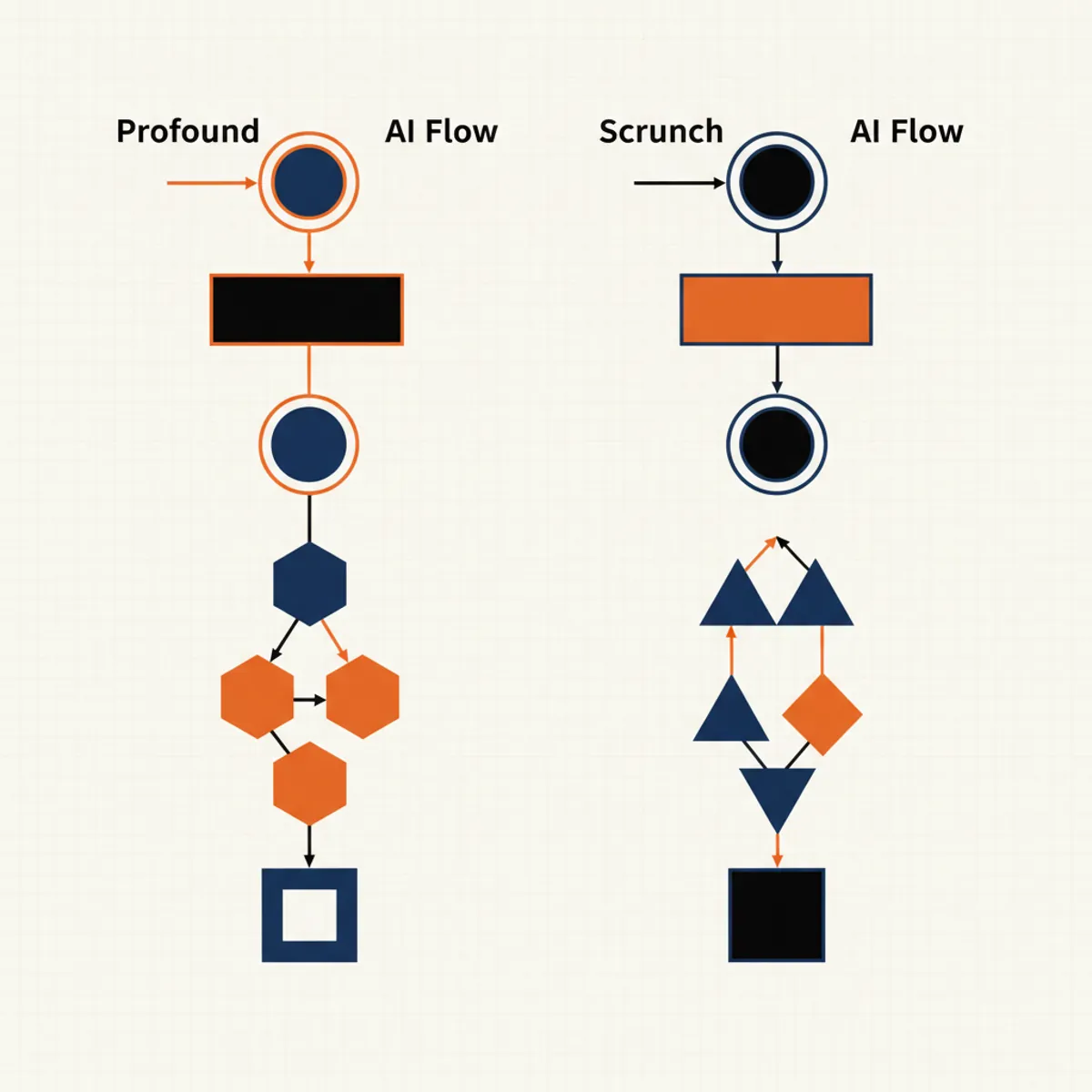
Side-by-Side Comparison: Profound AI vs. Scrunch AI
| Feature | Profound AI | Scrunch AI |
|---|---|---|
| Primary Use Case | LLM Share of Voice Tracking | Authority & Influencer Discovery |
| Data Source | Direct LLM API & Web Scraping | Social & Web Engagement Data |
| Reporting Focus | Citations and Brand Sentiment | Reach, Authority, and Creator Links |
| Target Audience | Enterprise SEOs & CMOs | Content Marketers & PR Teams |
| AEO Capability | Direct Visibility Measurement | Indirect Authority Building |
| Ease of Use | Technical / Analytical | Creative / Operational |
How to Choose the Right Tool for Your AEO Framework
Implementing a tool without a strategy is a recipe for wasted budget. You must first establish an aeo-framework to understand where your gaps lie. If your brand is already large but not being mentioned in AI results, you need Profound AI to diagnose why the engine is ignoring you. If you are a new brand trying to build the authority required to be noticed, Scrunch AI is the better starting point for building the necessary external signals.
Step 1: Baseline Your Current AI Visibility
Use Profound AI to run a search for your top 50 commercial intent keywords. Record how many times your brand appears in the "Answer" vs. the "Sources" section. This establishes your starting point. Common mistake: focusing only on ChatGPT. You must check Gemini and Perplexity as well, as their sourcing algorithms differ significantly. Gemini leans heavily on Google’s Knowledge Graph, while Perplexity is more aggressive about real-time web citations.
Step 2: Identify Citation Gaps
Analyze the sources that the AI is citing. Are they competitors? Are they third-party review sites? If the AI is citing a specific niche blog you’ve never heard of, that blog is an authority node. Pro tip: Use this data to inform your PR outreach. If the AI trusts a specific forum or a minor tech journalist, that is where your next guest post or product placement should go.
Step 3: Map Authority Nodes with Scrunch AI
Take the authority nodes identified in Step 2 and plug them into Scrunch AI. Find similar creators or platforms that have high engagement. The goal is to create a surrounding "halo" of mentions that the AI cannot ignore. Why it works: AI models look for consensus across multiple trusted sources. If three different influencers identified by Scrunch AI mention your product, the probability of an LLM citing you as the "best" choice increases exponentially.
Step 4: Content Execution and Schema Alignment
Produce content that answers the specific questions the AI is currently getting wrong. Ensure this content is supported by robust technical SEO. If you aren't sure where to start, an aeo-website-audit can reveal if your site structure is preventing AI bots from understanding your expertise. Use Scrunch AI to identify the "tone" that resonates in your niche and Profound AI to verify if your new content is actually being ingested and cited.
Step 5: Iterative Measurement
Re-run your Profound AI reports every 30 days. AEO is not a one-time fix; it is a continuous process of feeding the engines better data. If your citations increase but your sentiment stays flat, you need to refine your brand messaging. If your brand is mentioned but the links are broken, you have a technical debt issue that requires immediate attention.
Advanced Tactics: Leveraging Both Platforms for Multi-Channel Dominance
While many agencies treat these tools as "either-or," the most sophisticated AEO strategists use them in a feedback loop. This is known as the "Validation-Amplification" loop.
- Detection (Profound AI): Identify a specific query where your competitor is cited, but you are not. For example: "Best sustainable packaging for e-commerce."
- Reverse Engineering (Profound AI): Look at the sources cited for that query. Often, they are specific Reddit threads or industry reports.
- Expansion (Scrunch AI): Use Scrunch to find influencers and publications that are closely related to those sources but haven't covered you yet.
- Infiltration (Execution): Seed content into these new nodes—get the influencer to mention you, or get featured in the publication.
- Verification (Profound AI): Watch your "Share of Model" in Profound AI to see how long it takes for the LLM to update its internal representation of the topic to include your brand.
This tactical loop ensures you aren't just creating content for the sake of it; you are creating content specifically to fill the gaps in the AI's knowledge base.
Industry Examples: AEO in Action
To understand the scale of this, look at three different industries where the Profound vs. Scrunch choice changes based on business goals.
Example 1: B2B Enterprise Software (The Visibility Gap)
A global HR software firm found they were mentioned in 60% of Google Search results for "enterprise payroll," but only 12% of ChatGPT summaries.
- Tool used: Profound AI.
- Finding: The AI was pulling data from G2 and Capterra, where the brand had a 3.8-star rating, while the competitor had a 4.5.
- Result: The brand shifted focus from SEO blogging to a review generation campaign. Six months later, ChatGPT mentions rose to 35%, coinciding with a 20% increase in high-intent demo requests from "AI search" as a self-reported source.
Example 2: D2C Beauty Brand (The Authority Play)
A new sustainable skincare brand had zero presence in AI search because they were too new to be in the training sets of older models.
- Tool used: Scrunch AI.
- Strategy: They identified 15 "Micro-Authority" YouTubers whose transcripts were frequently appearing in Perplexity’s citations for skincare advice.
- Result: By securing features with 8 of these creators, the brand began appearing in Perplexity "Pro" answers within three weeks. Their Scrunch "Resonance Score" jumped by 300%, and they achieved a 15% Share of Voice for "best vegan serum" queries.
Example 3: Financial Services (Sentiment Correction)
A mid-sized bank was being characterized by Gemini as having "high fees" due to an outdated fee schedule from 2021 that was still being indexed.
- Tool used: Profound AI.
- Finding: Profound identified the specific PDF source the AI was scraping.
- Result: The bank updated the PDF, utilized proper schema-markup-tools to label their new fee structure, and requested a recrawl. Profound AI confirmed the sentiment shift from "Expensive" to "Competitive" within 45 days.
Addressing AEO Objections: FAQs in Prose
One common objection to investing in tools like Profound or Scrunch is that LLMs are "black boxes" and cannot be truly influenced. While it is true that we don't have the exact weights of GPT-4, we do have the outputs. If a model consistently provides a source link, that is a measurable data point. AEO is not about "hacking" the model; it is about providing the highest quality, most verifiable data so the model doesn't have to guess.
Another concern is the cost. These tools are enterprise-grade and carry the price tag to match. However, when you consider the cost of losing 30% of your search traffic to an AI summary that doesn't mention you, the ROI becomes clear. You are paying for the ability to protect your brand's reputation in the primary interface of the next decade.
Some marketers ask if traditional SEO tools aren't enough. The answer is a definitive no. An Ahrefs rank does not tell you if ChatGPT thinks your brand is a scam. It doesn't tell you if Gemini is summarizing your competitor’s product features while ignoring yours. You need tools that speak the language of LLMs, not just the language of backlink profiles.
Common Pitfalls in AEO Tool Adoption
- Treating AI Search like Google: The biggest mistake is assuming that ranking #1 on Google means you will be the primary answer in SearchGPT. This is often not the case. The AI prioritizes synthesis and trust over keyword density.
- Ignoring the Source of Truth: Many teams focus on the response and forget the source. If Profound AI shows you are mentioned but the link is to a 4-year-old press release, your information is stale. You must update the source, not just complain about the answer.
- Over-reliance on Automation: These tools provide the data, but they don't provide the strategy. You still need human experts to interpret why a model might be characterizing your brand as "expensive" rather than "premium." The "why" is often found in the intersection of sentiment data and competitive analysis.
- Neglecting Technical Foundations: No tool can help if your site is a technical mess. Ensure you are utilizing schema-markup-tools to provide a clear knowledge graph for the engines to ingest. If the bots can't parse your site, they won't cite you, no matter how much you spend on Scrunch AI creators.
Essential AEO Metrics to Track
To measure the ROI of your AEO efforts, move beyond clicks and focus on these four pillars:
- Answer Share: The percentage of AI responses for your target keywords that include your brand. This is your new "Market Share."
- Citation Depth: The number of unique pages from your site used as sources by the AI. A deep site with many cited pages indicates broad authority.
- Sentiment Index: The qualitative score of how the AI describes your brand (Neutral, Positive, Negative). This is critical for brand health.
- Source Persistence: How long your brand remains the primary answer before a competitor displaces you. This measures the "stickiness" of your authority.
The Future of Answer Engine Optimization
As we move toward a more fragmented search ecosystem, the distinction between "SEO" and "AEO" will blur until they are one and the same. Tools like Profound AI and Scrunch AI are the first generation of what will become a standard part of the marketing stack. The brands that win will be those that realize their website is no longer just for humans, but a structured data repository for the most powerful intelligence ever created.
We are entering the age of "Agentic Search," where AI agents will perform tasks on behalf of users. These agents will make decisions based on the data provided by these engines. If your brand is not optimized for these answers today, you will be invisible to the autonomous buyers of tomorrow.
If you're ready to see how your brand stacks up in the world of generative AI, consider starting with a free-aeo-audit to identify your biggest opportunities. The engines are reading—make sure they like what they see.
For more specialized advice on building a future-proof strategy, you can visit our services page or contact our team of AEO strategists directly. We help brands navigate the complex intersection of LLM visibility and authority building using a data-backed, technical approach.
Frequently asked questions
What is the primary difference between Profound AI and Scrunch AI?+
Profound AI is an enterprise-grade measurement platform specifically built to track brand share-of-voice and sentiment within LLMs and AI search engines. Scrunch AI, while incorporating AI-driven insights, primarily targets the creator economy and influencer-led content optimization, helping brands identify authority figures that influence AI training sets and general discovery.
Can I use both tools for my AEO strategy?+
Yes, they serve complementary roles. You would use Profound AI to audit your current standing in AI responses and identify citation gaps. You would then use Scrunch AI to execute a high-authority content strategy by partnering with influencers and creators whose work is frequently cited by AI models, bridging the gap between visibility and authority.
How does Profound AI track brand mentions in LLMs?+
Profound AI uses a proprietary monitoring system that queries various Large Language Models and AI search engines across a massive dataset of keywords. It analyzes the generated responses to determine if a brand is mentioned, how it is characterized, and which sources the AI is citing to form its conclusion.
Is Scrunch AI better for small businesses?+
Scrunch AI tends to be more accessible for small-to-medium businesses that rely on social proof and influencer marketing. Its interface is designed for rapid content execution. Profound AI is a heavy-duty data tool better suited for enterprise SEO teams and agencies that need to prove AEO ROI through granular reporting.
Do these tools help with Schema markup?+
Neither tool is a dedicated Schema generator, but both inform your Schema strategy. Profound AI shows you which entities the AI is confusing your brand with, signaling a need for better Organization Schema. Scrunch AI identifies high-authority nodes, which you can then link to using 'mentions' or 'about' properties in your JSON-LD.
Which tool provides better data on Perplexity and ChatGPT?+
Profound AI is the market leader for direct LLM visibility data. It provides specific dashboards for Perplexity, ChatGPT, and Gemini. Scrunch AI provides more tangential data focused on the web sources that these models likely crawl, rather than the direct output of the models themselves.
Sources & further reading
Soft next step
Want to see where AI answers mention you — and where they don't?
We run a free AEO audit across ChatGPT, Gemini, Copilot and Perplexity, then hand you the fixes in priority order. Start your AEO strategy today.
Keep reading
Tools & Measurement
AEO Website Audit: A 2026 Guide to AI Search SuccessAI Platforms
How AI Chooses Sources: The Definitive 2026 Guide to AEOTechnical AEO
Entity Optimization for AEO: Mastering AI Search in 2026