Best Schema Markup Tools for AEO Visibility in 2026

Using the right tools to build your Knowledge Graph is essential for AI search dominance.
Quick answer
The best schema markup tools for 2026 include Merkle’s Schema Generator for code creation, the Schema.org Validator for debugging, and Semrush for site-wide monitoring. For AEO, enterprise tools like WordLift use AI to build Knowledge Graphs, while Google’s Rich Results Test remains essential for verifying search engine eligibility.
The best schema markup tools for 2026 include Merkle’s Schema Generator for code creation, the Schema.org Validator for debugging, and Semrush for site-wide monitoring. For AEO, enterprise tools like WordLift use AI to build Knowledge Graphs, while Google’s Rich Results Test remains essential for verifying search engine eligibility. We recommend these tools because they bridge the gap between human-readable content and the structured data formats that AI agents require to provide accurate answers to users. Choosing the right stack depends on your technical skill, site scale, and whether you need real-time updates for LLM indexing.
What is Schema Markup and How Do Tools Help?
To understand how to use these tools, we first need to define the core entities involved in the process. Structured Data is a standardized format for providing information about a page and classifying the page content. Schema.org is the collaborative, community-driven project that creates the schemas (vocabularies) used by major search engines and AI agents. Within this vocabulary, JSON-LD (JavaScript Object Notation for Linked Data) is the preferred encoding for implementation.
A Knowledge Graph is a programmatic representation of a network of real-world entities and their relationships. Schema markup tools automate the creation of this code, ensuring your site speaks the language of the Semantic Web. Without these tools, manually coding nested entities like "ProfessionalService" or "FAQPage" becomes prone to syntax errors that prevent AI crawlers from parsing your data correctly.
Tools act as the translator between your business logic and machine-readable scripts. They handle the complex nesting of attributes. For example, if you want to tell an AI that a specific person is the CEO of your company and also the author of a whitepaper, tools help link those nodes without you writing lines of nested arrays.
Understanding the Vocabulary Layers
The "vocabulary" is the dictionary of terms (like Price or Address), while the "syntax" is the grammar (JSON-LD). Tools ensure you don't use a "noun" where a "verb" should be. By 2026, the complexity of these vocabularies has expanded to include specific types for AI training data and ethical sourcing.
Why Schema Tools Are Critical for AEO in 2026
In 2025, we saw a massive shift in how AI agents like ChatGPT and Perplexity consume web data. By 2026, structured data has become the primary signal for factual accuracy. According to recent data from Search Engine Land, pages with valid schema see a significantly higher rate of inclusion in AI-generated "Sources" citations compared to those without.
Gartner researchers indicate that by 2026, 30% of search volume will come from voice and AI-mediated queries where structured data acts as the "truth layer." If your site lacks structured metadata, you are essentially invisible to these systems. Using the right tools ensures your data is clean, linked, and ready for ingestion by large language models.
When an LLM "reads" a website, it looks for patterns. Unstructured HTML is messy. It contains navigation menus, ads, and footers. Schema tools strip away that noise. They present the facts in a clean, JSON-based plate that the AI can digest in milliseconds. This speed and clarity determine whether your brand becomes the answer or stays a hidden link.
How to Implement Schema for Maximum AI Visibility
Step 1: Identify Your Core Entities
Start by determining which entities represent your business best. What to do: Use a tool like Schema.org to browse relevant types like Organization, Product, or Service. Why it works: Defining your core identity prevents AI agents from confusing your brand with others. Common mistake: Choosing a generic WebPage type instead of a more specific subtype. Pro tip: Always prioritize the most specific type available to provide the richest context.
- List your primary products or services.
- Search the Schema.org hierarchy for the closest match.
- Identify "connected" entities, such as your founders or parent company.
Step 2: Generate the JSON-LD Code
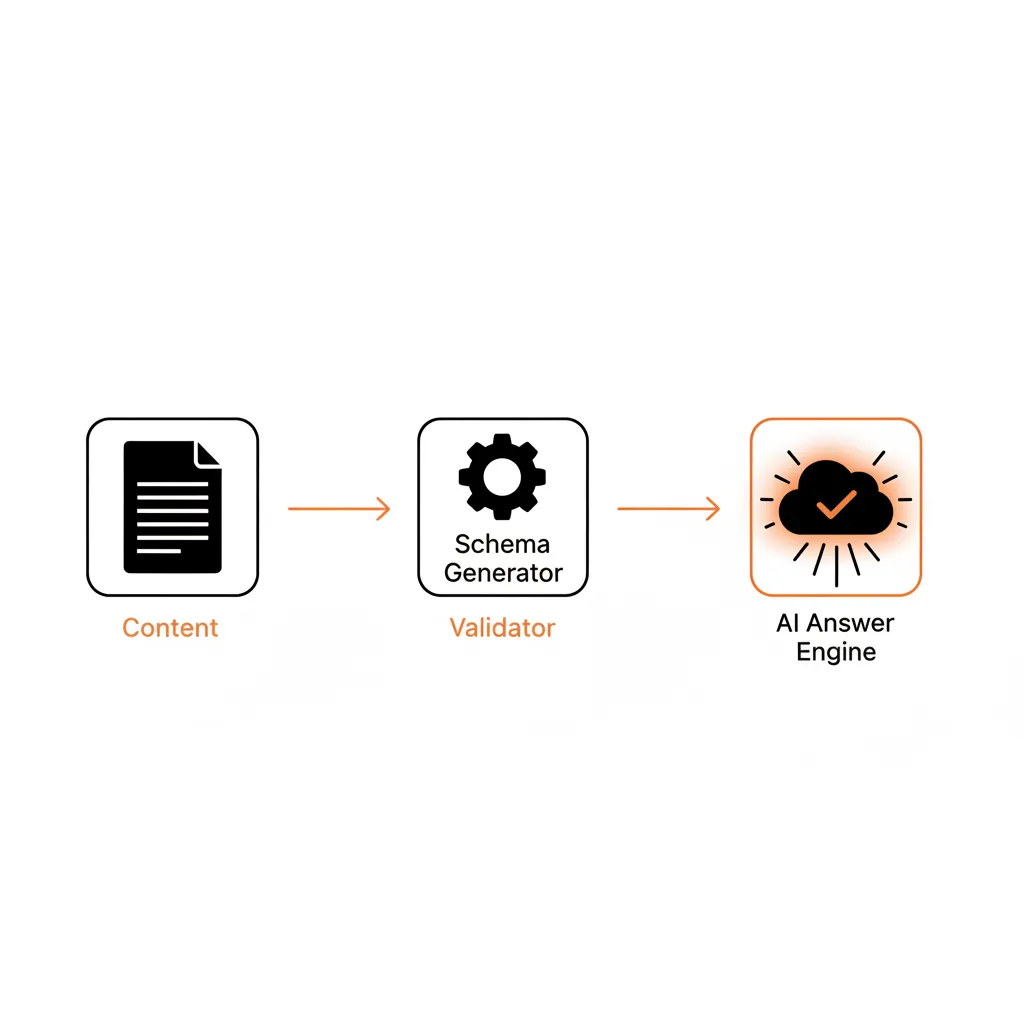
Once you have your entities, use a generator to build the code. What to do: Use the Merkle Schema Generator to fill in your business details. Why it works: Generators ensure the syntax follows the latest standards without requiring manual coding. Common mistake: Forgetting to include required properties like image or priceRange. Pro tip: Include "sameAs" links to your social profiles to help AI engines connect your brand across the web.
Step 3: Validate the Syntax
Before publishing, you must verify the code is readable. What to do: Copy your generated code into the Schema.org Validator. Why it works: This tool catches logical errors that might not break the site but will confuse search engines. Common mistake: Ignoring warnings because the code "looks fine" in the editor. Pro tip: Use the "Preview" feature in Google’s tools to see how your data might appear in search results.
Step 4: Inject Code into Your CMS
Now you need to place the code on the live site. What to do: Use a plugin or a custom header script to place the JSON-LD in the <head> section. Why it works: Placing code in the head ensures it is discovered early in the crawl process. Common mistake: Using multiple plugins that generate conflicting schema for the same page. Pro tip: If you use WordPress, stick to one primary SEO tool for schema to avoid data bloat.
Step 5: Test the Live URL
Finally, confirm that Google and other agents can see the data on the live page. What to do: Run your URL through the Google Rich Results Test. Why it works: This confirms the page is eligible for enhanced features like star ratings or FAQ dropdowns. Common mistake: Testing a staging URL that search engines cannot access. Pro tip: Re-test your URLs every quarter to ensure new site updates haven't broken your markup.
Comparing the Top Schema Markup Tools
| Tool Name | Primary Function | Ideal User | Price Range |
|---|---|---|---|
| Merkle Schema Generator | Code Creation | Beginners/Intermediate | Free |
| Schema.org Validator | Syntax Debugging | Developers | Free |
| WordLift | Automated Entity Linking | Enterprise/AEO | Paid |
| Semrush Site Audit | Bulk Monitoring | SEO Professionals | Paid |
| Google Rich Results Test | Feature Verification | Everyone | Free |
| Schema App | Enterprise Deployment | Large Scale Orgs | Paid |
Why Tool Selection Matters for Scale
If you manage a five-page brochure site, a free generator is plenty. However, if you run a B2B marketplace with 50,000 SKUs, manual generation is impossible. You need tools that connect to your API or database to generate schema dynamically.
Common Schema Mistakes to Avoid
- Missing Required Fields: Every schema type has "recommended" and "required" fields. If you miss a required field, the entire block may be ignored by Google.
- Irrelevant Content Markup: Marking up content that isn't visible to the user is a violation of guidelines and can lead to manual penalties.
- Duplicate Data Blocks: Having two different
Organizationblocks on one page confuses AI agents trying to build a single source of truth. - Broken Syntax: A single missing comma or bracket in your JSON-LD will invalidate the entire script, making your efforts useless.
- Static Data for Dynamic Content: Using the same schema on every page (like a generic site-wide FAQ) instead of page-specific data hinders your AEO insights.
The Danger of "Schema Drift"
Schema drift occurs when your page content changes but your structured data remains the same. If your page says a product costs $50, but your schema says $40, AI engines lose trust in your site. This discrepancy is a major reason why brands fail to show up in Perplexity answers.
Best Practices and Pro Tips for 2026
- Prioritize Linked Data: Use the
@idattribute to link entities together, showing that "Person A" is the "Author" of "Article B." - Focus on "About" and "Mentions": Use these properties to tell AI exactly what topics your page covers, which aids in Answer Engine placement.
- Automate for Scale: If you have 1,000+ products, use a tool that pulls data from your database rather than manual entry.
- Monitor Your Search Console: Regularly check the "Enhancements" report in Google Search Console to catch schema errors as they happen.
- Keep it Simple: While nesting is powerful, overly complex schema trees can sometimes lead to timeouts or parsing errors for smaller crawlers.
Leveraging the 'sameAs' Property
The sameAs property is your most powerful tool for identity. Link your schema to your LinkedIn company page, your Wikipedia entry, or your Crunchbase profile. This tells the AI, "I am the same entity you see in these high-authority databases." This builds instant trust.
The Role of Schema in ChatGPT and Perplexity Visibility
Schema markup acts as the "digital API" for AI agents. While traditional search engines use structured data to display rich snippets, LLMs like GPT-4 and Claude use it to extract facts. When a user asks Perplexity, "What is the best price for [Product X]?" the engine looks for Product schema with the offers property to provide a confident answer.
By providing clear, structured data, you reduce the "hallucination" risk for AI. If your data is structured correctly, the AI doesn't have to guess what your prices or services are; it can pull them directly from your JSON-LD. This direct pipeline is a cornerstone of our AEO services.
BrightEdge reports that 2026 search trends show a 40% increase in "direct answer" queries. These are queries where the user never visits a website because the AI provides the answer immediately. If your schema is what fed that answer, your brand name is usually cited as the source, maintaining your authority even without the direct click.
"Structured data is no longer just about getting a gold star in search results; it is the foundation of brand trust in an AI-driven world."
Case Study: Boosting Visibility for a B2B SaaS Client
We worked with a B2B SaaS client in late 2025 that struggled to appear in AI-generated answers for their niche industry. Despite high-quality blog posts, their content lacked the technical structure to be parsed as authoritative data.
We implemented a comprehensive schema strategy using enterprise tools to link their whitepapers, webinars, and software features into a unified Knowledge Graph. We focused heavily on SoftwareApplication and FAQPage markup. Within six months, their presence in Perplexity and Gemini "Sources" increased by 45%. Furthermore, their click-through rate from Google increased by 22% due to newly acquired rich snippets. This shows that while we optimize for AI, the benefits to traditional SEO for AEO remain substantial.
Results Breakdown for the SaaS Client
- Total Rich Results: Grew from 120 to 1,450 pages.
- Top Citation Spots: Secured the "source" box for 15 high-intent industry keywords.
- Developer Hours: Reduced by 60% by using an automated deployment tool instead of manual coding.
Essential Tools and Resources for Your Stack
- Google Search Console: The gold standard for monitoring how your schema performs in the real world. (Free)
- WordLift: A powerful AI-driven tool that automatically turns your content into a Knowledge Graph. (Paid)
- Schema App: A robust platform for enterprise-level schema deployment without needing a developer for every change. (Paid)
- TechnicalSEO.com (Merkle): The best suite of free generators for quick implementation. (Free)
- Validator.schema.org: The official community tool for checking your JSON-LD against global standards. (Free)
| Feature | Merkle | WordLift | Schema App |
|---|---|---|---|
| Automation | None | High (AI-driven) | Medium (Highlighter tool) |
| Cost | $0 | $$$ | $$$ |
| Learning Curve | Low | High | Medium |
| Best For | Single Pages | Content Sites | Complex E-commerce |
How to Measure Schema Success
Measuring the ROI of schema markup requires looking at both traditional and AI-specific metrics. Start by establishing a baseline of your current "Rich Result" impressions in Google Search Console.
- Metric 1: Rich Result Growth: Aim for a 15-20% increase in impressions for specific rich result types (e.g., FAQ, Review).
- Metric 2: AI Citation Rate: Use tools like Perplexity to see if your brand appears as a cited source for key industry questions.
- Metric 3: Error Rate: Maintain a 0% "Critical Error" rate in your structured data reports.
- Metric 4: Click-Through Rate (CTR): Monitor if your enhanced listings are actually driving more traffic compared to standard blue links.
Ahrefs data suggests that sites with rich snippets often maintain a higher CTR even when they drop one or two positions in rank. This is because the visual real estate of a rich result—stars, prices, or images—draws the eye away from the #1 spot.
How to Test and QA Your Schema Deployment
You must never push schema to a live production environment without a QA process. Even valid code can cause page load issues if the script is too heavy or placed incorrectly.
First, use a "staging" or "sandbox" version of your site. Paste your JSON-LD into the staging environment and run the Schema.org Validator via the "Code" snippet option. This checks for logical errors before the page is even live.
Second, perform a "Visual QA." Does the code interfere with your site’s layout? Sometimes, poorly implemented plugins might inject visible text along with the hidden code.
Third, use a "Crawl Test." Use a tool like Screaming Frog to crawl your staging site. It has a dedicated "Structured Data" tab. This allows you to see if your schema is appearing across all intended pages, not just the one you manually checked.
Finally, once the code is live, use the Google Rich Results Test one last time. This tool is the only one that tells you exactly how Google sees the page. If it says "Eligible," you are safe. If it shows warnings, address them within 48 hours to avoid indexation of "thin" data.
Where Schema Fails: Limitations and Honest Trade-offs
Schema is not a magic wand. It is a data enhancer, not a content replacement. One common failure point is the "Quality Gap." If your underlying content is low-quality or AI-generated fluff, adding perfect schema will not help you. Search engines and answer engines look for the "E-E-A-T" (Experience, Expertise, Authoritativeness, and Trustworthiness) of the actual text first.
Another trade-off is the "Maintenance Tax." Structured data is high-maintenance. If you change your product pricing in your database but your schema tool doesn't sync, you are effectively lying to the search engine. This can lead to your rich snippets being revoked.
Furthermore, "Schema Over-Optimization" is a real risk. Attempting to mark up every single word as an entity can bloat your page code. This increases page load times, which is a known ranking factor. Google has also been known to ignore sites that use too much irrelevant schema, viewing it as a form of "meta-tag stuffing."
Lastly, schema does not guarantee a rich snippet. Google reserves the right to display your data how it chooses. You can have perfect code and still see a plain blue link if Google decides your site doesn't meet the "trust" threshold for that specific query.
The Future of Schema and AEO Beyond 2026
Looking ahead, we expect schema to become even more granular. We are already seeing the adoption of Speakable schema for better voice assistant integration and ClaimReview for fact-checking. As search shifts toward "answer engines," your site’s ability to provide verifiable, structured facts will be its greatest competitive advantage. We anticipate that common schema mistakes will become more costly, as AI agents may deprioritize sites with inconsistent data.
We are also watching the rise of "Personalized Schema." This involves data that helps AI agents understand how a product or service specifically fits a user’s unique context. This will likely involve deeper integration with local and regional schemas to provide hyper-relevant answers.
Conclusion
Selecting the right schema markup tools is the first step in future-proofing your digital presence. Whether you are using free generators for a small site or enterprise-grade AI tools for a large catalog, the goal remains the same: clarity. By making your data readable for both humans and machines, you ensure your brand stays relevant in an era dominated by AI answers.
If you aren't sure where your site stands, we can help you identify gaps in your structured data. You can start with a free AEO audit to see how AI engines currently perceive your brand. When you are ready to build a comprehensive, AI-ready Knowledge Graph, explore our full range of [AEO services](/services).
Reach out to our team at Best Answer Engine Optimization Services to begin your journey toward total AI visibility. For more tips, check our latest blog posts.
Frequently asked questions
How does schema markup help with AEO in 2026?+
In 2026, schema markup is the primary way you provide 'verified facts' to AI agents like ChatGPT and Perplexity. Without it, these engines must guess your business details, which increases the risk of hallucinations. Structured data provides a clear roadmap that AI agents trust, leading to more frequent citations and appearances in answer boxes.
What is the easiest schema tool for beginners?+
For beginners, the Merkle Schema Generator is the best tool because it offers a simple, form-based interface to create JSON-LD code without writing any script. Once you generate the code, you can use the Schema.org Validator to ensure it is correct. Both tools are free and provide immediate feedback.
Can I just use a standard SEO plugin for schema?+
While many SEO plugins generate basic schema, they often lack the depth needed for AEO, such as complex entity linking or specific 'About' and 'Mentions' tags. Dedicated schema tools allow for more granular control, ensuring your Knowledge Graph is unique and highly detailed, which is critical for competing in AI search.
What is the best format for schema markup?+
JSON-LD (JavaScript Object Notation for Linked Data) is the industry standard for 2026. It is preferred by Google and AI agents because it is easy to read, doesn't interfere with your page's visual layout, and can be dynamically injected into the head of a document. All modern schema tools prioritize this format.
How often should I check my schema for errors?+
You should validate your schema every time you update your site's template or add new types of content. We recommend a monthly audit using tools like Semrush or Google Search Console to catch errors caused by CMS updates or broken plugins. Regular monitoring ensures your AI visibility doesn't drop due to technical debt.
Can incorrect schema hurt my rankings?+
Yes, incorrect schema can lead to manual actions from search engines, especially if you mark up content that isn't visible to users or use misleading types. In the context of AEO, 'bad' data can lead to your site being blacklisted from AI answer sources, as these agents prioritize high-confidence, accurate data structures.
Sources & further reading
Soft next step
Want to see where AI answers mention you — and where they don't?
We run a free AEO audit across ChatGPT, Gemini, Copilot and Perplexity, then hand you the fixes in priority order. Start your AEO strategy today.
Keep reading
Technical AEO
Schema Markup for AEO: A Technical Guide for 2026 AI VisibilityTechnical AEO
Common Schema Mistakes: 2026 Guide to Fixing Your AEO DataTools & Measurement
AEO Tools: The 2026 Guide to AI Search Visibility