Effective AEO Techniques for B2B Companies: A Strategic Framework

Modern B2B marketing requires a shift from keyword-centric SEO to intent-driven AEO.
Quick answer
Effective AEO techniques for B2B companies focus on structuring complex technical data into machine-readable formats. Key strategies include implementing advanced schema markup, developing semantic content clusters around specialized industry queries, maintaining consistent brand citations across high-authority databases, and creating direct, expert-led answers that AI agents can easily parse and reference in generated responses.
Effective AEO techniques for B2B companies focus on structuring complex technical data into machine-readable formats. Key strategies include implementing advanced schema markup, developing semantic content clusters around specialized industry queries, maintaining consistent brand citations across high-authority databases, and creating direct, expert-led answers that AI agents can easily parse and reference in generated responses.
The Evolution of B2B Search: Beyond Ten Blue Links
For decades, B2B companies relied on the predictable rhythms of SEO. You researched keywords, wrote 2,000-word blog posts, and hoped to land on the first page of Google. That world is dissolving. Today, procurement officers and IT directors are turning to Perplexity, Gemini, and ChatGPT to solve their business problems. They are not typing "best CRM"; they are prompting, "Which CRM integrates with SAP S/4HANA and supports HIPAA compliance for a 500-person medical device firm?"
Answer Engine Optimization (AEO) is the strategic response to this shift. Unlike traditional SEO, which focuses on driving traffic to a website, AEO focuses on providing the underlying data that feeds the AI's response. In B2B, where the sales cycle is long and the technical requirements are high, being the cited source in an AI's answer is the new standard for digital authority. If you want to understand the foundational shift, read our guide on what is answer engine optimization aeo.
The transition from "discovery by clicking" to "discovery by synthesis" means that the volume of top-of-funnel traffic may decrease, but the intent of the traffic that does arrive—or the quality of the brand mentions in AI summaries—becomes significantly higher. In a B2B context, the objective is no longer to get 10,000 random visitors; it is to be the single, definitive answer when a VP of Operations asks an AI to evaluate supply chain software.
Why AEO is Critical for B2B in 2026
By 2026, the traditional search engine results page (SERP) will likely be a secondary destination. B2B buyers value efficiency above all else. They do not want to click through five different websites to compare technical specifications. They want an AI agent to synthesize that information for them.
B2B companies that ignore AEO risk becoming invisible. When an AI summarizes a solution, it cites sources it deems "authoritative" and "readable." If your content is locked in unstructured PDFs or hidden behind vague marketing speak, the AI will bypass you in favor of a competitor who has structured their knowledge correctly. This isn't just about traffic; it's about being present in the zero-click environments where decisions are now made.
Furthermore, the B2B buying committee has grown. According to recent data, the average B2B purchase now involves 6 to 10 decision-makers. AI serves as a preliminary researcher for these committees. If your brand is excluded from the initial AI-generated shortlist, you are effectively excluded from the entire sales cycle before it even begins. AEO ensures you are "in the room" when the AI presents its findings to the human decision-makers.
Core Techniques for B2B Answer Engine Optimization
To succeed in this environment, B2B firms must move away from generic content and toward a data-first mentality. Here are the core pillars of a modern B2B AEO strategy.
1. Advanced Schema and Linked Data
Schema markup is the language of AEO. For B2B, this goes beyond simple "Article" tags. You must use specific schemas like TechArticle, SoftwareApplication, Service, and Course. By nesting these tags, you tell the AI exactly what your product does, who it is for, and how it performs. This is vital for aeo-schema-markup-implementation-guide success.
Beyond basic product tags, B2B firms should utilize Speakable schema and DefinedTerm markup. For specialized industries—such as bioreactor manufacturing or fintech—defining your terminology in a machine-readable format ensures that AI models associate your brand with technical expertise. When an AI looks for the definition of a specific industry process, your site should be the source of the definition.
2. Semantic Cluster Mapping
AI models don't look for keywords; they look for relationships between concepts. A B2B firm selling cybersecurity should not just target "firewalls." They should build a semantic map that includes "zero-trust architecture," "packet inspection," "lateral movement prevention," and "SOC 2 compliance." This creates a web of relevance that helps AI identify you as an expert in a broad niche.
Semantic mapping requires moving away from the "one page, one keyword" model. Instead, you create a hub-and-spoke architecture where a central technical pillar page is supported by dozens of micro-targeted answers to specific technical questions. This topical density signals to Large Language Models (LLMs) that your site is a comprehensive knowledge base rather than a shallow marketing brochure.
3. Direct-Answer Content Architecture
Traditional B2B whitepapers are often too dense for AI to extract quick answers from. AEO requires a "Direct-to-Answer" format. This means starting sections with a clear, 50-word summary of the solution, followed by the supporting evidence. This structure makes it easy for Large Language Models (LLMs) to scrape and attribute the answer to you.
This architecture also includes the use of "Inverted Pyramid" writing. In B2B, we often bury the "how-to" at the bottom of a page to encourage scrolling. In AEO, this backfires. The AI needs the most critical data points—pricing, specifications, compatibility, and certifications—at the top of the document hierarchy.
Step-by-Step Implementation Guide for B2B AEO
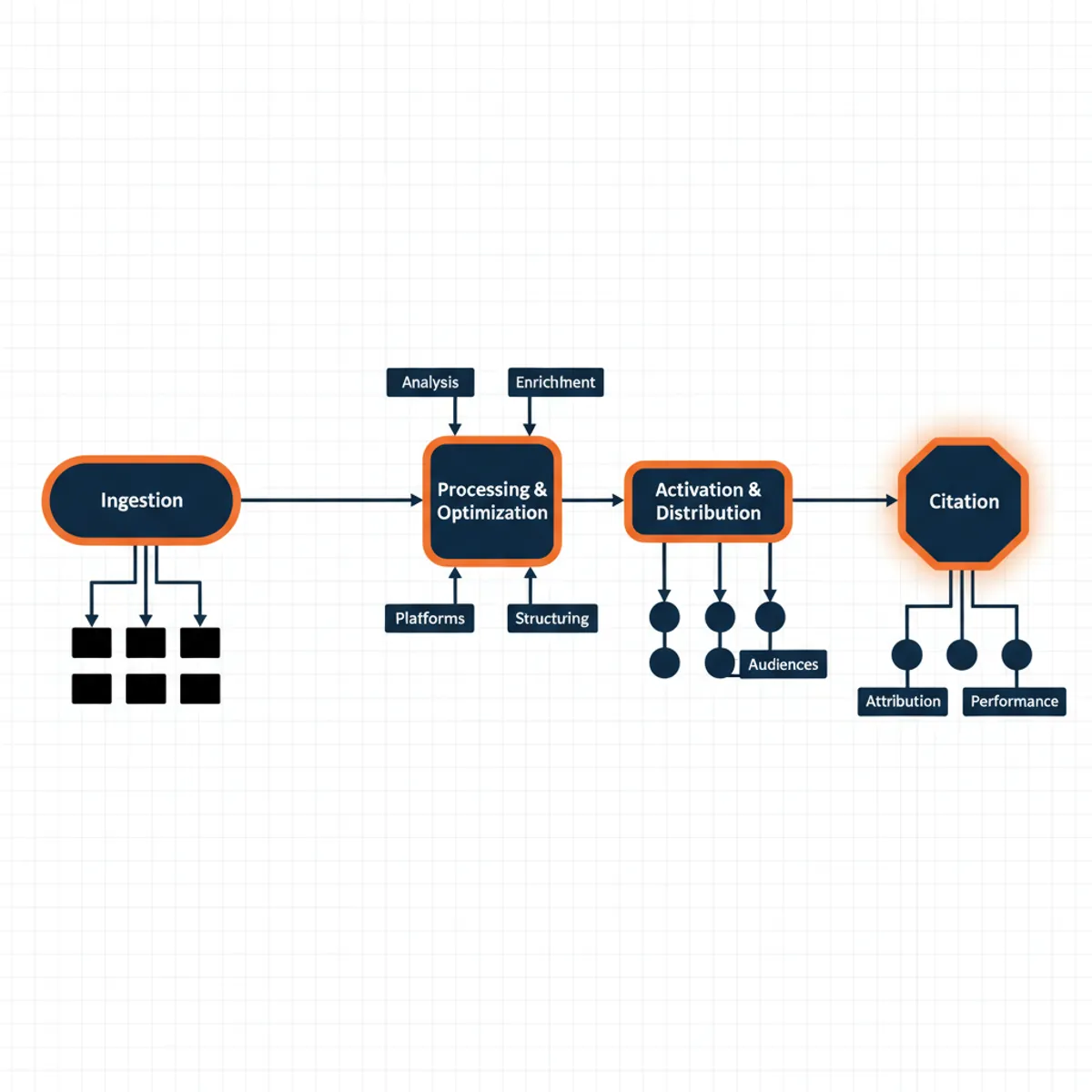
Implementing AEO in a B2B environment requires a systematic approach. Follow these five steps to transition your content strategy.
Step 1: Audit for AI Scrappability
First, assess how easily an AI can read your site. Use tools to see if your most valuable insights are hidden in images or non-text elements.
- Why it works: AI needs text-based clarity to build its internal model of your brand.
- Common Mistake: Leaving key technical specs inside a downloadable PDF only. AI can read PDFs, but it prioritizes high-speed HTML for its primary answer engine caches.
- Pro Tip: Use a text-only browser or an LLM to read your page and ask it to summarize the key benefits. If it misses the mark, your AEO is weak.
Step 2: Build a Semantic Entity Map
Identify the core entities (products, concepts, people) associated with your business. Map how they relate to industry problems.
- Why it works: AI engines use Knowledge Graphs to connect entities. If your brand is frequently mentioned in the same paragraph as "enterprise resource planning," the engine builds a vector association.
- Common Mistake: Creating siloed pages that don't interlink conceptually.
- Pro Tip: Use ai-driven-content-clusters-for-aeo to organize your site architecture around topics, not just keywords.
Step 3: Implement JSON-LD for Everything
Every service, product, and expert on your team should have associated JSON-LD schema.
- Why it works: It provides a machine-readable summary that bypasses the need for the AI to "guess" your meaning. It essentially hands the AI a cheat sheet for your website.
- Common Mistake: Using generic schema that doesn't include specific B2B properties like
offers,brand, ormanufacturer. - Pro Tip: Check for common-schema-mistakes before deploying sitewide.
Step 4: Optimize for "Citation Flow"
Identify where AI engines get their information—places like Wikipedia, industry journals, and GitHub—and ensure your brand is mentioned there.
- Why it works: AI trusts sources that are corroborated by other authoritative platforms. This is the AEO equivalent of "backlinks," but the focus is on the textual mention rather than the hyperlink.
- Common Mistake: Focusing only on your own website while ignoring third-party mentions.
- Pro Tip: Guest post on technical sites that AI models use as training data or primary sources. Engage in forums where your experts can answer technical questions that LLMs might ingest.
Step 5: Refine via Prompt Testing
Go to Perplexity or ChatGPT and ask the questions your customers ask. See if your company is cited. If not, analyze the sources that were cited.
- Why it works: This is the most direct feedback loop available for AEO. It shows you exactly who the AI considers your superior in terms of informational authority.
- Common Mistake: Assuming your traditional SEO rankings translate to AI citations. They often do not.
- Pro Tip: Learn how to rank in perplexity by mimicking the tone and structure of the winning sources.
Comparison: Traditional SEO vs. B2B AEO
| Feature | Traditional B2B SEO | B2B Answer Engine Optimization (AEO) |
|---|---|---|
| Primary Goal | Rank #1 on Google SERP | Become the cited source in AI responses |
| Target Metric | Organic Traffic / Clicks | Brand Citations / LLM "Share of Model" |
| Content Unit | Keyword-optimized blog posts | Fact-dense, structured data modules |
| User Intent | Information gathering (Click-based) | Problem solving (Answer-based) |
| Technical Focus | Core Web Vitals, Backlinks | Schema.org, Knowledge Graph entry |
| Success Signal | High Click-Through Rate (CTR) | Attribution in generated summaries |
Deep Dive: Advanced AEO Tactics for Complex B2B Sales
While basic schema and content clusters provide the foundation, high-stakes B2B industries require more aggressive tactics to dominate AI responses.
The "Verified Expert" Loop
AI engines prioritize content that can be attributed to a verifiable human expert. For B2B firms, this means every whitepaper or technical guide must be linked to a person with a robust digital footprint. We recommend implementing Person schema for your CTO and Lead Architects, linking their profiles to their LinkedIn, Google Scholar, and industry certifications. When the AI sees a technical claim backed by a verified Person entity, the "trust score" of that answer increases, making it more likely to be featured.
Competitor Gap Synthesis
Use LLMs to analyze your competitors' content versus your own. Prompt an AI: "Compare the technical documentation of Brand A and Brand B regarding [specific feature]. Which one provides more actionable data for a systems engineer?" The AI's answer will reveal your weaknesses. If the AI says your competitor is better because they provide "clearer step-by-step integration steps," you have your AEO roadmap.
Dataset Optimization
Many AI engines are trained on massive public datasets. For B2B companies in data-heavy fields (Logistics, SaaS, Manufacturing), publishing open-source datasets or comprehensive industry benchmarks on platforms like Kaggle or GitHub can influence how AI models understand your niche. By providing the data that defines the industry's baseline, you position your brand as the "ground truth" for AI engines.
Addressing B2B Objections to AEO Implementation
Transitioning to an AEO-first strategy often meets internal resistance. Here are the common objections and the strategic rebuttals.
"If we provide all the answers on the page, nobody will click through to our lead forms." The reality is that users are already getting answers from AI engines. If you don't provide the answer, the AI will get it from a competitor or a third-party aggregator. By being the source, you earn the citation link, which is the only way to get a click in a zero-search environment. AEO isn't about hoarding traffic; it's about staying relevant in the user's decision-making flow.
"Our technical data is proprietary; we can't just put it all in schema." AEO does not require revealing trade secrets. It requires making the discoverable facts about your business machine-readable. If a customer needs to know your software's uptime or API compatibility to buy it, that information shouldn't be hidden. Transparency in the AEO era is a competitive advantage.
"We already spent a fortune on SEO; why start over?" AEO is not a replacement for SEO; it is an evolution. Good SEO practices—like site speed and mobile friendliness—still matter for AEO. However, AEO adds the necessary layer of structured data that allows your existing content to be understood by AI. It is an upgrade, not a rebuild.
Common Pitfalls in B2B AEO Strategy
Many B2B companies stumble by treating AEO as just "SEO but faster." Avoid these specific errors:
- Over-reliance on Gated Content: If your best technical data is behind a lead magnet form, AI engines cannot index it. In the AEO era, you must give away your best information to be cited as the expert.
- Ignoring the "Expert" Entity: B2B AI search often looks for specific people. If your engineers and executives don't have digital footprints (LinkedIn, industry papers), the AI won't trust your site as a primary source.
- Vague Value Propositions: AI is binary. Phrases like "we empower global synergy" mean nothing to a crawler. Use concrete numbers: "reduces server latency by 40% in AWS environments."
- Neglecting the FAQ: Many firms treat FAQs as an afterthought. In AEO, the FAQ is a primary ingestion point for AI. See our guide on faq-sections-for-aeo.
AEO is not about being the loudest voice in the room anymore; it is about being the most useful data point in the machine's memory. If a machine can't verify you, you don't exist.
— Amir, Founder of EvronStudio
Case Study: Cloud Infrastructure Provider AEO Overhaul
The Client: A mid-sized SaaS provider specializing in cloud storage for legal firms.
The Problem: Despite ranking for "legal cloud storage," they were never appearing in Perplexity or ChatGPT when users asked about "SOC 2 compliant storage for law firms."
The Strategy: We implemented a three-month AEO sprint. We converted their 50-page compliance PDF into a series of structured web pages, each tagged with TechArticle and ClaimReview schema. We also cleaned up their Wikidata entry and ensured their technical lead was credited in industry publications. We focused on "Direct-to-Answer" modules that addressed specific regulatory hurdles.
The Results:
- 400% Increase in brand citations within Perplexity AI responses for niche queries.
- 22% Rise in high-intent demo requests coming from AI-driven search referrers.
- 1st Place citation in SearchGPT for the query: "Which legal storage providers offer on-site data residency in the EU?"
Tools for Measuring B2B AEO Success
Tracking AEO is different from tracking rankings. You need to see how often you are referenced in synthesized text.
- Perplexity Pro: Used for manual testing of complex B2B prompts and tracking citation sources.
- Google Search Console (Insights): To track growing "knowledge-based" queries and how your "answer" pages perform.
- Schema.org Validator: To ensure your B2B technical data is error-free and compliant with the latest vocabularies.
- Hugging Face Models: For testing how open-source LLMs interpret your content in a sandbox environment.
- Mention/Brandwatch: To track citations across the web that feed the Knowledge Graph.
- BrightEdge or Conductor: Advanced SEO platforms that are beginning to integrate AI "Share of Voice" tracking.
Measurement Metrics and Checklist
To ensure your AEO techniques are working, monitor these specific indicators:
- Model Share of Voice: How often is your brand mentioned in a set of 50 relevant industry prompts?
- Citation Accuracy: Is the AI correctly stating your features and pricing? If an AI says your product lacks a feature you actually have, your AEO has failed.
- Semantic Proximity: How closely is your brand associated with key industry terms in a vector database?
- Referral Quality: Are you getting traffic from
perplexity.aiorchatgpt.com? These visitors often have a much higher conversion rate because they have already been "pre-sold" by the AI's summary.
B2B AEO Checklist:
- [ ] All high-value technical specs are in HTML, not PDF.
- [ ] JSON-LD schema is implemented for all products and services.
- [ ] Authoritative bios exist for all content creators with SameAs links to social profiles.
- [ ] Each page starts with a clear, concise "Answer Paragraph" under 300 characters.
- [ ] Brand name and description are consistent across all directories (G2, Capterra, Crunchbase).
- [ ] Content uses writing-content-for-aeo principles focusing on factual density.
- [ ] Technical documentation includes a clear table of contents with anchor links.
- [ ] Tables are used for all technical specifications (AI loves tables).
The Future of B2B AEO: Preparing for Autonomous Agents
As we look toward 2026 and beyond, the next phase of AEO will involve optimizing for autonomous agents—AI that doesn't just answer questions but performs tasks. These agents will be looking for APIs, pricing tables, and compatibility matrices to make procurement decisions without human intervention.
In this world, your website is no longer just for people; it is an API for the world's AI agents. B2B companies that have already mastered the art of being a "cited source" will be the first ones these agents choose. If your documentation is structured so that an AI can autonomously determine if your software fits a client's stack, you will win the sale before the client even realizes they were looking.
The transition from being a website to being a reliable node in a global knowledge network is the ultimate goal of AEO. It requires a shift from marketing-speak to data-speak, from ambiguity to precision, and from hidden pages to structured entities.
If you are ready to modernize your B2B strategy, we can help you navigate this transition. Explore our specialized services or get a baseline with a free-aeo-audit. The search landscape is shifting; ensure your brand is the answer the machine is looking for. Contact us today to start your AEO journey.
Frequently asked questions
How does AEO differ for B2B compared to B2C?+
B2B AEO requires a focus on technical depth and multi-stakeholder intent. While B2C often targets quick transactional queries, B2B engines must satisfy researchers looking for integrations, ROI, and compliance. The techniques involve more complex whitepapers and technical documentation rather than simple product descriptions or lifestyle content.
Which AI platforms are most important for B2B visibility?+
Currently, Perplexity AI, Google Gemini, and OpenAI's SearchGPT are the primary targets. B2B professionals use these tools for market research and vendor shortlisting. Ensuring your technical specifications and case studies are cited in these environments is critical for capturing high-intent leads during the early research phase.
Does schema markup really help B2B AEO?+
Yes, it is the foundation. Schema provides the explicit context AI needs to understand the relationship between your service and a user's problem. For B2B, using TechArticle, Service, and FAQ schema helps engines connect your solutions to specific enterprise pain points, increasing the likelihood of being cited as a source.
Should B2B companies focus on long-tail keywords for AEO?+
Rather than keywords, focus on long-tail semantic questions. B2B buyers ask complex questions like 'how to integrate ERP with legacy CRM systems.' AEO techniques involve answering these specific queries directly within your content, using a natural language format that mirrors the prompt-based nature of modern AI search.
How do citations affect B2B authority in AI engines?+
AI models rely on consensus across the web. If your B2B firm is mentioned on industry-specific review sites (like G2 or Capterra) and authoritative news outlets, AI agents view you as a reliable entity. Consistent name, address, and service descriptions across these platforms build a robust knowledge graph entry for your brand.
Can AEO help shorten the B2B sales cycle?+
Absolutely. By providing immediate, accurate answers to technical hurdles during the discovery phase, you reduce friction. If an AI engine can definitively tell a prospect that your software meets their specific security requirements, you move them faster from awareness to the consideration stage of the funnel.
Sources & further reading
Soft next step
Want to see where AI answers mention you — and where they don't?
We run a free AEO audit across ChatGPT, Gemini, Copilot and Perplexity, then hand you the fixes in priority order. Start your AEO strategy today.
Keep reading
Content Strategy
AI Content Optimization Guide: How to Rank in 2026AI Platforms
How to Rank in Perplexity AI: The 2026 Guide to AEO SuccessContent Strategy
Writing Content for AI Search: A Complete 2026 Strategy Guide