The Ultimate AI Content Optimization Guide for 2026

Mastering the transition from traditional search to answer engine visibility.
Quick answer
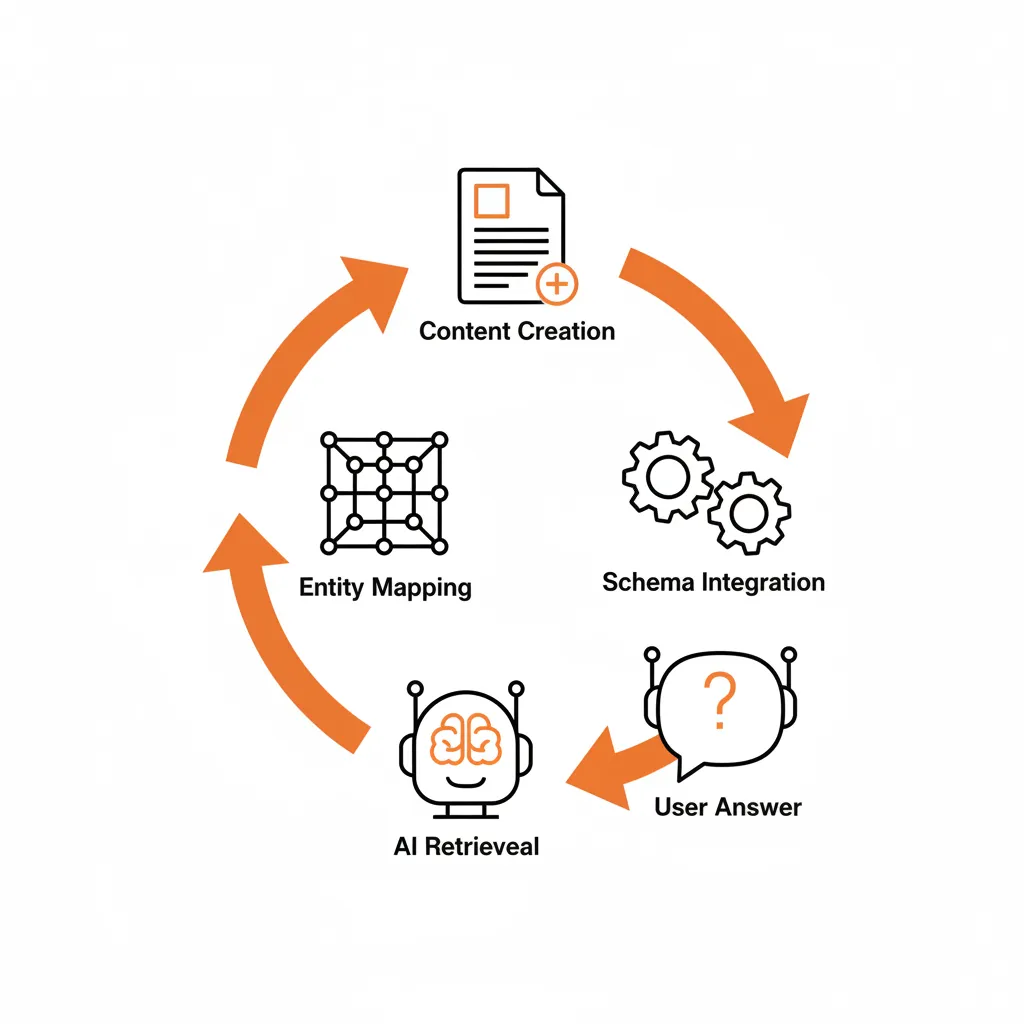
AI content optimization is the process of structuring and refining digital content to ensure AI agents like ChatGPT, Claude, and Gemini can accurately interpret, retrieve, and recommend your brand. It involves using structured data, entity-based writing, and clear information architecture to satisfy both traditional search algorithms and modern answer engines.
AI content optimization is the strategy of refining your digital assets so that large language models and answer engines can easily parse, understand, and cite your information as a primary source. To succeed in 2026, you must move beyond keywords to satisfy the technical requirements of Answer Engine Optimization (AEO), which focuses on providing direct, authoritative responses to specific user queries. This approach ensures your brand remains visible as AI assistants become the primary interface for information retrieval, shifting the focus from simple link clicks to becoming the definitive "answer" in a conversational interface. We help you bridge this gap by aligning your messaging with how machines actually learn.
Why AI Optimization Dominates Search in 2026
The search environment shifted permanently over the last year. In 2025, we saw the definitive rise of "agentic search," where AI doesn't just show links but performs tasks. According to Gartner, traditional search engine volume is projected to drop significantly as users pivot toward AI-integrated platforms. This makes AI Content Optimization the only way to protect your organic reach.
If your content isn't formatted for an LLM (Large Language Model)—a type of artificial intelligence trained on vast datasets to understand and generate human-like text—you effectively don't exist to a significant portion of your audience. Furthermore, the integration of the Knowledge Graph, a programmatic network of real-world entities and their relationships, means search engines now prioritize context over specific word matches.
Data from Search Engine Land suggests that brands using structured Schema Markup—a standardized code used to provide explicit clues about a page's meaning—see a much higher rate of citation in AI-generated summaries. By optimizing now, you ensure your site serves as the foundational data for these models.
The Shift Toward Computational Fact-Checking
In the current era, search engines no longer guess what a page is about based on word frequency. Instead, they use knowledge triplets (Subject-Predicate-Object) to verify claims. If your page states "Our software integrates with CRM," the AI looks for a verification of that relationship in the knowledge graph. Ahrefs notes that content providing clear, verifiable data points outperforms vague, adjective-heavy copy. We focus on these relationships to ensure your brand becomes a "node" in the global knowledge web.
A Step-by-Step AI Content Optimization Guide
1. Identify and Define Core Entities
Start by mapping out the primary subjects your brand owns. In AEO, we focus on Entities, which are unique, well-defined things or concepts that can be distinguished from others. Instead of targeting "best software," you define your product as a specific entity within a category. This helps AI models place you accurately within their internal maps. A common mistake is using vague pronouns like "it" or "this" too often. Pro tip: Use the Google Natural Language API to see how a machine identifies entities in your draft before you publish.
- List the top 10 nouns central to your business.
- Research these nouns in Wikidata or Google’s Knowledge Graph.
- Ensure these specific terms appear in your H1s and introductory sentences.
- Remove ambiguous pronouns that could refer to multiple subjects.
2. Implement Advanced Schema Paperwork
Schema is no longer optional. You must use specific types like TechArticle, FAQPage, and Product to tell AI exactly what your data represents. This structured layer acts as a translator between your creative copy and the machine's database. What to do: Use JSON-LD format to wrap your most important claims. It works because it removes ambiguity. A common mistake is using broken or outdated schema properties that models ignore. Pro tip: Reference Schema.org regularly to find new properties specific to your niche, like specialty for medical or legal content.
3. Structure Content with the Inverted Pyramid
AI agents scan for the "answer" immediately. Place your most critical information, the direct answer to the user's likely question, in the first 50 words of a section. This allows models like Gemini to quickly extract a "snippet" for a voice response. It works because it reduces the "computational cost" for the AI to find the value. A common mistake is "burying the lead" under long, flowery introductions. Pro tip: Write your H2 headings as direct questions and the following paragraph as the direct, factual answer.
4. Optimize for Natural Language Processing (NLP)
Write like a human, but with the clarity a machine requires. Natural Language Processing (NLP) is the branch of AI that helps computers understand, interpret, and generate human language. Use clear Subject-Verb-Object sentence structures. This works because it minimizes the risk of the AI misinterpreting your intent. A common mistake is using industry jargon that doesn't have a clear definition in the broader public dataset. Pro tip: Read your content aloud; if a sentence feels like a tongue-twister, it will likely confuse an AI parser too.
5. Verify Facts and Cite Sources
AI models are trained to prioritize accuracy to avoid "hallucinations." By citing high-authority external sources and keeping your own data consistent across the web, you build an "authority signal." This works because AI agents cross-reference data points across multiple sites to verify truth. A common mistake is publishing conflicting information (like different prices or features) on different pages. Pro tip: Create a dedicated "Data and Citations" section for research-heavy posts to make it easy for AI to credit your work.
Leveraging Semantic Triplets for Clarity
To truly optimize for NLP, you should organize your key facts into semantic triplets. A triplet consists of a subject, a predicate (or relationship), and an object. For example, "EvronStudio (Subject) provides (Predicate) AEO services (Object)." When you write in this clear, declarative format, you make it incredibly easy for an LLM to extract your data for its database. Avoid complex nested clauses that separate the subject from its verb by more than five words.
AEO vs. Traditional SEO: Key Differences
| Feature | Traditional SEO (Pre-2025) | AI Content Optimization (2026) |
|---|---|---|
| Primary Goal | Rank #1 on a SERP | Become the "Chosen Answer" |
| Success Metric | Click-Through Rate (CTR) | Brand Mention & Citation Rate |
| Content Focus | Keyword Density | Entity Relationships |
| Structure | Blog posts and landing pages | Atomic content units & Schema |
| User Intent | Browsing / Navigational | Task-oriented / Conversational |
| Discovery | Crawler-based Indexing | Large Language Model Training |
| Visibility | Blue links on a page | Voice, Chat, and Summary Citations |
Common Mistakes to Avoid
- Over-reliance on Generative AI for production. If you use AI to write your content without heavy human editing, you end up in a "feedback loop" where your content sounds exactly like every other bot. This lacks the unique insights AI agents look for when seeking "new" information.
- Neglecting the "About Us" and Author pages. AI models look for E-E-A-T (Experience, Expertise, Authoritativeness, and Trustworthiness). If they can't verify who wrote the content, they are less likely to recommend it as a factual source.
- Ignoring technical site speed. While AI agents crawl differently than humans, slow load times can still lead to timeouts or incomplete indexing of your latest updates.
- Using non-descriptive anchor text. Using "click here" tells an AI nothing. Your internal links should use descriptive text that defines the relationship between two pages.
- Failing to update old content. AI models prefer fresh data. If your "2024 Guide" is still live without updates, it will be deprioritized in favor of more recent 2026 data.
Best Practices for Maximum Visibility
- Use a Question-Answer Format: Organize your H3s to mirror the way people talk to Siri or ChatGPT.
- Focus on "Atomic Content": Break long guides into smaller, self-contained sections that each answer one specific sub-topic.
- Maintain a Consistent Brand Voice: Ensure your facts and tone are uniform across your site, social media, and third-party directories.
- Prioritize Readability: Aim for a Flesch Reading Ease score of 60 or higher to ensure the logic is easy for machines to follow.
- Audit Your Entity Footprint: Regularly check how your brand appears in "AI Overviews" and adjust your content to correct any misconceptions.
The Role of User Signals in AEO
While AEO is technical, user signals still matter. If a user asks an AI engine a follow-up question that contradicts your content, or if they constantly correct the AI after it cites you, your authority will drop. BrightEdge research indicates that "conversational depth"—how well a page answers subsequent "why" and "how" questions—is a major factor in maintaining a featured position in AI summaries. We recommend including a "Common Follow-up Questions" section at the end of your long-form articles.
"The brands that win in the age of AI aren't those with the most content, but those that provide the most reliable, structured, and accessible answers to the world's most complex questions."
Visibility in ChatGPT, Gemini, and Perplexity
Optimizing for these platforms requires a specific nuance. ChatGPT (OpenAI) tends to favor conversational, well-structured guides that it can summarize easily. According to OpenAI's documentation, their models look for high-quality, diverse sources that provide comprehensive coverage of a topic. Gemini (Google) relies heavily on the existing Google Knowledge Graph, making your AEO content strategy and Google Business Profile more important than ever.
Perplexity and SearchGPT act more like research engines; they value direct citations and data-backed claims. To show up here, your content must be cited by other authoritative sites, and you must include clear, outbound links to reputable data. Meanwhile, Microsoft Copilot integrates heavily with LinkedIn and Bing data, prioritizing B2B authority and professional context.
We’ve found that by writing content for AI search specifically, you can increase the likelihood of these models citing your URL in their footnotes. The goal is to move from being a hidden page in the search results to being the "Source [1]" at the end of a generated response.
Platform-Specific Optimization Tactics
| AI Platform | Main Data Source | Priority Optimization Task |
|---|---|---|
| ChatGPT | Web Crawl + Training Data | Long-form, conversational depth |
| Gemini | Google Knowledge Graph | Schema.org & Entity alignment |
| Perplexity | Real-time Web Search | Current stats & Factual citations |
| Copilot | Bing Index + LinkedIn | B2B Authoritative profiles |
Case Study: B2B SaaS Entity Alignment
We worked with a B2B SaaS client in the FinTech space that struggled with declining traffic as AI Overviews began to dominate their niche. Their content was high-quality but lacked the structural clarity machines require. We implemented a comprehensive AI Content Optimization Guide strategy over six months.
Our team started by restructuring their core service pages into "Entity Hubs." We replaced generic headings with specific, question-based H2s and injected deep JSON-LD schema across 50 key pages. We also audited their external citations to ensure their brand data was consistent across the web.
The results were significant. Within four months, the client saw a 45% increase in "brand mentions" within ChatGPT and Perplexity responses. Their organic traffic from traditional search stabilized, but their "assisted conversions"—leads coming from AI chat interfaces—grew by 110%. By optimizing content for AI search, they stopped fighting the algorithm and started fueling the engine. This composite example highlights why shifting to an AEO-first mindset is critical for modern B2B growth.
Tools and Resources for AI Optimization
- Google Search Console: Essential for monitoring how your site is indexed and identifying which queries trigger AI Overviews. (Free)
- WordLift: An AI-powered tool that helps you build a custom Knowledge Graph and automate Schema markup. (Paid)
- Claude.ai: Excellent for "stress-testing" your content. You can ask Claude to summarize your draft to see if the key entities and answers are easily identified. (Free/Paid)
- Semrush: Useful for tracking "Position Zero" and featured snippets, which are often the precursors to AI citations. (Paid)
- Schema.org Validator: The industry standard for checking that your structured data is error-free. (Free)
How to Measure Your AEO Success
Measuring success in 2026 requires looking beyond simple rankings. You need to track how often your brand is the "source of truth." Check your progress with this list:
- Answer Rate: How often does an AI engine cite your site when asked a direct question about your industry?
- Entity Sentiment: Is the AI describing your brand accurately and positively?
- Referral Traffic from AI Bots: Monitor your analytics for traffic coming from
openai.comorperplexity.ai. - Share of Voice in AI Overviews: Use AEO tools to track your visibility in Google's generative summaries compared to competitors.
Testing and QA Before Site-Wide Rollout
Before you apply AEO changes to your entire site, you must test your methodology on a small batch of pages. Rolling out unverified schema or drastic structural changes can lead to temporary indexing issues. We recommend a "pilot group" approach where you select five high-traffic pages and five low-traffic pages for optimization.
- Baseline Audit: Record current rankings, brand mentions in AI chat, and organic traffic for the pilot group.
- Apply Optimizations: Inject JSON-LD, restructure headings, and clarify entities on these 10 pages only.
- Prompt Testing: Use ChatGPT and Gemini to ask questions that these pages answer. Note if the AI uses your new phrasing or cites your page.
- Schema Validation: Run all updated pages through the Schema.org validator to ensure no syntax errors exist.
- Monitor for 30 Days: Watch for changes in the "Search Appearance" section of Google Search Console. If you see an uptick in "Product Snippets" or "FAQ Snippets," the rollout is successful.
The Trade-offs: When AI Optimization Fails
It is important to be honest about what this strategy cannot do. AI content optimization is not a magic fix for poor product-market fit or a lack of original research. If your brand offers nothing new, the AI will simply summarize your competitors who have been in the market longer.
Furthermore, over-optimizing for machines can sometimes lead to dry, robotic copy that fails to convert human readers. You must strike a balance. A common failure point occurs when brands prioritize "answer snippets" at the expense of their unique brand voice. If you become a generic utility, your brand equity disappears. Another risk is "citation dilution," where an AI summarizes your content perfectly but the user never clicks your link because they have the full answer. You must provide enough value to be cited, but include "dangling incentives"—like proprietary tools or gated whitepapers—that require a visit to your site.
The Future of AI Content in 2026 and Beyond
As we move deeper into 2026, the distinction between "human content" and "AI content" will blur. However, the machines will always value the "Source of Truth." We expect to see AI agents start making purchasing decisions on behalf of users. When that happens, your content won't just need to be readable; it will need to be transactional. Ensuring your services are clearly defined as entities will be the difference between being bought or being bypassed.
According to research by Pew Research Center, users are increasingly skeptical of AI-generated misinformation. This makes your role as a verified, human-led source even more important. The LLMs will eventually filter out the noise, leaving only the most structured and authoritative sites standing.
Moving Toward an AI-First Content Strategy
The transition from traditional search to answer engines is the biggest shift in digital marketing since the invention of the smartphone. You can no longer rely on tricking a search engine with keywords; you must provide genuine value that a machine can verify and trust. By following this guide, you position your brand as a leader in your field, ready to be discovered by the next generation of AI-driven users.
If you are ready to see how your current site stacks up against the latest AI models, we invite you to get a free AEO audit. Our team at Best Answer Engine Optimization Services is here to help you navigate this transition. We specialize in turning static websites into dynamic data sources that AI agents love to recommend. Explore our full range of [AEO and AI Content Services](/services) to start dominating the conversational search market today.
Frequently asked questions
What is AI content optimization?+
AI content optimization is the process of structuring and formatting digital content so that AI engines like ChatGPT and Gemini can easily parse and cite it. Unlike traditional SEO, which focuses on ranking in a list of links, AI optimization aims to make your brand the definitive answer in a conversational AI response. It relies heavily on structured data, clear entity definitions, and factual accuracy.
How do entities affect my AI visibility?+
Entities are the building blocks of AEO. An entity is a unique, well-defined person, place, or thing. By clearly defining the entities related to your brand, you help AI models understand exactly what you do and how you relate to other concepts in their knowledge graph. This reduces ambiguity and increases the chances of your content being used in AI-generated summaries.
Do I still need schema markup for AI search?+
Schema markup is a code you add to your website to help AI engines understand your content's context. For example, it can tell an AI that a string of numbers is a price, a review, or a date. In 2026, using schema like JSON-LD is essential because it provides the structured data that AI agents need to verify your information and present it as a factual answer.
Is SEO still relevant in the age of AI?+
Yes, SEO is evolving into AEO (Answer Engine Optimization). Traditional SEO techniques like high-quality backlinks and mobile responsiveness still matter, but they are now just the foundation. You must layer AI-specific strategies—like natural language formatting and entity optimization—on top of your SEO efforts to remain visible as users move toward conversational search platforms.
How can I get my brand mentioned in ChatGPT?+
To show up in ChatGPT or Perplexity, your content must be easily 'scrappable' and highly authoritative. These models prioritize information that is structured in a question-answer format and supported by external citations. By focusing on AEO strategies, you make it easier for these agents to find your content and credit your brand as the source of their generated responses.
How do I measure the ROI of AI content optimization?+
Success is measured by 'Brand Citations' and 'Share of Model.' You should track how often AI agents name your brand as a source, the sentiment of those mentions, and the amount of referral traffic coming from AI platforms like OpenAI or Perplexity. Using tools that monitor AI Overviews will help you see where you stand compared to your competitors.
Sources & further reading
Soft next step
Want to see where AI answers mention you — and where they don't?
We run a free AEO audit across ChatGPT, Gemini, Copilot and Perplexity, then hand you the fixes in priority order. Start your AEO strategy today.
Keep reading
Content Strategy
Optimizing Content for AI Search Engines: A 2026 GuideContent Strategy
Writing Content for AI Search: A Complete 2026 Strategy GuideContent Strategy
AEO Content Strategy: How to Optimize Content for AI Search in 2026