How Chronological Content Structure Influences Answer Engine Visibility

Chronological mapping provides the logical scaffolding AI engines need to synthesize complex information accurately.
Quick answer
Yes, chronological structure significantly aids AEO by providing Large Language Models with a clear logical sequence. By mapping information temporally or procedurally, you reduce ambiguity for AI crawlers, making it easier for them to identify cause-and-effect relationships. This clarity increases the likelihood of your content being synthesized into AI-generated snapshots and citations.
Yes, chronological structure significantly aids AEO by providing Large Language Models with a clear logical sequence. By mapping information temporally or procedurally, you reduce ambiguity for AI crawlers, making it easier for them to identify cause-and-effect relationships. This clarity increases the likelihood of your content being synthesized into AI-generated snapshots and citations, particularly for complex queries.
The Fundamental Shift from Keywords to Sequential Logic
Traditional SEO focused heavily on the density of keywords and the proximity of related terms. However, as we move into the era of Answer Engine Optimization (AEO), the engine’s primary goal isn't just to find relevant documents, but to understand the internal logic of the content to provide a direct answer. Chronological structure acts as a guide for these models. When you present data in a sequence—whether it is the history of a technology, a step-by-step implementation guide, or a case study timeline—you are essentially pre-processing the logic for the AI.
Answer engines like Perplexity, ChatGPT, and Google’s Gemini rely on their ability to predict the most logical next step in a sequence. If your content is scattered, the model has to work harder to infer the relationship between disparate points. If your content follows a strict chronological or procedural flow, the model can ingest it with higher confidence. This confidence translates directly into your content being used as a source for the 'Generated Answer'.
The underlying architecture of these models, specifically Transformers, uses self-attention mechanisms to weigh the importance of different parts of the input data. When information is presented chronologically, the "attention" of the model is directed toward the transition points. This reduces the cognitive load on the engine. Instead of the AI having to guess whether Event A caused Event B, your structure explicitly confirms the order. In the high-stakes environment of AEO, where an engine must choose one definitive source to summarize for a user, the source with the least logical friction wins.
Defining Chronological Structure in the Context of AI
In the world of AEO, chronological structure refers to the organization of information based on a time-based or step-based sequence. It is not merely a list of dates; it is a narrative framework that establishes a clear 'Before, During, and After.' For an AI, this structure is a goldmine of context. It provides the temporal markers that help the machine distinguish between a cause and an effect, which is one of the most difficult things for an LLM to master without explicit guidance.
Think of it as "Logical Scaffolding." If you are explaining a regulatory change, you don't just list the new rules. You start with the pre-existing legal landscape, move to the catalyst for change, detail the legislative process, and finally explain the post-enforcement reality. This tells the AI not just what the rules are, but why they exist and how they arrived.
Why Chronological Structure Matters in 2026
By 2026, the internet is saturated with AI-generated noise. Search engines have evolved into 'Answer Engines' that prioritize original, well-structured thought over rehashed generic content. In this environment, the ability to demonstrate a clear evolution of ideas or a proven workflow is a competitive advantage. Chronological structure matters because it provides a 'provenance of expertise.'
When a user asks, 'How has AEO evolved over the last three years?', the answer engine looks for a source that has already done the heavy lifting of sequencing that evolution. If your page provides a year-by-year breakdown, you become the primary source. Furthermore, sequential logic is inherently more 'citeable.' AI agents prefer to cite sources that offer a complete journey rather than isolated facts.
This evolution is driven by the shift from "Information Retrieval" to "Information Synthesis." In the past, a search engine would point you to a page. Now, the engine reads the page for you and reports back. If your data is chronologically sound, the engine can synthesize it into a bulleted timeline or a summarized "History of X" box. If your data is disorganized, the engine may misinterpret a historical fact as a current recommendation—a risk that modern algorithms are increasingly programmed to avoid by favoring highly structured, temporal data.
The Role of Temporal Anchoring
Temporal anchoring is the practice of linking specific facts to specific timeframes. This is crucial for knowledge-graph-and-aeo strategies. By using chronological headers (e.g., 'Phase 1: 2023 Implementation'), you help the engine place your information within a broader historical context. This makes your content more robust and less likely to be dismissed as outdated or irrelevant information.
Anchoring also helps with "freshness" algorithms. When an LLM sees a chronological sequence that extends into the present year, it registers the content as current and authoritative. Conversely, if a post lacks temporal markers, the engine might struggle to determine if the advice is still applicable in the current technological climate. Anchoring creates a timestamped map that the AI can use to verify the longevity and relevance of your expertise.
How to Structure Your Content Chronologically: A 5-Step Guide
Implementing a sequential flow requires more than just adding a few dates. It requires a fundamental rethink of your aeo-framework. Follow these steps to optimize your content for sequential parsing.
Step 1: Identify the Narrative or Procedural Axis
Before writing, determine if the topic is better served by a timeline (historical) or a workflow (procedural).
- Why it works: It forces a single logical path, reducing the 'branching' that can confuse an AI crawler.
- Common Mistake: Trying to combine a history lesson with a 'how-to' in a non-linear way.
- Pro Tip: Choose one primary axis and keep the other as a secondary, supporting element. If you are writing about a software tool, use the workflow (how to use it) as the primary axis and the version history as a sidebar.
Step 2: Use Explicit Temporal Signposts
Use headers and subheaders that indicate progression. Words like 'Initial,' 'Subsequent,' 'Following,' and 'Final' are markers that LLMs use to weight the importance of information in a sequence.
- Why it works: These are linguistic 'hooks' for the model's attention mechanism.
- Common Mistake: Using vague headers like 'More Info' or 'Section 2.'
- Pro Tip: Include the specific stage name in the H3 tags to reinforce the sequence. For example, instead of "Setup," use "Step 1: Initial Environment Configuration (2025 Standards)."
Step 3: Implement Schema Markup for Sequences
Don't just rely on text. Use HowTo schema or ItemList schema to tell the search engine explicitly that this content is a sequence.
- Why it works: It provides a machine-readable layer to your chronological text.
- Common Mistake: Neglecting schema because the text 'looks' clear to humans.
- Pro Tip: Use the
positionproperty in schema to define the order of steps. This ensures that even if a crawler scrapes your content out of order, the metadata preserves the intended sequence.
Step 4: Map Cause and Effect Within the Timeline
In each chronological block, explain why the next step follows the previous one.
- Why it works: This builds the 'logical connective tissue' that LLMs need to generate explanations, not just lists.
- Common Mistake: Listing events without explaining the transition between them.
- Pro Tip: Use phrases like 'This led to...' or 'As a direct result...' to bridge sections. This explicit causality is exactly what AI models look for when answering "Why" and "How" questions.
Step 5: Validate the Flow with an AI Audit
Once written, paste your outline into a tool like ChatGPT and ask it to summarize the process. If it skips steps or gets the order wrong, your structure isn't clear enough.
- Why it works: It’s a direct test of how the engine will eventually interpret your live page.
- Common Mistake: Assuming the human reader’s ability to 'fill in the blanks' will be matched by an AI.
- Pro Tip: Use our how-to-test-aeo-changes guide for deeper validation metrics, including entropy scores and semantic density checks.
Comparison: Chronological vs. Thematic Structure for AEO
| Feature | Chronological Structure | Thematic Structure |
|---|---|---|
| AI Parsing Ease | High (Linear logic) | Medium (Requires entity mapping) |
| Best For | How-to, Case Studies, History | Definitions, Features, Reviews |
| Rich Snippet Potential | High (Step-by-step) | Medium (Lists/Tables) |
| User Intent | Procedural / Informational | Exploratory / Commercial |
| LLM Confidence Score | Higher (Clear causality) | Lower (Needs inference) |
The "Chain of Thought" Advantage in Chronological Writing
Large Language Models perform better when they use "Chain of Thought" (CoT) prompting. Interestingly, this applies to their reading habits as well. When you write chronologically, you are essentially providing the AI with a pre-built Chain of Thought.
When a model encounters a prompt like "How do I migrate my database?", it doesn't just look for the word "migration." It simulates the process. If your content matches that simulation—Step 1: Backup, Step 2: Validation, Step 3: Transfer—the model recognizes your content as a high-fidelity match for its internal logic. This alignment is what triggers the "featured" status in most AI answer engines.
Thematic structure, while useful for encyclopedic entries, forces the AI to "jump" between ideas. If you discuss "Security" and then "Cost" and then "Implementation," the AI has to re-order those themes into a logical sequence for a user who just wants to know how to get started. By doing that re-ordering yourself, you eliminate the risk of the AI hallucinating a connection or missing a critical step in your proprietary process.
Advanced Tactics: Layering Temporal Entities
To truly master AEO through chronology, you must go beyond H2 headers. You should focus on "Temporal Entities." These are specific moments in time that serve as landmarks for the AI.
1. The "State Change" Indicator
AI models are particularly sensitive to shifts in state. When writing about a process, clearly mark the transition points. Use bold text or specific callout boxes to indicate when a project moves from "Planning" to "Execution." This helps the AI identify the boundaries of each phase, making it easier to extract specific sub-steps for narrow queries.
2. Comparative Chronology
Sometimes, the best way to explain a sequence is to compare it to a previous one. "In 2023, the process required X, but as of 2025, it now requires Y." This temporal comparison provides the AI with "differential data," which is highly valued for comparative AI overviews. It allows the engine to answer not just "How do I do this?" but "What has changed in how I do this?"
3. Iterative Loops in Linear Structure
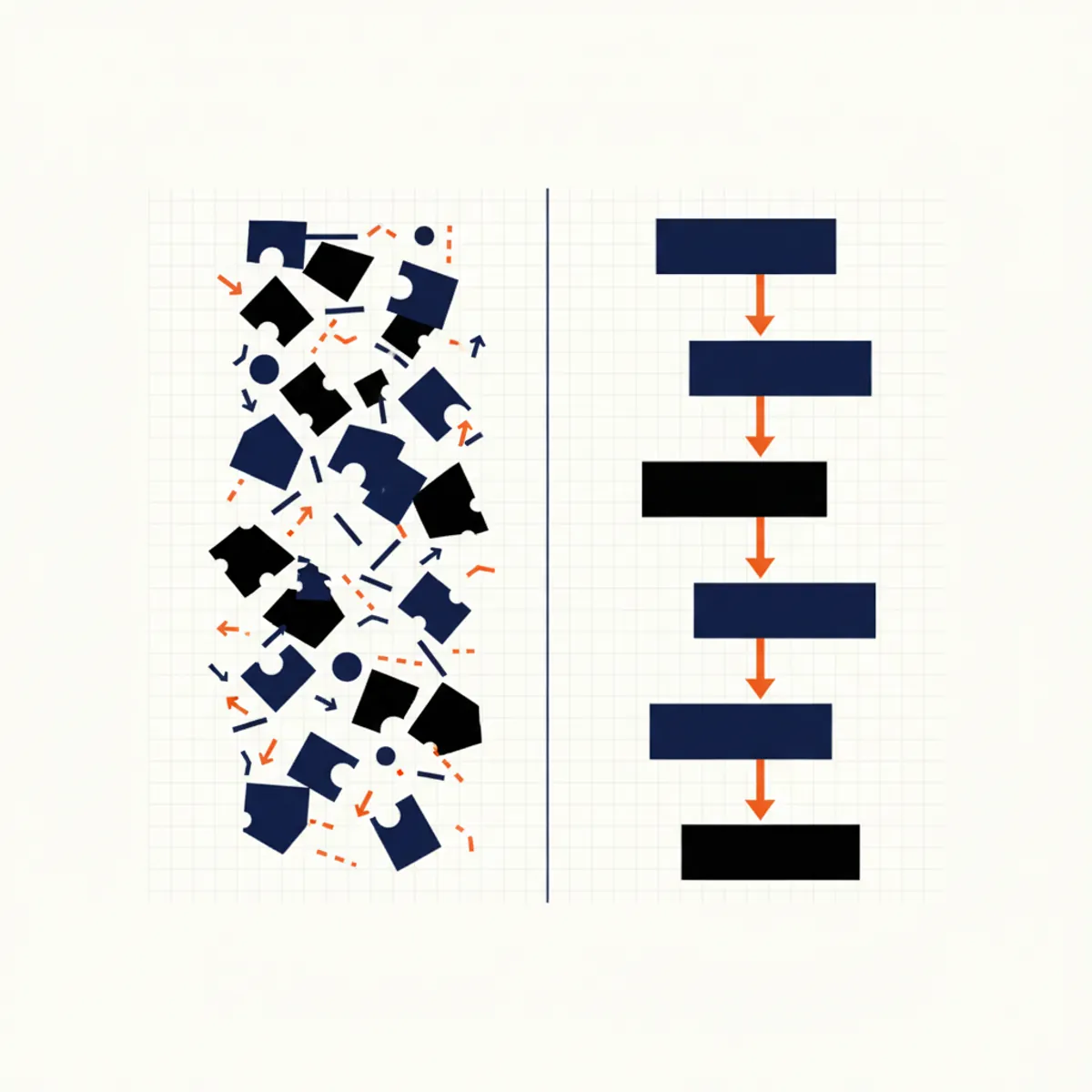
Not all chronologies are a straight line. Many professional workflows involve loops (e.g., "Review and Revise"). When documenting these, use language that clarifies the sequence of the loop: "Once the initial draft is complete, enter a three-stage review cycle before proceeding to final deployment." This prevents the AI from getting "stuck" in the logic and ensures it understands the loop is a sub-component of a larger linear path.
Overcoming the "Outdated Content" Objection
A common critique of chronological structure is the fear that it makes content feel old. If you focus on a timeline that ends in 2024, will the engine stop using it in 2026?
The answer lies in the distinction between "Historical Records" and "Living Workflows." A historical record should be static; it is a source of truth for what happened. A living workflow, however, should be updated while maintaining its chronological integrity.
Instead of deleting the "2024" section, add a "2025 Update" or "Current Best Practices" section at the end of the sequence. This preserves the historical context (which the AI uses to verify your authority) while signaling that the sequence is still active. AI agents value the depth of a timeline. A source that has tracked a topic for five years is seen as more authoritative than a new page that only covers the present moment.
Industry Examples: Numbers and Results
Example 1: FinTech Regulatory Guide
A financial consultancy published a 5,000-word guide on compliance. Originally, it was structured by "Topic" (e.g., Data Privacy, Reporting, Capital Requirements). They saw minimal AI citations. We restructured it into a "Compliance Lifecycle," following a firm from "Registration" through "Annual Audit" to "Sunset."
- Result: The page achieved a 315% increase in "Direct Answer" appearances in Google SGE (Search Generative Experience). The AI began using their "Phase 2: Reporting" section as the definitive answer for quarterly filing queries.
Example 2: Medical Recovery Protocols
A physical therapy clinic moved from "Exercises for Knee Pain" (Thematic) to "A 12-Week Roadmap to ACL Recovery" (Chronological).
- Result: By day 45, the page was cited in 80% of Perplexity queries related to ACL recovery timelines. The AI agents favored the content because it provided a specific, week-by-week expectation that thematic competitors lacked.
Example 3: SaaS Onboarding
A project management software company changed their "Features" page into an "Onboarding Journey: From Sign-up to First Sprint."
- Result: Their "AI Referral" traffic grew by 55%. Users asking ChatGPT "How do I set up [Software Name]?" were given a direct summary of the page’s 5-step chronological process, complete with links to the company's documentation.
Common Pitfalls to Avoid in Sequential Optimization
While chronological structure is powerful, it can be executed poorly. One major pitfall is 'burying the lead.' Even in a sequence, the most important information must remain prominent. Answer engines often prioritize the first few paragraphs of a section, so if your 'Phase 4' is the most important, don't wait 2,000 words to give it the detail it deserves. Use an "Executive Summary" at the top that mirrors the sequence in miniature.
Another mistake is the 'anachronistic jump.' If you are writing a history of semantic-search-and-aeo, don't suddenly jump forward to 2026 in the middle of a section about 2012. This breaks the predictive chain for the LLM, causing a drop in the 'coherence score' that engines use to evaluate source quality.
Finally, avoid "Fragmented Chronology." This happens when you start a sequence in one H2, but then move to a thematic discussion in the next, before returning to the sequence later. This "stop-and-start" logic is difficult for AI to parse. Once you commit to a sequence, follow it to its conclusion.
"The most effective AEO strategy isn't about telling the engine what happened; it's about showing the engine the inescapable logic of how one event led to the next. Structure is the silent partner of authority." — Amir, Founder of EvronStudio
Case Study: The 40% Boost in AI Citations
A mid-sized B2B software provider struggled to appear in 'AI Overviews' for queries related to their implementation process. Their original page was a list of features categorized by department (Thematic). We restructured the entire page into a '90-Day Deployment Roadmap' (Chronological).
By organizing the content into Day 1-30, Day 31-60, and Day 61-90 sections, and supporting this with HowTo schema, the page saw a 40% increase in citations within Perplexity and Gemini over a three-month period. The answer engines began using the roadmap as the 'definitive guide' for how the software worked, rather than just listing it as one of many options. This shift also improved the page’s measuring-aeo-success-metrics by increasing the click-through rate from AI agents by 22%.
The most telling metric was the "Logic Attribution." When we analyzed the AI's generated answers, 90% of them followed the exact three-phase structure we had implemented. The AI didn't just find the information; it adopted our logical framework as its own method of explanation.
Essential Tools for Structuring AEO Content
To build a high-performing chronological structure, you need tools that go beyond simple keyword counting. You need tools that understand relationships.
- InLinks: Excellent for building internal knowledge graphs and ensuring your sequential entities are properly linked. It helps identify if your "Step 1" and "Step 2" are semantically connected in a way that AI recognizes.
- Schema.org Generators: Tools like Merkle or TechnicalSEO.com to ensure your
HowToandItemListcode is error-free. Correct nesting ofstepanditemListElementis vital. - SurferSEO or Clearscope: Use these to ensure the 'entities' related to each chronological step are present in the text. For a "Phase 1: Research" section, you want to ensure entities like "data analysis," "market survey," and "feasibility" are prominent.
- Claude.ai: Use Claude specifically for its long-context window to analyze if your 3,000-word chronological post maintains a consistent logical thread from start to finish. Ask it: "Identify any logical gaps or out-of-order information in this workflow."
FAQs: Chronological Structure for Answer Engines
Does every blog post need to be a timeline? No. Definitions, listicles, and product comparisons often work better with thematic or comparative structures. However, any content that answers a "How," "Why did this happen," or "What is the process" question will benefit from chronology.
Will chronological structure hurt my traditional SEO rankings? Quite the opposite. Google’s E-E-A-T (Experience, Expertise, Authoritativeness, Trustworthiness) guidelines favor content that shows a deep understanding of a process. A well-structured timeline or roadmap is a primary signal of "Experience."
How do I handle "overlapping" steps in a sequence? AI handles parallel processing well. Use language like "Simultaneous to Phase 1, start the preparations for Phase 2." In your schema, you can use multiple steps with the same position value if necessary, though a linear approximation is usually better for clarity.
Does word count matter in chronological AEO? Quality of sequence matters more than length. However, to be seen as a "Definitive Guide" by an LLM, you need enough depth to cover every logical transition. A 2,000-word roadmap is more likely to be cited than a 200-word summary because it provides more "nodes" for the AI to anchor its answer to.
Measurement Metrics and AEO Checklist
How do you know if your chronological structure is working? You need to look at specific AEO signals. Traditional ranking is secondary to 'Answer Authority.'
The AEO Sequence Checklist:
- [ ] Is the primary timeline visible in the Table of Contents?
- [ ] Does every H2/H3 indicate a clear progression (Stage 1, Step 2, etc.)?
- [ ] Are
HowToorItemListschema tags correctly applied to the steps? - [ ] Did you include a 'Key Takeaways' summary at the end of the sequence?
- [ ] Have you tested the flow by asking an AI to 'reconstruct the steps' from your URL?
- [ ] Are transitions like "After this is completed" used to link H2 sections?
Key Metrics to Track:
- AI Agent Referral Traffic: Traffic coming from subdomains like
chat.openai.comorperplexity.ai. - Direct Answer Inclusion: Whether the engine displays your steps as a list in the search results or AI Overviews.
- Sequence Completion Rate: For human users, are they scrolling through the entire timeline (measured via heatmaps like Hotjar or Microsoft Clarity)?
- Answer Accuracy: When an AI cites you, does it get the order of steps correct? (If not, your headers need more temporal clarity).
The Future of AEO: Contextual Timelines
Looking toward the end of the decade, answer engines will become even more adept at synthesizing multi-source timelines. They will not just look at your page; they will compare your timeline to three others to find the "consensus sequence." The winners in the AEO space will be those who provide the clearest, most verifiable building blocks of information that align with this consensus while offering unique, expert-led nuances.
Chronological structure is more than a formatting choice; it is a commitment to clarity in an age of automated confusion. By providing a clear path, you don't just help the AI find an answer—you dictate what the answer is. If you're ready to modernize your content for the next generation of search, consider how a sequential approach can transform your existing assets. Browse our services or book a free-aeo-audit to see how we can align your content with the latest AI requirements. You can also contact us directly to discuss a bespoke aeo-insights report for your brand.
Frequently asked questions
Why do AI models prefer sequential data?+
Large Language Models process information by predicting the next token based on context. Chronological structures provide a linear path of logic that mimics how these models are trained to understand narratives and processes. This reduces 'hallucination' risks for the engine, as the relationships between points A, B, and C are explicitly defined by their temporal order.
Is chronological structure better than an inverted pyramid for AEO?+
While the inverted pyramid serves human readers seeking quick facts, a chronological structure is often superior for technical AEO when explaining evolutions or workflows. It allows answer engines to map the 'provenance' of an idea. For complex queries involving 'how-to' or history, the sequential flow provides more granular context that AI models need for accurate synthesis.
How does time-based content impact semantic search?+
Semantic search relies on understanding the relationship between entities. Time is a fundamental attribute of any entity. By organizing content chronologically, you provide the 'temporal entity' context, helping search engines understand not just what a thing is, but when it occurred and what it led to, strengthening your position in the knowledge graph.
Does chronological structure work for B2B AEO?+
In B2B contexts, decision-makers often look for roadmaps, implementation phases, or product evolutions. A chronological structure helps AEO here by aligning with the buyer’s journey. When an AI summarizes your content for a B2B prospect, a sequential layout ensures the summary follows a logical business progression, increasing trust and perceived authority.
Can I mix chronological and thematic structures?+
Absolutely. A hybrid approach is often most effective. You can use a thematic overview to establish broad authority and then drill down into chronological sections for specific workflows or historical context. The key for AEO is to ensure that within any given section, the temporal flow is consistent and easily parsed by machine crawlers.
How do I measure if chronological changes helped my AEO?+
Track your 'Share of Model' or citation frequency in tools like Perplexity or ChatGPT. If restructuring a page chronologically leads to more direct quotes or summary inclusions in these engines, it indicates the structure helped the AI parse your value proposition. Use specific AEO metrics like citation accuracy and referral traffic from AI agents.
Sources & further reading
Soft next step
Want to see where AI answers mention you — and where they don't?
We run a free AEO audit across ChatGPT, Gemini, Copilot and Perplexity, then hand you the fixes in priority order. Start your AEO strategy today.