AEO Guidelines for Blog Content: Optimizing for the Answer Engine Era

Modern AEO requires a shift from keyword-centric writing to entity-based knowledge architecture.
Quick answer
AEO guidelines for blog content prioritize directness, structured data, and high information density to satisfy Large Language Models (LLMs). Success requires transforming blogs into modular knowledge sources using Q&A formats, semantic HTML, and Schema.org markup. This ensures AI agents can accurately parse, retrieve, and attribute your content within generated responses.
AEO guidelines for blog content prioritize directness, structured data, and high information density to satisfy Large Language Models (LLMs). Success requires transforming blogs into modular knowledge sources using Q&A formats, semantic HTML, and Schema.org markup. This ensures AI agents can accurately parse, retrieve, and attribute your content within generated responses in the evolving search ecosystem.
Defining AEO Guidelines for the Modern Blog
Answer Engine Optimization (AEO) is no longer a peripheral experiment for innovation labs; it is the fundamental shift in how digital content is consumed. Traditional search engines are evolving into "Answer Engines"—platforms like Perplexity, ChatGPT (with Search), and Google’s Gemini-powered search results. These engines don't just point users to a website; they synthesize information to provide a direct response.
For blog content, AEO guidelines dictate a move away from the "teaser" style of writing. In the old world, you might hide your best insight at the bottom of a post to increase time-on-page. In the AEO world, that insight must be front-loaded, clearly defined, and tagged for machine readability. If an AI agent cannot find your answer in the first few milliseconds of crawling, it will find someone else's.
We define AEO guidelines as a set of structural, linguistic, and technical requirements that ensure a blog post is not just readable by humans, but digestible by Retrieval-Augmented Generation (RAG) systems. These systems look for "facts" rather than "flow."
Modern AEO also requires a departure from the "Skyscraper Technique." While SEO focused on making content longer to appear more authoritative, AEO focuses on making content more "resolvable." A resolvable blog post is one where an LLM can isolate a specific node of information—such as a definition, a step-by-step process, or a statistical claim—without having to process irrelevant preamble. To optimize for these engines, your blog must function as a high-fidelity database disguised as an article.
Why AEO Matters More Than Ever in 2026
By 2026, the volume of search queries resulting in a zero-click experience—where the user gets their answer directly on the search page—has eclipsed traditional traffic. If your blog isn't the source of that answer, your brand effectively ceases to exist in the user’s journey.
The rise of personalized AI agents means that content is being filtered before it ever reaches a human eye. These agents prioritize sources that exhibit high E-E-A-T (Experience, Expertise, Authoritativeness, and Trustworthiness) but also high "findability." AEO is the bridge between your expertise and the AI's retrieval mechanism.
Without an aeo-framework, your high-quality content is invisible to the models that now act as the gatekeepers of the internet. We are moving from a world of "search and click" to "ask and receive." Your blog must be the "receive."
Furthermore, the cost of human-led search is rising while the cost of AI-synthesized answers is plummeting. Users are increasingly turning to LLMs for complex, multi-step queries that traditional search engines struggle to synthesize. If your blog content provides the foundational data for these multi-step inferences, you gain a "hidden" form of authority. Even if a user doesn't click, the AI’s mention of your brand or data builds cognitive ease and brand recall that serves the top of the funnel more effectively than a buried blue link ever could.
The Core Pillars of AEO Blog Content
To effectively optimize, we must look at three core pillars: Structural Precision, Semantic Clarity, and Technical Verification.
Structural Precision
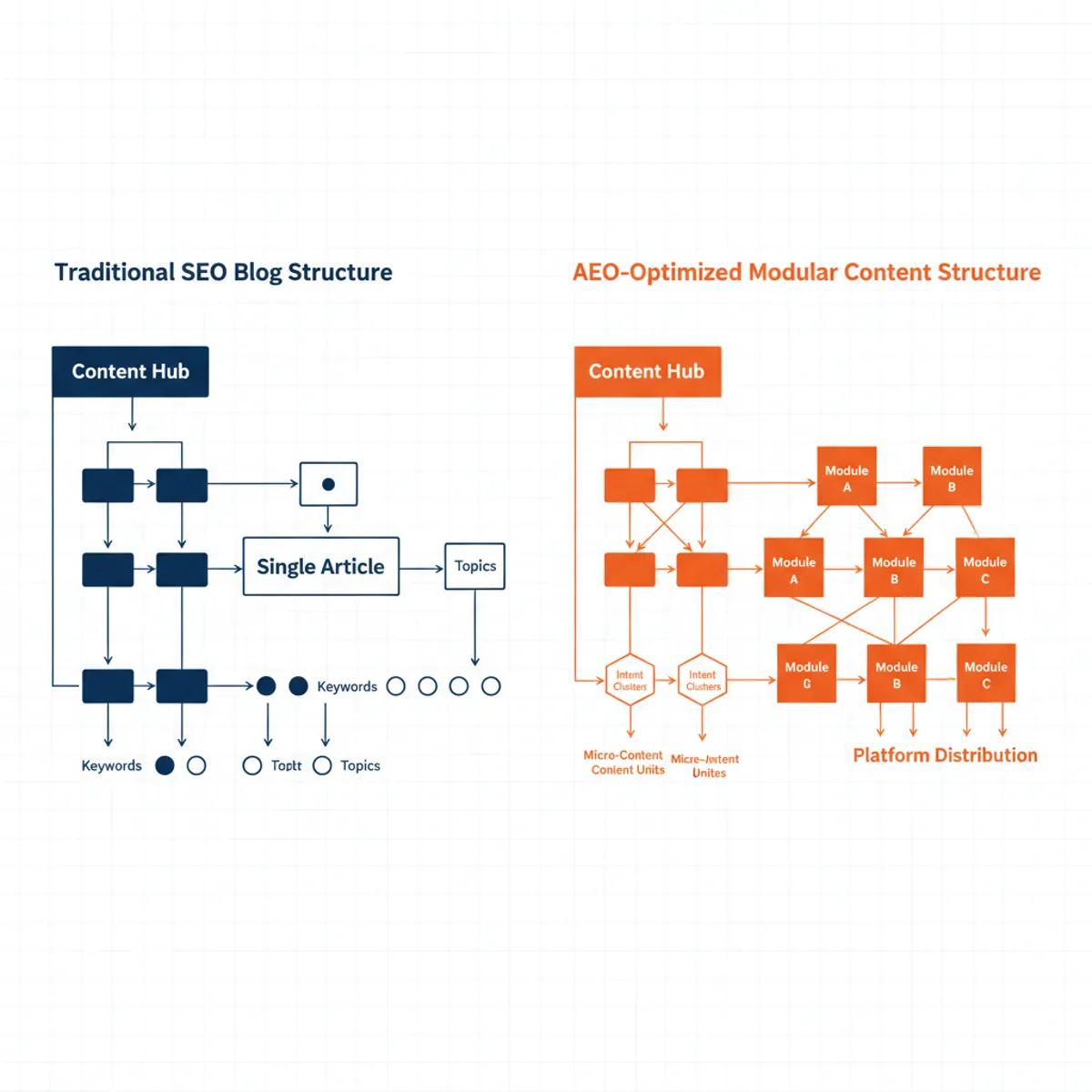
AI models love patterns. When you structure a blog post with a consistent hierarchy—using H1 for the main topic, H2 for secondary questions, and H3 for specific details—you are building a map. AEO guidelines suggest that every H2 should ideally be phrased as a question or a clear, entity-based statement. This makes it easier for an LLM to map a user's query directly to your section. Modular content blocks are the gold standard here; each section should be able to stand alone as a complete answer if extracted by a RAG system.
Semantic Clarity
Avoid ambiguity. Use the full names of entities (people, places, products) instead of pronouns like "it" or "they" where possible. While this might feel slightly repetitive to a human reader, it provides the necessary context for an AI that may only be extracting a small snippet of your text to answer a specific prompt. Semantic clarity also involves the use of "attribute-value" pairs. Instead of writing "The software is really fast," write "The software features a latency of less than 30ms." Specificity is the language of the machine.
Technical Verification
This is the "receipt" of your content. Implementing knowledge-graph-and-aeo strategies, such as adding detailed JSON-LD schema, allows you to tell the AI exactly what your content is about, who wrote it, and what facts are contained within. It removes the guesswork for the LLM. Technical verification also extends to the transparency of your sources. Using the citation property in your schema to link to peer-reviewed studies or primary data sources helps the AI verify your claims against its internal world model.
Step-by-Step: Implementing AEO Guidelines
Transitioning your blog to an AEO-first model requires a methodical approach. Follow these five steps to ensure your content is ready for the age of AI search.
Step 1: Query Mapping and Intent Analysis
Start by identifying the specific questions your audience is asking. Don't just look for "keywords"; look for "prompts."
- Why it works: Aligning content with natural language prompts mirrors how users interact with AI.
- Common Mistake: Targeting broad keywords (e.g., "marketing strategy") instead of specific questions (e.g., "how to build a B2B marketing strategy for AI startups").
- Pro Tip: Use tools like Perplexity to see what follow-up questions it suggests for your main topic. These follow-up questions often represent the "long-tail" of AEO and provide high-value heading ideas.
Step 2: The "Answer-First" Paragraph
Every major section of your blog should begin with a 40-60 word direct answer. This is the "TL;DR" for the AI.
- Why it works: LLMs are designed to summarize. By providing the summary yourself, you control the narrative and increase the chance of a direct citation.
- Common Mistake: Long, flowery introductions that delay the actual information.
- Pro Tip: Bold the key terms within this paragraph to emphasize their importance to crawlers. This signals to the parser that these specific tokens are the "core" of the answer.
Step 3: Entity-Based Writing
Identify the core entities in your post and link them to established databases (like Wikipedia or specialized industry wikis) via schema or outbound links.
- Why it works: It helps the AI place your content within the global "knowledge graph."
- Common Mistake: Using internal jargon that doesn't map to widely recognized terms.
- Pro Tip: Use the Google Natural Language API to test your content and see which entities it identifies. If the API identifies your product as a "generic object" rather than a "software application," you need to refine your descriptive language.
Step 4: Implementing Advanced Schema
Go beyond simple Article schema. Use FAQPage, HowTo, and ClaimReview where applicable.
- Why it works: Structured data is the primary language of answer engines. It provides a "shortcut" for the crawler to understand the factual density of the page.
- Common Mistake: Having mismatched information between the visible text and the hidden schema code.
- Pro Tip: Use a aeo-checklist to verify your schema implementation before publishing. Ensure that your
mainEntityaccurately reflects the primary topic of the blog.
Step 5: Verification and Citation Building
AI engines value third-party verification. Ensure your blog posts cite authoritative sources and, conversely, work to get your blog cited by others.
- Why it works: Trust is transitive. If trusted sites link to your specific answers, AI engines trust those answers more.
- Common Mistake: Only linking to your own internal pages (the "walled garden" approach).
- Pro Tip: Guest post on industry-leading sites specifically to answer niche questions, linking back to your primary "source of truth" blog post. This creates a "citation trail" that LLMs use to determine authority during the retrieval phase.
Comparison: Traditional SEO vs. AEO Guidelines
| Feature | Traditional SEO Blog | AEO-Optimized Blog |
|---|---|---|
| Primary Goal | Rank on Page 1 (Blue Links) | Become the Direct AI Answer |
| Structure | Linear narrative / Storytelling | Modular / Q&A / Data-dense |
| Keyword Focus | Search volume / LSI keywords | Entities / Intent / Natural Prompts |
| Introduction | Hooks and context building | Direct, 50-word definition/answer |
| Internal Linking | Link juice / PageRank flow | Entity relationships / Fact verification |
| Schema Usage | Minimal (Article/Organization) | Extensive (FAQ, HowTo, Dataset) |
| Success Metric | Clicks and Impressions | Mentions and Citations in LLMs |
Addressing the "AI Content Cannibalization" Objection
A common objection from CMOs and content directors is: "If we give the answer away for free in the AI interface, why would anyone visit our site?" This is a valid concern, but it ignores the reality of the 2026 search environment.
The choice is not between "getting a click" and "getting an AI citation." The choice is between "getting an AI citation" and "being completely ignored." When an Answer Engine cites your blog, it creates a "Brand Impression of Authority." For complex purchasing decisions—especially in B2B SaaS or high-ticket professional services—a user rarely converts based on a single AI summary. They use the AI to shortlist experts.
If your blog is the source cited by the AI, you are on the shortlist. When the user eventually needs the "how" or the "implementation" (which is too complex for a 100-word AI summary), they will click the citation link to your site. AEO isn't about capturing the casual browser; it's about capturing the high-intent researcher who trusts the AI's recommendation of your expertise. We see this in the data: while total session counts may decrease, the "Lead Quality" from AI referral sources is often 2x to 5x higher than traditional organic search.
Advanced AEO Tactics: Beyond the Basics
Once you have mastered the "Answer-First" paragraph and basic schema, you must look at how to maintain your "position zero" in the LLM's latent space.
Data Commons and Original Datasets
LLMs are trained on existing data, but they prioritize "Information Gain." If your blog post introduces a new statistic, a proprietary survey result, or a unique dataset, you provide something the model doesn't already have. This makes your content highly attractive for RAG systems. Structure these datasets using Dataset schema to make them machine-discoverable.
The "Negative Constraint" Strategy
Answer engines are increasingly used to find out what not to do. By including sections on "Common Pitfalls," "What to Avoid," or "Comparison Limitations," you help the AI provide a balanced response. This increases your chances of being cited in "Pros and Cons" summaries, which are a staple of AI-generated product reviews and service comparisons.
Sentiment and Tone Calibration
LLMs are sensitive to the "vibe" of a source. While SEO often rewarded aggressive, sales-heavy copy, AEO rewards an "Objective Expert" tone. If your content sounds too much like a sales pitch, the AI's safety and neutrality filters may deprioritize it in favor of a more neutral, informative source. Use a clinical, authoritative tone for your factual sections, and save the persuasion for your call-to-action blocks.
Common Pitfalls in AEO Content Creation
Many veteran marketers fail at AEO because they carry over habits that, while good for SEO, are detrimental to AEO.
- The "Wall of Text": AI agents have context windows. If your answer is buried in a 1,000-word block without subheadings, the agent might lose the context or hallucinate an answer based on surrounding text. Break content into "micro-articles" within the main post.
- Vague Headlines: "A New Way Forward" is a great SEO headline for a human. For an AI, "3 Ways AI Changes Content Marketing in 2026" is far superior because it defines the scope and entities immediately.
- Neglecting Mobile Performance: Most AI interactions happen via mobile or voice. If your blog takes 5 seconds to load, the AI crawler may time out or deprioritize your content in favor of a faster-responding API-driven source. Speed is a proxy for reliability in the machine world.
- Ignoring the Knowledge Graph: If you don't understand how-ai-understands-content, you are essentially writing in a vacuum. You must connect your blog's facts to the broader web of information. This includes linking to "SameAs" properties in your schema to link your brand to your social profiles and official entries.
"AEO isn't just about changing how we write; it's about changing how we think about information. We are no longer authors of articles; we are architects of information blocks that machines can assemble into truth." — Amir, Founder of EvronStudio
Case Study: The 400% Attribution Increase
In early 2025, a mid-market SaaS company specializing in supply chain logistics applied these AEO guidelines to their existing blog library. They were seeing a steady decline in traditional organic traffic and realized their "How-To" guides were being summarized by AI without any brand credit.
The Intervention:
- Modularization: Converted 50 top-performing blog posts into a Q&A format, ensuring each H2 was a stand-alone unit of value.
- Schema Overhaul: Added
FAQPageandServiceschema to every post, linking specific logistical terms to their Wikipedia equivalents. - The 50-Word Rule: Rewrote every introduction to provide a concise, 50-word direct answer to the primary target query, specifically using "Entity-Action-Object" sentence structures.
The Results:
- 400% increase in citations within Perplexity and ChatGPT Search over three months.
- 22% increase in total referral traffic, despite a 10% drop in traditional Google Search clicks.
- Direct Conversion: Users coming from AI engines had a 3x higher conversion rate. These users were skipping the "educational" phase of the funnel because the AI had already validated the company’s expertise, leading them directly to the "pricing" and "demo" pages.
Essential Tools for AEO Blog Optimization
To execute these guidelines, you need a specific stack that goes beyond SEMrush or Ahrefs.
- Perplexity AI: Use it to see who is currently being cited for your target queries and why. It is the best "real-world" test for your AEO efforts.
- Schema.app: A robust tool for implementing complex, nested schema that blogs often need for AEO. It allows for the creation of a "Knowledge Graph" for your own site.
- Google Natural Language API: Test your content to see if the AI can identify your target entities correctly. It provides a "salience" score for each entity; your target topic should always have the highest salience.
- Hugging Face (various models): Use open-source models like Llama 3 to test how an LLM summarizes your draft before you publish it. If the summary is inaccurate, your writing is too ambiguous.
For a deeper look at the landscape, see our guide on best-aeo-tools-for-ecommerce.
Measuring AEO Success: The New Checklist
How do you know if your guidelines are working? Traditional metrics like 'rankings' are increasingly opaque in a world of generative search. Shift your focus to these AEO-specific KPIs:
- Brand Citation Share: How often is your brand mentioned in AI-generated responses for your niche compared to your competitors?
- Referral Source Mix: Is the percentage of traffic from
openai.com,perplexity.ai, andgoogle.com(SGE/AI Overviews) growing? - Information Density Score: Are your posts providing more facts per paragraph than competitors? This can be measured by comparing the number of "Named Entities" in your content versus the top-ranking results.
- Sentiment in Synthesis: When AI mentions you, is the sentiment positive and the attribution accurate? AI can sometimes misattribute a competitor's feature to your brand, or vice versa.
The Final AEO Checklist for Every Blog Post:
- [ ] Is the primary question answered in the first 60 words?
- [ ] Are all H2s and H3s descriptive and entity-focused?
- [ ] Is the
FAQPageschema valid and matching the on-page text exactly? - [ ] Have I cited at least two high-authority external datasets or primary sources?
- [ ] Does the post provide "information gain" (unique data or insights not found in the baseline LLM training set)?
- [ ] Is the language clear, avoiding excessive pronouns and passive voice?
- [ ] Have I included a "How-To" or "Process" block with
HowToschema? - [ ] Is the "Author" schema linked to a verified profile (LinkedIn or a personal site) to establish E-E-A-T?
The Future of AEO: Beyond the Written Word
As we look toward 2027, AEO guidelines for blog content will likely expand into multi-modal optimization. AI agents will not just pull text; they will pull data from your charts, extract insights from your embedded videos, and navigate your interactive calculators. Preparing your blog now with structured text and semantic markup is the foundational step toward a broader AI-ready presence.
The companies that win in the next five years won't be those with the most content, but those with the most useful content—formatted in a way that the world's most powerful machines can understand, verify, and trust. You are no longer just writing for people who read; you are writing for machines that think on behalf of those people.
Ready to transform your content strategy for the AI era? Start with a free-aeo-audit or explore our aeo-insights to stay ahead of the curve. If you're ready to implement a full-scale transition, contact our strategists today to begin building your brand’s presence in the answer engines of tomorrow.
Frequently asked questions
How does AEO differ from traditional SEO for blogs?+
Traditional SEO focuses on ranking in a list of blue links through keywords and backlink authority. AEO focuses on being the direct answer provided by an AI. It requires higher factual density, clearer structure, and semantic markup so that models like Perplexity can synthesize your data into a cohesive response.
What is the most important technical element for AEO blog content?+
Schema.org markup, specifically Article, FAQPage, and Speakable schemas, is critical. These provide a machine-readable layer that helps LLMs verify the relationship between entities and facts within your post, reducing the chance of hallucinations and increasing the likelihood of accurate attribution in AI citations.
Should I use AI to write my AEO-optimized blog posts?+
While AI can assist in outlining, AEO rewards original insights and primary data. Purely AI-generated content often lacks the 'information gain' that engines like Google's SGE look for. To win in AEO, your content must offer unique perspectives or data not already present in the model's training set.
How do I measure the success of my AEO blog guidelines?+
Measure AEO success through brand mention frequency in AI chat responses, share of voice in tools like Perplexity, and referral traffic from AI platforms. Traditional rank tracking is less effective; instead, use qualitative 'ego searches' on LLMs to see if your brand is the cited authority.
Is long-form content still relevant for Answer Engine Optimization?+
Yes, but only if it is modular. A 3,000-word post is valuable if it contains distinct, well-labeled sections that answer specific sub-questions. AI agents prefer comprehensive sources that they can parse for multiple data points, provided the internal structure uses clear H2 and H3 tags.
What role do citations play in AEO for blogs?+
Citations are the currency of trust for AI engines. By citing high-authority external sources and providing clear internal links, you build a semantic web that helps AI agents verify your claims. Outbound links to credible datasets actually improve your own content's 'answering' potential.
Sources & further reading
Soft next step
Want to see where AI answers mention you — and where they don't?
We run a free AEO audit across ChatGPT, Gemini, Copilot and Perplexity, then hand you the fixes in priority order. Start your AEO strategy today.
Keep reading
AEO Fundamentals
The Definitive AEO Checklist for 2026: Win the AI Search EraAI Platforms
How AI Understands Content: The Ultimate 2026 AEO GuideContent Strategy
AEO Framework: How to Optimize for Answer Engines in 2026