Top Answer Engine Optimization (AEO) Strategies 2026: A Definitive Guide
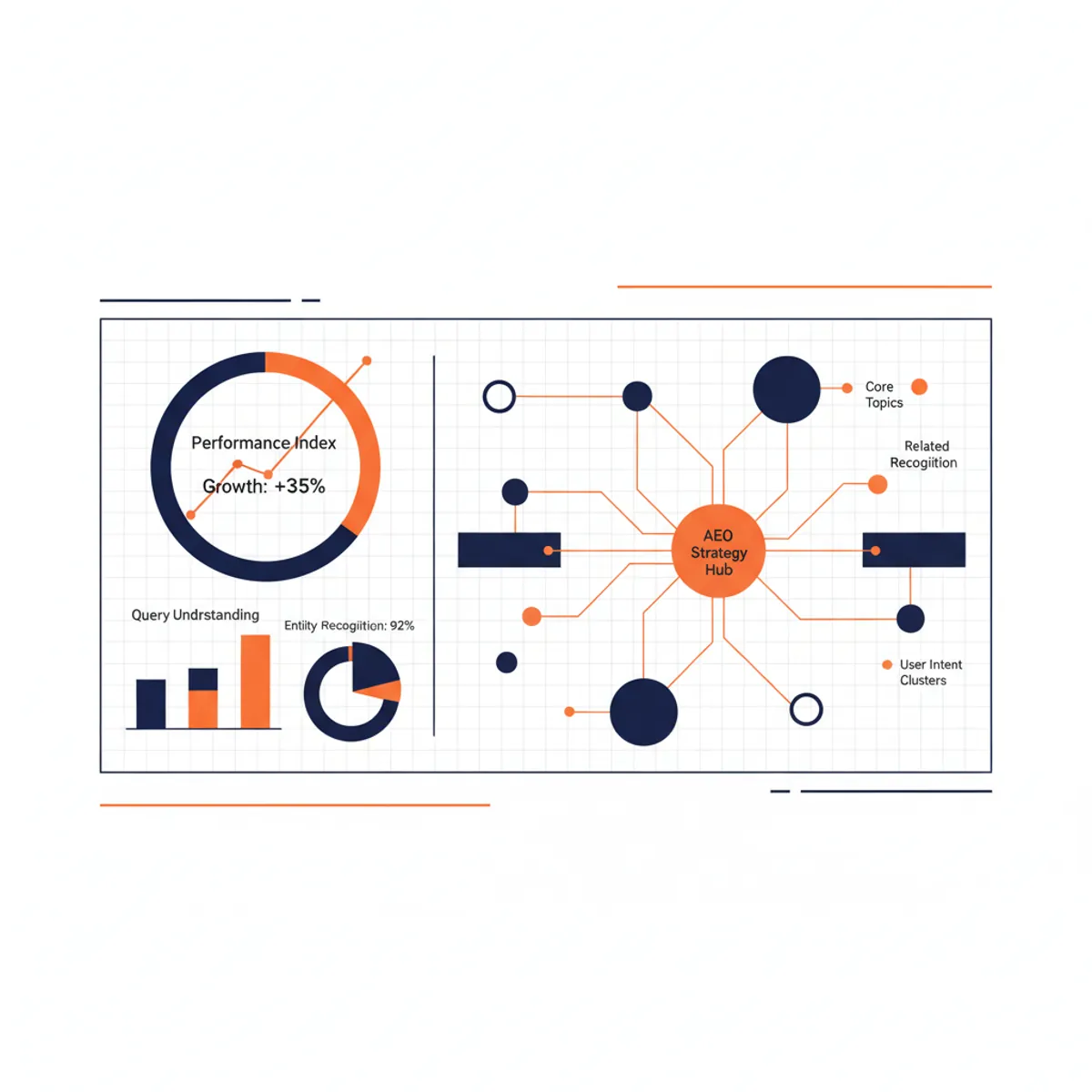
AEO in 2026 requires a shift from keyword tracking to entity-based visibility and conversational authority.
Quick answer
The top answer engine optimization strategies for 2026 focus on high-fidelity entity mapping, structured content chunking, and verifiable expertise (E-E-A-T). Success requires moving beyond keywords to provide direct, modular data that AI agents can easily parse, verify against authoritative knowledge graphs, and synthesize into concise responses for platforms like ChatGPT and Perplexity.
The top answer engine optimization strategies for 2026 focus on high-fidelity entity mapping, structured content chunking, and verifiable expertise (E-E-A-T). Success requires moving beyond keywords to provide direct, modular data that AI agents can easily parse, verify against authoritative knowledge graphs, and synthesize into concise responses for platforms like ChatGPT and Perplexity.
The Shift from Discovery to Synthesis
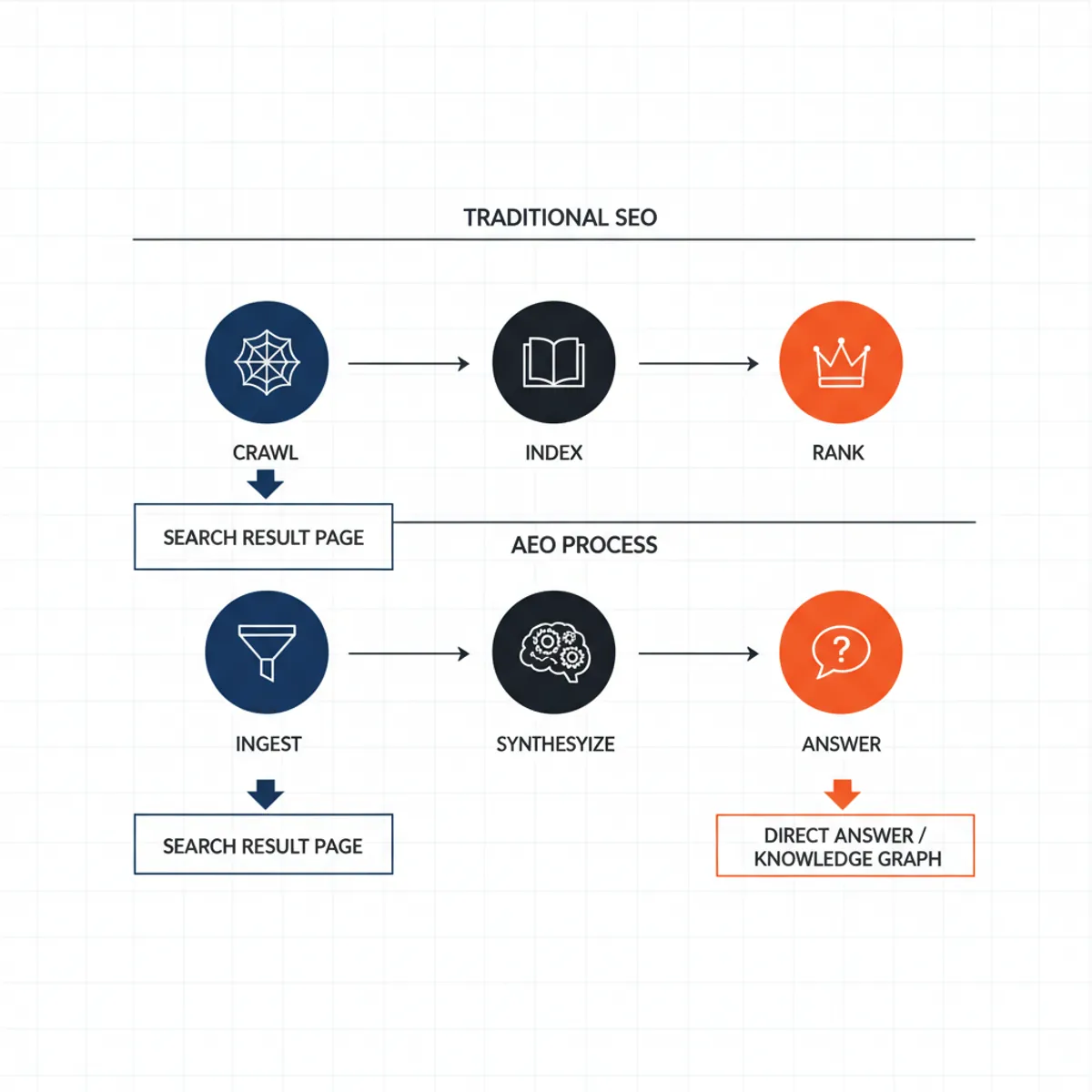
By 2026, the search landscape has fractured into two distinct realms: traditional search for deep exploration and answer engines for immediate utility. Answer Engine Optimization (AEO) is no longer a peripheral tactic; it is the core driver of digital visibility. While SEO focused on getting a user to click a blue link, AEO focuses on being the source material that an AI model uses to construct its response.
Traditional search engines like Google have evolved their Search Generative Experience (SGE) into a seamless interface where the website is often the 'source' rather than the 'destination.' At the same time, platforms like Perplexity, ChatGPT, and Claude have become the primary entry points for informational queries. These systems operate using Retrieval-Augmented Generation (RAG). They don't just find a page; they find the facts on that page and weave them into a conversational output. To win in 2026, you must optimize for these retrieval mechanisms.
The nuance of synthesis lies in the "Zero-Click" reality. In previous years, a zero-click search was a lost opportunity. In 2026, a zero-click search where your brand is the primary citation is a victory. It establishes cognitive brand bias. When an AI agent repeatedly cites your data to solve a user's problem, your brand becomes the "latent" choice when that user finally moves to a transactional phase.
Understanding the 2026 Answer Engine Ecosystem
To implement effective strategies, you must understand who you are optimizing for. The ecosystem is categorized by how the models access and process information:
- Direct Retrieval Engines (Perplexity, SearchGPT): These browse the web in real-time. They value high-speed indexing, clean HTML, and immediate factual density. They are sensitive to "hallucination mitigation," meaning they prefer sites that offer multiple corroborating data points.
- LLM-Native Agents (GPT-5, Claude 4): These rely more on their training data but use web-browsing plugins to verify facts. They value established authority and long-term brand reputation. For these models, your historical presence across the web—social proof, white papers, and historical citations—matters as much as your current page content.
- Hybrid Platforms (Google Gemini, Bing Chat): These combine traditional index signals (backlinks, technical health) with AI-summarization. They require a blend of aeo-framework principles and classic SEO hygiene. Here, the "ranking" still matters, but the "summary snippet" is the real prize.
Strategy 1: The Entity-First Content Architecture
In 2026, AI engines do not see keywords; they see entities (people, places, things, and concepts) and the relationships between them. If you write about 'AEO,' the engine sees the relationship between 'Digital Marketing,' 'Artificial Intelligence,' and 'Search Algorithms.'
Mapping the Knowledge Graph
Your content must explicitly define its place within a broader industry knowledge graph. This means using 'sameAs' attributes in your JSON-LD to link your brand to verified entities on Wikipedia or LinkedIn. When an AI agent can bridge your content to a known, trusted entity, your data is perceived as more reliable.
For example, if you are a FinTech brand, your schema should not just say you provide "loans." It should link your specific financial products to established NAICS codes and regulated financial concepts in Wikidata. This reduces the "semantic distance" between what you claim to be and what the AI knows to be true.
The Relationship Web
Don't just write a guide; build a network of related facts. If you are discussing entity-optimization-for-aeo, you should link to your specific tools, case studies, and expert bios. This creates a dense web of information that AI models can use to confirm the internal consistency of your claims. AI models use "triangulation" to verify data. If your site says one thing, but your LinkedIn and industry press releases say another, the AI will label your content as "low confidence."
Strategy 2: Content Chunking and Semantic Formatting
Answer engines do not read pages the way humans do. They ingest data in tokens and segments. If your answer is buried in the fourth paragraph of a 2,000-word block of text, the RAG system may truncate it before it reaches the 'useful' part.
The Modular Approach
Break your content into 'answer modules.' Each section should consist of a clear H2 question, a 50-word direct summary, and a supporting bulleted list or table. This is known as the content-chunking-strategy. It allows an AI agent to extract exactly what it needs without noise.
In 2026, the "Inverted Pyramid" of journalism has returned, but for bots. The most critical, fact-dense information must occupy the top 15% of every modular section. The goal is to provide a "Minimum Viable Answer" that the LLM can grab in a single retrieval pass.
Semantic Signaling
Use HTML5 tags correctly. <article>, <section>, and <aside> provide structural cues to scrapers about what part of the page contains the primary answer versus supplementary information. By 2026, messy code is the fastest way to be ignored by an LLM scraper. Modern scrapers are trained to ignore "boilerplate" (headers, footers, sidebars). If your main content is not clearly demarcated in the DOM (Document Object Model), the AI may fail to attribute your best insights to your brand.
Strategy 3: Verifiable E-E-A-T and The Trust Layer
With the explosion of AI-generated content, answer engines have become hyper-sensitive to misinformation. In 2026, the 'Trust' in Experience, Expertise, Authoritativeness, and Trustworthiness is the most weighted factor.
AEO is no longer about tricks or keyword density. It is about becoming a verifiable source of truth. If the AI cannot verify your claims against a trusted third-party source, it will simply hallucinate a better answer from your competitor. — Amir, Founder of EvronStudio
Citation Optimization
To be cited, you must cite. Providing links to peer-reviewed studies, government data, or high-authority industry reports signals to the AI that your content is grounded in reality. This 'citation-net' increases the likelihood that your site will be the one chosen as the reference for a generated summary.
Furthermore, you must monitor your brand's "Knowledge Sentiment." If the general consensus across the web (Reddit, specialized forums, news sites) is that your product is unreliable, the AI will synthesize that sentiment into its answer, even if your own website claims excellence.
Strategy 4: Technical AEO - The 2026 Requirements
Technical SEO used to be about crawl budgets and sitemaps. Technical AEO is about API accessibility and LLM readability.
| Feature | Traditional SEO (2020) | AEO Strategy (2026) |
|---|---|---|
| Primary Goal | Rank #1 on SERP | Be the 'Source' in AI Response |
| Key Metric | Click-Through Rate (CTR) | Share of Model Response (SOMR) |
| Structure | Long-form Articles | Content Chunking & Modules |
| Markup | Basic Schema (Product, Blog) | Advanced Entity & Fact-Check Schema |
| Link Value | Link Equity / PageRank | Verifiable Citation & Trust |
Robots.txt and AI Permissions
In 2026, managing how AI agents access your site is critical. You must optimize your robots.txt to allow agents like GPTBot or OAI-SearchBot while ensuring your high-value proprietary data isn't being used to train models without attribution. You should also implement aeo-schema-markup-implementation-guide to give these bots a direct map of your content.
A new technical requirement for 2026 is "Vector-Ready Data." This involves providing high-quality XML or JSON feeds that specifically summarize your site's knowledge base, allowing AI aggregators to ingest your facts without the overhead of rendering JavaScript or CSS.
Advanced AEO Tactics: Beyond the Basics
To truly dominate the 2026 landscape, you must employ tactics that treat the AI as your primary customer.
1. The "Negative Space" Content Strategy
Identify the gaps where current AI models struggle or hallucinate. Use tools to query Perplexity or Gemini on complex industry topics. Where the AI gives a vague or "I don't have access to real-time data on..." response, that is your opening. By creating a definitive, data-backed module on that specific gap, you become the primary source for that query overnight.
2. Conversational Hook Injection
AI models are trained to follow the "flow" of human conversation. By structuring your content to include natural follow-up questions, you "guide" the AI's next retrieval. For example, at the end of a section on AEO costs, include a sub-section: "What is the ROI of AEO compared to traditional PPC?" This prompts the AI to pull your next "chunk" when the user naturally asks the follow-up question.
3. Dataset Publishing
In 2026, AI engines love raw data. Publishing original research in .csv or .json formats, properly wrapped in Dataset schema, makes your site an irresistible target for RAG systems looking for empirical evidence to support a claim.
Addressing AEO Objections: The Skeptic's Guide
As AEO matures, many marketing leaders remain skeptical. Here we address common concerns through the lens of 2026 reality.
"If the AI gives the answer, why will anyone visit my site?" This is the most common objection. The reality is that the type of traffic is changing. AEO focuses on the mid-to-bottom funnel. While informational "top-of-funnel" traffic may decrease, the users who do click through are those seeking the "how-to" implementation, the purchase, or the deep-dive expertise that a 100-word AI summary cannot provide. Your site becomes the destination for validation rather than just discovery.
"Is AEO just schema markup on steroids?" No. While schema is the language, the substance is the strategy. An AI can read perfectly formatted schema and still reject the content if it lacks "semantic uniqueness." If your content is just a rewrite of existing web data, the AI has no reason to prioritize your site over the original source. AEO requires original insights and proprietary data.
"What if AI models stop citing sources?" Regulatory frameworks in 2025 and 2026 (such as the EU AI Act updates) have increasingly mandated transparency in AI outputs. Furthermore, users trust AI more when it provides "receipts." Platforms that fail to cite sources lose market share to those that do (like Perplexity). Citing sources is the AI's way of delegating liability—if the answer is wrong, the "source" is blamed.
Industry Examples: AEO in Action (2025-2026)
Example 1: E-commerce (Specialized Equipment)
A manufacturer of industrial lab equipment utilized "Spec-Sheet Chunking." They transformed 40-page PDF manuals into modular, schema-verified web fragments.
- The Result: Their "Share of Model Response" for technical troubleshooting queries rose from 5% to 62%.
- The Outcome: Direct sales increased by 18% as lab technicians used voice assistants to "Ask the Manual" during experiments, with the AI citing the manufacturer as the source for precise calibration steps.
Example 2: Legal Services
A boutique law firm focused on "Statute Mapping." They created a database of local zoning laws, each with a ClaimReview schema that cited specific 2026 legislative updates.
- The Result: When users asked AI agents "Can I build a secondary dwelling in [City]?", the firm was the sole cited authority.
- The Outcome: The firm saw a 300% increase in "High-Intent" consultation requests, bypassing the need for expensive "Legal Advice" keywords in PPC.
How to Implement AEO: A 5-Step Execution Plan
Step 1: Query Intent Analysis
Identify the specific conversational queries your audience is asking. Use tools that track 'People Also Ask' and AI-generated follow-up questions.
- Why it works: Aligning with natural language patterns ensures your content matches the retrieval triggers of RAG systems.
- Common Mistake: Targeting high-volume head terms (e.g., "marketing") instead of long-tail questions (e.g., "how to improve AEO in 2026").
- Pro Tip: Use Perplexity's 'Related' section to find the next three questions a user will ask after their initial search.
Step 2: Direct Answer Engineering
Write the answer first. Place a concise, 40-60 word summary at the top of your section or page.
- Why it works: AI models prioritize the first few hundred tokens of a relevant section for synthesis.
- Common Mistake: Using flowery, introductory prose like "In the ever-changing world of..." which wastes token space.
- Pro Tip: Treat every H3 as a standalone micro-article that can be read and understood without the rest of the page.
Step 3: Entity Integration
Use specific nouns and link to authority hubs. Instead of saying "our software," say "the EvronStudio AEO platform."
- Why it works: Noun-density helps AI models categorize your content within their internal latent space.
- Common Mistake: Using vague pronouns (it, they, this) which makes it harder for AI to attribute facts to your brand.
- Pro Tip: Explicitly mention your brand name in close proximity to the solution you provide in your summary paragraphs.
Step 4: Structured Data Layering
Deploy advanced Schema.org types like ClaimReview, Speakable, and Dataset.
- Why it works: Schema provides a non-ambiguous data layer that bypasses the need for the AI to 'guess' your meaning.
- Common Mistake: Having invalid JSON-LD code that prevents bots from parsing the structured data.
- Pro Tip: Use the
mentionsandaboutproperties in yourWebPageschema to link to established Wikidata entries.
Step 5: Authority Verification
Secure mentions on third-party 'Source of Truth' sites. A link from a major news outlet or an industry-standard wiki is worth more than 100 low-tier blog links.
- Why it works: AI engines use a 'consensus' model; if five trusted sites say the same thing, the AI accepts it as fact.
- Common Mistake: Focusing on quantity of backlinks rather than the 'trust-score' of the referring domain.
- Pro Tip: Engage in PR that focuses on being cited as a source for data or statistics, rather than just getting a brand mention.
Common Pitfalls in AEO Strategy
- Ignoring Voice Search Nuance: In 2026, many AEO responses are delivered via audio. If your content is too complex or contains too many parenthetical statements, it won't be selected for voice-activated answer engines.
- Over-Optimization for One Model: Don't build your strategy solely around ChatGPT. OpenAI, Google, and Anthropic all have slightly different retrieval priorities. Stay platform-agnostic by following core aeo-content-strategy principles.
- Failing to Update Content: Answer engines prioritize 'fresh' facts for many queries. An article from 2024 with outdated stats will be discarded by a 2026 RAG agent looking for the current state of the industry.
- Token Bloat: Writing 5,000 words when 500 will do. AI models have context windows. If you provide too much irrelevant filler, the "relevant" data point might get pushed out of the model's immediate attention span.
Case Study: B2B SaaS AEO Overhaul
A mid-sized project management software company saw a 40% drop in organic traffic in early 2025 as AI summaries replaced their top-ranking blog posts. By pivoting to an AEO-first strategy, they focused on three things:
- Converting 50 high-traffic guides into 'Chunked' modules.
- Implementing strict Entity Schema for all their product features.
- Creating a 'Research Hub' with original industry data cited by 15 major publications.
Result: Within six months, while their total website sessions only recovered by 10%, their Share of Model Response for their primary category grew from 2% to 18%. More importantly, the leads coming from AI citations had a 25% higher conversion rate than previous organic search leads, as the AI had already 'vetted' the brand for the user. The brand moved from being a "vendor" to being a "market fact."
Essential AEO Tools for 2026
- Perplexity Pages: For monitoring how your brand is summarized in real-time.
- Diffbot: To see how AI scrapers extract entities and facts from your site.
- Google Search Console (Insights): To track impressions in the Gemini/SGE interface.
- EvronStudio AEO Audit Tool: To check your site's 'LLM-Readability' score.
- Graphlytic: For visualizing your brand's internal knowledge graph and finding disconnected entities.
Measuring Success: Metrics That Matter
You cannot manage what you cannot measure. In the AEO era, your dashboard must include:
- Share of Model Response (SOMR): The percentage of time your brand is cited in a response for a specific set of queries. This is the new "Share of Voice."
- Citation Accuracy: How correctly the AI is representing your brand's facts and pricing. Hallucinated prices or features can damage your reputation.
- Brand Sentiment in AI Responses: Whether the AI describes your brand as a 'leader,' 'alternative,' or 'budget option.'
- Assisted Conversions: Tracking users who visit your site after interacting with an AI agent (often found in referral logs from
openai.comorperplexity.ai). - Semantic Proximity: Measuring how often your brand name appears in the same vector space as high-intent industry terms.
The Future of AEO: Toward 2027 and Beyond
As we look past 2026, AEO will likely integrate with personal AI agents—individualized LLMs that live on users' devices. These agents will 'know' the user's preferences and will filter answers accordingly. The ultimate strategy will be to ensure your brand is not just a source of information, but a preferred entity within the user's own personalized AI ecosystem.
We are moving toward a "Push" economy. Rather than users searching for you, their AI agents will proactively pull your data to solve their needs. To exist in that future, your data must be the most accessible, most verifiable, and most relevant in your niche.
To stay ahead, focus on the fundamentals: be clear, be structured, and above all, be truthful. The machines are reading, and they value accuracy above all else. In the age of AI, the ultimate competitive advantage is being the source of truth that the AI trusts most.
If you want to ensure your brand is the one providing the answers, explore our services or book a free-aeo-audit to see where you stand in the AI search landscape. For more deep dives, visit our aeo-insights page.
Ready to dominate the answer engines? Contact our team today to build your 2026 AEO roadmap.
Frequently asked questions
What is the difference between SEO and AEO in 2026?+
Traditional SEO focuses on driving traffic to a website through keyword-based rankings. AEO (Answer Engine Optimization) prioritizes providing direct, accurate answers that AI engines like Perplexity or ChatGPT can extract and display within their interface. While SEO targets clicks, AEO targets being the definitive source of truth for an AI's synthesized response.
How does content chunking improve AEO performance?+
Content chunking breaks long-form articles into discrete, self-contained modules that answer specific user intents. By using clear H2/H3 headings and concise paragraphs, you make it easier for LLMs to ingest and retrieve specific sections of your content. This increases the likelihood that a snippet of your page will be cited as a direct answer.
Which schema types are most important for AEO?+
In 2026, the most critical schemas include FAQPage, HowTo, Product, and ClaimReview. Furthermore, using 'sameAs' properties to link entities to Wikidata or DBpedia helps AI engines reconcile your content with their internal knowledge graphs. This technical bridge reduces ambiguity and builds the trust necessary for AI agents to recommend your brand.
Is backlink quality still relevant for AEO?+
Yes, but the nature of the link has changed. Answer engines use links as trust signals to verify the accuracy of a claim. High-authority links from recognized industry bodies or academic institutions act as citations. If multiple trusted sources point to your content, an AI agent is more likely to view your data as the 'consensus' answer.
Can I optimize for specific AI models like ChatGPT vs. Perplexity?+
While both use RAG (Retrieval-Augmented Generation), Perplexity relies more on real-time web indexing, whereas ChatGPT Search blends indexed data with its pre-trained knowledge. AEO strategies for 2026 must be platform-agnostic, focusing on structured data and conversational clarity that any LLM can interpret regardless of its specific training architecture or retrieval mechanism.
How do I measure AEO success if users don't click through?+
Measurement shifts from CTR to Share of Model Response (SOMR) and brand sentiment in AI citations. Tools now track how often your brand appears in AI-generated answers and the accuracy of the information provided. While sessions may decrease, the quality of referred traffic often increases as users seek deeper engagement after an initial AI summary.
Sources & further reading
Soft next step
Want to see where AI answers mention you — and where they don't?
We run a free AEO audit across ChatGPT, Gemini, Copilot and Perplexity, then hand you the fixes in priority order. Start your AEO strategy today.
Keep reading
Content Strategy
AEO Framework: How to Optimize for Answer Engines in 2026Content Strategy
Content Chunking Strategy for AEO: A 2026 Guide to AI VisibilityTechnical AEO
Entity Optimization for AEO: Mastering AI Search in 2026