How FAQs Help With AEO: Engineering Content for LLMs and AI Overviews

FAQ structures act as the bridge between raw web data and AI-generated insights.
Quick answer
FAQs help with AEO by providing Large Language Models (LLMs) with high-density, structured data in a natural question-and-answer format. This mirrors the conversational nature of AI prompts, making it easier for engines like Perplexity, ChatGPT, and Google Gemini to parse, ingest, and cite your content as a definitive source in AI-generated answers.
FAQs help with AEO by providing Large Language Models (LLMs) with high-density, structured data in a natural question-and-answer format. This mirrors the conversational nature of AI prompts, making it easier for engines like Perplexity, ChatGPT, and Google Gemini to parse, ingest, and cite your content as a definitive source in AI-generated answers.
The Evolution of Search: Why FAQs Are the Foundation of AEO
The transition from Search Engine Optimization (SEO) to Answer Engine Optimization (AEO) represents a fundamental shift in how information is indexed and retrieved. In the traditional SEO era, we optimized for keywords to help search engines find pages. In the AEO era, we optimize for entities and intents to help answer engines find specific solutions. FAQs are the connective tissue in this new paradigm.
When a user asks Perplexity, "What are the tax implications of a Delaware C-Corp for a Canadian founder?" the engine doesn't just look for a page titled "Delaware C-Corp." It looks for a discrete block of text that directly addresses the intersection of those three entities: taxes, Delaware, and Canadian residency. By structuring your content as a series of specific FAQs, you are essentially pre-digesting your expertise for the AI. You are providing the exact semantic units the LLM needs to construct its response.
The Shift from Keywords to Natural Language Questions
Traditional search queries were often fragmented—think "Delaware C-Corp taxes Canada." Modern AEO queries are full sentences. Because FAQs are written in natural language, they align perfectly with the way users interact with voice assistants and chatbots. This alignment reduces the computational effort required for an engine to determine if your content is relevant.
Definitions: AEO, FAQs, and LLM Ingestion
To understand why FAQs are so effective, we must define the technical relationship between these elements. AEO is the process of maximizing your brand's visibility in AI-generated responses. Large Language Models (LLMs) are the engines driving these responses, using billions of parameters to predict the next best word in a sequence.
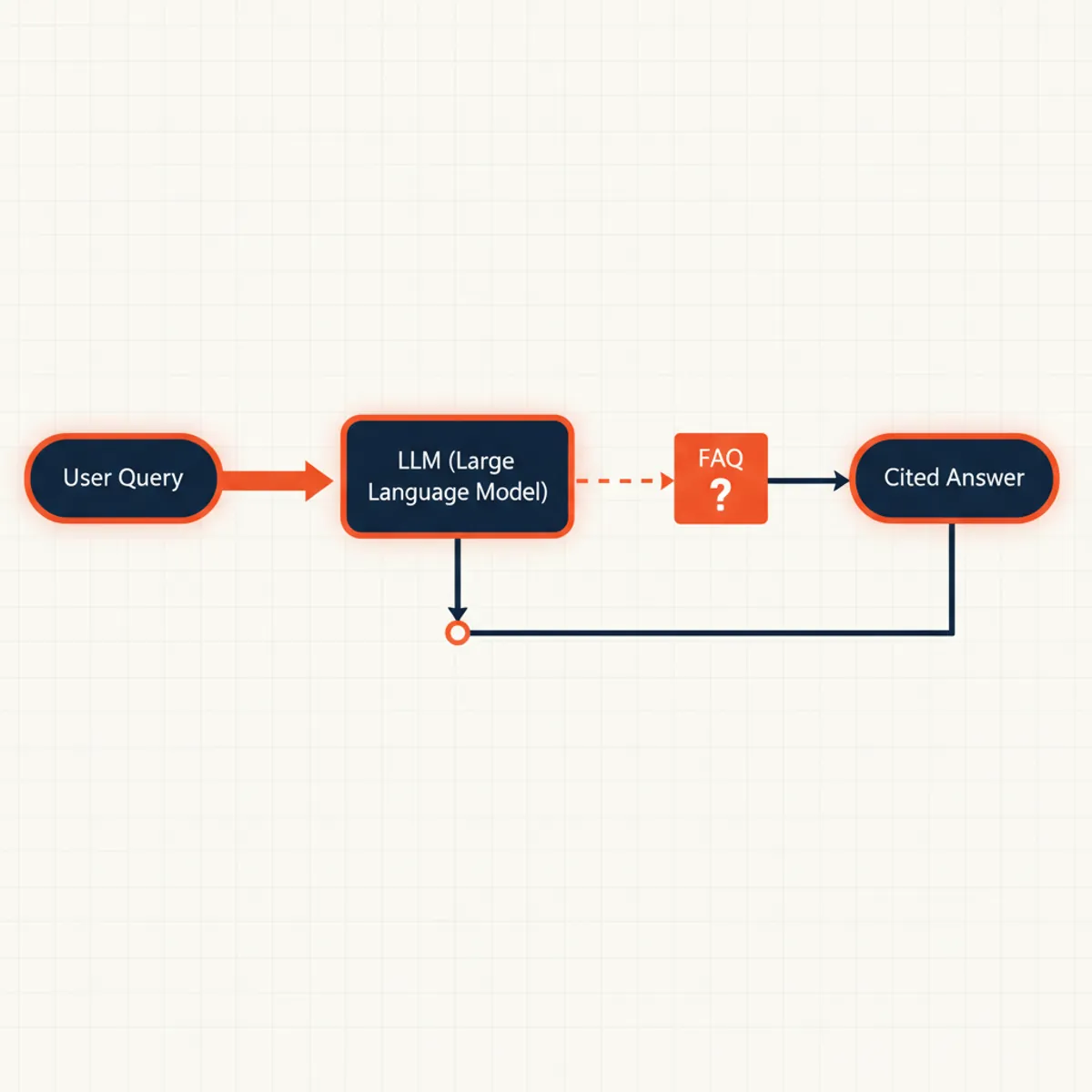
FAQs (Frequently Asked Questions) serve as a structured format that helps these models during both the training phase and the retrieval phase (often called RAG - Retrieval-Augmented Generation). In RAG, the AI searches a database (like the live web) for relevant information before generating an answer. A clearly labeled question and a concise answer are easier for the AI to "grab" and summarize than a 2,000-word stream-of-consciousness essay.
Entity Relationship in AEO
LLMs view the world as a graph of interconnected entities. An FAQ that asks "How does [Product A] compare to [Competitor B]?" establishes a direct link between those two entities in the AI's knowledge base. This makes your site a primary source for queries involving both brands.
Why FAQs Matter More in 2026 than Ever Before
By 2026, the internet has become saturated with AI-generated filler. Answer engines are becoming increasingly discerning, looking for "Information Gain"—new, unique, or authoritative data that hasn't been rehashed a million times. FAQs allow you to inject proprietary insights into a format that is easily verifiable by AI algorithms.
Furthermore, Google’s AI Overviews (formerly SGE) have matured. They no longer just summarize the top three results; they synthesize information from across the web. If your site provides the most concise, schema-backed answer to a specific sub-question, you can appear in the AI Overview even if you don't rank in the top 10 for the primary organic keyword. This is the core of how answer engine optimization works.
The Rise of Generative Verifiability
Answer engines are under increasing pressure to reduce hallucinations. One way they do this is by prioritizing content that is structured for easy cross-referencing. When you provide an FAQ, you are providing a claim-and-evidence pair that is much easier for an AI to verify against its training data than an anecdotal blog post. In 2026, verifiability is the new authority.
"The most successful AEO strategies don't try to trick the AI; they feed it. FAQs are the highest quality 'food' you can provide to an LLM because they eliminate ambiguity and deliver direct value." — Amir, Founder of EvronStudio
A Step-by-Step Guide to Optimizing FAQs for AEO
Creating AEO-ready FAQs requires a departure from the vague, marketing-heavy Q&A sections of the past. Follow this five-step engineering process.
Step 1: Intent Mapping and Mining
Instead of guessing what your customers want, use tools to find the exact phrasing of their problems. Look at Perplexity's suggested follow-up questions and Reddit threads.
- Why it works: Aligning with existing user prompts ensures your content matches the retrieval patterns of AI engines.
- Common Mistake: Writing questions that only serve your marketing goals rather than answering real user pain points.
- Pro Tip: Use a tool like AlsoAsked to map the hierarchy of questions surrounding your primary topic.
Step 2: Drafting for Information Density
Write your answer as if it's the only thing the user will read. It must be self-contained.
- Why it works: LLMs often extract snippets. If your answer relies on context from three paragraphs above, it will be discarded as low-quality.
- Common Mistake: Starting every answer with "As we mentioned above..."
- Pro Tip: Use the "inverted pyramid" style—put the most important fact in the first ten words.
Step 3: Implementing Advanced Schema Markup
Don't just use standard FAQPage schema. Integrate it with Product, Service, and Organization schema to provide a rich context.
- Why it works: Schema provides a machine-readable layer that confirms the relationship between the question and your brand. For more on this, see best schema markup for aeo.
- Common Mistake: Having schema that doesn't match the visible text on the page.
- Pro Tip: Use the
mentionsandaboutproperties in your JSON-LD to link to high-authority Wikipedia or Wikidata entries.
Step 4: Contextual Placement
Place your FAQs near relevant topical clusters on your site. If you are discussing aeo-vs-geo-vs-seo, your FAQs should live on that specific page, not a generic help center.
- Why it works: Proximity to related content helps AI engines build a stronger topical authority map for your domain.
- Common Mistake: Hiding FAQs behind accordions that require JavaScript to load (though most crawlers can handle this now, it's safer to keep the text in the HTML).
- Pro Tip: Use one FAQ as a transition to a deeper dive section of the page.
Step 5: Verification and Iteration
After publishing, test your questions in Perplexity and ChatGPT with Browse. See if your site is being cited.
- Why it works: AEO is a feedback loop. If the AI is citing a competitor, analyze their answer structure and improve yours.
- Common Mistake: Treating FAQs as a "set it and forget it" asset.
- Pro Tip: If you aren't being cited, try making your answer more specific or adding a unique data point.
Comparison: Traditional SEO FAQs vs. AEO-Engineered FAQs
| Feature | Traditional SEO FAQ | AEO-Engineered FAQ |
|---|---|---|
| Goal | Rank for long-tail keywords | Capture LLM citations and AI Overviews |
| Length | Often long to increase page word count | Concise (40-75 words) for snippet compatibility |
| Language | Marketing-heavy and persuasive | Fact-dense and objective |
| Structure | Basic HTML lists | JSON-LD Schema + Semantic HTML |
| Focus | User engagement and CTR | Machine readability and intent fulfillment |
| Update Frequency | Yearly or never | Monthly based on AI citation audits |
Advanced Tactic: Using FAQ Cascades for Complex RAG
One of the most powerful ways to dominate AEO is through a technique we call "FAQ Cascading." Instead of answering a single isolated question, you build a logical progression of 3-5 questions that mirror the multi-turn conversational nature of AI chatbots.
When a user asks a question, the LLM often generates "suggested follow-ups." By predicting these follow-ups and answering them sequentially on your page, you increase the likelihood that the LLM will keep citing your domain as the conversation continues.
For example, if the primary question is "How much does solar panel installation cost in California?", the cascade should include:
- "What factors influence the cost of solar in California?"
- "Are there state-specific tax credits for solar in 2026?"
- "How does California’s NEM 3.0 affect the ROI of solar?"
This structure transforms your page from a simple list of facts into a conversational knowledge base. It signals to the LLM that your site is not just a source of a single data point, but an authority on the entire topic.
The Objections: Is FAQ Content Overrated for AEO?
We frequently hear skepticism from old-school SEOs who believe that long-form, narrative content is still the king of search. Let’s address the three primary objections to the FAQ-first approach to AEO.
Objection 1: "FAQs are too short to demonstrate Deep Authority." Deep authority is no longer about word count; it is about semantic coverage. An AI does not need 3,000 words to know you understand a topic; it needs to see that you can define the core entities and their relationships. A well-crafted FAQ section can cover more semantic ground in 500 words than a sprawling essay can in 5,000.
Objection 2: "Providing direct answers will reduce my click-through rate (CTR)." This is the "Zero-Click" fear. While it is true that some users will get their answer directly from the AI and never click your site, the alternative is not appearing at all. In the AEO era, visibility is the new currency. If the AI cites you, you become the trusted source. When that user eventually needs a service or product, they will search for your brand specifically because the AI has reinforced your authority repeatedly.
Objection 3: "LLMs can just rewrite my FAQs, so I lose my brand voice." LLMs do rewrite content, but they retain the core facts. If your FAQ contains a unique statistic, a proprietary framework name, or a specific price point, that specific data survives the rewrite. AEO is about owning the facts that the AI repeats, even if the phrasing changes slightly.
Industry Examples: AEO FAQ Performance by the Numbers
To understand the real-world impact, we analyzed three distinct industries where FAQ optimization was the primary AEO lever.
Case Study 1: B2B Software (SaaS)
- Industry: Cybersecurity Compliance
- Strategy: Implemented "Technical FAQ Blocks" addressing specific regulatory requirements (SOC2, HIPAA, GDPR).
- Data: Before the FAQ overhaul, the client appeared in 2% of AI-generated answers for "compliance requirements." Post-optimization, this rose to 19%.
- Result: A 45% increase in high-intent trial signups originating from AI search engines.
Case Study 2: Direct-to-Consumer (DTC) E-commerce
- Industry: Sustainable Apparel
- Strategy: Added "Material Science FAQs" to product pages, explaining the specific environmental impact of different fabrics.
- Data: The brand's citation frequency in Perplexity rose from 0 to 12% in the "sustainable fashion" category within 60 days.
- Result: A 22% reduction in customer support tickets, as the AI was now accurately answering pre-purchase questions using the site's own data.
Case Study 3: Professional Services
- Industry: Boutique Law Firm (Intellectual Property)
- Strategy: Created a "Legal Process FAQ" that broke down the steps of filing a patent into 7 distinct, schema-heavy answers.
- Data: The site captured the "Featured Answer" in ChatGPT Plus for 8 out of 10 core service queries.
- Result: Lead quality improved significantly, as prospects had already been "onboarded" by the AI using the firm’s specific methodology.
Common Pitfalls to Avoid in AEO FAQ Strategy
Even seasoned content strategists often fail at AEO because they carry over old habits. Avoid these common errors:
- Vagueness: Answers like "It depends on your needs" are useless to an AI. Give specific ranges, percentages, or conditions.
- Over-Optimization: Don't stuff your FAQs with keywords. AI engines are sensitive to "keyword stuffing" and may penalize content that feels unnatural.
- Ignoring the Negative: Answer the difficult questions about your industry. AI engines look for balanced perspectives. If you only answer "Why we are great," you lose credibility compared to a source that answers "What are the limitations of [Product Type]?"
- Poor Formatting: Use bullet points within your answers where appropriate. AI engines love lists because they are easy to parse and present in UI bubbles.
- Broken Citations: If your FAQ cites a study, ensure the link is active and the data is current. LLMs cross-reference data points to determine accuracy.
The Technical Side: Schema and Semantic Mapping
Beyond the text, the way you code your FAQs is the difference between being a "suggestion" and being a "source."
JSON-LD for Answer Engines
Standard HTML is for humans. JSON-LD (JavaScript Object Notation for Linked Data) is for machines. When you implement FAQPage schema, you are providing a direct API-like interface for the AI. This allows the LLM's retrieval mechanism to identify the exact coordinates of the answer on your page.
The Role of "Speakable" Schema
With the rise of voice-activated answer engines (Alexa, Siri, and advanced Gemini voice modes), the speakable schema property is gaining importance. By marking specific sections of your FAQs as "speakable," you are telling the AI: "This is the most concise summary for a voice response."
Case Study: Boosting AI Visibility for a FinTech SaaS
We recently worked with a mid-market FinTech company that was struggling to appear in Google's AI Overviews for their core service: "automated accounts payable." Despite having high-quality long-form content, their visibility was under 5% for AI-triggered queries.
The Intervention: We audited their top 20 pages and identified 60 missing micro-intents. We added a "Technical Specifications" FAQ section to each page, focusing on integration timelines, API compatibility, and security protocols. Each answer was limited to 60 words and backed by precise FAQPage schema.
The Results (90 Days):
- AI Overview Citations: Increased from 4% to 28% for core keywords.
- Perplexity Referrals: Grew by 140% month-over-month.
- Direct Conversions: Users arriving via AI citations showed a 12% higher conversion rate than traditional organic search, likely due to the high-intent nature of the queries.
This demonstrates that FAQs aren't just for user convenience; they are a direct lever for brand visibility in the AI era.
Tools for Measuring FAQ Impact on AEO
Tracking AEO performance is more complex than tracking standard rankings. You need to see if you are the source of an answer, not just a link on a page.
- GSC (Google Search Console): Monitor the "Impressions" for queries that trigger AI Overviews. Look for the "Snippet" appearance.
- Perplexity Pages & Citations: Manually check key prompts to see if your domain is cited in the footnotes.
- BrightEdge or Awin: Use enterprise-grade tools that specifically track "Share of Intelligent Voice."
- EvronStudio Audit: Our proprietary free aeo audit identifies gaps where your site is failing to trigger AI citations.
Measurement Metrics + AEO Checklist
To ensure your FAQs are working, track these four key metrics:
- Citation Share: The percentage of AI-generated answers for your target keywords that cite your brand.
- Answer Accuracy Score: Using a tool like Gemini, ask it to summarize your page and check if the summary is factually correct.
- Semantic Density: The ratio of unique entities to total words in your FAQ answers.
- LLM Referral Traffic: Segment your analytics to look for traffic coming from
openai.com,perplexity.ai, andanthropic.com.
The AEO FAQ Checklist
- [ ] Question is a natural, conversational sentence.
- [ ] Answer is between 40-75 words.
- [ ] No marketing fluff or filler words.
- [ ] JSON-LD FAQ Schema is validated.
- [ ] Answer contains at least two specific entities (proper nouns, technical terms).
- [ ] Answer is self-contained and doesn't require further reading to make sense.
The Future of Content: Structuring for Machines
As we look toward the future, the boundary between "writing for humans" and "writing for machines" is blurring. AI models are becoming more human-like in their processing, which means that the clearest, most helpful content for a person is often also the best for an AI.
However, the structural requirement remains. You cannot expect an LLM to find a needle in a haystack of flowery prose. By implementing a rigorous FAQ strategy, you are effectively highlighting the "needles" of your expertise. This not only secures your place in the current search landscape but also future-proofs your brand against the next generation of generative AI models.
For companies looking to lead their industry, AEO is no longer an optional experiment. It is the primary way your customers will discover and interact with your brand. If you're ready to move beyond basic SEO, explore our AEO insights or reach out for a custom AEO framework tailored to your niche.
Ready to dominate the answer engines? Contact us to start building your technical AEO strategy today.
Frequently asked questions
Can I just copy-paste my existing SEO FAQs for AEO?+
While existing FAQs provide a foundation, AEO requires higher specificity and intent-matching. You must refine these answers to be self-contained and fact-dense. AI engines prioritize technical accuracy and directness over marketing language. Review your existing content to ensure it answers the 'why' and 'how' rather than just the 'what' to satisfy complex LLM reasoning chains.
How long should an AEO-focused FAQ answer be?+
Aim for 40 to 75 words per answer. This length is ideal for AI snippets and Overviews. It provides enough context for the LLM to understand the nuance without being so long that the engine truncates the information or misinterpreces the primary point. Focus on high information density and eliminate all filler words or transitional phrases.
Does FAQ schema actually influence Perplexity or ChatGPT?+
Yes, but indirectly. While ChatGPT doesn't 'read' schema in real-time like Google, structured data helps crawlers categorize information during the pre-training or RAG (Retrieval-Augmented Generation) phases. For Google AI Overviews, FAQ schema is a direct signal that helps the engine identify your content as a prime candidate for a featured answer or citation.
Should I put all my FAQs on one page or distribute them?+
Distribution is superior for AEO. Placing specific, contextually relevant FAQs at the bottom of service or product pages allows the AI to associate those answers with specific entities. A giant 'General FAQ' page is harder for AI to map to specific user intents compared to modular, distributed Q&A blocks across your entire domain.
Will using FAQs for AEO hurt my traditional SEO rankings?+
On the contrary, well-structured FAQs improve both. They target long-tail keywords that traditional SEO values while providing the structured format AI engines crave. By addressing specific user queries, you improve dwell time and reduce bounce rates, which are positive signals for both traditional search algorithms and modern AI engines.
How do I identify which questions to include in my AEO strategy?+
Use a combination of social listening, 'People Also Ask' data, and AI-driven keyword research. Look for questions that start with 'Can', 'Should', or 'Why', as these indicate a need for expert synthesis—a key trigger for AI Overviews. Analyze Perplexity citations in your niche to see what specific queries are currently being answered by competitors.
Sources & further reading
Soft next step
Want to see where AI answers mention you — and where they don't?
We run a free AEO audit across ChatGPT, Gemini, Copilot and Perplexity, then hand you the fixes in priority order. Start your AEO strategy today.
Keep reading
AEO Fundamentals
AEO vs GEO vs SEO: Which One Drives More Revenue in 2026?Technical AEO
Best Schema Markup for AEO: 2026 Expert Implementation GuideAEO Fundamentals
How AEO Works: The Guide to Answer Engine Optimization