AEO for Advisors: The Strategic Shift from Search Engines to Answer Engines

The shift to answer-based search requires advisors to move beyond traditional keywords into semantic authority.
Quick answer
AEO for advisors is the process of optimizing specialized professional content to be cited as a primary source by Answer Engines like Perplexity, ChatGPT, and Gemini. By structuring data through Schema.org and providing direct, verifiable solutions to complex financial and legal queries, advisors ensure their expertise remains the foundational source for AI-generated recommendations.
AEO for advisors is the process of optimizing specialized professional content to be cited as a primary source by Answer Engines like Perplexity, ChatGPT, and Gemini. By structuring data through Schema.org and providing direct, verifiable solutions to complex financial and legal queries, advisors ensure their expertise remains the foundational source for AI-generated recommendations.
The Death of the Ten Blue Links in Wealth Management
For two decades, the goal of digital marketing for financial advisors was simple: appear on page one of Google. If a prospect searched for "estate planning in Chicago," you wanted your URL to be one of the top ten links. That era is ending. Today, users are increasingly bypassing the list of websites and asking AI models to synthesize an answer for them. This is the shift from Search Engine Optimization to Answer Engine Optimization (AEO).
When a user asks Perplexity, "Should I use a backdoor Roth IRA if I earn over $250k?" the engine doesn't just provide a link; it provides a multi-paragraph explanation. If your firm’s content isn't the source behind that explanation, you effectively don't exist in that conversation. AEO for advisors is about securing your place as the cited authority in these synthesized responses. It is a transition from winning clicks to winning citations.
In the old model, high traffic was the prize. In the AEO model, "source dominance" is the prize. Large Language Models (LLMs) act as filters. They ingest millions of data points and output a single, cohesive narrative. If your firm provides the data points that form the backbone of that narrative, the AI grants you the "citation," which acts as a powerful endorsement to the user. This is particularly vital for high-net-worth individuals who value precision and brevity over scrolling through pages of search results.
Why AEO Matters in 2026: The Advisor Perspective
By 2026, the traditional search landscape will be unrecognizable. Most search queries will be handled by Generative Engines that favor high-authority, technical accuracy over generic marketing copy. For advisors, this is particularly high-stakes due to the "Your Money or Your Life" (YMYL) standards. AI models are programmed to be conservative with financial advice, meaning they will only cite sources that demonstrate extreme technical proficiency and clear data structures.
Advisors who ignore AEO will see their organic traffic stagnate. Conversely, those who implement aeo-vs-seo strategies now will capture a disproportionate share of the market as AI-driven search becomes the primary method for high-net-worth individuals to vet professionals. The competition is no longer about who has the most blog posts, but who has the most "cite-able" insights.
Furthermore, the rise of "Agentic AI"—where AI assistants like Claude or specialized financial agents perform tasks on behalf of a user—means your content must be machine-understandable. If an AI agent is tasked with "finding a wealth manager in Boston who specializes in tech IPO exits," it won't just look for keywords. It will look for verifiable signals of expertise within a global knowledge graph. AEO is the methodology used to broadcast those signals clearly.
Advanced Tactics: Beyond Basic Optimization
To truly dominate the Answer Engine landscape, advisors must go deeper than just adding keywords to their metadata. Advanced AEO involves a multi-layered approach to digital presence.
1. Entity-Based Content Strategy
AI models think in terms of "Entities" (People, Places, Things, Concepts) rather than strings of text. For an advisor, you are the entity. Your firm is the entity. Your specific expertise—say, "Cross-border tax planning for expats"—is the topical entity. Your content strategy should focus on strengthening the connection between these entities. Use consistent naming conventions across the web and ensure your internal linking structure treats your core services as central nodes in a network of information.
2. The Power of "Answer Summaries"
LLMs are trained to look for concise summaries that can be easily pulled into a RAG (Retrieval-Augmented Generation) pipeline. At the top of every technical blog post, include a 2-3 sentence summary that directly answers a specific question. This is not a "teaser"; it is the answer itself. By giving the AI exactly what it needs to satisfy the user's prompt, you increase the likelihood of being the primary citation.
3. Nodal Linking and Citations
Just as you want to be cited by the AI, the AI wants to see that you cite authoritative sources. Link to IRS tax codes, SEC filings, and peer-reviewed economic research. This creates a "trust bridge." When the AI sees your content sits in the middle of a cluster of high-authority links, it treats your original insights with higher confidence.
Step-by-Step Guide to Implementing AEO for Advisors
To succeed in this new environment, advisors must move beyond basic blogging and embrace a more technical, data-driven approach to content. Follow these five steps to align your practice with how AI models actually retrieve information.
Step 1: Identify Niche-Specific Query Clusters
AI models excel at answering specific questions rather than general topics. Instead of targeting "wealth management," target "tax optimization for 1031 exchanges in California real estate."
- Why it works: LLMs search for the most relevant "chunk" of text to satisfy a prompt. Hyper-specific content has less competition and higher relevance.
- Common Mistake: Writing broad, 500-word overviews that contain no unique data or specific scenarios.
- Pro Tip: Use a tool like Perplexity to see what common follow-up questions are asked about your niche and answer them directly. Look for the "Why" and "How" questions that represent a user deep in the research phase.
Step 2: Implement Advanced Schema Markup
Schema is the language of AI. It allows you to tell the engine exactly what your content is about in a machine-readable format.
- Why it works: It reduces the "hallucination" risk for the AI by providing structured facts that the model can easily verify. Check out how-to-implement-schema-markup-for-aeo for technical details.
- Common Mistake: Using only basic "Article" schema and ignoring "FinancialService" or "ProfessionalService" tags.
- Pro Tip: Use the 'knowsAbout' property in your Person schema to link individual advisors to specific areas of expertise like 'Tax Law' or 'Estate Planning.' This helps build the "Expertise" portion of your E-E-A-T profile.
Step 3: Architect for "Information Gain"
Information Gain is a concept where search engines reward content that provides new information not found in other top-ranking sources.
- Why it works: AI models don't want to summarize ten identical articles. They want the one article that offers a unique perspective or a proprietary data point.
- Common Mistake: Summarizing news without adding expert commentary or unique calculations.
- Pro Tip: Include custom tables, unique case study numbers, or a proprietary framework (e.g., "The 4-Pillar Exit Strategy") that the AI can credit to you. If your article provides a unique calculation for "Net Unrealized Appreciation" that no one else has, you become the definitive source.
Step 4: Optimize for Conversational Logic
Users interact with Answer Engines using natural language. Your content should reflect this.
- Why it works: Matching the semantic structure of a user's question (e.g., "How can I..." or "What are the risks of...") makes it easier for the model to map your content to the user's intent.
- Common Mistake: Using overly formal, academic language that doesn't mirror how people actually speak or ask questions.
- Pro Tip: Include an FAQ section at the bottom of every page that uses exact question-and-answer formats. For more on this, see faq-sections-for-aeo. Ensure these FAQs cover the "objections" a client might have in real life.
Step 5: Build a Citation-First Backlink Profile
In AEO, the quality of your citations matters more than the volume of your links. You want to be cited by other authoritative entities in the financial space.
- Why it works: AI models use the web's "knowledge graph" to verify your authority. If your insights are cited by industry journals or government sites, the AI trusts your content more.
- Common Mistake: Chasing low-quality guest posts on irrelevant sites instead of focusing on industry-specific PR.
- Pro Tip: Contribute data-backed insights to industry whitepapers or news outlets to build your digital footprint as an expert source. Being cited in a Wall Street Journal or InvestmentNews piece carries significant weight for LLM confidence scores.
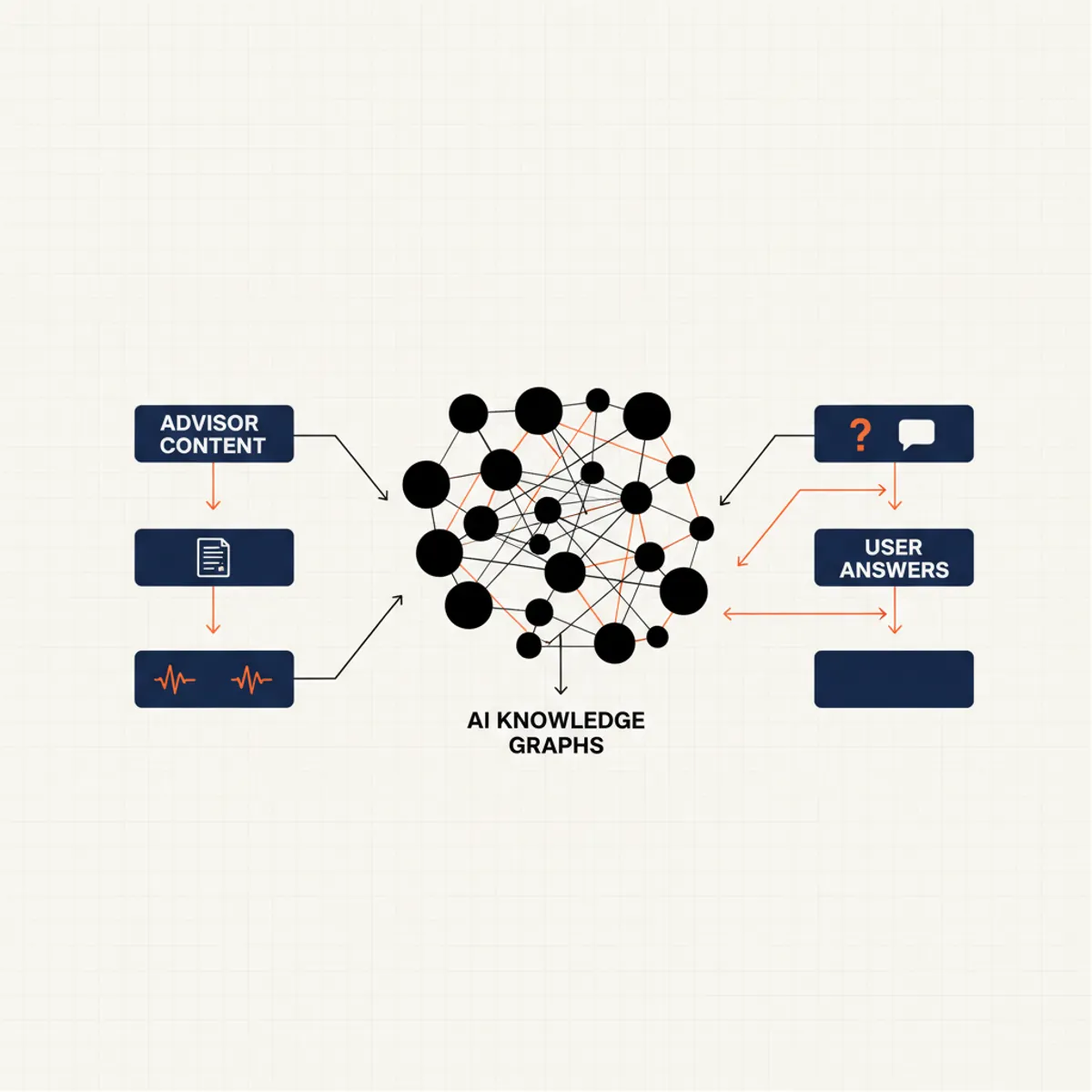
SEO vs. AEO: A Strategic Comparison for Advisory Firms
| Feature | Traditional SEO | Answer Engine Optimization (AEO) |
|---|---|---|
| Primary Goal | Ranking on Page 1 | Becoming the "Synthesized Answer" |
| Metric of Success | Organic Traffic / Clicks | Citations / LLM Mentions |
| Content Focus | Keywords and Backlinks | Semantic Meaning and Information Gain |
| Technical Priority | Page Speed and Mobile UI | Schema.org and Knowledge Graph Integration |
| User Interaction | One-way Search | Multi-turn Conversational Dialogue |
| Trust Factor | Domain Authority | E-E-A-T (Experience, Expertise, Authoritativeness, Trust) |
Objections and FAQs: Is AEO Right for Your Firm?
As a boutique AEO agency, we often encounter skepticism from established firms. Here are the most frequent objections addressed through the lens of modern search behavior.
"Won't giving the answer away stop people from clicking my site?"
This is the "Zero-Click" fear. While it's true that some users will get their answer and leave, those users were likely looking for a simple fact, not a financial advisor. The high-value prospect—the one with a $10M liquidity event—uses the AI's answer as a starting point. When they see your name cited as the expert who provided that sophisticated answer, your brand equity skyrockets. You aren't just a link; you are the authority.
"Can't I just use ChatGPT to write my blog posts?"
Using AI to rank in AI search is a recipe for failure. LLMs look for Information Gain. If you publish an AI-generated summary of existing knowledge, you are adding zero value to the knowledge graph. The AI has no incentive to cite you because it already knows what you just wrote. AEO requires human-led, expert-driven insights that provide a "delta" of new information.
"Is this just another trend like voice search?"
Unlike voice search, which had limited utility for complex financial planning, Generative AI is being integrated into every professional tool, from Microsoft Copilot to specialized research platforms like Perplexity. It is not a niche device; it is a fundamental shift in how the internet is indexed and consumed.
"We already have a great SEO agency. Aren't they doing this?"
Most traditional SEO agencies are still focused on keyword density, backlink volume, and technical site health. While these are important, they do not address semantic mapping, JSON-LD knowledge graph integration, or RAG optimization. AEO is a specialized discipline that requires a deeper understanding of natural language processing (NLP).
Common Pitfalls for Advisors Entering the AEO Space
Transitioning to AEO is not without risks. Many advisors fall into the trap of over-optimizing for robots while forgetting the human client. Here are the most common mistakes:
- Ignoring Compliance: In the rush to provide direct answers, advisors may overlook SEC or FINRA requirements regarding testimonials or projected returns. Every AEO-optimized answer must still pass your compliance officer's desk. Disclaimers should be embedded in the structured data where possible.
- Generic Content Creation: Using AI to write your AEO content creates a feedback loop of mediocrity. If you use AI to write what is already in the AI's training data, the AI has no reason to cite you as a new source. Focus on your proprietary "Firm View."
- Neglecting the "Why": AI can give a direct answer (the "what"), but prospects hire advisors for the "why" and the "how it applies to me." Your content must bridge the gap between a factual answer and a professional consultation.
- Incomplete Knowledge Graphs: Failing to claim your Google Business Profile, LinkedIn, and industry directory listings prevents AI from connecting the dots between your website and your professional identity. If the AI doesn't know "Advisor X" works at "Firm Y," your authority is diluted.
The future of professional services is not found in the search bar, but in the conversation. If an AI can't verify your expertise through structured data, it will simply invent an expert who can. AEO is the insurance policy for your firm's digital authority.
— Amir, Founder of EvronStudio
Case Study: Boutique Wealth Management Firm in 2024
To understand the impact of AEO, we looked at a boutique firm specializing in high-net-worth divorce settlements. Previously, they relied on traditional SEO, ranking for broad terms like "divorce financial planner." Their traffic was high, but their lead quality was low, often consisting of individuals looking for basic legal forms rather than wealth management.
By pivoting to an aeo-strategy-for-businesses approach, they focused on highly specific technical queries like "tax treatment of QDROs in California 2024" and "division of restricted stock units during divorce." They implemented specialized 'FinancialService' schema and structured their blog posts to provide direct, 50-word answers at the top of every page, followed by deep-dive analysis.
The Results after 6 Months:
- Perplexity Citations: Increased from 0 to 42 for specific technical queries. They became the "source of truth" for RSUs in divorce scenarios.
- Lead Quality: 65% increase in high-net-worth inquiries (assets > $5M). The leads were more educated and entered the sales funnel with a high degree of trust.
- Conversion Rate: The firm saw a 12% increase in discovery call bookings because prospects had already "conversed" with their expertise through an AI interface before even reaching the site. The sales cycle shortened because the "authority building" happened before the first call.
Essential Tools for the AEO-Driven Advisor
Managing an AEO strategy requires a different toolkit than traditional search marketing. Here are the essential categories of tools you need:
- Knowledge Graph Analyzers: Tools like Kalicube or WordLift help you manage how your brand is perceived by the Google Knowledge Graph and other LLM training sets. These tools help you build an "Entity Home" that defines your firm to the web.
- Semantic Keyword Research: Use AnswerThePublic or AlsoAsked to find the long-tail, conversational questions your prospects are asking. Don't look for keywords; look for problems.
- Schema Generators: Merkle’s Schema Generator or specialized plugins for CMS platforms to ensure your JSON-LD code is flawless. Validating your schema with the Google Rich Results Test is a daily requirement.
- AI Visibility Monitoring: Use newer platforms like Perplexity’s own dashboard or specialized SEO tools (Ahrefs, Semrush) that are now tracking "Generative AI Visibility." You need to know when your "Share of Voice" in AI responses drops.
- Natural Language API: For larger firms, using Google’s Natural Language API to analyze your own content can reveal how a machine "sees" your expertise. It helps identify if your writing is too ambiguous for an AI to confidently summarize.
Measurement Metrics and Your AEO Checklist
How do you know if your AEO strategy is working? You cannot rely on traditional rankings alone. You must track:
- Citation Share: How often is your brand cited as a source in Perplexity or SearchGPT for your core keywords? Use manual audits and emerging tracking tools to measure this.
- Branded Query Accuracy: When you ask an AI "What does [Your Firm Name] specialize in?", is the answer accurate and comprehensive? If the AI is hallucinating your services, your AEO signals are weak.
- Semantic Visibility: Are you appearing in the "People Also Ask" and "Follow-up Question" sections of generative engines? This indicates that the AI sees you as a relevant part of a broader conversation.
- Direct Traffic from AI Referrals: Monitor your analytics for referral traffic from
openai.com,perplexity.ai, andgemini.google.com. These are your highest-intent visitors.
The Advisor AEO Checklist:
- [ ] Claim and verify all professional profiles (LinkedIn, NAP data, Industry associations).
- [ ] Implement Person and Organization schema for all senior partners, linking to their specific accolades.
- [ ] Rewrite top-performing blog posts to include a direct "answer paragraph" (45-60 words).
- [ ] Add structured FAQ sections to all service pages using the
FAQPageschema. - [ ] Audit your content for "Information Gain"—does it offer anything a basic AI doesn't already know?
- [ ] Ensure all financial data points are cited to authoritative external sources (IRS, SEC, etc.) to build trust bridges.
- [ ] Create a "Professional Profile" page for each lead advisor that acts as a central hub for their entity data.
- [ ] Monitor LLM responses for your firm name weekly to ensure brand alignment.
The Path Forward: Securing Your Digital Legacy
As we look toward a future where AI agents act as the primary interface between clients and advisors, the importance of being "machine-readable" cannot be overstated. AEO is not a one-time project; it is a fundamental shift in how expertise is communicated and verified in the digital age. By focusing on writing-content-for-ai-search today, you are ensuring that your firm remains the primary source of truth for your clients tomorrow.
The transition from a link-based economy to a citation-based economy is the most significant change in professional services marketing since the invention of the search engine. Advisors who master AEO will find themselves with a powerful competitive advantage: they will be the recommended choice in the very moment a prospect is seeking clarity on a complex financial issue. The transition is challenging, requiring technical precision and a commitment to high-level content, but the reward is a sustainable, high-authority digital presence that no algorithm change can erase.
In a world saturated with generic AI-generated noise, your human expertise—properly structured and broadcast through AEO—is your most valuable asset.
If you are ready to transition your advisory firm into the era of AI search, explore our services or book a free-aeo-audit to see where you stand in the generative landscape. Let’s build your authority where the answers are actually being found.
Frequently asked questions
How does AEO differ from traditional SEO for financial advisors?+
Traditional SEO focuses on keyword rankings and driving traffic to a website via blue links. AEO focuses on being the factual source used by an AI to synthesize a direct answer. For advisors, this means prioritizing high-trust data structures and semantic relevance over mere backlink volume or keyword density.
Which AI platforms are most important for advisors to target?+
Perplexity AI is currently the leader for research-heavy financial queries due to its real-time browsing. However, ChatGPT (SearchGPT) and Google’s Gemini are critical for broader reach. Advisors should focus on LLMs that cite their sources, as these provide the direct click-through opportunities necessary for lead generation.
Does schema markup really help with AI search rankings?+
Yes. AI models use RAG (Retrieval-Augmented Generation) to pull data. Schema.org markup like 'FinancialService' or 'Review' provides a machine-readable layer that confirms your location, credentials, and specialties. Without it, the AI has to guess your expertise, which increases the likelihood of being ignored in favor of structured competitors.
Is content length still important for AEO?+
The goal is depth and precision rather than length. While traditional SEO often rewarded 2,000-word fluff pieces, AEO prioritizes the density of unique information. An advisor’s content must answer 'why' and 'how' with specific data points that an AI can extract to satisfy a user’s complex financial intent.
Can I use AI to write my AEO content?+
Using AI for drafts is acceptable, but pure AI-generated content often lacks the 'Information Gain' required for high AEO rankings. For advisors, the value lies in unique insights, proprietary data, and nuanced advice that general LLMs don't already possess. Human oversight ensures regulatory compliance and professional accuracy.
How long does it take to see results from an AEO strategy?+
AEO results can manifest faster than traditional SEO because LLMs crawl and re-index authoritative sources frequently. An advisor focusing on specific niche queries (e.g., 'tax implications of RSUs for tech executives') can see citations in generative engines within 4 to 8 weeks of implementing technical schema and semantic optimizations.
Sources & further reading
Soft next step
Want to see where AI answers mention you — and where they don't?
We run a free AEO audit across ChatGPT, Gemini, Copilot and Perplexity, then hand you the fixes in priority order. Start your AEO strategy today.