AEO vs SEO: Navigating the Search Evolution in 2026

The transition from traditional search to AI-driven answer engines requires a new optimization framework.
Quick answer
AEO focuses on providing direct, concise answers to AI models like ChatGPT and Perplexity, while SEO focuses on driving traffic to websites through search engine result pages. In 2026, SEO gets you found on Google, but AEO ensures AI assistants recommend your brand as the definitive source.
The primary difference between AEO vs SEO is that SEO optimizes for search engines to drive clicks, while Answer Engine Optimization (AEO) optimizes for AI models to provide direct answers. While SEO builds a library, AEO ensures the librarian quotes you as the ultimate authority. In 2026, winning requires both: visibility in traditional search and citations in AI responses.
Defining the Core Entities: AEO vs SEO
To understand this shift, we must define the specific players in the 2026 digital space. Answer Engine Optimization (AEO) is the process of making content machine-readable so AI can extract facts easily. Search Engine Optimization (SEO) remains the practice of improving website visibility on pages like Google. An Answer Engine is a platform like Perplexity or ChatGPT that synthesizes information rather than just listing links. A Knowledge Graph is a programmatic database of facts that AI uses to understand relationships between your brand and your products. Finally, Large Language Models (LLMs) are the underlying AI systems, like GPT-4o or Gemini 1.5, that process your content to generate these answers.
Understanding the Information Supply Chain
In the context of AEO, your website is no longer a destination; it is a data source. When a user asks an AI about a specific B2B solution, the model goes through a "Retrieval-Augmented Generation" (RAG) process. It scans indexed data, identifies the most credible "entities," and synthesizes a response. SEO helps the crawler find the page, but AEO ensures the model can digest the facts within the page. If your data is trapped in a messy layout, the AI moves to your competitor’s cleaner, more structured data.
Why the AEO vs SEO Distinction Matters in 2026
In 2025, we saw a massive shift in user behavior that has now become the standard. According to data from Gartner, search engine volume is projected to drop as users migrate toward AI-integrated assistants for quick queries. We have seen this firsthand with our 200+ B2B clients; users no longer want to click through three pages to find a pricing table. They want the answer in the chat interface.
Furthermore, Search Engine Land reports that AI Overviews now appear for a majority of informational queries. If your content is not structured for these "zero-click" experiences, your organic reach will likely stagnate. SEO provides the foundation of site health and authority, but AEO is what puts your brand’s name in the mouth of the AI assistant. Ignoring AEO means you are essentially invisible to the millions of users who no longer use traditional browsers for top-of-funnel research.
The Rise of Brand Mentions Over Clicks
For years, the industry obsessed over the "Blue Link." In 2026, a click is a secondary victory. The primary victory is being the named recommendation in a ChatGPT session. When an AI says, "Based on current data, [Your Brand] offers the most reliable API for this use case," you have won the trust of the buyer before they ever visit your homepage. This is why the AEO vs SEO distinction is vital for your budget allocation. SEO keeps your site healthy; AEO keeps your brand relevant in the AI conversation.
A Step-by-Step Guide to Integrated Optimization
Merging these two disciplines requires a systematic approach. You cannot simply rewrite your meta tags and hope for the best. You need to re-engineer how you present information to the web.
1. Implement Advanced Schema Markup
You must go beyond basic "Article" schema and use specific types like "SoftwareApplication," "Course," or "FAQPage." Schema.org provides the vocabulary that allows bots to understand the context of your data without guessing. When you define your CEO as a "Person" linked to your "Organization," you build a credible entity relationship.
- Audit your current schema using the Schema Markup Validator.
- Identify "Product" or "Service" nodes that lack specific price or feature attributes.
- Map out "About" and "Mentions" properties to link your content to established industry topics.
- Deploy the code via JSON-LD for the cleanest injection.
A common mistake is using generic tags that don't describe the specific data point. Pro tip: Use the "sameAs" property to link your social profiles and Wikipedia pages, reinforcing your brand's digital footprint in the Knowledge Graph.
2. Transition to a Q&A Content Architecture
Traditional long-form blog posts often bury the answer under 500 words of fluff. In 2026, you should structure your H2s as specific questions and provide a direct 40-60 word answer immediately following. This "inverted pyramid" style helps AI extract your text for featured snippets and AI Overviews.
The mistake here is being too vague or using marketing jargon in the answer block. If the question is "What is the cost of AEO?", do not start with "In a world of digital transformation..." Start with "The cost of AEO services typically ranges from..." Pro tip: Use a "Key Takeaways" box at the top of every page to give the AI a high-density summary to crawl.
3. Build Niche Topical Authority
Answer engines favor sources that demonstrate deep expertise in a narrow field. Instead of writing about "Marketing," write 50 detailed articles about "B2B Attribution for SaaS." This builds a cluster of information that AI models recognize as a primary source.
- Create a "Topic Hub" page that links to every sub-topic.
- Ensure every sub-topic article answers at least three unique user questions.
- Use internal linking to show the model how these concepts relate.
Many brands make the mistake of trying to cover too many unrelated topics, which dilutes their authority score. Pro tip: Map your content to a comprehensive AEO strategy that identifies specific knowledge gaps in your industry.
4. Optimize for Natural Language Processing (NLP)
You need to write the way people speak to their devices. Long, academic sentences are difficult for models to summarize accurately. Use active voice and simple sentence structures. A common mistake is keyword stuffing, which actually confuses modern LLMs that look for semantic meaning rather than word frequency.
Consider how a user asks a question to Siri or Alexa. They don't use keywords; they use full-intent sentences. Pro tip: Read your content aloud; if it feels awkward to say, it will be difficult for an AI to synthesize as a "spoken" answer.
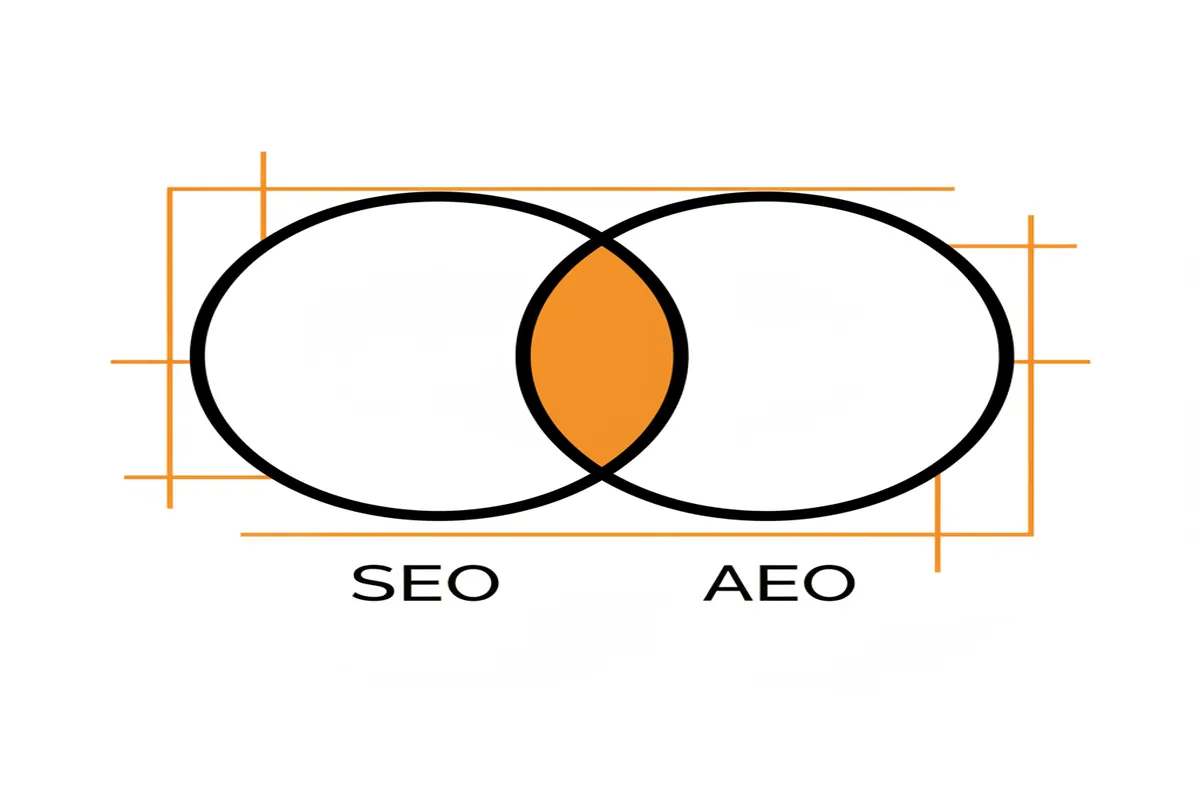
AEO vs SEO: Comparison of Key Features
| Feature | SEO (Search Engine Optimization) | AEO (Answer Engine Optimization) |
|---|---|---|
| Primary Goal | High rankings and click-through rate (CTR) | Being the "single source of truth" |
| Success Metric | Organic traffic and impressions | Citation share and brand mentions |
| Content Format | Long-form articles, landing pages | Q&A blocks, data tables, structured facts |
| User Intent | Browsing and researching | Finding specific, immediate answers |
| Primary Platform | Google, Bing, DuckDuckGo | ChatGPT, Perplexity, Gemini, Copilot |
| Crawler Priority | HTML structure and metadata | Semantic meaning and entity relationships |
| Update Frequency | Monthly or quarterly refreshes | Near real-time factual accuracy |
Common Mistakes to Avoid in Your Hybrid Strategy
- Neglecting technical SEO fundamentals. AEO cannot function if your site is slow or un-crawlable. You still need a fast, secure site to be indexed. If Googlebot can't see you, OpenAI's GPTBot likely won't either.
- Focusing solely on keywords. If you ignore the metrics that define AEO success, you will miss how often AI mentions your brand without a click. Keyword volume is a dying metric for B2B authority.
- Using gated content for core facts. If your best data is behind a PDF or a login, AI models cannot see it to reference it. Move your most valuable statistics to the "front of the house" in HTML.
- Ignoring entity relationships. Failing to link your brand to known industry experts or other verified entities makes you appear less trustworthy to the Knowledge Graph. Use digital PR to get mentioned alongside industry leaders.
- Over-reliance on AI-generated content. Ironically, using unedited AI content to rank for AI search often results in generic, low-authority answers. LLMs recognize their own patterns and often prefer "human-in-the-loop" content for citations.
Best Practices for Dominating 2026 Search
- Prioritize Factuality: Cite your sources clearly. AI models are trained to avoid "hallucinations" and will prefer content that links to reputable data. Use external links to Ahrefs or Semrush to validate industry trends.
- Use Table Summaries: Whenever you compare products or services, use a Markdown table. AI models love structured data for comparison queries. A table is much easier for an LLM to tokenize than three paragraphs of text.
- Audit Your Brand Mentions: Regularly check how ChatGPT or Perplexity describes your company. If the AI thinks you only sell "Product A" when you have moved into "Product B," you have an AEO gap.
- Optimize for Voice: Ensure your answers are brief enough to be read aloud by a smart speaker without losing context. Aim for the "one-breath" rule—if you can't say the answer in one breath, it's too long.
- Refresh Content Frequently: AI models value recent information. An outdated price or feature list can disqualify you from an answer box. We recommend a "Facts Audit" every 90 days for core service pages.
AI Visibility in ChatGPT, Gemini, Copilot, and Perplexity
In 2026, your visibility across these platforms depends on your "citability." ChatGPT uses a mix of its training data and real-time web browsing to answer queries. If your site provides structured, factual summaries, you are more likely to be the "source" link at the bottom of the chat. Gemini and Copilot are more tightly integrated with Google and Microsoft ecosystems, meaning your AEO and SEO efforts must work in tandem with your business listings and cloud data.
Perplexity, acting as a true "Answer Engine," relies heavily on the quality of your citations. To show up here, you need to be mentioned by other high-authority sites. It isn't just about what you say on your own site, but how the rest of the web validates your expertise. We focus on ensuring your brand becomes a recognized entity that these models trust enough to recommend in high-stakes B2B buying conversations.
Platform-Specific Nuances
- ChatGPT: Favors clear, conversational definitions and "how-to" guides.
- Gemini: Heavily influenced by Google’s Knowledge Graph and your Google Business Profile.
- Perplexity: Prioritizes academic-style citations and recent news or data points.
- Copilot: Integrates heavily with LinkedIn and Microsoft 365 data for B2B queries.
Testing and Quality Assurance for AEO
You should never roll out an AEO strategy site-wide without testing. Because LLMs are probabilistic, the same prompt can yield different results. You need a QA process to ensure your "Answer Blocks" are actually being picked up.
- The "Summary Test": Copy a URL from your site and paste it into Claude or ChatGPT. Ask: "What are the three main takeaways from this page?" If the AI misses your primary value proposition, your content hierarchy is failing.
- Schema Validation: Use the Google Rich Results Test to ensure your JSON-LD is eligible for snippets. An error here means the bot ignores your structured data.
- The "Direct Answer" Prompt: Ask Perplexity a question your page is designed to answer. If a competitor is cited instead of you, analyze their page structure. Often, they have a clearer H2/Answer relationship.
- Bot Accessibility: Check your robots.txt file. Ensure you are not accidentally blocking GPTBot or OAI-SearchBot. Many sites blocked these in 2024 out of fear, but in 2026, this is equivalent to deleting your site from Google.
Honest Trade-offs: Where AEO Fails
AEO is not a magic bullet. There are specific scenarios where it is less effective than traditional SEO or paid media. You must understand these limitations to avoid wasting your budget.
First, AEO does not work for "visual-first" discovery. If you are selling high-end furniture or aesthetic medical services, an AI-generated text answer will never replace a high-ranking Google Image or a TikTok video. Second, AEO can actually reduce your ad revenue if you rely on page views. Since the goal is a "zero-click" answer, your on-site traffic might drop even as your brand influence grows.
Finally, you have less control over the final output. In SEO, you control the meta description. In AEO, the AI synthesizes your content and might occasionally paraphrase you in a way that loses your brand's unique "voice." If your product is highly complex and regulated, such as legal or medical advice, the risk of an AI misinterpreting your data is high. In these cases, traditional SEO with a focus on PDF downloads and direct consultation remains superior.
"The shift from SEO to AEO is not about losing traffic; it is about changing the nature of how your brand provides value in the first ten seconds of a user's journey."
Case Study: B2B SaaS Growth through Integrated AEO
We worked with a mid-market B2B SaaS client in the fintech space who was struggling with a 20% year-over-year decline in organic search traffic during early 2025. Their content was high-quality but formatted in long, narrative whitepapers that AI models couldn't easily parse.
We implemented a dual AEO and SEO strategy. First, we converted their primary research into 150 structured Q&A blocks and deployed comprehensive "FinancialService" schema across their product pages. Next, we optimized their technical infrastructure to ensure that LLM crawlers could access their data without friction.
Within six months, while their traditional "click-through" traffic stabilized, their brand citations in Perplexity and ChatGPT increased by over 450%. This led to a 30% increase in "Direct" traffic and "Branded Search" queries, as users who saw the brand in AI answers eventually navigated directly to the site to start a trial. This composite example demonstrates that AEO doesn't just replace SEO; it feeds the top of the funnel by building brand recall in AI-driven environments. You can see our full range of AEO services to understand how we apply these tactics.
Essential Tools and Resources
- Google Search Console: Essential for monitoring traditional indexation and identifying which queries trigger AI Overviews (Free).
- Semrush / Ahrefs: Useful for tracking keyword rankings and identifying the "Featured Snippet" opportunities that often transition into AI answers (Paid).
- Schema.org: The official resource for finding the correct tags to label your data for machines (Free).
- Perplexity Pages: A great tool to see how an answer engine aggregates information on a specific topic (Freemium).
- Claude / ChatGPT: Use these to "interview" your own content. Ask the AI to summarize your page and see if it captures your key selling points accurately (Freemium).
- BrightEdge: Provides excellent data on the prevalence of AI Overviews in specific industries (Paid).
How to Measure Your Success
Measuring success in AEO is different from tracking a blue link on page one. You need to look at "Share of Model Response." This requires a shift in how you report to your stakeholders.
- Baseline: Perform a manual audit of 20 core industry questions in ChatGPT and Perplexity. Note how many times your brand is mentioned.
- Metric 1: Citation Count. How many times does an AI engine link to your site as a source? Use tools like Perplexity's source list to track this.
- Metric 2: Sentiment Score. Is the AI describing your product accurately and positively? If the AI calls your software "complex to set up," you have a sentiment issue.
- Metric 3: Branded Search Volume. As AEO grows, your direct brand searches should also rise. This is the most reliable "offline" indicator of AEO success.
- Checklist: Are your core FAQs updated? Is your schema valid? Is your most important data "un-gated" for crawlers?
The Future of Search: 2026 and Beyond
We are entering an era where "Search" is a dialogue, not a list. By late 2026, we expect AI agents to handle not just the research, but the initial procurement steps for B2B buyers. These agents will "read" your pricing pages, compare your features to competitors, and present a recommendation.
If your data isn't structured for these agents, you won't even make the short-list. The line between your website and the global knowledge base will continue to blur. Winning will require a commitment to being the most helpful, most structured, and most cited authority in your niche. You must move from being a "content creator" to a "knowledge provider."
Balancing Your Strategy for Long-Term Growth
Navigating the transition between AEO vs SEO doesn't mean abandoning the techniques that built the modern web. You still need backlinks, you still need a mobile-friendly site, and you still need to write for humans. However, you must now treat AI models as a critical segment of your audience. By providing clear, structured, and factual answers, you satisfy both the human reader looking for depth and the AI model looking for efficiency.
Think of SEO as the road that leads to your store and AEO as the helpful assistant standing at the door. If the road is broken, no one arrives. If the assistant is silent, no one buys. You need both to function in harmony.
If you are unsure where your site stands in this new landscape, we can help. Our team specializes in bridging the gap between traditional search visibility and AI-driven recommendations. You can start by requesting a [free AEO audit](/free-aeo-audit) to see your current citation share. When you are ready to dominate your category and ensure your brand is the first name an AI mentions, explore our full [Answer Engine Optimization services](/services).
Next Steps for Your Brand
- Check our latest [AEO insights](/aeo-insights) for weekly updates.
- Review our [blog](/blog) for more deep dives into technical optimization.
- Reach out to our team via the [contact page](/contact) for a custom strategy.
- Audit your site's schema using the official [Google Search Central](https://developers.google.com/search) tools.
- Stay updated on AI developments at [OpenAI](https://openai.com).
- Test your top 10 informational pages in a "Summary Chat" to see how LLMs perceive your brand.
- Replace generic H2 headings with specific, high-intent questions to capture more AI citations.
Frequently asked questions
What is the main difference between AEO and SEO?+
SEO focuses on ranking pages in search results like Google to drive clicks. AEO (Answer Engine Optimization) focuses on providing structured data and direct answers so AI models like ChatGPT and Perplexity cite your brand as a source. In 2026, SEO drives traffic to your site, while AEO ensures your brand is recommended by AI.
Is SEO still relevant with the rise of AI answer engines?+
Yes, SEO is still highly relevant in 2026. While AI usage has grown, traditional search engines still drive a significant portion of transactional and deep-research traffic. SEO provides the technical foundation (speed, security, authority) that AEO requires to function effectively. You cannot have successful AEO without a strong SEO base.
How do I optimize my content for ChatGPT and Perplexity?+
To optimize for Perplexity and ChatGPT, you must use structured data (Schema.org), provide direct answers to common industry questions, and maintain high factual accuracy. These models look for 'citability.' Focus on creating 'Key Takeaway' sections and Markdown tables that AI can easily parse and present to users in a conversational format.
How do I measure AEO success compared to SEO?+
Key metrics for AEO include Citation Share (how often AI mentions you), Sentiment Score, and the growth of Branded Search. Unlike SEO, which tracks clicks, AEO success is often measured by how often your brand is cited as the definitive source for a specific query within an AI's response window.
What are the biggest mistakes in AEO?+
Common AEO mistakes include burying answers deep in long paragraphs, ignoring schema markup, and gating your most factual data behind forms. Additionally, failing to update outdated facts can lead to AI models flagging your site as an unreliable source. Always prioritize 'crawlability' for AI bots just as you do for search crawlers.
Why is structured data important for AEO?+
Structured data, such as JSON-LD schema, acts as a translator for AI models. It explicitly tells the AI what a piece of data represents (e.g., a price, a CEO, or a review). This reduces the model's need to 'guess,' making it significantly more likely to use your content in its generated answer.
Sources & further reading
Soft next step
Want to see where AI answers mention you — and where they don't?
We run a free AEO audit across ChatGPT, Gemini, Copilot and Perplexity, then hand you the fixes in priority order. Start your AEO strategy today.
Keep reading
AEO Fundamentals
What is Answer Engine Optimization (AEO)? A 2026 Guide for B2BAEO Fundamentals
AEO vs GEO: Understanding the Difference in AI Search 2026Tools & Measurement
Measuring AEO Success Metrics: The 2026 Guide to AI Visibility