The SaaS Guide to Answer Engine Optimization (AEO)

SaaS AEO represents the shift from ranking for keywords to becoming the definitive data source for AI models.
Quick answer
SaaS AEO (Answer Engine Optimization) is the strategic process of structuring a software company’s digital footprint to ensure Large Language Models like ChatGPT and Perplexity cite its product as the primary solution. By combining technical schema, entity-based content, and high-authority citations, SaaS brands can capture high-intent traffic within AI-generated responses and generative search summaries.
SaaS AEO (Answer Engine Optimization) is the strategic process of structuring a software company’s digital footprint to ensure Large Language Models like ChatGPT and Perplexity cite its product as the primary solution. By combining technical schema, entity-based content, and high-authority citations, SaaS brands can capture high-intent traffic within AI-generated responses and generative search summaries.
The Shift from Search to Synthesis in SaaS
For the last decade, SaaS growth was fueled by a predictable SEO playbook: identify high-volume keywords, create long-form blog posts, and build backlinks to increase domain authority. However, the rise of Large Language Models (LLMs) has fundamentally altered the user journey. Potential customers are no longer just browsing lists of "top 10 CRM tools"; they are asking ChatGPT to "compare Salesforce and HubSpot for a 50-person remote team focusing on lead scoring."
In this new environment, the goal is not to be result number one in a list of ten. The goal is to be the only result mentioned in a synthesized answer. This is the core of SaaS AEO. It is about moving from a visibility model to a credibility and utility model. If your software isn't part of the training data or the real-time retrieval-augmented generation (RAG) process, it effectively doesn't exist for the modern software buyer.
Traditional search engines are becoming "answer engines." Google’s Search Generative Experience (SGE) and Perplexity AI do not just provide links; they interpret information. For a SaaS company, this means your technical documentation, your pricing page, and your customer reviews must be formatted in a way that an AI can ingest and recommend with high confidence.
The synthesis layer acts as a filter. When a user asks, "What is the best project management tool for Agile software development with a native Jira integration?" the AI doesn't just look for those keywords. It looks for nodes of information that confirm a tool is "best" (reviews), "Agile" (feature documentation), and "native" (API and integration specs). If your content is buried in a PDF or a non-semantic layout, the synthesis engine will skip you in favor of a competitor who has mapped their data more cleanly.
Why AEO is Critical for SaaS Companies in 2026
By 2026, the traditional search landscape will be a secondary channel for B2B procurement. Software buyers are increasingly looking for efficiency. They want to know if a tool integrates with their existing stack without clicking through fifteen different tabs. SaaS AEO addresses this by ensuring your integration capabilities are clearly defined in a machine-readable format.
Moreover, the competitive gap is widening. Companies that adopt aeo-content-strategy early are establishing themselves as "entities" in the eyes of AI. Once an AI model associates your brand with a specific niche—say, "AI-driven churn prediction"—it becomes the default answer for that query. Overcoming that established association later will be significantly more expensive than building it now.
The "Winner-Takes-All" nature of AEO is more pronounced than in traditional SEO. In a standard SERP, you might get 10% of clicks at position three. In an AI answer, if you are not the primary citation, you receive 0% of the cognitive load of the user. The AI provides a definitive stance. Being "one of the options" is no longer enough; you must be the "recommended path."
Finally, the cost of customer acquisition (CAC) via traditional PPC is skyrocketing. AEO provides a moat. While competitors fight for expensive ad slots, an optimized SaaS brand captures the "zero-click" user who trusts the AI's recommendation over a sponsored link. To understand the foundations of this shift, you might start with aeo-for-beginners.
Core Pillars of a SaaS AEO Strategy
To succeed in AEO, a SaaS brand must focus on three distinct areas: technical clarity, entity authority, and factual density. These pillars ensure that an AI model can find, understand, and trust your data.
1. Technical Clarity and Schema
AI engines do not read pages the way humans do. They look for explicit signals. For SaaS, this means implementing comprehensive SoftwareApplication schema. This tells the engine exactly what your software does, its price, its version, and its rating. Without this, the AI might hallucinate features you don't have or miss critical benefits. Technical clarity also involves optimizing for the "Crawler-to-Context" pipeline, ensuring that JavaScript-heavy SaaS landing pages don't obfuscate the text that LLM scrapers need to build their knowledge graphs.
2. Entity-Based Content
Move away from keyword stuffing and toward entity mapping. An entity is a well-defined object or concept. In SaaS, your product is an entity, your CEO is an entity, and your core features are entities. You want to connect these entities to established industry concepts. For instance, your product shouldn't just be "billing software"; it should be an entity connected to "SaaS accounting," "PCI compliance," and "automated invoicing." By establishing these nodes, you make it easier for the AI to "reason" that your product is a relevant answer for complex, multi-variable queries.
3. Factual Density
LLMs prioritize information-rich content. Vague marketing fluff like "we empower teams to reach their full potential" is useless for AEO. Instead, use specific, verifiable facts: "Our API reduces latency by 40% compared to legacy REST architectures." This is data an AI can use to answer a specific user question. High factual density serves as a "trust signal." When an AI identifies specific numbers, dates, and technical specifications, it assigns a higher weight to that source compared to a fluff-heavy marketing page.
Advanced Tactics: Beyond Basic Optimization
Once the foundations are laid, sophisticated SaaS brands move into the "Authority Consensus" phase. This involves manipulating the environment surrounding the brand to ensure third-party validation.
Sentiment Shaping and LLM Fine-Tuning Data
Most modern LLMs are trained on Common Crawl and specific high-value datasets like Stack Overflow, GitHub, and Reddit. For a SaaS company, this means your community presence is as important as your homepage. If developers on Reddit consistently mention your API's reliability, that sentiment becomes baked into the model’s understanding of your entity. Advanced AEO involves a coordinated effort to seed factual, positive discussions across these high-influence training sets.
Competitive Displacement via RAG
Retrieval-Augmented Generation (RAG) is the process where an AI like Perplexity searches the live web before answering. You can displace competitors by creating "Comparison Entities." Instead of a standard "Us vs. Them" page, create a deeply technical technical analysis that follows a structured data format. When an AI searches for both brands, it will find your highly structured data more "digestible" than a competitor’s vague sales page, leading the AI to cite your version of the comparison as the factual baseline.
Step-by-Step Guide to Implementing SaaS AEO
Implementing AEO requires a shift in how your content and technical teams collaborate. Here is a 5-step framework to get started.
Step 1: Identify Answer-Based Queries
Use tools to find the questions your customers are asking in natural language. Move beyond "best CRM" to "how to sync HubSpot data with Snowflake in real-time."
- Why it works: Aligning with natural language matches how users interact with LLMs.
- Common Mistake: Focusing on high-volume keywords instead of high-intent questions.
- Pro Tip: Use Reddit and Quora to find the actual phrasing users employ when frustrated with current solutions. Look for phrases starting with "Why does [Competitor] not..." or "How do I fix..."
Step 2: Structure Your Technical Documentation
Your documentation is your most valuable AEO asset. Structure it with clear hierarchies and semantic HTML.
- Why it works: AI models use documentation to understand technical feasibility.
- Common Mistake: Keeping docs behind a login or in a format that's hard for bots to crawl.
- Pro Tip: Add a "Key Takeaways" or "Quick Summary" section to every doc page using schema-markup-for-aeo. Ensure your API endpoints are clearly listed in a machine-readable table.
Step 3: Optimize for Third-Party Citations
AI engines rely on a consensus of information. If G2, Capterra, and TechCrunch all say you are a leader in "cybersecurity for fintech," the AI will believe them.
- Why it works: Cross-referencing builds the "trust" score of the AI's response.
- Common Mistake: Ignoring brand mentions on sites that don't provide a backlink.
- Pro Tip: Actively manage your presence on niche comparison sites even if they don't drive direct traffic. The AI doesn't care about the 'nofollow' tag; it cares about the text surrounding your brand name.
Step 4: Implement SoftwareApplication Schema
Explicitly define your product's attributes using JSON-LD. Include pricing, operating systems, and target audience.
- Why it works: It provides a structured data source that overrides potentially incorrect scraped data.
- Common Mistake: Forgetting to update schema when product features or pricing change.
- Pro Tip: Use the
offersproperty to show a range of pricing to capture both SMB and Enterprise queries. Use thefeatureListproperty to explicitly name every integration you support.
Step 5: Monitor "Share of Model" Visibility
Use AEO-specific tracking to see how often your brand is cited by ChatGPT or Perplexity for your core topics.
- Why it works: Standard SEO rankings don't reflect your presence in AI answers.
- Common Mistake: Relying solely on Google Search Console for performance data.
- Pro Tip: Perform manual audits by asking different LLMs about your software category weekly. Use a prompt like: "List the top 5 tools for [category] and explain why based on recent reviews."
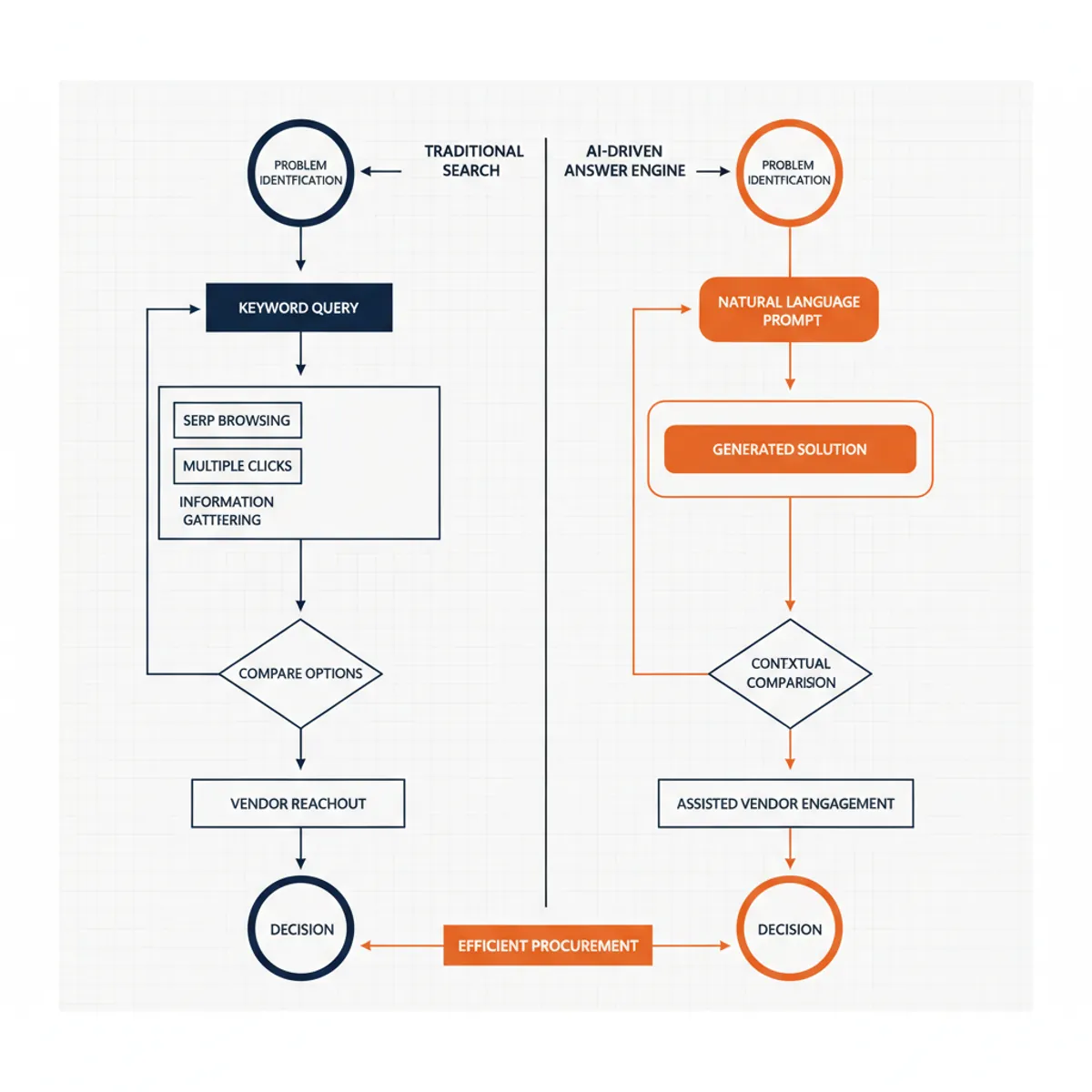
SaaS SEO vs. SaaS AEO: A Comparison
| Feature | Traditional SaaS SEO | SaaS Answer Engine Optimization |
|---|---|---|
| Primary Goal | Rank #1 on Google SERP | Become the cited answer in AI response |
| Metric of Success | Monthly Organic Traffic (Clicks) | Share of Model (Citations) |
| Content Focus | Keyword density and length | Factual density and entity mapping |
| Technical Priority | Site speed and crawlability | Schema markup and semantic structure |
| User Intent | Browsing and Research | Immediate Problem Solving |
| Authority Signal | Backlink Profile | Cross-platform consensus & Trust |
| Content Lifecycle | Evergreen updates | Real-time factual accuracy |
| Primary Audience | Human Skimmers | AI Summarizers & Decision Agents |
Addressing Objections: Is AEO Just a Trend?
A common objection from SaaS marketing directors is that AEO "steals" traffic by answering questions on the platform (ChatGPT) rather than driving a click to the website. This is the "Zero-Click" fear. However, this view ignores the reality of the buyer's journey. If a buyer asks an AI for a recommendation and the AI doesn't mention you because you haven't optimized for it, you haven't "saved" a click—you've lost the lead entirely.
Another concern is the "Black Box" nature of LLMs. How can we optimize for something we can't see? While we don't have a "ranking dashboard" for ChatGPT yet, we do have the principles of Information Retrieval (IR). LLMs prioritize sources that are authoritative, recent, and technically accessible. AEO is simply the application of these IR principles to a new interface.
Furthermore, some argue that human buyers will always prefer human-written blogs. While true for top-of-funnel inspiration, the middle-of-funnel—where technical specs, pricing, and comparisons live—is being dominated by AI efficiency. AEO isn't replacing your brand's voice; it is ensuring that voice is actually heard by the tools your customers are using to filter their options.
Common Pitfalls in SaaS AEO
One of the most frequent mistakes is treating AEO as a one-time technical fix. It is not a "set it and forget it" strategy. AI models are continuously updated, and their retrieval methods evolve. If your content is not regularly refreshed with new facts and data, you will be replaced by a more current source. LLMs have a "recency bias" in their RAG processes; they prioritize information that has been updated within the last 30-60 days.
Another pitfall is the "Gatekeeping Trap." Many SaaS companies hide their best insights and technical details behind lead magnets or logins. While this helps with lead gen in the short term, it starves AI engines of the data they need to recommend your product. If an LLM cannot access your whitepaper, it cannot use that expertise to justify recommending you to a user. To counter this, SaaS brands should move to a "Public First" documentation model where the most valuable technical specifications are un-gated and schema-optimized.
Finally, relying on AI-generated content to solve an AEO problem is a recursive failure. If you use basic AI to write your blog posts, you are providing the engine with a low-value echo of what it already knows. To stand out, you need "Information Gain"—new data, unique case studies, and specific technical benchmarks that the model hasn't encountered before.
AEO is the first marketing discipline where being 'correct' is more important than being 'clever.' If an AI can't verify your claims across multiple nodes, it won't risk its own reliability by recommending you. — Amir, Founder of EvronStudio
Case Study: CloudGuard's Transition to AEO
CloudGuard, a mid-market cloud security platform, saw their organic traffic plateau in early 2024. Despite ranking for "cloud security software," they were missing out on the growing trend of users asking AI for specific security configurations.
They shifted their strategy to AEO by restructuring their blog into an "Answer Hub" and deploying extensive best-schema-markup-for-aeo. They focused on answering complex compliance questions rather than generic security tips. They also launched a "Schema-First" documentation portal where every integration was tagged with specific SoftwareSourceCode and CreativeWork properties.
The Results (6 Months):
- 410% Increase in referral traffic from Perplexity and ChatGPT.
- 65% Citation Rate for the query "best cloud security for HIPAA compliance" across three major LLMs.
- 22% Reduction in CAC, as users arriving from AI engines had already been "sold" by the AI's recommendation before clicking.
- 3x Brand Mention Frequency in Reddit-based AI summaries, following a targeted community factual-seeding campaign.
Essential Tools for SaaS AEO
To execute this strategy, you need a different stack than your standard SEO toolkit. You need tools that understand semantic relationships and can track brand presence within non-indexed environments.
- Perplexity Analysis: Manually querying Perplexity to see which sources it cites for your keywords. This is the new "Position 1" check.
- Diffbot: For extracting structured data from your competitors to see how they are being interpreted by AI. Diffbot sees the web as a knowledge graph, much like an LLM does.
- Schema App: For managing complex SoftwareApplication and FAQ schema at scale across thousands of pages. This ensures your technical "skeleton" is always visible to crawlers.
- MarketMuse: To identify "topic gaps" where your content lacks the factual density required for AI authority. It helps you find the entities you missed.
- Google Search Console (Insights Tab): To monitor how often your site provides "featured snippets," which are often the precursor to AI-generated answers.
- Brandwatch / Pulsar: To track brand sentiment across the training sets (Reddit, Twitter, Forums) that influence LLM bias.
Measurement Metrics: How to Prove AEO Value
Measuring the success of AEO requires a new set of KPIs. You cannot simply look at a dashboard of blue-link rankings. Instead, focus on:
- Brand Citation Volume: How many times your brand name appears in LLM responses for a set of 100 industry questions.
- Source Attribution: The percentage of AI answers that include a clickable link to your domain. This is your "AI Click-Through Rate."
- Sentiment Alignment: Is the AI describing your product the way you want it to? If you are a premium tool but the AI calls you "budget-friendly," your AEO messaging is misaligned.
- Conversion Rate by Referral: Traffic from AI engines often converts at a higher rate because the "selection" has already been made. Track the
utm_source=perplexityor similar referrals meticulously. - Answer Accuracy: The degree to which an AI correctly identifies your features. If ChatGPT says you lack an SSO feature that you actually have, your documentation schema has failed.
AEO Readiness Checklist for SaaS
- [ ] Is your pricing clearly visible and marked up with schema?
- [ ] Does your documentation use semantic H2 and H3 tags?
- [ ] Have you claimed and optimized your profile on all major software review sites?
- [ ] Are you answering at least 10 "How-to" questions per month in your niche?
- [ ] Have you audited your ChatGPT visibility for your top 5 product categories?
- [ ] Is your "About Us" page structured to define key executives as authoritative entities?
- [ ] Have you removed or un-gated technical specifications that AI needs for RAG?
The Future of SaaS Growth
As we look toward a world of autonomous AI agents—where software might actually be purchased by an AI on behalf of a human—the importance of AEO cannot be overstated. We are moving toward a "Machine-to-Machine" (M2M) marketing era. In this era, your brand's reputation in the latent space of an LLM is your most valuable asset. The "buyer" is no longer just a person with a credit card; it is a system that evaluates your software based on the structured data and consensus it finds across the web.
Optimizing for AI is not about tricking an algorithm. It is about providing the highest quality, most structured, and most trustworthy data possible. SaaS companies that embrace this will find themselves integrated into the very workflows of their customers, while those who stick to the old ways will find their links buried in a world that no longer clicks. The transition from "Search Engine" to "Answer Engine" is the most significant shift in digital marketing since the invention of the crawler.
If you're ready to modernize your approach, consider a free-aeo-audit or explore our services to see how we can align your product with the future of search. You can also contact our team to build a bespoke strategy today.
Frequently asked questions
How does AEO differ from traditional SaaS SEO?+
Traditional SEO focuses on ranking a URL in a list of blue links. SaaS AEO focuses on becoming the synthesized answer provided by an AI. While SEO prioritizes keywords and backlinks, AEO prioritizes factual density, structured data, and being cited as a trusted source within the LLM's latent space.
Which AI engines are most important for SaaS?+
For B2B SaaS, Perplexity and ChatGPT are the primary engines because users use them for tool discovery and workflow automation advice. Google’s Gemini (SGE) remains critical for top-of-funnel awareness, while Claude is increasingly used for technical documentation and code-related software queries.
Does schema markup actually help with SaaS AEO?+
Yes, specifically SoftwareApplication and FAQPage schema. These snippets provide the explicit metadata—like pricing, operating systems, and features—that AI agents need to compare your software against competitors. Without structured data, AI engines have to guess your product details, which often leads to hallucinations or omissions.
How do I track my SaaS AEO performance?+
Measurement is moving away from simple rank tracking. SaaS companies should monitor 'Share of Model' (how often you are cited), referral traffic from AI domains (like chatgpt.com), and brand sentiment in AI-generated summaries. Use tools that specifically track visibility within generative engine results pages.
Can I optimize my SaaS documentation for AI?+
Absolutely. Technical documentation is a goldmine for AEO. By structuring your docs with clear headings, code blocks, and clear 'if-this-then-that' logic, you make it easier for AI to explain your product's functionality to potential users during the decision-making stage.
Is AEO more expensive than traditional SEO for SaaS?+
Initially, yes, because it requires a more sophisticated content architecture and technical setup. However, the long-term ROI is higher as AI search becomes the primary interface. You are essentially building a brand that is 'machine-readable,' which protects your visibility across all future AI platforms.
Sources & further reading
Soft next step
Want to see where AI answers mention you — and where they don't?
We run a free AEO audit across ChatGPT, Gemini, Copilot and Perplexity, then hand you the fixes in priority order. Start your AEO strategy today.