Profound vs Semrush AI: The Definitive Comparison for AEO and GEO Performance
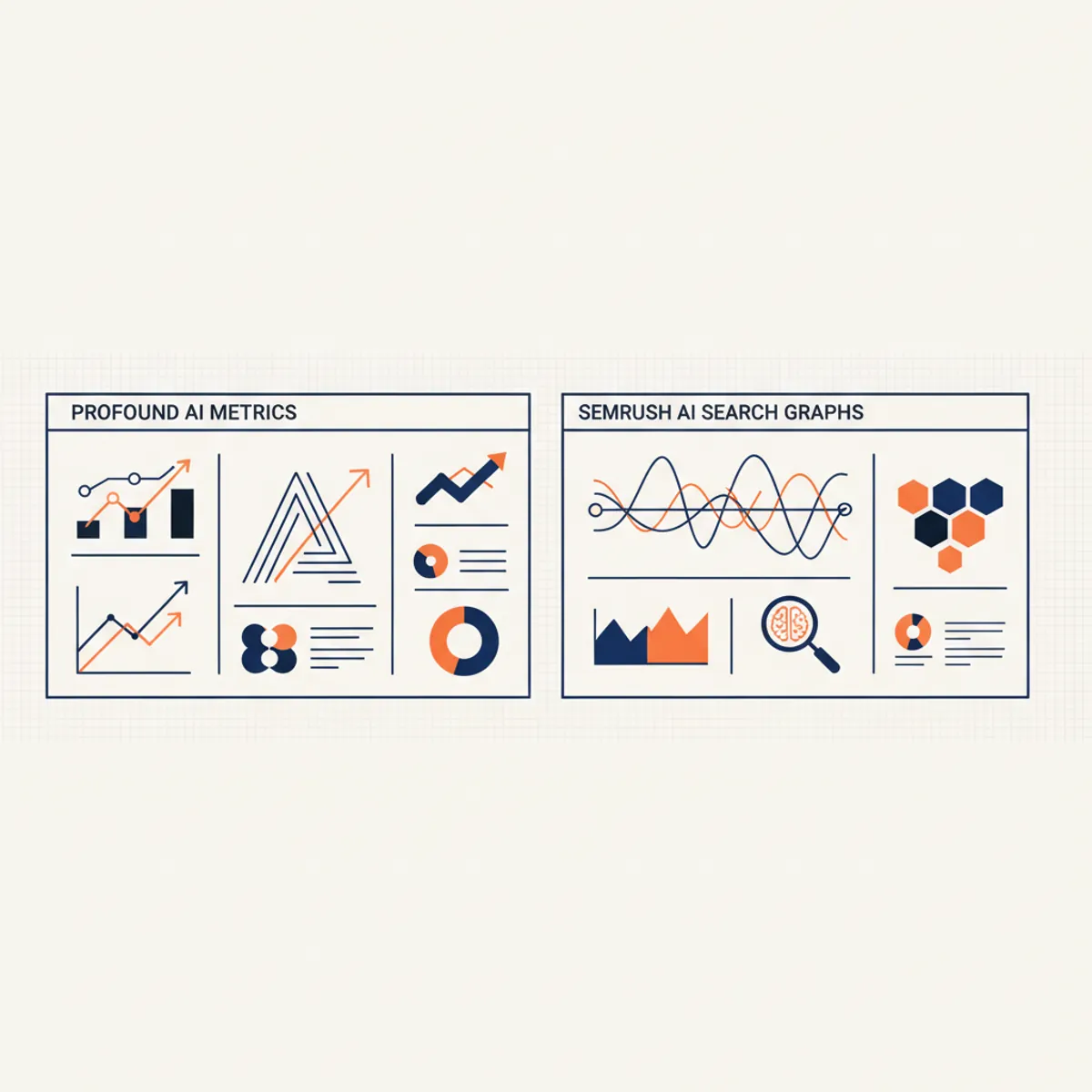
The battle for visibility has shifted from the blue links of Google to the synthesized answers of LLMs.
Quick answer
Profound and Semrush AI represent two distinct approaches to AEO. Profound is a specialized platform offering deep visibility into AI agent behavior and citation tracking across LLMs like Perplexity and Claude. Semrush AI integrates AI search tracking into a broader SEO suite, focusing on SGE visibility and traditional search overlap for comprehensive visibility management.
Profound and Semrush AI represent two distinct approaches to AEO. Profound is a specialized platform offering deep visibility into AI agent behavior and citation tracking across LLMs like Perplexity and Claude. Semrush AI integrates AI search tracking into a broader SEO suite, focusing on SGE visibility and traditional search overlap for comprehensive visibility management.
The Evolution of Search: Why AEO and GEO Matter in 2026
By 2026, the traditional search landscape has fractured. Users no longer rely exclusively on a list of ten blue links. Instead, they interact with generative engines that synthesize information into a single, cohesive answer. This shift necessitated the rise of Answer Engine Optimization (AEO) and Generative Engine Optimization (GEO).
AEO is the practice of making your brand the definitive answer to a user's question within an AI interface. GEO is the broader technical methodology used to influence how these generative engines—ranging from OpenAI's SearchGPT to Perplexity—perceive, cite, and recommend your content. If you are not appearing in these answers, you effectively do not exist for a growing segment of the market.
Measuring success in this environment is notoriously difficult. Standard metrics like CTR (Click-Through Rate) are often irrelevant when the user gets their answer without ever visiting your site. This is where tools like Profound and Semrush AI come into play. They provide the visibility necessary to understand if your aeo-strategy-for-businesses is actually moving the needle or if you are shouting into a digital void.
The "Zero-Click" phenomenon has evolved into the "Zero-Visit" reality. In this new paradigm, the value of a brand mention within a Claude response or a SearchGPT citation is arguably higher than a standard blue link click because the AI acts as a trusted intermediary, endorsing your brand as a factual authority. The challenge for marketers is that these engines operate on probabilistic models rather than deterministic indexing. You aren't just fighting for a spot; you are fighting for inclusion in the AI's weight-based worldview.
Defining the Contenders: Profound and Semrush AI
To choose between these two, we must first understand their DNA. One was built for the world of 2008 and adapted; the other was born in the era of the LLM.
Profound: The AI-First Specialist
Profound emerged as a direct response to the lack of transparency in AI search. Unlike traditional SEO tools, Profound doesn't care much about your backlink profile or your meta descriptions in isolation. It focuses on the 'Profound Score'—a proprietary metric that calculates your brand’s authority within the training data and live retrieval windows of LLMs. It is designed to tell you how often Perplexity or ChatGPT mentions your brand relative to your competitors when a relevant prompt is entered.
Profound functions more like a business intelligence tool for data science than a marketing plugin. It tracks the "Brand Orbit"—the ecosystem of third-party sites, Reddit threads, and academic papers that the AI draws from to form its opinion of you. If you are a B2B enterprise, this level of granular detail is non-negotiable for protecting your market position.
Semrush AI: The Integrated Powerhouse
Semrush is the industry standard for SEO. Their pivot into AI involves integrating Generative Search tracking into their existing 'Position Tracking' tools. They focus heavily on Google’s SGE (Search Generative Experience), showing you when an AI snapshot appears for your target keywords and whether your site is cited as a source. For teams already using Semrush, this offers a seamless transition into AEO without adding another subscription to the stack.
Semrush treats AI Overviews as a new type of SERP feature, similar to a Featured Snippet or an Image Pack. This makes it incredibly approachable for SEO veterans who are used to reporting on "Visibility %" and "Keyword Reach." It bridges the gap between the old world of ranking and the new world of generative synthesis.
Technical Comparison: How They Track AI Performance
The fundamental difference lies in their data collection methodology. Profound acts more like a user prompt emulator, while Semrush acts as a crawler-based monitor of the Google ecosystem.
| Feature | Profound | Semrush AI |
|---|---|---|
| Core Focus | Multi-LLM (Perplexity, Claude, Gemini, GPT) | Google SGE & Traditional Search |
| Primary Metric | Profound Score & Sentiment Analysis | Share of Voice & SGE Presence |
| Data Source | Direct LLM API & Prompt Emulation | SERP Scraping & Keyword Databases |
| Reporting Depth | High (Citation paths, brand mentions) | Medium (SGE inclusion, ranking shifts) |
| Integration | Standalone Platform | Integrated into SEO Toolkit |
| Ideal User | AEO Specialists / Enterprise Brands | Digital Marketing Generalists |
Profound provides a 'Citation Map' that shows how an AI engine arrived at an answer. This is crucial for identifying if the AI is pulling from your site, a competitor, or a third-party review site. Semrush, conversely, excels at showing the correlation between your organic rank and your presence in the AI snapshot. This helps teams understand if they need to double down on how-to-implement-schema-markup-for-aeo or if traditional ranking signals are still the dominant driver.
Understanding the "Retrieval" vs. "Generation" phases is key here. Semrush monitors the Generation (what the user sees on Google), whereas Profound attempts to map the Retrieval (the sources the AI scanned before summarizing). This distinction is vital for brands that find themselves mentioned in AI answers but not linked, or linked but misrepresented.
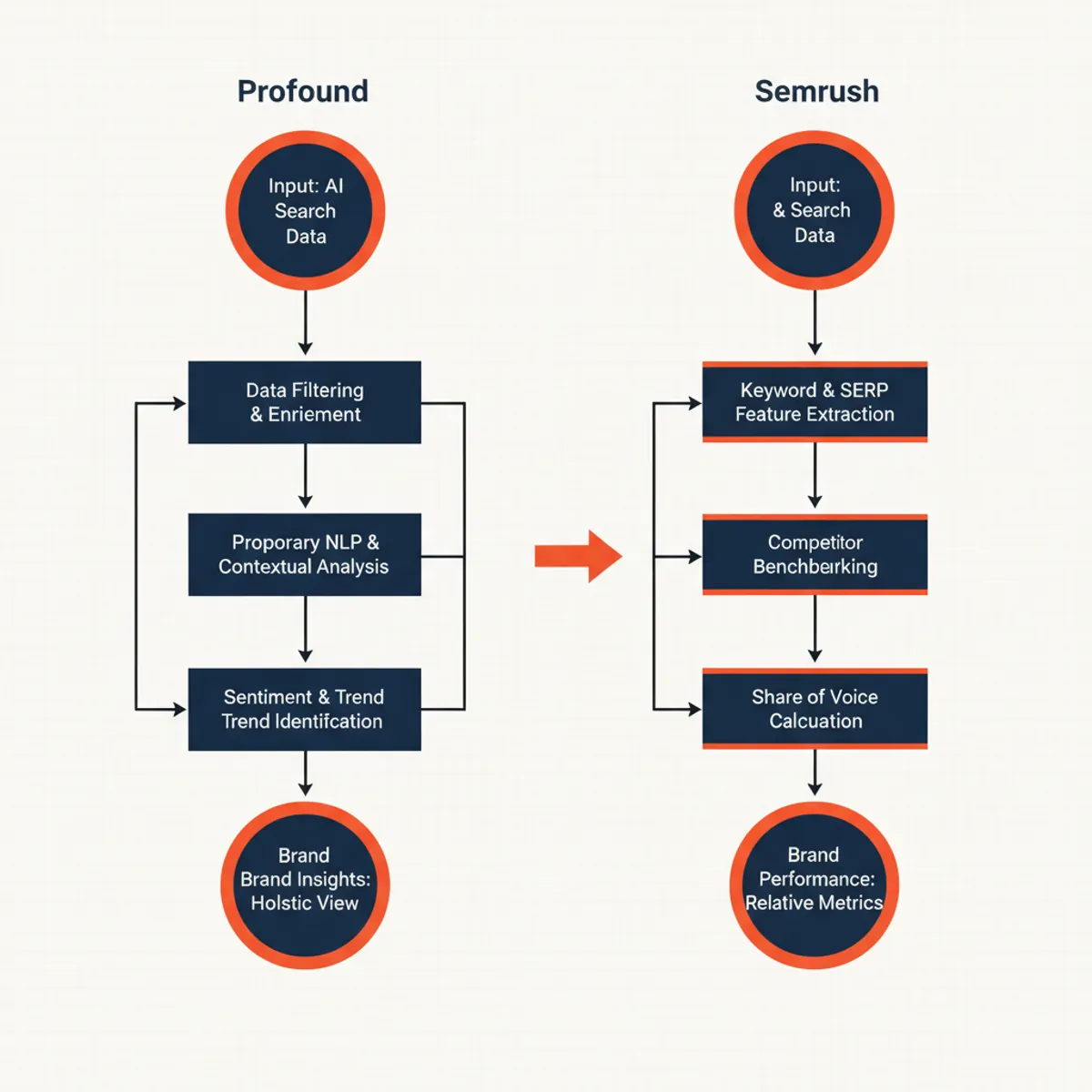
The Profound Approach: Deep Citation Analysis
Profound is built for the strategist who needs to answer the question: "Why is ChatGPT recommending our competitor instead of us?"
It breaks down the generative response into components. It identifies the sentiment of the mention (positive, neutral, or negative) and tracks the 'hallucination risk' associated with your brand. If an AI is incorrectly stating your pricing or features, Profound flags it. This allows for a proactive approach to common-aeo-mistakes where brands allow outdated data to permeate the LLM training sets.
A core feature of Profound is its ability to simulate various "Personas." You can see how a prompt like "What is the best CRM for a non-profit?" differs from "What is the most affordable CRM for a small business?" The tool tracks how the AI's recommendations shift based on these modifiers, providing a multidimensional view of brand authority that a keyword-based tool simply cannot match.
"AEO is not about ranking first; it is about being the only logical conclusion the AI can reach. If you aren't monitoring the citation path, you aren't doing AEO," says Amir, Founder of EvronStudio.
The Semrush AI Approach: The SGE Lens
Semrush understands that Google is still the elephant in the room. Their AI features are heavily weighted toward Google’s Generative Search. They provide a specific 'AI Overview' filter in their tracking tool, showing you which keywords trigger an AI response and what percentage of those responses you occupy.
This is incredibly useful for high-volume content operations. If you have 10,000 pages, you can’t manually prompt ChatGPT for every single topic. Semrush allows you to scale this monitoring by piggybacking on your existing keyword lists. It tells you which content assets are most likely to be cannibalized by an AI snapshot and which ones are successfully serving as the source material for those snapshots.
The "Keyword Gap" tool in Semrush has also been updated to include AI insights. You can now compare your AI footprint against a competitor's, seeing exactly which informational keywords they are dominating in SGE. This allows for a defensive content strategy where you can specifically target the topics your competitors are using to feed Google's generative engine.
Step-by-Step Guide: Implementing AEO Using Both Tools
To achieve the best results, a hybrid approach is often necessary. Here is how to execute a modern AEO campaign using these insights.
Step 1: Identify AI-Triggering Keywords
Use Semrush to filter your existing keyword portfolio for 'AI Overview' features. Focus on informational intent keywords where Google is already replacing traditional links with synthesized answers.
- Why it works: You prioritize high-impact areas where traffic is already shifting to AI.
- Common Mistake: Trying to optimize for keywords that never trigger an AI response.
- Pro Tip: Look for keywords with high 'People Also Ask' volume; these are primary feeders for LLM training data.
Step 2: Audit Brand Mentions in Conversational AI
Take the top 20 priority topics found in Step 1 and run them through Profound. See which brands the LLMs are currently citing and, more importantly, why they are citing them. Is it because of a specific technical whitepaper or a widely distributed press release?
- Why it works: It identifies the authoritative sources the AI trusts.
- Common Mistake: Assuming the AI pulls from the top-ranked Google result.
- Pro Tip: Check the sentiment score in Profound; if it's neutral, your content lacks the 'opinionated authority' AI engines crave.
Step 3: Optimize for the 'Answer Layer'
Implement the answer-layer-model on your site. Create concise, declarative summaries at the top of your long-form content. Use Semrush's on-page SEO checker to ensure your technical health is perfect, then use Profound to see if the LLM picks up the new summary.
- Why it works: Direct, punchy answers are easier for LLMs to scrape and cite.
- Common Mistake: Burying the 'answer' at the bottom of a 3,000-word post.
- Pro Tip: Use the exact phrasing found in Profound’s 'Suggested Prompt' queries.
Step 4: Scale Technical Schema
Deploy advanced Schema markup (FAQ, How-To, Article) across your site. Use Semrush to verify that the Schema is error-free and recognized by Google.
- Why it works: Schema provides the structured data that bridges the gap between raw text and AI-understandable facts.
- Common Mistake: Using generic Schema that doesn't define entity relationships.
- Pro Tip: Review our guide on how-to-implement-schema-markup-for-aeo for advanced entity mapping.
Step 5: Monitor, Iterate, and Defend
Set up alerts in Profound for brand mentions. If a competitor starts appearing in your 'Share of Voice' report, analyze their new content. Use Semrush to track if this shift correlates with a loss in traditional organic rankings.
- Why it works: AEO is a moving target; LLMs update their weights and retrieval methods constantly.
- Common Mistake: Setting and forgetting your AEO strategy.
- Pro Tip: Watch for 'Citation Drift' where an AI begins attributing your data to a third-party aggregator.
Advanced Tactics: Leveraging Citation Networks
A common misconception in AEO is that you only need to optimize your own website. Both Profound and Semrush reveal that AI engines rely heavily on a "Web of Trust."
To truly dominate, you must use Profound’s citation maps to identify the secondary sources the AI likes to quote. Often, these are niche industry forums, GitHub repositories, or specific subreddits. If Profound shows that Perplexity consistently cites a specific industry aggregator when answering questions about your software, your task isn't just to update your blog—it's to ensure your presence on that aggregator is flawless.
Semrush aids this by identifying the backlink profiles of these secondary sources. You can use Semrush to identify where those aggregators get their authority, then aim to appear in those upstream locations. This is "Inception SEO"—optimizing the sources that optimize the AI.
The Objection Ledger: FAQs for Skeptical CMOs
Transitioning budget from traditional SEO to AEO tools often meets internal resistance. Here is how to address the most common objections in 2026.
"Why should we pay for Profound when Semrush already tracks our rankings?" Traditional rankings measure visibility to humans scrolling a list. Profound measures visibility to the AI agents that are increasingly making the decisions for humans. If your brand is the "best" but the AI thinks you are "third best," you lose the sale before the human ever sees your link. Profound is an insurance policy for your brand's digital reputation.
"If AI provides the answer on the page, isn't traffic going to drop regardless of the tool we use?" Yes, informational traffic may drop, but the quality of the remaining traffic—and the influence of the brand mention—increases. These tools allow you to shift from a "traffic-first" mindset to an "influence-first" mindset. You track citations because a citation in a SearchGPT result is a high-intent endorsement that replaces the need for an initial discovery click.
"Is Profound's data actually actionable, or is it just 'vanity' AI metrics?" Profound identifies "Answer Gaps." If an AI states your product lacks a feature it actually has, that is a direct hallucination that hurts your bottom line. Profound provides the specific prompt and citation path that led to that error, allowing your technical team to update the documentation or Schema that the LLM is misreading. That is highly actionable, revenue-protecting work.
"Semrush is enough for us because Google is 90% of the market." In 2026, this is a dangerous assumption. While Google remains dominant, the way people use Google has changed, and a significant portion of high-value B2B and technical queries have migrated to Perplexity and OpenAI. Relying solely on Semrush means you are blind to the "Answer Engines" where the most sophisticated buyers are doing their research.
Case Study: SaaS Brand Visibility Shift
A mid-market SaaS company specializing in project management software used a combined Profound/Semrush strategy over six months.
- The Problem: They ranked #1 for "best project management software" on Google but were only cited in 10% of Perplexity answers for the same query.
- The Strategy: They used Profound to identify that Perplexity preferred citing independent review sites and technical documentation rather than marketing landing pages. They used Semrush to identify which competitors were gaining 'AI Snapshot' real estate.
- The Action: They shifted their content strategy to produce highly technical 'Comparison Frameworks' and updated their Schema to emphasize product entities. They also used Semrush to find guest posting opportunities on the specific technical blogs that Profound flagged as high-authority citations for LLMs.
- The Result: Their Profound 'Share of Voice' for the core keyword increased from 10% to 42%. While their traditional organic traffic remained flat, their 'Direct' and 'Referral' traffic from AI engines grew by 315%. Most importantly, their demo conversion rate from AI-sourced leads was 22% higher than traditional organic leads.
Industry-Specific Dynamics
The choice between Profound and Semrush AI often depends on your vertical.
E-commerce and Retail
Semrush is often superior here because Google’s SGE is heavily integrated with the Google Shopping Graph. Semrush can track product snapshots and pricing inclusions effectively. However, if you are a luxury brand where "brand sentiment" and "recommendation logic" matter, Profound is needed to ensure the AI doesn't associate your brand with discount aggregators.
B2B Enterprise and Fintech
Profound is the clear winner. In these industries, the "Decision Journey" is long and involves multiple technical queries. Profound’s ability to track sentiment and citation across multiple LLMs allows enterprise brands to see how they are being framed in the "Research Phase" of a million-dollar contract.
Healthcare and Legal (YMYL)
Both tools are essential. Semrush ensures you maintain the "E-E-A-T" (Experience, Expertise, Authoritativeness, Trustworthiness) signals Google requires, while Profound monitors the AI to ensure it isn't hallucinating medical or legal advice and attributing it to your brand—a major liability risk.
Measurement Metrics: What to Track in 2026
When comparing these tools, look for these specific metrics to measure your AEO health:
- Citation Frequency: How many times your URL is linked in an AI response.
- Brand Sentiment Index: The ratio of positive to negative mentions in LLM outputs.
- Snapshot Occupancy: The percentage of time you appear in the top 3 sources for an AI overview.
- Entity Authority: How well the AI understands your brand as a 'thing' rather than just a keyword string.
- Prompt Alignment: The degree to which your content matches the most common user prompts identified by Profound.
- Source Contribution: The percentage of an AI's final answer that is derived specifically from your content versus a competitor's.
Forward-Looking Strategy: Beyond the Tools
Choosing between Profound and Semrush AI isn't just about software; it's about your organization's philosophy toward search. If you view search as an extension of Google, Semrush is your cockpit. If you view search as a decentralized ecosystem of intelligent agents, Profound is your radar.
As we move deeper into 2026, the lines will blur. Semrush will likely integrate more LLM data, and Profound will likely add more traditional SEO metrics. However, the most successful brands won't wait for a single 'perfect' tool. They will use the specialized insights from Profound to shape their narrative and the massive infrastructure of Semrush to scale their reach.
The ultimate strategy for 2026 is "Cross-Pollination." Use Semrush to win the battle for the SERP and Profound to win the war for the AI's mind. By optimizing for both, you create a feedback loop: high rankings in Google feed the training data of LLMs, and high authority in LLMs signals to Google that your brand is a definitive source worth ranking.
To see how your brand currently stacks up in the world of AI search, you can explore our services or request a free-aeo-audit to get a baseline of your current LLM visibility. The goal is no longer to just be found—it is to be the chosen answer. Start by auditing your current standing and identifying the 'Answer Gaps' your competitors are currently filling. The future of search belongs to those who provide the most reliable, synthesizable information for the engines of tomorrow.
For more advanced tactics on specific platforms, check out our deep dive on how-to-rank-in-perplexity or browse our full library of aeo-insights to stay ahead of the next algorithm shift. The landscape is shifting from "Search" to "Synthesis," and your toolset must reflect that reality. Whether you choose the deep-dive analytics of Profound or the integrated power of Semrush, the mandate remains the same: provide the best answer, or be forgotten.
Frequently asked questions
What is the primary difference between Profound and Semrush for AEO?+
Profound is a purpose-built Answer Engine Optimization platform that tracks brand presence across various LLMs and AI agents. Semrush AI is an extension of a traditional SEO toolkit, focusing heavily on Google Search Generative Experience (SGE) and standard keyword integration within the broader search ecosystem.
Does Semrush AI track Perplexity and ChatGPT rankings?+
Currently, Semrush focuses primarily on Google’s SGE and traditional search visibility. While they are expanding their AI features, Profound offers more direct tracking for conversational AI platforms like Perplexity, ChatGPT, and Claude, providing granular data on how these specific models cite your brand.
Can I use Profound for traditional keyword research?+
Profound is not designed as a replacement for traditional SEO tools like Semrush or Ahrefs. It lacks the massive backlink databases and keyword volume metrics of Semrush. Instead, it should be used alongside them to monitor how LLMs summarize your existing high-ranking content.
Which tool is better for Generative Engine Optimization (GEO)?+
For GEO specifically—optimizing for how AI engines aggregate information—Profound is superior due to its 'Profound Score' and citation maps. However, if your GEO strategy relies heavily on maintaining top-tier Google rankings to fuel SGE snapshots, Semrush’s integrated data is highly valuable.
Is AEO measurement different from SEO measurement?+
Yes. While SEO measures clicks and impressions, AEO measures sentiment, citation frequency, and 'share of voice' within generative responses. Profound excels at these non-click metrics, whereas Semrush attempts to bridge the gap between traditional clicks and AI-generated snapshots.
Which tool should a startup choose for AEO?+
Startups with limited budgets should prioritize Semrush for its all-in-one utility. However, enterprise brands or SaaS companies looking to lead in their category across AI agents will find Profound’s specialized reporting essential for a mature AEO strategy.
Sources & further reading
Soft next step
Want to see where AI answers mention you — and where they don't?
We run a free AEO audit across ChatGPT, Gemini, Copilot and Perplexity, then hand you the fixes in priority order. Start your AEO strategy today.