The Future of AI Search: Navigating the Era of Agentic Discovery in 2026

AI search has evolved into a personalized, agentic experience.
Quick answer
The future of AI search in 2026 centers on agentic discovery, where AI models act as personal assistants. Instead of just listing links, search engines now provide synthesized answers, execute tasks, and prioritize brands that demonstrate high authority and structured data clarity across diverse LLM ecosystems.
The future of AI search revolves around agentic systems that synthesize information rather than just indexing links. In 2026, search shifted from keyword matching to intent resolution, where AI models like GPT-5 and Gemini 2.0 prioritize brands that provide verifiable, structured data and clear expert consensus. Success now depends on your visibility within the retrieval-augmented generation pipelines that power modern digital assistants. As the line between search and action blurs, your brand must focus on becoming a trusted entity in the global knowledge graph to remain relevant in this automated discovery era.
What is AI Search in 2026?
To navigate this new environment, you must understand the core components of the modern search ecosystem. We now live in an era of Answer Engine Optimization (AEO), which refers to the process of making your content easily digestible for AI models so they can serve it as a direct answer to a user query. AI search is no longer a list of URLs. It is a synthesized response built from multiple high-confidence sources. When you ask a question, the engine doesn't just find a page; it builds a custom answer for you.
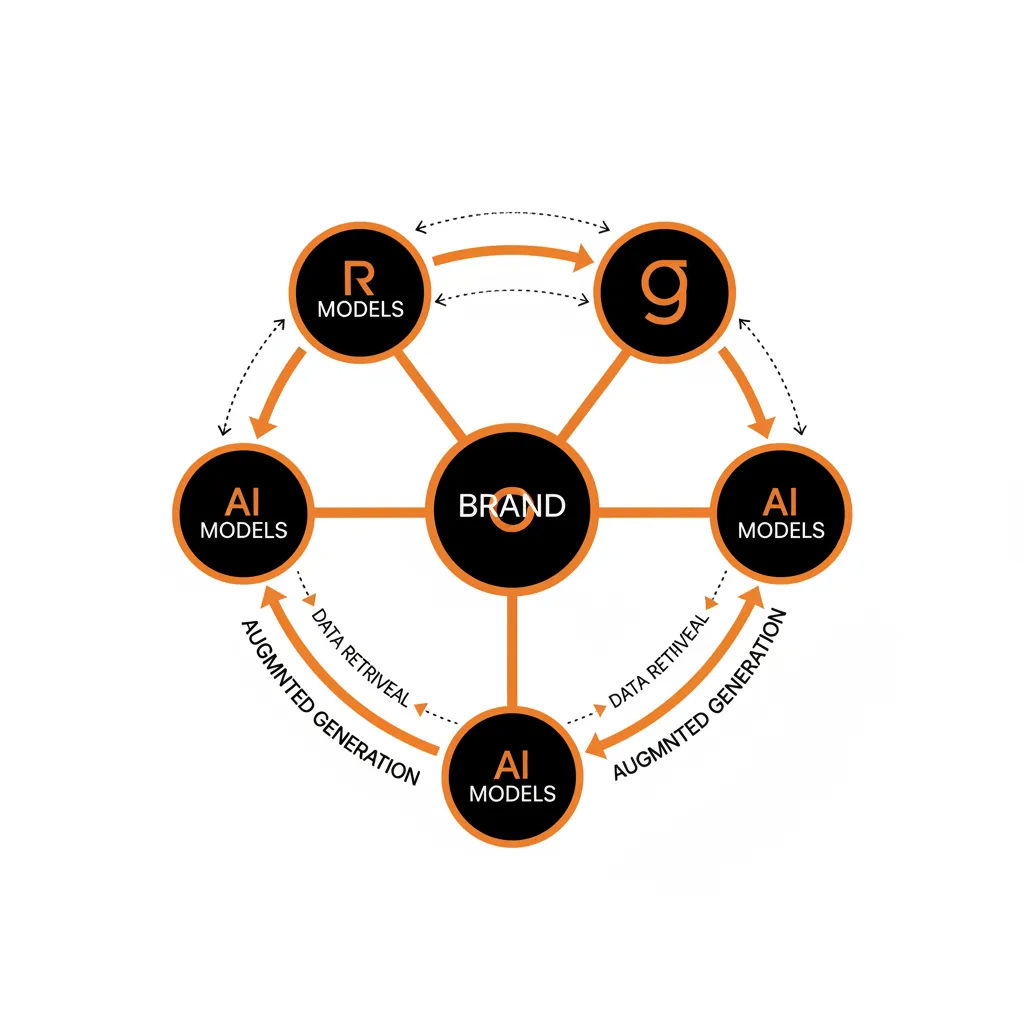
Central to this is the Large Language Model (LLM), a type of artificial intelligence trained on vast datasets to understand and generate human-like text. These models no longer just guess the next word; they use Retrieval-Augmented Generation (RAG), a framework that allows the AI to pull real-time, factual information from external sources before generating a response. This process ensures the AI stays grounded in current facts rather than relying solely on its static training data.
Your brand is viewed by these systems as an Entity, a distinct and well-defined object or concept that search engines can identify uniquely. Finally, the Knowledge Graph acts as the massive database of these entities and the relationships between them, serving as the "brain" that AI search engines consult to verify facts. If your brand exists in the graph, the AI can connect you to specific problems and solutions.
Understanding the RAG Pipeline for Brands
To optimize effectively, you should know how a RAG system actually processes your site. It generally follows a three-step cycle:
- Retrieval: The AI identifies a set of relevant documents from its index based on a user’s prompt.
- Augmentation: The system narrows down the specific "chunks" of text that provide the most factual utility.
- Generation: The LLM rewrites those chunks into a cohesive, conversational answer, citing the original sources.
If your content is not "chunkable" or lacks clear factual markers, the system will discard your page during the retrieval stage. You want to be the "golden chunk" that the AI selects to form the core of its answer.
Why the Future of AI Search Matters for Your Strategy
In 2025, we saw the definitive shift away from traditional blue links. According to a report by Gartner, traditional search engine volume was projected to drop significantly as users migrated to AI-powered overviews. By 2026, this is no longer a projection—it is the standard. Data from Search Engine Land indicates that over 70% of informational queries are now resolved within the AI interface without the user ever clicking through to a website. This "zero-click" reality means your visibility is now tied to citations within the AI response itself.
This matters because your old SEO tactics—like keyword stuffing or backlink schemes—don't work when an AI is the one reading your page. AI search engines value "information gain," a metric that measures how much new, unique value your content adds to the existing pool of knowledge. If you aren't providing unique insights, you are invisible. Furthermore, Pew Research notes that trust in AI-generated answers has reached a tipping point, meaning if the AI doesn't mention your brand, the consumer assumes you aren't a leader in your field.
| Search Factor | Old SEO Weight | AI Search Weight | Change Driver |
|---|---|---|---|
| Exact Match Keywords | High | Low | Semantic Understanding |
| Backlink Quantity | High | Medium | Authority Verification |
| Content Uniqueness | Medium | Very High | Information Gain Requirement |
| Schema Markup | Low | Very High | Entity Identification |
| Page Load Speed | Medium | Low | Background Crawling |
How to Prepare Your Brand for the Future of AI Search
1. Optimize for Entity Recognition
You need to move beyond keywords and start defining who you are to the machines. This involves using Schema Markup to explicitly tell search engines the relationship between your products, your founders, and your industry. By implementing organizational and person schema, you help the AI build a map of your brand. If the AI understands that "Brand X" is a "Software Provider" founded by "Expert Y," it is more likely to trust your content for technical queries. A common mistake here is using generic tags; you must be specific to stand out.
To boost entity recognition, follow these steps:
- Audit your "About Us" page: Ensure it lists key people, locations, and defined categories.
- Connect Social Profiles: Use the
sameAsproperty in your Schema to link your website to your LinkedIn, Wikipedia, and Twitter profiles. - Use Canonical Names: Avoid using different variations of your brand name. Stick to one legal entity name across all platforms.
2. Focus on Information Gain and Originality
The AI has already read the top 10 articles on your topic. To get cited in a RAG response, you must provide something the LLM hasn't seen before. This could be original research, a unique case study, or a controversial (but defended) expert opinion. AI models are trained to avoid repetitive fluff. If your blog post is just a rehash of existing content, the AI will ignore it. Pro tip: use first-person narratives and unique data points that cannot be found elsewhere to prove you are a primary source.
3. Build a Verifiable Trust Signal Network
In 2026, "Expertise, Authoritativeness, and Trustworthiness" (E-A-T) is checked by cross-referencing multiple sources. The AI search engine doesn't just look at your site; it looks at what OpenAI or Gemini sees on LinkedIn, Wikipedia, and industry trade journals. If your site says you are an expert but no other high-authority entity mentions you, the AI will flag your content as low-confidence. A common mistake is neglecting your off-site footprint. You should prioritize guest appearances on reputable podcasts and niche news sites to build a web of digital proof.
4. Structure Content for Direct Answer Delivery
Structure your content so it is easy for an AI to "chunk." This means using clear headings, concise summary paragraphs, and bulleted lists. When an AI searches for a specific answer, it looks for blocks of text that directly address the prompt. If your answer is buried in a 3,000-word narrative without clear signposts, the AI will skip it for a competitor who uses a "Quick Answer" section. Pro tip: Start your H2 sections with a direct answer to the question posed in the heading to increase your chances of being the primary citation.
Semantic Continuity and Contextual Linking
Inside your content, you must ensure that every paragraph leads logically to the next. AI models evaluate the "flow" of information to determine if a source is high-quality. Use internal links that use descriptive, entity-based anchor text rather than "click here." For example, instead of linking "read more," link "the evolution of B2B SaaS security protocols." This tells the AI exactly what the destination page is about, strengthening your site's internal knowledge graph.
Comparing Search Eras: 2024 vs. 2026
| Feature | Traditional SEO (2024) | Future of AI Search (2026) | Goal for Brands |
|---|---|---|---|
| Primary Goal | Rank #1 for Keywords | Become the "Featured Entity" | Authority & Citation |
| User Action | Click to Website | Interaction with AI Agent | Brand Mention & Trust |
| Content Style | Long-form, SEO-optimized | Modular, Fact-dense | Information Gain |
| Success Metric | Click-Through Rate (CTR) | Brand Sentiment & Mentions | Conversational Share of Voice |
| Technical Focus | Core Web Vitals | Schema & API Accessibility | Machine Readability |
Common Mistakes to Avoid in AI-First Marketing
- Over-reliance on AI-generated content: If you use AI to write your content without heavy human editing, you end up in a "feedback loop" where you provide zero new information, leading to a total loss in rankings.
- Neglecting Structured Data: Failing to use Schema.org standards makes you a "ghost" to AI agents that rely on structured formats to verify facts.
- Ignoring Brand Consistency: If your brand name or messaging varies wildly across the web, the AI cannot resolve your identity into a single, trusted entity.
- Focusing on Volume over Value: Producing 50 mediocre blog posts is now less effective than producing 5 high-authority whitepapers that the AI can use as foundational reference material.
- Gating Crucial Information: If your best insights are behind a PDF or a login, the AI crawlers can't see them, and you won't be cited in the answer.
Best Practices and Pro Tips
- Implement a "TL;DR" at the top: Give the AI the answer immediately in a dedicated summary block.
- Update your content frequently: AI models prioritize fresh data, especially for fast-moving industries like tech or finance.
- Use Natural Language: Write as if you are answering a client's question in person; this matches the conversational nature of modern search queries.
- Monitor your "Mention Share": Use tools to see how often ChatGPT or Perplexity cites your brand compared to competitors.
- Audit your digital footprint: Regularly check that your Google Search Central profile and other entity databases are accurate.
- Speak to your Audience Directly: Avoid corporate jargon that obscures your point. AI models interpret simple, direct language more accurately.
"The brands that win in 2026 aren't the ones with the most backlinks, but the ones that the AI models trust as the definitive source of truth for their specific niche."
Impact on ChatGPT, Gemini, Copilot, and Perplexity
Each AI search platform handles information differently, but they all share a common goal: accuracy. ChatGPT relies heavily on its internal training data but uses Bing for real-time verification; if your site is indexed well in Bing, you have a head start. Gemini is deeply integrated with the Google Knowledge Graph, making your Google Business Profile and Schema markup more critical than ever.
Copilot focuses on productivity, often pulling from LinkedIn and Microsoft-indexed technical documentation, while Perplexity functions as a real-time research engine that prioritizes academic-style citations. To succeed across all four, you must maintain a consistent "source of truth" across the web. If these platforms find conflicting information about your pricing or services, they will likely exclude you from the answer to avoid providing incorrect data. Understanding how AI search works is essential for tailoring your technical architecture to these specific models.
Case Study: B2B SaaS Authority Growth
We worked with a B2B SaaS client in the cybersecurity space who was struggling with declining traffic from traditional search. Their content was technically sound but buried in long, unstructured guides. They had plenty of high-quality information, but it was trapped in 5,000-word walls of text that search agents struggled to parse.
We pivoted their strategy to focus on AEO insights and entity-based optimization. We restructured their top 50 pages into "modular" formats, added extensive technical schema, and focused on gaining mentions in three high-authority industry publications. We also moved their key data points out of locked PDFs and onto live, indexable HTML tables.
Over a six-month period ending in early 2026, the results were significant:
- A 45% increase in brand mentions within Perplexity and ChatGPT search results.
- A 30% rise in "referral" traffic coming directly from AI assistant citations.
- A 12% improvement in conversion rate, as users arriving from AI searches were better qualified and had their primary questions already answered.
This composite example shows that by focusing on becoming a "cited source" rather than just a "ranked page," you can recapture the audience lost to traditional search engines. You can learn more about these specific AI search ranking factors to replicate this success.
Essential Tools and Resources
- Semrush / Ahrefs: Still vital for tracking traditional search trends and identifying which keywords are triggering AI overviews. (Paid)
- Schema.org Validator: The official, free tool to ensure your structured data is error-free and readable by machines. (Free)
- Perplexity Pages: Use this to see how an AI synthesizes your brand's information in real-time. (Free/Paid)
- Google Search Console: Essential for monitoring how the "Googlebot" and "Vertex AI" crawlers interact with your site. (Free)
- Hugging Face: For more technical teams, use this to test how different open-source models interpret your content. (Free)
- BrightEdge: Useful for tracking Generative Search Experience (GSE) trends and share of voice. (Paid)
How to Measure Success in the AI Era
Measuring success in 2026 requires looking beyond simple traffic numbers. You need to track Citation Share, which is the percentage of time an AI search engine mentions your brand when asked about your category. If a user asks, "Who are the best B2B RevOps agencies?" and you aren't in the top three responses, your Citation Share is failing.
- Metric 1: AI Referral Traffic (Found in your analytics under specific AI referrers).
- Metric 2: Brand Sentiment Score (How the AI describes your brand to users).
- Metric 3: Entity Maturity (How well-connected your brand is in the knowledge graph).
- Metric 4: Conversational Share of Voice (SOV) across top LLMs.
Short Checklist for your next audit:
- [ ] Is my main value proposition visible in the first 100 words?
- [ ] Does every page have at least two types of Schema markup?
- [ ] Have I removed all "fluff" that doesn't add new information?
- [ ] Is my brand information consistent across LinkedIn, Crunchbase, and my website?
- [ ] Are my images optimized with descriptive, entity-based alt-text?
Testing and Quality Assurance for AI Visibility
Before you roll out a site-wide Answer Engine Optimization strategy, you must test your content against the models. You cannot assume an AI will read your page exactly as a human does. You need a rigorous QA process to ensure your "information gain" is actually recognized by the RAG pipelines.
First, use a "Prompt Injection Test." Copy a segment of your new content into ChatGPT or Claude and ask the AI to summarize the key unique facts. If the AI misses your most important data points, your formatting is too complex or your writing is too vague. You should repeat this for every major service page before it goes live.
Second, perform a "Consistency Check." Use a local LLM or an API-based tool to query your brand across different platforms. Ask, "What does [Brand Name] do?" If the answer varies significantly between Gemini and ChatGPT, you have a digital footprint problem. You must harmonize your messaging on third-party sites like G2, Capterra, and LinkedIn before the AI can settle on a definitive brand identity for you.
Third, run your Schema through the Schema.org validator one last time. A single misplaced comma in your JSON-LD can lead to your entire entity profile being ignored by the crawler. In the future of AI search, technical perfection is the baseline for entry.
Honesty and Trade-offs: When AI Search Strategy Fails
We must be honest: Answer Engine Optimization is not a silver bullet for every business. There are clear trade-offs and scenarios where these tactics will not yield the results you expect. You should understand these limitations before shifting your entire marketing budget.
One major trade-off is the loss of top-of-funnel traffic volume. When an AI search engine answers a user's question directly, you might lose 40% or more of your traditional "informational" clicks. You are trading thousands of casual visitors for a handful of highly-qualified leads who saw your name cited as an authority. If your business model relies on high-volume ad impressions, the AI search era will be incredibly painful for your bottom line.
Furthermore, this strategy fails if your brand lacks a foundation of real-world expertise. You cannot "optimize" your way into authority if you haven't actually done the work. AI models are becoming increasingly proficient at spotting "SEO-first" content that lacks depth. If you try to fake authority by rewriting existing articles with a few new adjectives, the AI will eventually flag you as a low-value source.
Finally, the speed of model updates is a constant risk. A strategy that works for GPT-4 might need adjustment for GPT-5. You are essentially building on rented land. If a major provider like Google or OpenAI changes how they cite sources, your referral traffic could drop overnight. This is why we always recommend a diversified approach that includes direct-to-consumer channels like email and community-building alongside AEO.
The Future of AI Search Beyond 2026
Looking further ahead, we expect search to become even more "proactive." Instead of you searching for a solution, your personal AI agent will anticipate your needs based on your calendar and preferences. It will "search" the web on your behalf and present you with a single, curated recommendation. This agentic search will act as a gatekeeper, filtering out anything that doesn't meet a high threshold of trust.
For businesses, this means the "winner takes all" dynamic will intensify. Being the second or third best answer won't be enough when the AI agent only presents the top choice. The integration of the "Internet of Things" will also mean your brand needs to be discoverable via voice search in cars, homes, and wearable devices. The focus will shift from "searchable content" to "accessible intelligence." You aren't just writing for a screen anymore; you are writing for an ecosystem of interconnected devices.
Conclusion
The future of AI search is no longer a distant concept; it is the current reality of the digital market. By shifting your focus from traditional keyword ranking to Answer Engine Optimization, you ensure your brand remains a visible and trusted entity. You must prioritize structured data, original insights, and a consistent digital footprint to satisfy the sophisticated requirements of modern LLMs and agentic search systems.
Staying ahead of these changes requires a proactive approach to your technical and content strategy. If you are unsure where your brand stands in this new environment, we invite you to get a free AEO audit to identify your gaps. To fully transform your digital presence for the age of intelligence, explore our comprehensive **AEO and AI search services** and let us help you dominate the discovery engines of tomorrow. Give us a call at our contact page to start your journey. For more updates, visit our blog for the latest industry trends.
Ready to lead your industry? [View our AEO services today](/services).
Explore our [latest AEO insights](/aeo-insights) to stay ahead of the competition.
Frequently asked questions
What is the future of AI search?+
The future of AI search is defined by a shift from indexing links to synthesizing answers. AI agents now use Retrieval-Augmented Generation (RAG) to pull real-time data from trusted sources, providing direct solutions to user queries. For businesses, this means visibility is no longer about ranking on page one, but about being the cited authority within the AI's generated response.
How does AI search differ from traditional SEO?+
SEO focus on ranking websites in search engine results pages (SERPs), while AEO (Answer Engine Optimization) focuses on optimizing content to be the definitive answer provided by AI models. In 2026, SEO is the foundation, but AEO is the competitive layer that ensures your brand is mentioned by ChatGPT, Gemini, and other LLMs that users now use as their primary search interface.
What is 'information gain' in AI search?+
Information gain is a metric used by AI search engines to determine if a piece of content adds new, unique value to the existing knowledge pool. Unlike traditional SEO, which often rewards long-form content, AI search prioritizes original data, unique perspectives, and fresh insights that the model hasn't already encountered in its training data or other search results.
How can I improve my brand's visibility in AI search results?+
To rank in AI search, you must prioritize 'entity-based' optimization. This means using structured data (Schema markup) to define your brand, focusing on high-quality citations from other trusted entities, and creating modular content that AI models can easily parse. Consistently providing factual, expert-level information across multiple platforms helps build the trust signals that LLMs require for citations.
Do backlinks still matter for AI search in 2026?+
Yes, backlinks still matter, but their role has evolved. Instead of just passing 'link equity,' backlinks now serve as trust signals and verification sources for AI models. When an LLM performs a RAG search, it looks for consensus among high-authority sites. If reputable industry publications link to your content, it confirms to the AI that your information is credible and worth citing.
What metrics should I track for AI search success?+
The most important metrics for AI search success include 'Citation Share' (how often your brand is mentioned by AI assistants), AI Referral Traffic (clicks coming from AI platforms), and 'Sentiment Alignment' (how accurately and positively the AI describes your services). Tracking these requires specialized AEO tools that monitor LLM outputs rather than traditional keyword ranking trackers.
Sources & further reading
Soft next step
Want to see where AI answers mention you — and where they don't?
We run a free AEO audit across ChatGPT, Gemini, Copilot and Perplexity, then hand you the fixes in priority order. Start your AEO strategy today.