Answer Engine Optimization (AEO) for SMEs: Winning the AI Retrieval Race
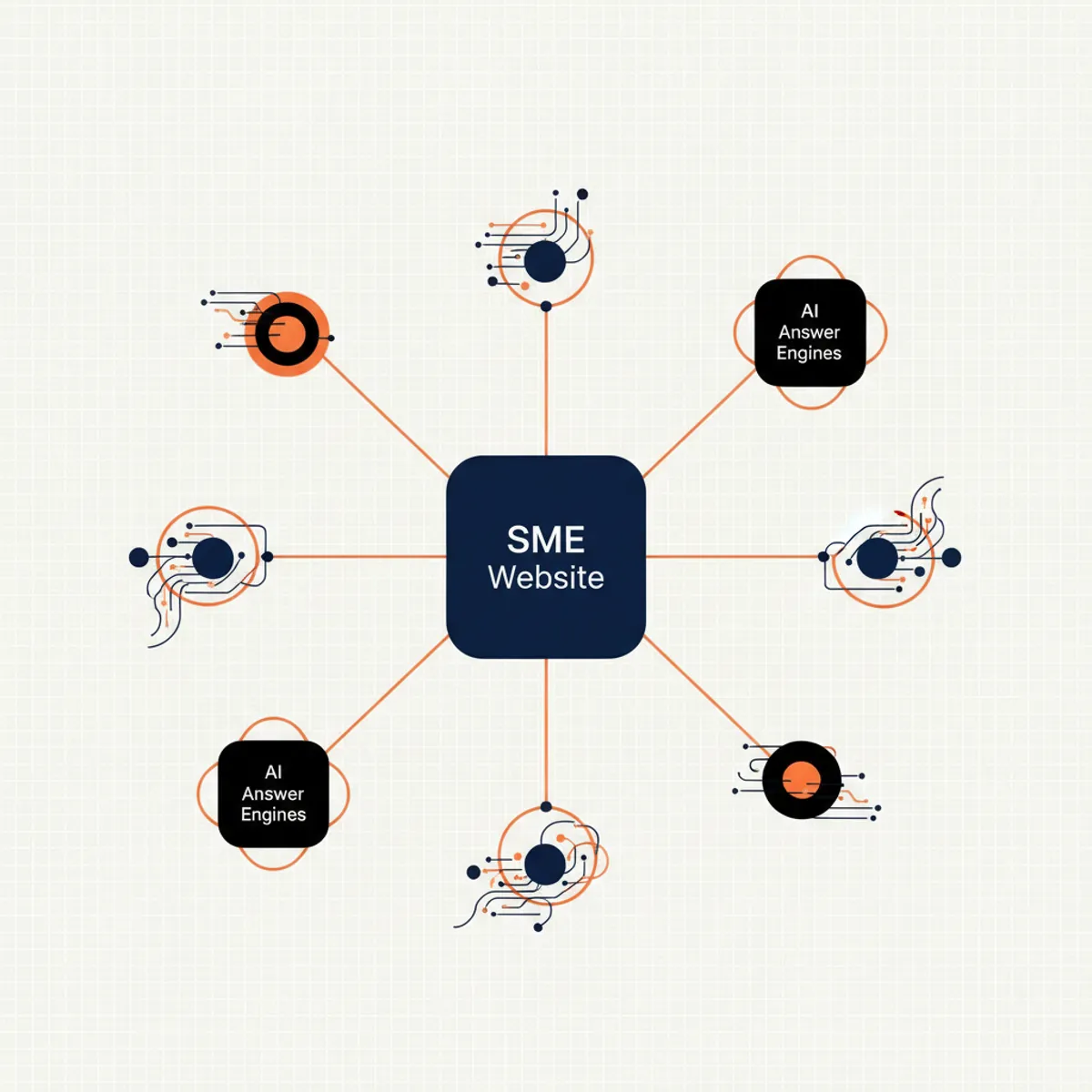
SMEs must transition from page-based SEO to entity-based AEO to survive the shift toward generative search.
Quick answer
Answer Engine Optimization (AEO) for SMEs is the strategic process of structuring business data and content to be easily synthesized by LLM-based engines like ChatGPT, Perplexity, and Google AI Overviews. By prioritizing technical schema and authoritative direct answers, SMEs can capture high-intent traffic without competing for traditional high-volume keywords against massive enterprise budgets.
Answer Engine Optimization (AEO) for SMEs is the strategic process of structuring business data and content to be easily synthesized by LLM-based engines like ChatGPT, Perplexity, and Google AI Overviews. By prioritizing technical schema and authoritative direct answers, SMEs can capture high-intent traffic without competing for traditional high-volume keywords against massive enterprise budgets.
The Evolution of Search: Why SMEs Need AEO in 2026
For two decades, small and medium-sized enterprises (SMEs) have played by the rules of the ten blue links. If you optimized for keywords and earned enough backlinks, you could theoretically rank. However, the landscape has fundamentally shifted. Users are increasingly turning to Large Language Model (LLM) interfaces to get immediate answers rather than navigating through a list of websites. This shift necessitates a transition from SEO to AEO.
In 2026, the search experience is conversational. Users don't search for "plumber in Austin"; they ask their AI assistant, "Who is a reliable plumber in Austin that can fix a tankless water heater today?" The AI doesn't just show a list; it recommends a specific business based on its ability to parse and verify that business’s specific capabilities. For an SME, being the source that the AI cites is the new gold standard of digital visibility.
The Rise of Generative Retrieval
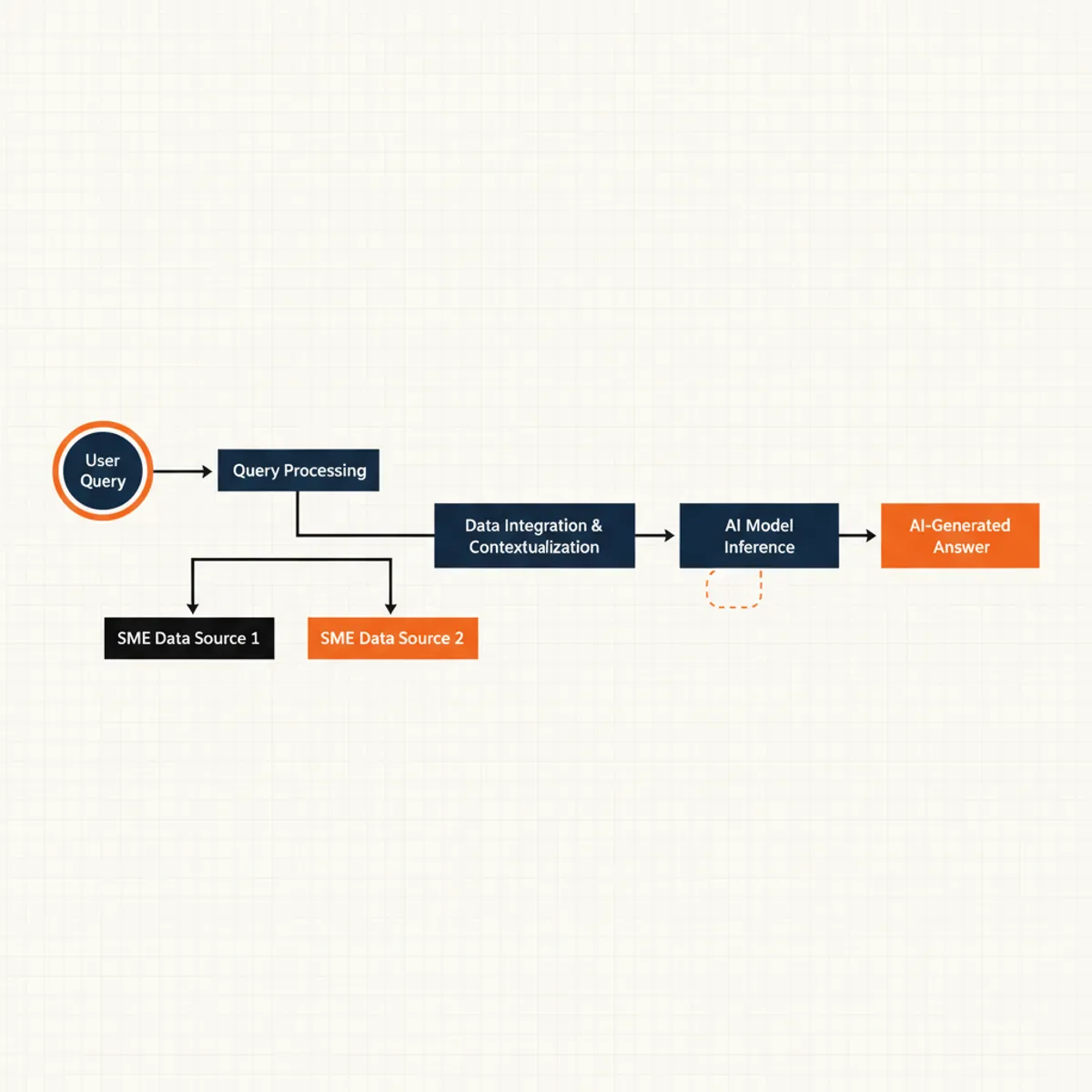
Generative retrieval differs from traditional indexing. Instead of a crawler simply noting that a word exists on a page, modern engines use Retrieval-Augmented Generation (RAG) to pull specific facts from trusted sources to build a response. If your content isn't structured for retrieval, you effectively don't exist to the AI. This process involves the engine identifying relevant "chunks" of information across the web, embedding them into a high-dimensional vector space, and selecting the most semantically relevant pieces to synthesize a final answer. For an SME, this means your content must be modular, factual, and extremely easy for an LLM to parse without losing context.
Moving Beyond Clicks to Citations
In the AEO era, the metric of success shifts. While clicks remain important, appearing in the 'Sources' list of a Perplexity answer or a Google AI Overview is the primary goal. These citations build brand authority that transcends a single session, training the model that your SME is a definitive authority on a specific topic. When an engine cites you, it isn't just a link; it is a validation of your data's accuracy. Over time, frequent citations lead to "LLM brand preference," where the model becomes biased toward your information because it has repeatedly found your data to be reliable and structured.
Understanding the Core Components of AEO
AEO isn't a replacement for SEO; it is an evolution. While traditional SEO focuses on domain authority and keyword density, AEO prioritizes entity relationships and factual density. To understand how to optimize, we must first look at what answer engines look for.
Entity-Based Search
AI engines don't see words; they see entities—distinct, identifiable things or concepts. Your SME is an entity. Your products are entities. The problems you solve are entities. AEO involves defining these relationships clearly so that the AI understands exactly what your business does, where it operates, and why it is trustworthy. You can learn more about this in our guide on what is answer engine optimization aeo. By connecting your business entity to other established entities—such as specific geographic locations, professional organizations, or well-known software integrations—you provide the "contextual glue" that AI needs to recommend you.
Factual Accuracy and Credibility
Large Language Models are prone to hallucination. To mitigate this, they prioritize sources that provide verifiable, consistent information. For an SME, this means ensuring that your NAPs (Name, Address, Phone) are identical across the web and that your technical advice is grounded in industry standards. Consistency across platforms is the foundation of digital trust. If your website claims you offer 24/7 emergency support but your Google Business Profile says you close at 5 PM, the AI perceives a factual conflict and may demote your visibility to avoid providing the user with incorrect information.
AEO vs. SEO: A Comparison for Small Business Owners
Understanding the nuances between these two strategies is vital for resource allocation. Small businesses often have limited budgets, making it imperative to know where each dollar goes.
| Feature | Traditional SEO | Answer Engine Optimization (AEO) |
|---|---|---|
| Primary Goal | High ranking in Search Engine Results Pages (SERPs) | Being the definitive answer in AI responses |
| Success Metric | Click-Through Rate (CTR) and Organic Traffic | Citations, brand mentions, and direct answers |
| Content Focus | Long-form, keyword-optimized articles | Fragmented, structured, and factual data blocks |
| Technical Priority | Site speed, mobile-friendliness, and crawlability | Schema markup, JSON-LD, and API accessibility |
| User Intent | Browsing and information gathering | Specific problem-solving and task completion |
Advanced Tactics: Beyond the Basics of Retrieval
Once the foundation is laid, SMEs must employ sophisticated tactics to maintain their lead in AI Overviews. This involves shifting from "writing for humans" to "structuring for machines that serve humans."
Creating "Knowledge Fragments"
Instead of massive, monolithic guides, break your content into "knowledge fragments." These are self-contained sections of approximately 200–300 words that provide a complete answer to a sub-topic. Use clear H3 headers that mirror natural language questions. When an LLM like GPT-4o scans your page, it shouldn't have to read the whole article to find the answer to a specific sub-query; it should be able to grab a single fragment that contains the question, the answer, and the supporting evidence in one neat package.
Semantic Triangulation
AI engines verify facts by "triangulating" information from multiple sources. For an SME, this means your technical data should be mirrored on high-authority third-party sites. If you are a specialized engineering firm, ensuring your white papers are cited on platforms like ResearchGate or industry-specific wikis helps the AI confirm that the information on your site is objectively true. The goal is to create a digital footprint where every node confirms the same set of facts about your business expertise.
Optimization for Voice and Multi-Modal Search
AEO is inherently tied to how people speak. In 2026, many queries are initiated via voice or even through images (e.g., a user taking a photo of a broken part). SMEs should optimize image alt-text not just with keywords, but with descriptive, technical language that explains function. Similarly, your text should mirror the cadence of spoken language. Use "filler-free" prose. Instead of "We are a company that likes to help people with their taxes," use "We provide tax preparation and IRS audit defense for small businesses in the Pacific Northwest."
Step-by-Step AEO Strategy for SMEs
Implementing AEO does not require a massive overhaul of your digital presence, but it does require a shift in how you publish information. Follow this five-step framework to begin.
Step 1: Identify Long-Tail Conversational Queries
Analyze how your customers actually speak. Move away from generic head terms and toward specific, multi-word questions. Use tools like 'AlsoAsked' or analyze your own customer support tickets to find the exact phrasing people use when they have a problem.
- Why it works: AI engines are designed to answer questions. Aligning your content with the question format makes it easier for the AI to map your content to a query.
- Common Mistake: Trying to rank for broad terms like "accounting software" instead of "how to automate payroll for a 10-person agency."
- Pro Tip: Use H2 and H3 tags as the questions themselves, with the immediate following paragraph providing the direct answer. This follows the "Featured Snippet" logic but applies it to the context window of an LLM.
Step 2: Implement Advanced Schema Markup
Schema is the language of AI. For an SME, you should go beyond basic 'Article' schema. Use 'LocalBusiness', 'Product', 'FAQPage', and 'Service' schema to provide a machine-readable layer to your site. Explore our detailed breakdown of schema markup for aeo for technical implementation details.
- Why it works: It removes the guesswork for the AI. You are explicitly telling the engine what your data means.
- Common Mistake: Using outdated or broken schema that leads to validation errors in Google Search Console.
- Pro Tip: Use the 'sameAs' property in your schema to link your website entity to your social profiles and Wikipedia entries (if applicable) to reinforce identity. Link to your Crunchbase profile or your local Chamber of Commerce listing to prove you are a verified entity.
Step 3: Develop a "Direct Answer" Content Architecture
Modern content should follow an 'inverted pyramid' for each section. Start with a 40-60 word direct answer to a specific question, then follow with supporting data, charts, and nuanced explanation.
- Why it works: LLMs often look for a concise summary to pull into their response buffer. If you provide that summary, you are more likely to be quoted.
- Common Mistake: Hiding the answer behind 500 words of introductory fluff.
- Pro Tip: Create a dedicated FAQ section that addresses common industry myths; this positions you as a critical thinker and a source of unique truth. Use the
Speakableschema on these sections to ensure they are accessible for voice-activated answer engines.
Step 4: Build Digital Authority Through E-E-A-T
Experience, Expertise, Authoritativeness, and Trustworthiness (E-E-A-T) are more important than ever. For an SME, this means showcasing the real people behind the business. Detailed author bios, links to professional certifications, and genuine case studies are essential.
- Why it works: AI models are trained to avoid low-quality, AI-generated 'chaff.' Highlighting human expertise proves your content is worth retrieving.
- Common Mistake: Using generic 'Admin' accounts for blog posts.
- Pro Tip: Link to third-party mentions of your brand in your schema to show the AI that other entities trust you. If your founder was interviewed on a podcast, link to that episode within their author bio to bridge the gap between human experience and digital authority.
Step 5: Optimize for Multi-Platform Retrieval
Your content doesn't just live on your site. It lives on LinkedIn, Google Business Profile, and industry-specific directories. Ensure your brand message and core facts are consistent across all these nodes.
- Why it works: AI engines cross-reference data. If your site says one thing and your Google Business Profile says another, the engine will likely discard both as unreliable.
- Common Mistake: Ignoring third-party review sites which act as major data sources for AI.
- Pro Tip: Regularly update your Google Business Profile with 'Updates' that answer specific customer questions. These updates are indexed by Google's AI Overview and can serve as a direct source for localized queries.
Addressing SME Objections to AEO (FAQs in Prose)
As small business owners transition to this new paradigm, several valid concerns frequently arise regarding the ROI and longevity of AEO.
One of the most common questions is, "If the AI provides the answer directly, why will anyone visit my website?" This is the "Zero-Click" fear. While it is true that informational queries may result in fewer clicks, the clicks you do get are significantly more qualified. If a user reads an AI-generated answer that cites your SME as the source for a complex problem, and then they click through to your site, they are no longer just "browsing." They are entering your ecosystem with a high level of trust, having already been pre-screened by the AI. You are trading volume for intent.
Another frequent concern involves the perceived cost of technical implementation. SMEs often worry they need a team of data scientists to handle schema and LLM optimization. In reality, AEO is more about discipline than high-cost technology. Most modern CMS platforms have plugins that handle advanced JSON-LD. The real "cost" is the time spent auditing your content for factual density and ensuring your entity information is consistent across the web. It is a strategic pivot, not a financial barrier.
Finally, owners often ask, "Is AEO just a fad that will be replaced by the next algorithm update?" Unlike traditional SEO hacks, AEO is built on the fundamental way LLMs process human language and factual data. As long as we use AI to retrieve information, the need for clearly structured, authoritative data will exist. By optimizing for AEO, you aren't chasing an algorithm; you are aligning your business with the way modern intelligence—both human and artificial—consumes information.
Common Pitfalls SMEs Must Avoid
Many small businesses approach AEO with an SEO mindset, leading to wasted effort. Avoid these traps:
- Over-Optimization: Avoid stuffing keywords into your answers. AI models are sophisticated enough to recognize natural language and will penalize content that feels robotic.
- Neglecting Brand Consistency: If your brand is mentioned as "XYZ Corp" in one place and "XYZ Consulting" in another, you dilute your entity strength.
- Ignoring Technical Errors: Broken links and slow load times might be tolerated by users, but they signal poor quality to retrieval engines.
- Failure to Update: Facts change. If your content contains outdated pricing or methods, AI engines will eventually flag your site as an unreliable source.
- Using Generic AI Content: If you use basic AI to generate your blog posts without significant human editing, you are likely producing content the engines have already seen. To be cited, you must provide a "delta"—unique information or a specific perspective that isn't available in the baseline training data.
The biggest mistake SMEs make in the age of AI is trying to sound like a corporation. AI engines value unique, specific expertise that only a specialized business can provide. Authenticity is a technical advantage. — Amir, Founder of EvronStudio
Case Study: Local HVAC Company Wins with AEO
A mid-sized HVAC company in Colorado noticed a 30% drop in traditional search traffic as Google began rolling out AI Overviews. Their strategy focused on broad terms like "AC repair."
We shifted their strategy to AEO by creating a series of hyper-specific guides answering questions like, "Why does my heat pump make a clicking sound in sub-zero temperatures?" We implemented deep technical schema for their service areas and technicians. We also focused on capturing "long-tail" problems that require specific diagnostic steps, which AI engines love to scrape for step-by-step instructions.
The Results:
- AI Citations: The company appeared in the 'Sources' section for 45% of local HVAC-related queries in their county within four months.
- Conversion Rate: While total traffic decreased by 10%, the leads generated were 50% more likely to book a service call because they had already received the technical answer they needed from the AI.
- Revenue: A 22% increase in high-margin repair services within six months.
- Cost Per Lead: Reduced by 18% as the reliance on aggressive PPC for "emergency" terms decreased due to high organic AI visibility.
This demonstrates that for SMEs, AEO isn't just about traffic; it's about the right traffic. You can read more about how this differs from traditional methods in our article on aeo-vs-geo-vs-seo.
Essential AEO Tools for SMEs
You don't need an enterprise budget to master AEO. Here are the tools that matter:
- Google Search Console: Still the best way to see how your site is being indexed and where AI engines might be finding your data. Pay close attention to the "Search Appearances" tab.
- Schema.org / JSON-LD Generators: Essential for creating the code that AI engines use to understand your business. Tools like Merkle or technical SEO plugins for WordPress are sufficient for most SMEs.
- Perplexity AI: Use it to search for your own business and see how the AI describes you. If it's wrong, your AEO needs work. Treat Perplexity as your "AI Mirror."
- Claude and ChatGPT: Treat these as testing grounds. Prompt them with industry questions to see if your brand is being cited as an authority. If the model says "I don't know who the best [Your Service] is in [Your City]," you have an entity problem.
- Semrush/Ahrefs: Still useful for monitoring backlink health, which remains a proxy for authority in AI retrieval. Use them to track "Position Zero" and AI Overview inclusions.
- Diffbot: An advanced tool that shows you how an AI "sees" your page as a collection of data rather than just text and images.
Measuring Success in the AEO Era
How do you know if your AEO strategy is working? You must look at new metrics.
- Impression Share in AI Overviews: Monitor how often your brand appears in generative responses for target queries. This can be tracked manually or through emerging AEO tracking platforms.
- Referral Traffic from AI Engines: Track traffic coming from
openai.com,perplexity.ai, and other LLM platforms in your analytics. Look for the "Referral" medium in Google Analytics 4. - Entity Health: Use tools to see if your business is correctly identified as a distinct entity in the Google Knowledge Graph. Check our guide on knowledge-graph-and-aeo for more info.
- Sentiment and Accuracy: When an AI mentions your brand, is the information accurate? Improving the accuracy of AI mentions is a key AEO win. If the AI is giving out the wrong phone number, your first AEO priority is correcting the digital record.
- Direct-to-Answer Conversion: Measure how many users engage with your site after seeing your data in an AI response. This is often tracked via "branded search" increases, as users see your name in an AI answer and then search for you specifically.
The Future of SME Visibility: Staying Ahead of the Curve
The trajectory of search is clear: we are moving toward a world of frictionless answers. SMEs that continue to rely solely on traditional SEO will find themselves invisible to a generation of users who expect AI to do the heavy lifting of information gathering.
As we look toward late 2026 and 2027, AEO will likely expand into "Agentic Optimization." This is the process of ensuring that autonomous AI agents (like those powered by AutoGPT or specialized OpenAI agents) can not only find your information but also perform actions—like booking an appointment or placing an order—on behalf of the user. For an SME, this means having clean API endpoints and structured booking systems that an AI can interact with directly.
AEO is not a one-time task; it is a fundamental shift in how you present your business to the world. By embracing structured data, factual authority, and conversational content today, you position your SME to be the primary source for the AI-driven consumers of tomorrow. You are essentially building a "digital twin" of your business expertise that can live and breathe inside any LLM.
If you're ready to see how your business stacks up in the world of generative search, we can help. Our team specializes in helping small and medium businesses bridge the gap between traditional search and AI retrieval. We focus on the technical nuances that allow boutique brands to punch above their weight class.
Stop fighting for blue links and start winning the answer. Book a free aeo audit or contact us to learn how we can modernize your digital presence for the age of AI.
Frequently asked questions
How does AEO differ from SEO for small businesses?+
Traditional SEO focuses on driving clicks to a website through keyword-optimized pages. AEO focuses on providing the 'best' answer that an AI model can summarize directly. While SEO requires high domain authority, AEO rewards clarity, structured data, and being the primary source of truth for specific, niche queries.
Can an SME compete with big brands in AI search?+
Yes. AI engines prioritize the most relevant and structured answer, not just the highest ad spend or backlink count. By focusing on hyper-specific niche expertise and using advanced schema markup, an SME can become the definitive source for a query that a generalized big brand ignores.
Which AI engines should SMEs prioritize?+
Currently, SMEs should optimize for Google AI Overviews (formerly SGE), ChatGPT (via SearchGPT features), Perplexity AI, and Claude. Each has different retrieval patterns, but all rely heavily on structured content, factual accuracy, and clear entity relationships defined in your site's code.
Does AEO reduce website traffic?+
AEO may reduce 'top-of-funnel' informational clicks, as AI provides the answer directly. However, the traffic that does click through is typically much higher intent. It moves the needle from vanity metrics to conversion-ready users who need your specific expertise after receiving an initial AI-generated answer.
What is the role of Schema markup in AEO?+
Schema markup acts as the translator between your human-readable content and an AI's database. It explicitly defines entities, prices, locations, and relationships. For SMEs, robust schema is the most effective way to ensure an AI engine correctly attributes information to your brand.
Is AEO expensive for a small business to implement?+
AEO is more about strategy and technical precision than brute-force content volume. While it requires an initial investment in technical setup and high-quality writing, it is often more cost-effective than traditional SEO because it targets the precise way modern users interact with LLMs.
Sources & further reading
Soft next step
Want to see where AI answers mention you — and where they don't?
We run a free AEO audit across ChatGPT, Gemini, Copilot and Perplexity, then hand you the fixes in priority order. Start your AEO strategy today.