AEO for SaaS: The Ultimate Playbook for AI-Driven Growth in 2026

Winning the AI-first search market requires a strategic approach to SaaS AEO.
Quick answer
AEO for SaaS is the strategic practice of optimizing software-related content to be the primary source for AI agents and answer engines. By structuring data through schema markup and direct, authoritative answers, SaaS brands ensure ChatGPT, Perplexity, and Gemini recommend their software as the definitive solution for user queries.
AEO for SaaS is the process of optimizing your software brand’s digital footprint so AI models and answer engines prioritize your content when users ask technical or commercial questions. In 2026, capturing the "zero-click" answer in an AI summary is the primary way to drive high-intent trial signups. By focusing on entity-based content and structured data, you move beyond simple keyword ranking to becoming the trusted source for the algorithms that power modern search.
What is AEO for SaaS and how does it work?
To master AEO for SaaS, you must understand how AI models process information. Unlike traditional search, which looks for keywords, answer engines look for Entities, which are unique, well-defined things or concepts in a knowledge graph. For a software company, your SaaS Platform is an entity, as are your features, your founders, and the specific problems you solve.
We also focus on the Knowledge Graph, a programmatic database that stores relationships between entities. When a user asks an AI for the "best project management tool for remote teams," the AI queries its graph to find tools with high Trust Signals. These signals are data points like verified reviews, mentions in authoritative tech publications, and structured Schema Markup on your website. By defining these connections clearly, you make it easier for AI agents to categorize your software as a leader in its niche.
The Role of LLM Training Sets and RAG
Large Language Models (LLMs) like GPT-4o or Claude 3.5 Sonnet rely on two types of data. First, they use the massive "frozen" training set they were built on. Second, they use Retrieval-Augmented Generation (RAG) to browse the live web for current facts. For a SaaS company, this means you need a two-pronged approach. You must ensure your brand was prominent during the initial training phase through high-authority PR and Wikipedia-style citations. Simultaneously, you must optimize your current site so RAG-enabled bots can find and verify your latest pricing or feature updates in milliseconds. If the bot finds conflicting information between a 2022 blog post and your 2026 pricing page, it will likely exclude you to avoid providing an incorrect answer.
Why AEO matters for SaaS growth in 2026
The shift from 2025 to 2026 has been dramatic. According to Gartner, search engine volume for traditional queries is expected to drop significantly as users migrate to AI-native interfaces. For SaaS companies, this means your SEO strategy must evolve. Traditional organic traffic is no longer the only metric; Brand Visibility in AI Responses is the new gold standard.
Data from BrightEdge indicates that over 40% of B2B software research now begins within an AI chat interface rather than a standard search bar. If your product isn't part of the LLM’s training data or its real-time search results, you effectively don't exist to a huge segment of your market. Furthermore, Search Engine Land reported in late 2025 that AI-generated overviews now trigger for 80% of "how-to" and "best of" SaaS queries. Adapting to this ensures you remain competitive in an era where the AI, not the user, often decides which links are worth clicking.
We are seeing a trend where the "middleman" click is disappearing. In the past, a user would search for "how to automate invoice processing," click your blog, read 1,000 words, and then maybe sign up. Today, the AI reads your blog for them, summarizes your three-step process, and mentions your software as the tool that handles step two. If you aren't the source of that summary, your competitor will be.
A step-by-step guide to SaaS Answer Engine Optimization
Implementing an effective strategy requires moving from "writing for humans" to "structuring for machines and humans." Here is our proven framework for 2026.
1. Identify your core brand entities
Start by defining exactly what your software is and who it is for in plain, unambiguous language. AI models struggle with clever marketing jargon. What you call a "Synergy Suite," the AI needs to recognize as "Cloud-Based CRM Software." List your core features, your target industries, and your primary competitors.
Why it works: It builds a clear identity in the AI's internal knowledge base, making it easier to trigger your brand for relevant category searches. Common mistake: Using creative metaphors that obscure your actual product category. Pro tip: Use the "About" and "Mentions" properties in your Schema.org markup to link your brand to established industry concepts.
2. Build a comprehensive FAQ library
Analyze the specific questions your sales and support teams hear every day. Transform these into dedicated pages or sections. Use a clear Question-and-Answer format where the answer is provided in the first 50 words. This makes your content "snackable" for AI scrapers.
Why it works: AI models prioritize content that directly answers a user’s prompt with minimal fluff. Common mistake: Burying the answer at the bottom of a 2,000-word blog post. Pro tip: Monitor "People Also Ask" and Perplexity’s "Related" queries to find the exact phrasing users use in 2026.
3. Implement advanced technical schema
Standard SEO uses basic tags, but AEO for SaaS requires SoftwareApplication and Organization schema. You need to tell the search engine your price, your operating system requirements, and your aggregate user ratings in a language it can parse instantly.
Why it works: It provides "structured certainty," reducing the AI's hallucination risk and increasing the chance it will cite you as a factual source. Common mistake: Having outdated or conflicting schema data across different landing pages. Pro tip: Include isRelatedTo and isSimilarTo properties to help AI understand your place in the competitive ecosystem.
4. Secure third-party citations and mentions
AI models gain confidence in your software when other authoritative sites talk about you. This includes review sites (G2, Capterra), news outlets, and niche industry blogs. This is the 2026 version of backlink building, but focused on sentiment and context.
Why it works: Answer engines use "Consensus Algorithms" to verify facts. If ten sites say you are the best for "security," the AI will repeat that. Common mistake: Focusing on low-quality link farms that don't provide contextual relevance. Pro tip: Reach out to industry analysts to ensure your brand is mentioned in the latest sector reports and whitepapers.
5. Optimize for conversational intent
Review your long-form content and ensure it matches how people actually speak to AI. Use natural language, second-person perspectives ("you"), and clear instructional steps. Move away from rigid, robotic prose.
Why it works: Modern LLMs are trained on conversation. Content that mirrors this style is more likely to be selected for verbal or chat-based answers. Common mistake: Over-optimizing for specific keyword strings while ignoring the flow of natural speech. Pro tip: Read your content aloud. If it sounds like a manual and not a conversation, rewrite it.
6. Curate a "Data Source" Hub
Answer engines prefer sources that aggregate high-value data points. For SaaS, this means building a hub of original industry statistics or benchmarks. If a user asks an AI, "What is the average churn rate for B2B SaaS in 2026?" and your site provides a clear, cited answer, you become the definitive source for that session.
Detailed Procedure for Data Hubs:
- Identify a Metric: Choose a metric your software tracks (e.g., "time to resolve tickets").
- Anonymize Data: Pull a large sample of anonymized data from your platform.
- Format for AI: Create a dedicated page with a table of these findings.
- Add Dataset Schema: Use specific
Datasetmarkup so Google and OpenAI recognize the page as a primary source. - Refresh Quarterly: Update the numbers every 90 days to stay relevant to live-search bots.
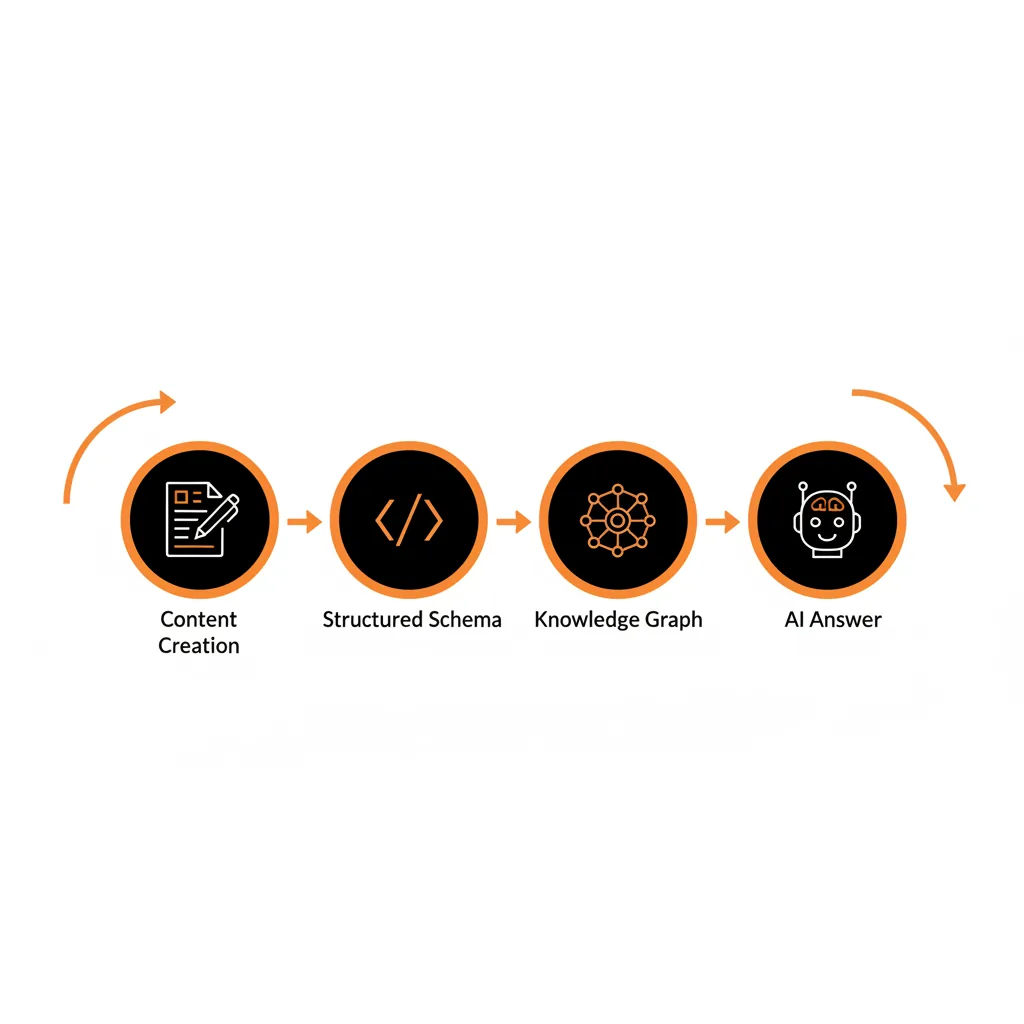
Comparing SEO vs. AEO for Software Companies
| Feature | Traditional SEO | AEO for SaaS (2026) |
|---|---|---|
| Primary Goal | Rank #1 on Google SERP | Become the "Single Source of Truth" |
| Content Structure | Long-form, keyword-dense | Modular, Q&A, Structured Data |
| Key Metric | Click-Through Rate (CTR) | Impression Share in AI Overviews |
| User Intent | Keywords and phrases | Conversational Prompts |
| Conversion Path | Website Landing Page | Direct in-chat conversion/referral |
| Indexing Speed | Weeks/Months | Hours/Days via RAG |
| Brand Perception | Determined by human readers | Determined by algorithmic sentiment |
Common mistakes to avoid in your SaaS strategy
- Ignoring zero-click content: Many SaaS brands fear that providing the full answer on the page will prevent clicks. In 2026, if you don't provide the answer, the AI will simply get it from a competitor who does.
- Neglecting technical documentation: Your "Help Center" is a goldmine for AEO. If your documentation is behind a login or poorly indexed, AI models can't learn how your product works.
- Over-reliance on AI-generated content: While it’s tempting to use AI to write your AEO content, search engines are increasingly penalizing "circular logic" where AI simply rewrites what it already knows. Original research is vital.
- Static brand messaging: If your software pivots but your digital footprint still reflects your 2024 version, AI will give users outdated information. You must clean up your "digital legacy."
- Focusing only on Google: In 2026, Perplexity and ChatGPT have significant market share in the B2B space. You must optimize for the specific scrapers used by OpenAI and others.
The "Hallucination Loop" Error
One of the most dangerous mistakes is feeding the AI conflicting data points about your pricing or security features. If your homepage says "Starts at $50" but an old press release says "Starts at $20," the answer engine may experience a conflict. Instead of guessing, the AI will often choose a competitor who provides a single, consistent number. We call this the "Hallucination Loop," where the AI generates incorrect data because your site is messy. You must audit your top 20 external mentions to ensure they align with your current site data.
Best practices and pro tips for 2026
- Create "Definition" pages: Own the dictionary for your niche. If you sell "AI-driven churn prediction," have the definitive page explaining exactly what that is.
- Update content frequently: Answer engines favor fresh data. Re-verify your statistics and feature lists every quarter to maintain authority.
- Use clear heading hierarchies: Use H2s and H3s as questions. This helps AI models map the structure of your information quickly.
- Leverage video transcripts: AI models now index video content deeply. Ensure your YouTube or Loom demos have perfect, keyword-optimized transcripts.
- Monitor "Share of Model": Use specialized tools to track how often your brand appears in AI responses compared to your top three competitors.
Managing Your "Digital Twin"
In 2026, every SaaS brand has a "Digital Twin"—the version of your company that exists purely in the memory of an LLM. You need to manage this twin by feeding it clean, high-intent data. Think of it as public relations for robots. If you launch a new feature, don't just write a blog. Update your Wikipedia entry (if applicable), send a newsletter that will be indexed by scrapers, and update your software's technical documentation simultaneously.
Impact on ChatGPT, Gemini, Copilot, and Perplexity
The way your SaaS brand appears varies across the major engines. ChatGPT tends to favor sites it has crawled via its latest GPTBot, often looking for high-authority blogs and official documentations. Gemini integrates deeply with the Google Knowledge Graph, meaning your Google Business Profile and structured schema are paramount.
Microsoft Copilot leans heavily on the Bing index and LinkedIn data. For SaaS, this means your company’s LinkedIn presence and employee thought leadership contribute to your AEO score. Perplexity acts more like a research assistant, citing multiple sources for a single answer. To win on Perplexity, you need to be mentioned across a diverse set of high-DR (Domain Rating) sites so that you appear as a consensus choice.
| Engine | Primary Data Source for SaaS | Best Optimization Strategy |
|---|---|---|
| ChatGPT | GPTBot / Common Crawl | High-authority blogging & FAQs |
| Gemini | Google Knowledge Graph | Schema.org & Merchant Center |
| Copilot | Bing Index & LinkedIn | Professional profiles & B2B PR |
| Perplexity | Real-time Web Search | Citation density & Review sites |
The winners in the SaaS space for 2026 aren't the ones with the most backlinks, but the ones who provide the clearest, most verifiable answers to the industry's most complex questions.
Real-world Case Study: A B2B SaaS Transition
We worked with a B2B SaaS client in the fintech space who saw a 35% decline in traditional organic traffic during the first half of 2025. Their content was high-quality but formatted as long, rambling thought-leadership pieces that AI engines struggled to summarize accurately.
We implemented a comprehensive AEO for SaaS overhaul. First, we restructured their top 50 blog posts into a modular Q&A format. We added specific SoftwareApplication schema to their product pages and "How-To" schema to their integration guides. We also launched an aggressive campaign to get their founders quoted in reputable financial tech publications to build entity authority.
Within six months, while their traditional "keyword rankings" remained flat, their AI Visibility Score increased by 150%. They became the "featured source" in ChatGPT and Perplexity for queries related to "automated compliance workflows." This led to a 22% increase in high-quality demo requests, as the users coming from AI interfaces were more "pre-sold" on the solution than those from traditional search. You can see more about our approach to AI search optimization to understand the technical side of this shift.
Tools and resources for AEO
- Perplexity Pages: Excellent for seeing how an AI engine synthesizes current web data about your brand. (Free/Paid)
- Schema.org Validator: The essential tool for testing if your structured data is readable by machines. (Free)
- Semrush AI Writing Assistant: Helps you adjust the tone and "answerability" of your content for 2026 standards. (Paid)
- Google Search Console: Still vital for monitoring which queries are triggering AI Overviews for your site. (Free)
- Best Answer Engine Optimization Services Audit: Our proprietary tool for measuring your current AI visibility.
How to measure success in AEO
Success in AEO isn't just about traffic; it's about being the chosen answer. You should track:
- Brand Citation Frequency: How often does an AI mention your name in a category search?
- Referral Traffic from AI Bots: Check your analytics for traffic coming from
chatgpt.comorperplexity.ai. - Sentiment Score: Is the AI describing your software accurately and positively?
- Zero-Click Dominance: Are your snippets being used as the primary answer in AI Overviews?
Success Checklist:
- [ ] All product pages have SoftwareApplication schema.
- [ ] Every blog post starts with a direct answer to a target question.
- [ ] Brand entities are clearly defined on the "About" page.
- [ ] Third-party reviews are updated and consistent.
Testing and QA for AEO Rollouts
You cannot simply change your entire site structure and hope for the best. AEO requires a rigorous QA process to ensure you don't tank your existing SEO while chasing AI visibility. We recommend a "canary rollout" for your optimization.
The AEO Testing Procedure:
- Select a Subset: Choose 10-15 low-risk pages or one specific category folder (e.g., your
/help/section). - Apply Modular Changes: Convert these pages to the Q&A format and add SoftwareApplication schema.
- Baseline Prompts: Run 20 specific prompts in ChatGPT, Claude, and Gemini to see how your brand is currently cited.
- Wait for Re-indexing: Use API indexing tools to force the bots to crawl the new pages.
- Re-Test Prompts: After 72 hours, run the same 20 prompts. Look for changes in how the AI summarizes your features.
- Verify Schema: Use the Rich Results Test to ensure the new code isn't throwing errors that could confuse search bots.
- Scale: If the AI citations improve and your organic traffic remains stable, roll out the changes to the rest of the site.
The Trade-offs: Where AEO Fails
AEO is not a magic bullet, and it comes with real risks. Honesty is key here. If you optimize purely for answer engines, you might sacrifice the emotional resonance that converts a human reader. AI likes dry, factual, and structured data. Humans like stories, humor, and unique perspectives.
One major trade-off is the potential loss of "dwell time." If you give the answer immediately in a 50-word snippet, the user may never scroll down to see your beautiful UI screenshots or read your glowing customer testimonials. Furthermore, AEO can be extremely volatile. A single update to an LLM’s algorithm can change how it perceives your brand overnight, leaving you with no way to "appeal" the decision like you might with a traditional Google penalty. Finally, if your niche is highly regulated (like healthcare SaaS), an AI summarizing your content might strip away vital legal disclaimers, potentially creating a compliance headache. You must balance machine readability with human-centric safety.
The future of AEO for SaaS in 2026 and beyond
As we look toward 2027, the line between "the web" and "the model" will vanish completely. We expect AI agents to start performing "autonomous procurement," where an AI bot researches, compares, and even signs up for a SaaS trial on behalf of a human user.
In this world, your AEO strategy becomes your entire sales funnel. If the agent can't verify your security protocols or pricing through your public-facing structured data, you will be filtered out before a human ever sees your logo. The goal is to build a "machine-readable brand" that maintains its human appeal.
Ready to dominate the new search era? You can start with a free AEO audit to see where your software brand stands today. Our team is ready to help you transition from traditional SEO to a future-proof visibility strategy.
Book our professional [AEO Services](/services) to secure your spot in the AI answers of tomorrow.
Resources
Frequently asked questions
How does AEO for SaaS differ from traditional SEO?+
AEO for SaaS focuses on making your software the direct answer provided by AI engines like ChatGPT and Gemini. While SEO aims for high rankings on a results page, AEO aims to be the single source used by an AI to answer a user's question, often bypassing the traditional list of blue links entirely.
What are the first steps to implement an AEO strategy for my software?+
Start by identifying the 'Entities' related to your software, such as your category, features, and target audience. Implement advanced Schema.org markup like SoftwareApplication and FAQPage. Finally, restructure your content into a clear Q&A format that addresses specific user pain points in the first paragraph of each page.
Which schema types are most important for SaaS AEO?+
For SaaS brands, the SoftwareApplication and Organization schemas are critical. These help AI engines understand your pricing, features, ratings, and company details. Adding FAQ schema is also vital for appearing in 'People Also Ask' sections and AI-generated conversational summaries.
Why is AEO becoming essential for software companies in 2026?+
In 2026, many B2B buyers use AI research tools like Perplexity or Copilot to shortlist software. If your brand is not optimized for these engines, you miss out on high-intent leads who are already looking for solutions. AEO ensures you are visible at the exact moment a buyer is asking for recommendations.
How can I measure the success of my AEO efforts?+
Metrics for AEO include 'Brand Citation Frequency' in AI responses, referral traffic from AI platforms (like chatgpt.com), and your 'Share of Model' compared to competitors. You should also monitor if your structured data is correctly appearing in Google's AI Overviews and other conversational interfaces.
Do third-party reviews and mentions affect my AEO ranking?+
Yes, third-party mentions on sites like G2, Capterra, and industry news outlets are crucial. AI models use these as 'Consensus Signals' to verify that your software is a reputable leader. A strong digital footprint across multiple authoritative sites increases the likelihood of being the AI's top-recommended tool.
Sources & further reading
Soft next step
Want to see where AI answers mention you — and where they don't?
We run a free AEO audit across ChatGPT, Gemini, Copilot and Perplexity, then hand you the fixes in priority order. Start your AEO strategy today.