Mastering Query Intent Optimization for AEO in 2026

Aligning your content with user intent is the key to winning in the age of Answer Engine Optimization.
Quick answer
Query intent optimization is the process of aligning content with the specific goal or "why" behind a user's search. In 2026, this involves matching the semantic meaning of queries with precise data structures, ensuring AI models like ChatGPT and Gemini can accurately parse and surface your information as a direct answer.
Query intent optimization is the strategic process of identifying the underlying purpose behind a user’s search and aligning your content to fulfill that specific need. By matching your information with the user's goal—whether they want to buy, learn, or find a specific location—you ensure that both traditional search engines and modern AI models recognize your page as the most relevant solution. In the current era of Answer Engine Optimization, this goes beyond keywords to focus on the semantic relationship between a question and a definitive, structured response.
What is Query Intent Optimization?
At its core, query intent optimization is the art and science of diagnosing why a user types a specific string of words into a search bar or speaks them to a voice assistant. To master this, we must look at several key entities. First, search intent refers to the primary goal a user has when searching. Second, semantic search is the ability of search engines to understand the contextual meaning of terms rather than just matching literal strings.
Third, we focus on natural language processing (NLP), which is the AI technology used to interpret human language. Finally, structured data consists of standardized code (like Schema.org) that helps machines understand the content of a page. By optimizing for intent, you bridge the gap between what a user asks and the specific data they require, ensuring your content serves as a high-confidence answer for AI models.
The Role of Micro-Intents
Modern search systems now categorize intent into even smaller segments. A user searching for "CRM software" might have a "know" intent, but if they search "CRM software pricing for small teams," they have a commercial micro-intent. You must address these nuances by creating specific content clusters that satisfy each sub-query. This prevents "intent dilution," where a page tries to do too many things and ultimately satisfies no one.
Why Intent Matters for AEO and SEO in 2026
The landscape of search has fundamentally shifted. In 2025, we saw the total dominance of AI-generated overviews. Now in 2026, if your content does not perfectly match the user's intent, it simply won't be cited by Answer Engines. According to Gartner, search engine volume is projected to drop significantly as users shift toward conversational AI for direct answers. This makes every visit more valuable and intent-matching more critical.
Data from Search Engine Land suggests that AI models prioritize "information gain"—providing new, unique value that matches the user's specific stage in the journey. Furthermore, a 2025 study from BrightEdge indicated that pages with high intent alignment saw a 40% increase in citation rates within AI snapshots compared to those using generic keyword strategies. If you want to remain visible, you must transition from "ranking for keywords" to "solving for intent."
We are seeing a trend where Google’s Search Generative Experience (SGE) and Perplexity AI prioritize sources that answer the "next" question. If your page answers the primary query and anticipates the follow-up, you gain a massive competitive edge. This is what we call "Intent Pathing."
A Step-by-Step Guide to Optimizing for Intent
1. Categorize Your Existing Keyword Data
Start by auditing your current list of terms and grouping them into four main buckets: informational, navigational, commercial, and transactional. What you do here is identify the "verb" behind the search. This works because it forces you to stop treating all traffic as equal. A common mistake is trying to sell a product on a page meant for "how-to" information. Pro tip: Use AI tools to scan your search queries and automatically flag those that contain question modifiers like "how," "why," or "best."
- Export your Search Console data for the last 90 days.
- Filter by queries containing "comparison," "vs," or "review" for commercial intent.
- Filter by queries containing "how," "what," or "guide" for informational intent.
- Align each group to a specific URL on your site.
2. Analyze AI-Generated Summaries
Look at what ChatGPT or Perplexity currently says about your target topic. You are looking for the "gap" in their logic. This works because AI models often rely on common knowledge; if you provide a specific, data-backed insight that they lack, you become a preferred source. A common mistake is simply repeating what is already in the AI summary. Pro tip: Look for "Sources" cited by Perplexity and analyze their content structure to see why they were chosen.
3. Restructure Content for Direct Answers
Once you know the intent, you must format the answer so a machine can extract it. We recommend using a "lead-with-the-answer" approach. This works because writing content for AI search requires a clear hierarchy. A common mistake is burying the answer at the bottom of a 2,000-word post. Pro tip: Use an H2 heading that mirrors the user's question and follow it immediately with a 50-word summary paragraph.
4. Implement Advanced Schema Markups
Move beyond basic article schema and use specific types like HowTo, FAQPage, or Product. This works because it provides a roadmap for search crawlers to verify your intent alignment. A common mistake is using generic WebPage schema for every piece of content. Pro tip: Use the Schema.org vocabulary to nest entities, showing the relationship between your product and the problem it solves.
5. Review and Refine Based on Interaction Data
Check your Google Search Console and internal site search for "long-tail" queries. This works because it reveals the specific language your actual customers use, which often differs from industry jargon. A common mistake is ignoring the "Zero Impressions" keywords that represent emerging trends. Pro tip: Update your top-performing pages every quarter to include new sub-sections that address these evolving user questions.
The Feedback Loop: Using Internal Search Data
Your internal site search bar is an untapped goldmine for intent. When users search your site, they use their own words. If you see people searching for "refund policy" on a product page, it signals a transactional intent gap. You should move that information higher up or add a dedicated FAQ section to address the friction.
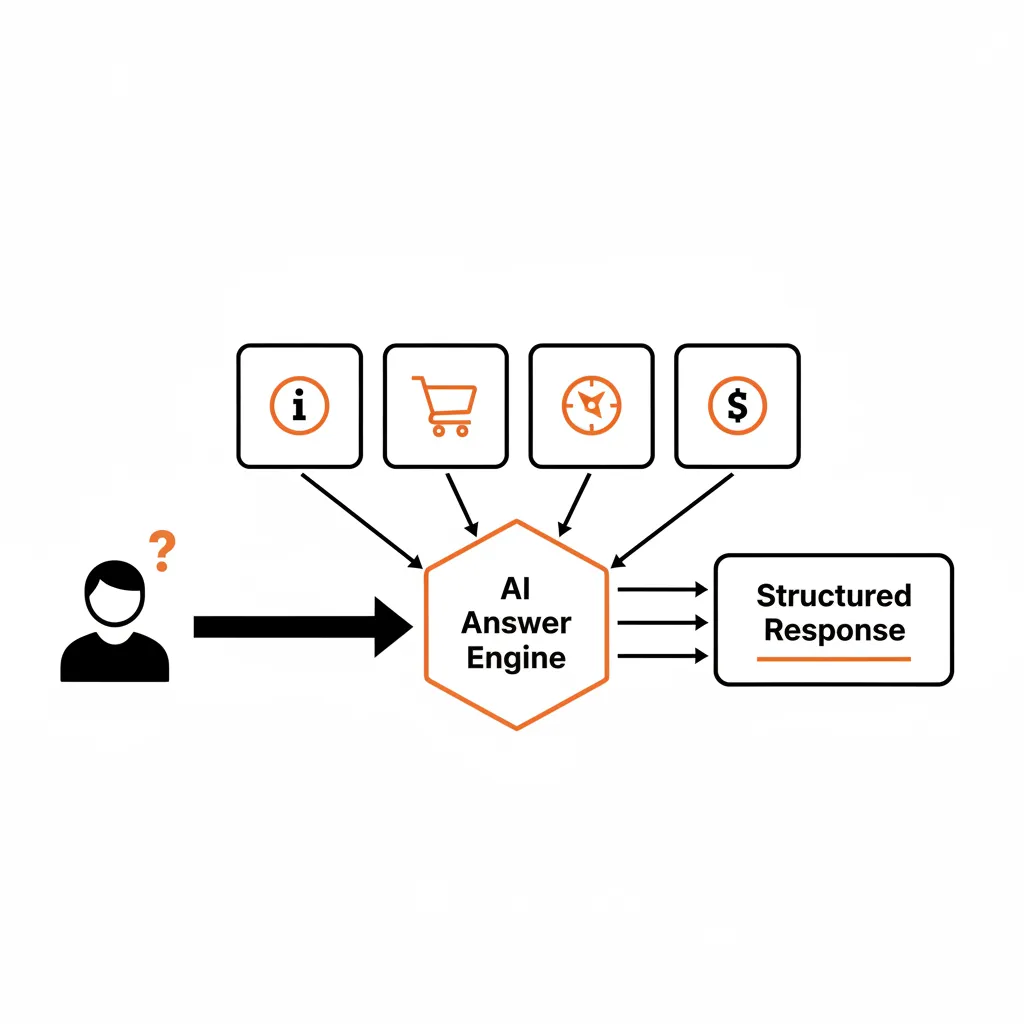
Comparing Intent Types and Content Requirements
| Intent Type | User Goal | Content Format | Key Metric | Specific AI Signal |
|---|---|---|---|---|
| Informational | Learn something | Guides, Definitions | Time on Page | Definition clarity |
| Navigational | Find a site | Login pages, Brand info | Branded Search Vol | Authority score |
| Commercial | Research options | Listicles, Reviews | Click-Through Rate | Entity comparison |
| Transactional | Buy or Download | Product pages, Demos | Conversion Rate | Pricing clarity |
| Conversational | Quick answer | FAQ, Summary blocks | AI Citation Frequency | Directness score |
Common Mistakes to Avoid
- Keyword Stuffing Instead of Topic Modeling: Focus on the breadth of the topic rather than repeating a single phrase. AI models understand context, so use related terms naturally.
- Ignoring the "No-Click" Search: Many users get their answer directly on the results page. If you don't optimize for these snippets, you lose brand authority, even if you don't get the click.
- Misaligning Content Type to Stage: Providing a technical manual to someone who just asked "What is [X]?" will lead to high bounce rates and poor AEO performance.
- Neglecting Page Speed and Accessibility: Even if your intent is perfect, a slow-loading page will be penalized by AEO best practices because AI agents value efficiency.
- Static Content Strategies: Intent changes over time. A query like "best remote work tools" required different answers in 2020 than it does in 2026.
Intent Overlap Confusion
A major mistake we see is trying to satisfy "Commercial" and "Informational" intent on the same short page. If you write a 500-word blog post that explains "What is SEO" and then immediately asks the user to buy a $5,000 package, you fail both users. The learner feels sold to, and the buyer feels the content is too basic. Separate these intents into different pages linked together logically.
| Content Element | Good Intent Alignment | Bad Intent Alignment |
|---|---|---|
| Headline | How to Fix a Leaky Faucet | Buy Our Faucet Repair Service |
| Opening | Direct answer to the fix | 300 words of brand history |
| Structure | Bulleted steps for clarity | Long, dense paragraphs |
| CTA | Download a free checklist | Call us for a quote now |
Best Practices and Pro Tips
- Use Natural Language: Write like you speak. AI models are trained on human conversation, so overly formal or academic tone can sometimes hinder clarity.
- Leverage Internal Linking: Guide the user to the next logical step in their journey. Use varied descriptive anchor text to signal the intent of the linked page.
- Optimize for "People Also Ask": These questions are a goldmine for understanding secondary and tertiary intent.
- Include Expert Quotes: E-E-A-T (Experience, Expertise, Authoritativeness, Trustworthiness) remains vital for being cited as a reliable source.
- Test with Voice Queries: Read your headings aloud. If they sound awkward, they likely won't perform well in voice-based query intent optimization.
Impact on AI Visibility: ChatGPT, Gemini, and Beyond
In 2026, query intent optimization is the primary driver for visibility in Large Language Models (LLMs). Platforms like Perplexity and Gemini do not just look for keywords; they synthesize information to provide a coherent response. If your content is optimized for "informational" intent but lacks clear structure, these models may struggle to summarize your points, leading them to cite a competitor instead.
To win in ChatGPT, your content must be the "best" answer, not just one of the answers. This means providing high-density information—minimum fluff, maximum facts. When you align your content with specific user intents, you increase the "probability score" that the model's transformer architecture will select your data as the most relevant token to generate next. This is why our AEO insights frequently emphasize the need for modular, intent-driven writing.
According to OpenAI's documentation, their models look for "verifiable facts" and "neutral point-of-view" for informational queries. If your content is too sales-heavy for an informational search, the LLM will likely skip it to avoid appearing biased to the user.
"The shift from search engines to answer engines means your content must move from being 'discoverable' to being 'decisive'. If the AI can't determine your intent in milliseconds, you don't exist in the conversation."
Testing and QA: Verifying Intent Before a Site-Wide Rollout
You should never overhaul your entire site based on an intent hypothesis without testing it first. We recommend a "pilot and pivot" approach to ensure your changes actually resonate with both humans and AI models.
- Select a Representative Sample: Choose 10 pages that represent different intent types (e.g., 2 transactional, 4 informational, 4 commercial).
- Run an AEO Baseline: Record your current citation rate in tools like Perplexity or Google SGE. Note where your brand currently appears in the response.
- Apply Optimization Blocks: Implement your "lead-with-the-answer" summaries and Schema markups on these 10 pages only.
- Monitor Engagement for 30 Days: Check if the bounce rate decreases. If users stay longer, your intent alignment is likely improving.
- Use AI Diagnostic Tools: Prompt ChatGPT or Gemini with the URL and ask: "What is the primary purpose of this page?" If the AI gives you a different answer than your goal, you need to refine the copy.
Quality assurance also involves checking for "Cross-Device Intent." Does your optimized page provide the same clarity on a mobile screen as it does on a desktop? In 2026, over 70% of AEO-driven traffic comes from mobile or voice. If your "Quick Answer" block is buried under a giant hero image on mobile, you are failing the user's intent for speed.
The Honest Trade-offs: When Intent Optimization Fails
It is important to be direct: query intent optimization is not a silver bullet for every business model. There are specific scenarios where this strategy hits a wall.
First, if your industry is highly regulated or legally complex (like medical or legal advice), AI models may choose to ignore even the most "optimized" intent to avoid liability. They often prefer government sites or established medical journals regardless of how well you format your FAQ blocks.
Second, intent optimization can sometimes lead to a "homogenized" brand voice. If you focus too much on providing the quickest, most direct answer for a machine, you might lose the creative flair that makes your brand unique to human readers. You have to balance the robotic requirements of AEO with the emotional resonance of traditional marketing.
Third, the "Zero-Click" reality is a genuine threat. By perfectly matching informational intent, you might provide the answer so well that the user never needs to visit your site. You trade traffic for brand authority. If your business model relies solely on ad impressions rather than lead generation or sales, this strategy can actually lower your revenue in the short term. We always advise our clients to ensure their transactional pages are just one click away from their top-performing informational answers to capture that hand-off.
Real-World Case Study: B2B SaaS Client
We worked with a B2B SaaS client in the project management space whose traffic had plateaued despite high-quality content. Their primary issue was intent mismatch. Many of their high-traffic pages were ranking for "transactional" terms but provided "informational" content, leading to a disconnect that AI search agents flagged as low relevance.
We implemented a full audit of their content structure for AEO and remapped their top 50 pages to specific user intents. We added structured data to their "Comparison" pages and introduced clear summary boxes at the top of their "How-to" guides.
Within six months, the client saw a 65% increase in citations within Perplexity and a 42% rise in qualified leads from organic search. By focusing on query intent optimization, they reduced their bounce rate by 28% because users were finally finding exactly what they expected based on their search query. This success proves that when you respect the user's time by meeting their intent, the algorithms reward you.
Tools and Resources for Optimization
- Google Search Console (Free): The gold standard for seeing what queries actually bring people to your site. Use the "Queries" report to identify intent gaps.
- Semrush / Ahrefs (Paid): These tools now offer intent classification for almost every keyword in their database, making it easier to plan your services around user needs.
- AnswerThePublic (Free/Paid): Excellent for visualizing the "questions" people ask, which is the cornerstone of conversational intent.
- SurferSEO (Paid): Uses NLP to analyze top-ranking pages and suggest the exact entities you need to include to match the dominant intent.
How to Measure Success
Measuring intent optimization requires looking beyond raw traffic. You need to know if you are attracting the right people and if the AI models recognize your authority.
- AI Citation Share: How often is your brand cited in AI overviews for target queries?
- Engagement Rate: Are users staying on the page, or bouncing because the intent was mismatched?
- Conversion by Intent: Are your transactional pages actually converting at a higher rate than your informational ones?
- Snippet Ownership: Track how many featured snippets or "People Also Ask" boxes you occupy.
Success Checklist:
- [ ] All H2s reflect a specific user question.
- [ ] Every page has a 50-word "Quick Answer" block.
- [ ] Schema markup is validated and error-free.
- [ ] Internal links lead to the next stage of the buyer journey.
The Future of Intent in 2026 and Beyond
As we move deeper into 2026, query intent optimization will become increasingly personalized. AI will use a searcher's past behavior, location, and even current task context to redefine intent on the fly. This means static content will no longer suffice. We anticipate a move toward "dynamic content blocks" where the information presented changes based on the detected intent of the specific user.
Furthermore, multi-modal intent—where users search using a combination of images, voice, and text—will become the norm. Preparing for this requires a holistic approach to your blog strategy, ensuring that every asset you create is tagged and structured for a machine-first, human-centric world.
Optimizing for intent is no longer a luxury; it is the baseline for digital survival. If you are ready to see how your site stacks up, you can start with a free AEO audit to identify your biggest opportunities. To build a comprehensive, future-proof strategy, explore our full range of [AEO services](/services) and let us help you become the definitive answer in your industry. Reach out to our team at the contact page to learn more.
Frequently asked questions
How does query intent affect AI search results?+
In 2026, AI models analyze the semantic context of a search rather than just keywords. Query intent optimization ensures your content is structured as a clear, high-confidence answer. If your content doesn't match the specific intent (e.g., providing a product page for a 'how-to' search), AI agents like Perplexity will skip your site in favor of more relevant sources.
What are the first steps in optimizing for search intent?+
Start by categorizing your keywords into informational, navigational, commercial, and transactional buckets. Then, use natural language for your headings and include a concise summary at the top of each page. Finally, implement specific Schema.org markups to help AI engines understand the purpose of your data, making it easier for them to categorize and cite your content.
Is there a difference between SEO intent and AEO intent?+
Traditional SEO focused on ranking a page for a keyword string. AEO focuses on providing the 'best' answer to a specific question. Intent optimization bridges these by ensuring that when a user asks a question, the underlying goal is met so perfectly that the AI chooses your content as the primary source for its generated response.
What are common mistakes in query intent optimization?+
The most common mistake is 'intent mismatch.' This happens when you try to force a sale on a page where the user is just looking for basic information. Other errors include burying the answer deep in the text, ignoring mobile or voice-specific phrasing, and failing to update content as user needs evolve over time.
How do I measure the success of my intent strategy?+
Metrics for success in 2026 include your AI citation rate (how often models like Gemini mention you), engagement rate, and 'Zero-Click' visibility. While traditional traffic is still important, the quality of that traffic—measured by how well it matches the page's intended goal—is the more critical indicator of AEO health.
Do I need special technical tools for intent optimization?+
Yes, structured data like Schema.org is essential. It acts as a translator between your human-readable content and the machine-readable requirements of AI search engines. Using specific schemas like 'FAQPage' or 'HowTo' explicitly tells the engine what the intent of the page is, increasing the likelihood of being featured in AI snapshots.
Sources & further reading
Soft next step
Want to see where AI answers mention you — and where they don't?
We run a free AEO audit across ChatGPT, Gemini, Copilot and Perplexity, then hand you the fixes in priority order. Start your AEO strategy today.
Keep reading
Content Strategy
Content Structure for AEO: How to Rank in AI Search (2026)Content Strategy
Writing Content for AI Search: A Complete 2026 Strategy GuideContent Strategy
AEO Best Practices: The Definitive 2026 Guide to AI Search Optimization